Establishing secure connection…Loading editor…Preparing document…

Family Limited Partnership

This template is fully customizable. Edit the text, fill out the fields, and send it for signature. Give it a try!
Family Limited Partnership

What a Family Limited Partnership Is and when it’s used

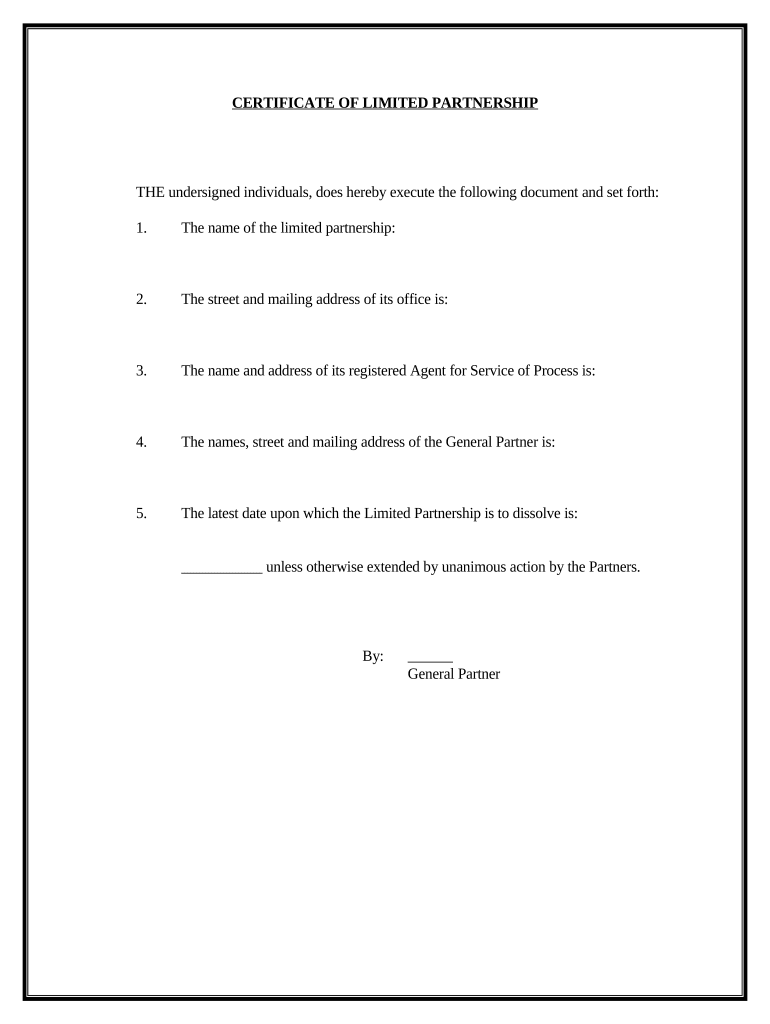
A Family Limited Partnership (FLP) is a state-governed limited partnership created to hold family-owned assets, centralize management, and facilitate intergenerational transfers. Typically one or more general partners manage operations while limited partners hold transferable economic interests. FLPs are frequently used for estate planning, centralized investment management, and to obtain valuation discounts for transfer tax purposes. An FLP must comply with the formation and filing requirements of the state where it is created and with applicable federal tax rules that govern reporting and gift transfers.

Why families choose an FLP

An FLP helps consolidate assets, clarify management authority, and may enable estate and gift tax planning by shifting economic interests while retaining centralized control for designated general partners.

Why families choose an FLP

Who typically prepares or signs an FLP agreement

Professional guidance from counsel and tax advisors is common because FLPs involve statutory formation steps, tax reporting, and valuation considerations.

  • Family owners and founders who want centralized management while transferring economic interests to relatives.
  • Estate planning attorneys and wealth managers who draft, review, and advise on tax and governance provisions.
  • Trust officers and family office administrators responsible for recordkeeping, distributions, and compliance with partnership terms.

Typical signers and their roles

General Partner — Managing Member

A general partner (often a spouse or family member entity) holds management authority, signs on behalf of the partnership, and accepts fiduciary duties. Their signature binds the FLP to contracts and operational decisions.

Limited Partner — Passive Investor

Limited partners contribute capital or assets and receive distributions but generally do not manage daily operations; they sign to acknowledge terms, capital accounts, and transfer restrictions.

Essential information to capture in the FLP document

Partnership Name: Legal entity name exactly as filed
Formation State: State of organization under statute
Partner Names: Full legal names and entity types
Capital Contributions: Dollar amounts or asset descriptions
Ownership Percentages: Percentage or unit allocation
Governing Law: Designated state law for disputes

Step-by-step: complete and formalize an FLP agreement

Follow these sequential steps to form, document, and execute a Family Limited Partnership with clear governance and tax compliance.

  • 01
    Draft Agreement: Prepare partnership terms, management powers, and transfer restrictions.
  • 02
    List Partners: Record full legal names, roles, and capital contributions.
  • 03
    Decide Governance: Specify general partner authority, voting, and buy-sell triggers.
  • 04
    Execute and File: Sign, notarize if required, and file any statutory certificate.

Where to file, serve, and maintain FLP paperwork

Understand routing: formation filings go to state agency, executed agreements are retained by partners, and tax forms are filed with federal and state authorities.

  • State Filing: File certificate or formation documents with the state Secretary of State.
  • Tax Reporting: File partnership returns (Form 1065) with the IRS and issue Schedule K-1s to partners.
  • Record Retention: Keep signed originals and amendments in secure records for retention period.
  • Third-Party Notices: Serve notices to banks, title holders, and beneficiaries as required.

How to set up an online signing workflow for an FLP

Configure an ordered signing flow and required fields to ensure complete, auditable execution across partners and witnesses.

Field Configuration
Signature Order Set general partners to sign first, then limited partners
Required Fields Mark dates, printed names, and capital entries as mandatory
Authentication Use email plus SMS or ID verification for high-assurance signers
Audit Trail Enable detailed timestamps, IP capture, and certificate export

Digital signing and eSubmission considerations

Ensure the chosen platform supports ESIGN/UETA compliance and retains an exportable audit trail for IRS or legal review.

  • Authentication Options: Email, SMS, knowledge-based or certificate-based verification
  • Document Formats: Use PDF or DOCX with locked fields for executed copies
  • Integration Needs: Connect with cloud storage, accounting, or CRM systems

Core clauses every professional FLP agreement should include

A professionally drafted FLP contains specific clauses that allocate management, economic rights, transfer restrictions, tax allocations, and dissolution mechanics.

Management Powers

Define the general partner’s authority, limitations, and decision thresholds to avoid ambiguity and fiduciary disputes.
Capital Contributions

Specify initial contributions, valuation methodology, capital accounts, and procedures for additional funding.

Distributions

Detail timing, priorities, allocations, and whether distributions are mandatory or discretionary.

Transfer Restrictions

Include drag, tag, right of first refusal, and permissible transferee rules to control ownership changes.

Valuation Method

Prescribe an appraisal or formula for valuing interests for transfers, buyouts, or estate tax reporting.

Dissolution Procedures

Set triggers for dissolution, winding-up steps, creditor priority, and asset distribution mechanics.

Supporting documents and exhibits to attach

Attach schedules and exhibits that document contributed assets, capital accounts, appraisal reports, and partner consents to ensure completeness.

Schedule A

Itemized list and fair market value of assets contributed by each partner, with dates.

Capital Account Ledger

Initial balances, subsequent contributions, distributions, and allocation basis for each partner.

Appraisal Report

Independent valuation for non-cash contributions or assets likely to be scrutinized by tax authorities.

Consent Resolutions

Signed partner waivers, consents, or special allocations approved per the agreement.

Practical tips for accurate and defensible FLP documents

Follow established procedures and document the rationale for valuations, transfers, and distribution decisions to withstand tax or probate review.

Use Clear Definitions
Define capital, distributions, related-party, and valuation terms to prevent interpretive disputes.
Document Valuations
Retain appraisals and contemporaneous memos explaining valuation methods for gift tax scrutiny.
Limit Managerial Role
Avoid hybrid arrangements that erode limited partner protections; document any consulting or management fees separately.
Periodic Review
Revisit the agreement on major life events, tax law changes, or material asset shifts.

Common mistakes to avoid

  • Poor valuation documentation leads to IRS challenges and reappraisals.
  • Vague transfer clauses permit unintended ownership changes or disputes.
  • Mixing personal and partnership assets undermines liability protection.
  • Insufficient signature or execution formalities risk enforceability.

Short-form risks and potential legal consequences

Gift Tax Exposure: IRS may assess gift tax on discounted transfers
Valuation Challenge: Reappraisals can increase tax liability
Loss of Liability Shield: Commingling assets can pierce protections
Informational Penalties: Incorrect returns trigger IRC §6721 penalties
State Filing Errors: Missed filings can create administrative fines
Operational Disputes: Poor governance causes partner litigation

Real-world FLP scenarios and outcomes

Examples show common uses: estate transfer planning and centralized real estate management inside a family entity.

Estate Transfer Example

A family transfers rental property into an FLP to centralize management and simplify distributions.

  • Internal valuations were documented and a professional appraisal obtained.
  • Proper documentation reduced probate exposure and provided a clear record for subsequent gift tax reporting and family accounting.

Family Real Estate Holding

Siblings place multiple rental properties into an FLP to coordinate maintenance and leasing.

  • The general partner manages day-to-day operations while limited partners receive distributions.
  • The structure supported consistent reporting, simplified refinancing, and clarified responsibility for capital calls and property improvements.

Sample eSignature vendor comparison for executing FLP documents

Compare common vendor features and starting prices; signNow is listed first to match typical procurement comparisons.

signNow DocuSign Adobe Sign PandaDoc HelloSign
Starting Price $8/user/mo $15/user/mo $14/user/mo $19/user/mo $15/user/mo
Free Trial 7-day free trial No No Yes, limited Yes, limited
Bulk Send Yes Yes Yes Yes No
Audit Trail Yes Yes Yes Yes Yes
HIPAA Compliant Yes Yes Yes No No

Frequently asked questions about Family Limited Partnerships

Answers to common execution, tax, and enforceability questions addressing signature, filing, and valuation concerns.


Need help? Contact support

be ready to get more
Join over 28 million airSlate SignNow users