Establishing secure connection…Loading editor…Preparing document…

Letter Requesting Payment for Gift Share

This template is fully customizable. Edit the text, fill out the fields, and send it for signature. Give it a try!
Letter Requesting Payment for Gift Share

What the Letter Requesting Payment for Gift Share Is

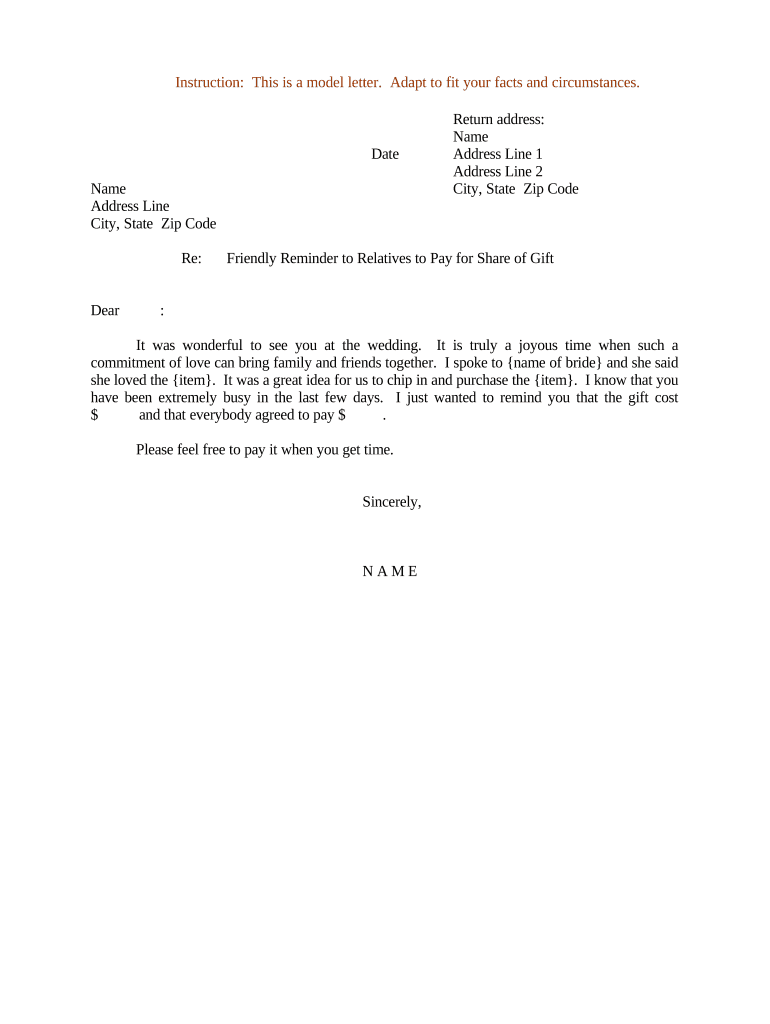
A Letter Requesting Payment for Gift Share is a formal written notice sent by an organizer or purchaser to contributors who agreed to share the cost of a group gift. The letter identifies the event or recipient, states each person's agreed share or outstanding balance, and requests payment by a specified date. It creates a clear record of the request, the payment terms, and the identity of payees, and can be used as supporting documentation if collection or dispute resolution becomes necessary.

Why a Clear Payment Request Matters

A concise, documented request reduces ambiguity about amounts and deadlines, encourages timely payment, and preserves evidence of the request if later needed for reconciliation or small‑claims actions.

Why a Clear Payment Request Matters

Who Typically Prepares and Receives This Letter

Common senders and recipients vary but share the need for clear financial accounting and simple proof of the request.

  • Event organizer or host coordinating contributions for a shared present, responsible for tracking payments and closing the event ledger.
  • Individual purchaser who fronted the gift cost and seeks reimbursement from co‑contributors for the agreed share.
  • Group members or invited contributors who agreed to pay a portion and need a formal reminder of amount and due date.

Signatory Roles and Contact Examples

Organizer — Gift Coordinator

The organizer signs to attest they paid or arranged the gift and to authorize collection. Include full name, phone, and email so recipients can confirm payment status or ask questions.

Payor — Contributor

A named contributor signs or acknowledges receipt of the request to confirm they were notified of the amount owed and the payment deadline; this helps prove notice if a dispute arises.

Essential Elements to Include in the Letter

A professional letter is concise, factual, and documents the who, what, how much, when, and where for payment; include attachments as needed.

Header

Date and sender contact information at the top — full name, mailing address, phone, and email to enable responses and verification.
Recipient Details

Full legal name and contact details of the person being asked to pay, and any group identifier if multiple recipients share payments.

Description of Gift

Concise description of the gift or expense, including purchase date, vendor, total cost, and reason for the collection.

Payment Breakdown

Exact amount requested from the recipient, how the share was calculated, and any prior payments or credits applied.

Payment Terms

Due date, acceptable payment methods, account or routing details, and any late fee or reminder schedule stated clearly.

Documentation

Attach or reference receipts, invoices, or a spreadsheet showing contributions to support the amount requested and avoid disputes.

Step-by-Step: Drafting and Sending the Letter

Follow these steps to prepare a clear, actionable request and track responses efficiently.

  • 01
    1. Prepare: Gather receipt and contribution spreadsheet.
  • 02
    2. Calculate: Confirm each person's share and prior payments.
  • 03
    3. Draft: Write a concise letter with amounts and due date.
  • 04
    4. Send & Track: Deliver via chosen channel and record delivery.

Where to Send and How to Submit Payments

Choose a delivery and payment flow that matches the group's tech comfort level and provides a durable record of the request and any receipts.

  • Email: Attach the letter and receipt PDF.
  • Printed Letter: Hand or mail to recipient with return receipt.
  • Group Chat: Post summary plus attached document link.
  • Payment Link: Provide a verified payment URL or account details.

Digital Delivery and eSignature Considerations

Use formats and platforms that preserve the letter text and create an auditable record of delivery and acceptance.

  • File Formats: PDF, DOCX supported
  • Authentication: Email or SMS code
  • Integrations: CRM and cloud storage

Configuring an Online Workflow for Collection

Set up fields and routing to collect payment confirmations and signatures automatically; test the flow before sending to contributors.

Field Configuration
Signature Field Require signer name and date
Payment Field Include payment method or confirmation
Routing Send copy to organizer automatically
Reminders Schedule automatic follow‑ups

Typical Deadlines and Reminders to Include

Specify a clear due date and a concise reminder schedule so recipients know when and how to pay without surprise.

Request Date:

Date the letter is sent to start the payment timeline

Payment Due:

Commonly 7–14 days after request; choose what fits your event

First Reminder:

Send one reminder 3–5 days before due date

Late Notice:

Issue a second notice 7–14 days after missed due date

Final Notice:

Consider a final demand before escalation at 30+ days

Key Milestones from Request to Closure

Use a milestone view to track the lifecycle of the request and coordinate follow‑up steps if payments are delayed.

01

Draft Completed

Letter and supporting receipt gathered and verified

02

Request Sent

Delivery method recorded and timestamped

03

Payment Received

Organizer logs incoming payment and matches it

04

Account Closed

All shares reconciled and contributors notified

Common Mistakes to Avoid

  • Vague amounts or rounding without explanation — always show the full calculation to prevent confusion and disputes later.
  • Missing contact information — without a clear sender contact, recipients may ignore or delay responding to the request.
  • Unclear payment methods — not listing acceptable options causes back‑and‑forth and can delay reconciliation of funds.
  • No supporting receipt — failing to attach the original receipt or invoice reduces credibility and increases likelihood of contesting the charge.

Risks and Potential Consequences of an Improper Request

Collection Difficulty: May require repeated follow‑up
Unenforceable Terms: Ambiguous deadlines are hard to enforce
Dispute Escalation: May lead to small claims or arbitration
Reputational Risk: Poorly worded demands can harm relationships
Backup Withholding: 24% withholding if TIN missing
Legal Costs: Attorney fees may exceed amount owed

Example Scenarios Where the Letter Is Used

Realistic examples show how a concise letter clarifies expectations and speeds reimbursement among contributors.

Small Team Gift

A manager pays for a farewell gift and requests $25 from each contributor.

  • Contributors receive a clear invoice with due date and payment link.
  • The manager logs payments and sends a final reconciliation showing who paid and the remaining balance to avoid follow‑up disputes.

Family Group Present

One family member arranges an expensive present and covers the cost upfront.

  • The requester sends an itemized letter showing each share with bank transfer details.
  • Clear documentation and a two‑week due date result in prompt payments and a clean record for family budgeting.

Security and Compliance Considerations

Encryption: TLS 1.2/1.3; AES‑256 at rest
Audit Trail: Timestamps, IP, action log
Certifications: SOC 2 Type II; ISO 27001
Privacy: GDPR and CCPA controls
Healthcare: HIPAA support with BAA
Legal Acts: ESIGN and UETA compliance

Frequently Asked Questions and Troubleshooting

Answers to common operational and legal questions about sending a Letter Requesting Payment for Gift Share and handling common issues.


Need help? Contact support

be ready to get more
Join over 28 million airSlate SignNow users