Establishing secure connection…Loading editor…Preparing document…

South Carolina Hearing Postponement Notice

This template is fully customizable. Edit the text, fill out the fields, and send it for signature. Give it a try!
South Carolina Hearing Postponement Notice

What the South Carolina Hearing Postponement Notice Is

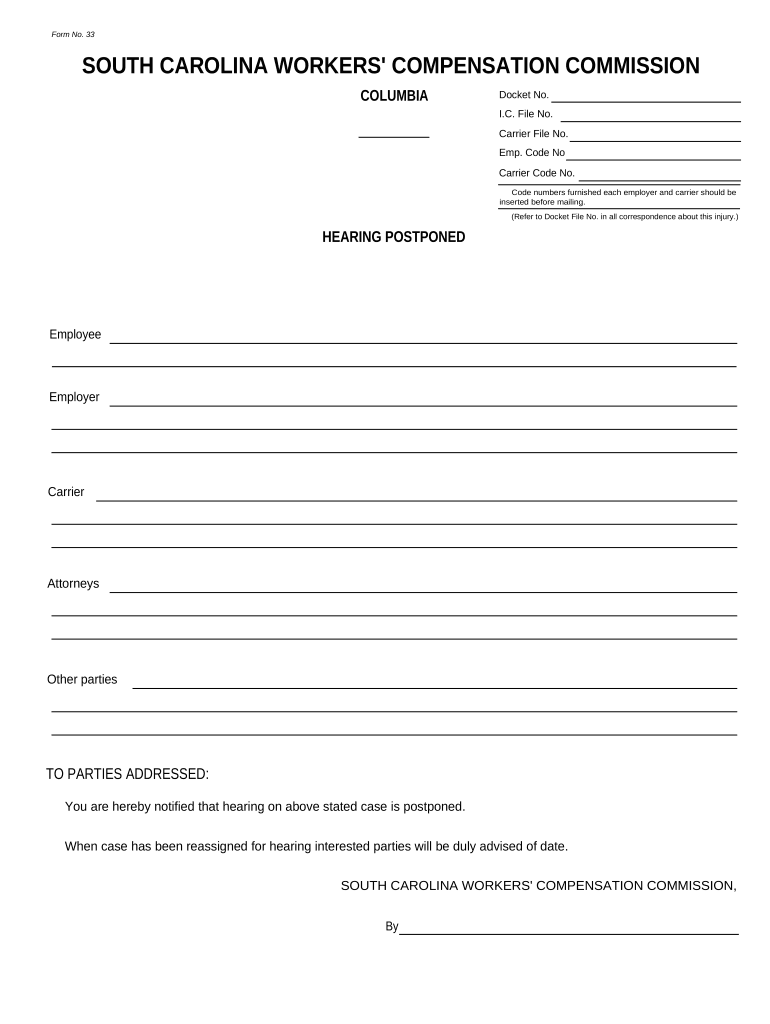
A South Carolina Hearing Postponement Notice is a written filing used to request a delay or rescheduling of a court or administrative hearing in South Carolina. The notice typically identifies the case, current hearing date, reason for the requested postponement, any proposed alternate dates, and proof of service to opposing parties and the clerk. Courts and agencies have local rules governing how and when such requests must be submitted, and some hearings require supporting documentation or a motion rather than a simple notice. Electronic delivery may be acceptable where the court or agency permits e-filings or electronic service.

Why a Clear Postponement Notice Matters

A properly completed postponement notice preserves rights, gives the court a clear record of the request, and reduces the risk of a contested continuance or sanctions. Clarity on dates and service helps the clerk and opposing counsel act quickly.

Why a Clear Postponement Notice Matters

Who Typically Submits a Postponement Notice

Always verify the court or agency’s local rules for required content, timelines, and whether a formal motion or judge approval is necessary.

  • Attorneys of record filing on behalf of clients in civil or family court matters where counsel controls scheduling and service.
  • Self-represented litigants requesting a continuance when unable to attend, who must follow local clerk procedures.
  • Administrative parties or agencies requesting rescheduling for hearings before state boards or regulatory tribunals.

Step-by-step: Complete and File the Notice

Follow these core steps to prepare a compliant postponement notice for a South Carolina proceeding.

  • 01
    Identify case: Enter case caption and docket number exactly as shown on filings.
  • 02
    State dates: List current hearing date and proposed new date if available.
  • 03
    Explain reason: Provide concise factual grounds for the requested postponement.
  • 04
    Serve parties: Deliver copies per local rules and file proof of service with the clerk.

How to configure an online postponement workflow

Set up a consistent digital workflow to prepare, sign, and distribute postponement notices electronically where permitted.

Field Configuration
Template Create a reusable postponement notice template with required fields.
Signer Order Set signer roles for attorney, client, and filing party.
Authentication Require email or SMS verification for signer attribution.
Retention Save completed notices and audit trail for the retention period.

File and serve the notice: typical routing steps

A clear routing path ensures the clerk and all parties receive the notice and proof of service is preserved.

  • Prepare document: Populate template and attach supporting documents.
  • Obtain signatures: Sign electronically or physically as required by the court.
  • File with clerk: E-file or submit at clerk’s office per local rules.
  • Serve opposing parties: Deliver by approved method and file proof of service.

Technical requirements for eSubmission and e-signing

Keep both signed copies and the platform audit trail; verify that the chosen eSignature method meets court acceptance and retention needs.

  • File formats: PDF or DOCX accepted in most e-filing portals.
  • Authentication: Email verification or two-factor where required.
  • Integrations: Common connectors include Microsoft 365 and Google Workspace.

Typical timing and processing expectations

Timing rules vary by court; submit notices as early as possible and check local rules or the judge’s scheduling order for specific deadlines.

Immediate filing recommended:

File as soon as the need is known to allow clerk review.

Judge approval may be needed:

Some continuances require opposing party consent or judicial approval.

Service timing matters:

Timely service on all parties prevents objections to the request.

Clerk processing:

Allow time for clerk to docket and notify participants.

Verify local rule:

Local administrative orders set specific notice periods and exceptions.

Consequences of an incorrect or late notice

Hearing proceeds: The court may convene the hearing as scheduled.
Default risk: Default judgment or adverse ruling may result.
Sanctions possible: Judge may impose costs or sanctions for improper filings.
Service objections: Opposing parties can object to inadequate service.
Delay denied: Request can be denied without prejudice.
Record gaps: Missing proof of service can complicate appeals.

Security and legal compliance considerations

Encryption in transit: TLS 1.2/1.3 protects data during transmission.
Encryption at rest: AES-256 safeguards stored documents.
Audit trail: Timestamps, IP, and action logs support attribution.
HIPAA-ready: BAA available when handling PHI.
ESIGN / UETA: Electronic signatures comply with ESIGN/UETA rules.
Certifications: SOC 2 Type II and ISO 27001 controls available.

eSignature pricing snapshot for preparing and signing notices

This table summarizes common plan starter prices and core capabilities across several eSignature vendors; signNow is listed first per platform comparison requirements.

signNow DocuSign Adobe Sign PandaDoc HelloSign
Starting Price $8/user/mo $15/user/mo $14/user/mo $19/user/mo $15/user/mo
Free Trial 7-day trial Trial available Trial available Trial available Trial available
Bulk Send Yes (Premium) Yes Yes Yes No
Audit Trail Yes Yes Yes Yes Yes
HIPAA Compliant Yes Yes Yes No No
Envelope Cap No cap 100 envelopes/user/year Varies Varies Varies

Essential elements to include in a professional notice

A complete postponement notice presents the case identity, scheduling details, reason for delay, service proof, and signature information clearly and concisely.

Case Caption

Exact plaintiff/defendant names and court designation so the clerk assigns the notice to the correct file.
Docket Number

The official case number that ensures the document is associated with the correct matter in the court record.

Current Hearing

Full date and time of the scheduled hearing being postponed to avoid ambiguity about which event is affected.

Requested Date

A specific alternate date or range, if available, to help the court reschedule efficiently and reduce follow-up.

Reason

Concise factual grounds for the request; attach supporting documentation when required by local rule or the judge.

Proof of Service

Statement of how opposing parties were served and the filing party’s signature block with date for verification.

Practical tips for accurate completion and faster processing

Use these practical steps to reduce disputes and speed clerical handling of postponement notices.

Confirm local rules before filing
Review the county or court administrative orders to confirm timing, whether consent suffices, and how proof of service must be documented.
Attach supporting evidence
Provide medical notes, scheduling calendars, or stipulations to support the request and reduce the need for a hearing on the continuance itself.
Coordinate with opposing counsel
When possible obtain and document opposing counsel’s consent in writing; agreed continuances are typically processed more quickly by clerks.
Keep an audit trail
Maintain signed copies, delivery receipts, and the platform’s audit trail to prove timing and receipt in case of dispute.

Common mistakes to avoid when preparing the notice

  • Incomplete caption or wrong docket number leads to misfiled notices and processing delays.
  • Vague or unsupported reasons force the court to require a hearing on the continuance.
  • Failure to serve all parties or to file proof of service can result in the request being denied.
  • Relying on electronic filing where the court requires in-person submission risks rejection without clerk acceptance.

Frequently asked questions about postponement notices

Answers below address common procedural and technical questions about filing and serving postponement notices in South Carolina proceedings.


Need help? Contact support

be ready to get more
Join over 28 million airSlate SignNow users