Establishing secure connection…Loading editor…Preparing document…

Indiana Verified Motion to Set Aside Default Judgment

This template is fully customizable. Edit the text, fill out the fields, and send it for signature. Give it a try!
Indiana Verified Motion to Set Aside Default Judgment

What the Indiana Verified Motion to Set Aside Default Judgment Is

The Indiana Verified Motion to Set Aside Default Judgment is a sworn court filing requesting relief from a default judgment entered against a party. It combines a formal motion with a verification or sworn statement attesting to facts that justify setting aside the judgment, such as excusable neglect, lack of proper service, or newly discovered evidence. The motion must comply with Indiana trial rules and local court procedures and typically requires prompt service on all parties, a supporting memorandum of law or affidavit, and appropriate scheduling for a hearing before the court.

Why Filing a Verified Motion May Matter in Your Case

A verified motion provides sworn factual basis for reopening a case and can restore litigation rights lost by default. Courts weigh timeliness, prejudice to the opposing party, and whether the movant has a meritorious defense.

Why Filing a Verified Motion May Matter in Your Case

Who Typically Prepares This Motion

Timely, well-documented motions with a verified affidavit increase the chance the court will consider relief rather than dismiss the request on procedural grounds.

  • Pro se defendants seeking to reopen a default judgment when service or notice issues exist.
  • Defense attorneys asserting excusable neglect, mistake, or newly discovered evidence as grounds.
  • Plaintiff-side counsel when correcting an error in entry or judgment records.

Core Elements to Include in a Professional Verified Motion

A thorough motion combines procedural statements, factual affidavit or verification, legal argument, and appropriate attachments so the court can assess whether to set aside the default judgment.

Caption

Complete court caption showing case number, parties, and court division.
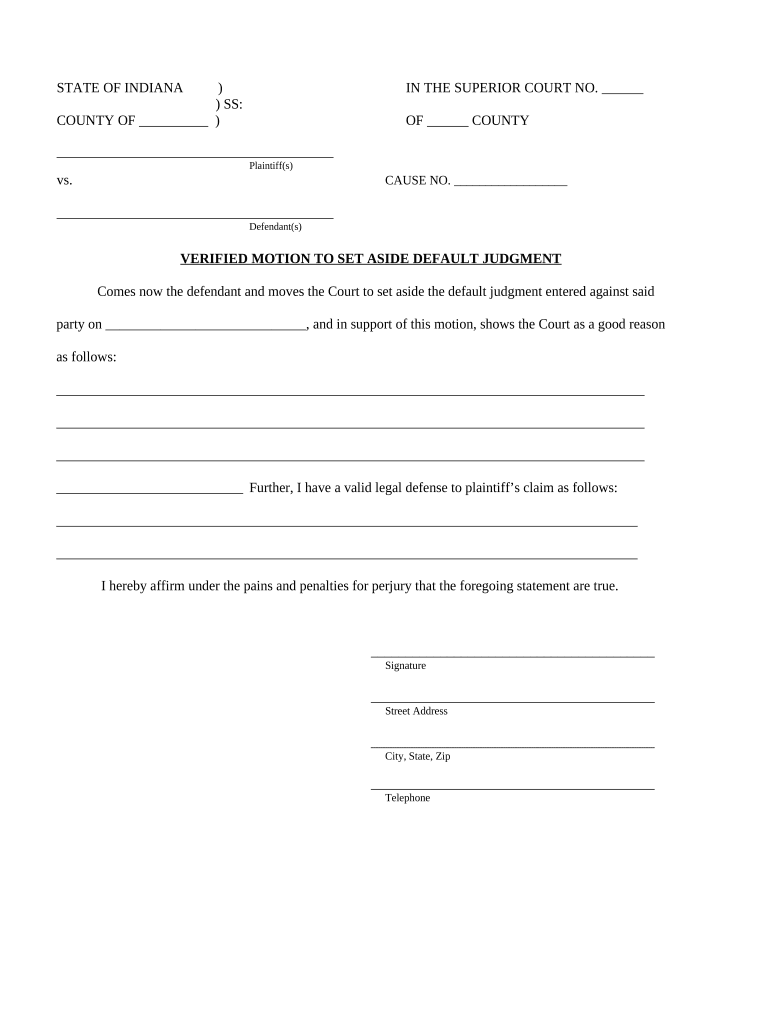
Motion Statement

Clear, concise request stating the precise relief sought to set aside the judgment.

Verification/Affidavit

Sworn or notarized facts describing why relief is warranted and how service or notice failed.

Legal Basis

Cite relevant Indiana trial rules and case law supporting relief (timeliness, excusable neglect, fraud).

Exhibits

Attach supporting documents: proof of service, correspondence, affidavits, or new evidence.

Certificate of Service

Statement confirming how and when all parties were served with the motion.

Step-by-Step: Completing and Filing the Verified Motion

Follow a clear sequence: prepare documents, verify statements, file with the clerk, and serve opposing parties promptly.

  • 01
    Prepare Motion: Draft the motion and supporting affidavit with factual specifics and legal citations.
  • 02
    Verify/Affidavit: Sign under oath before a notary or use the court's allowed verification method.
  • 03
    File with Clerk: Submit the motion by e-file or in-person per local court rules and obtain a stamped copy.
  • 04
    Serve Parties: Serve all parties using permitted methods and file a certificate of service.

Setting Up an Electronic Workflow for This Motion

Configure e-filing and e-sign steps to match court requirements and evidence preservation standards.

Field Configuration
Document Format PDF/A recommended for long-term fidelity and court compatibility
Signer Authentication Use email plus SMS code or stronger methods for affidavit attribution
Audit Trail Capture IP, timestamp, and action log for each signer
Delivery Method E-file to court where supported; supplement with certified mail if required

Typical Filing and Service Flow

The process moves from preparation to sworn verification, filing, service, and hearing scheduling when necessary.

  • Draft: Create motion, affidavit, and exhibits
  • Verify: Sign affidavit before notary or as allowed
  • File: Submit to court via e-file or clerk's office
  • Serve: Serve opposing parties and file certificate

Technology and Integration Considerations

Ensure the platform records a complete audit trail and stores the signed, timestamped PDF for court presentation and retention obligations.

  • Integrations: Salesforce, NetSuite, Google Workspace
  • Formats: PDF, PDF/A, DOCX supported
  • Authentication: Email, SMS, KBA options

How eSignature Vendors Compare for Court Documents

Comparison of representative eSignature plans and core features relevant to verified court filings; signNow appears first per vendor ordering rules.

signNow DocuSign Adobe Sign PandaDoc HelloSign
Starting Price $8/user/mo $15/user/mo $14/user/mo $19/user/mo $15/user/mo
Free Trial 7-day free trial Varies by plan Varies by plan Varies by plan Varies by plan
Bulk Send Yes (Business Premium) Yes Yes Yes No
Audit Trail Yes Yes Yes Yes Yes
HIPAA Compliant Yes Yes Yes No No
Envelope Cap No cap 100 envelopes/user/year Varies Varies Varies

Security and Compliance Considerations for Electronic Submissions

Encryption: TLS 1.2/1.3 in transit, AES-256 at rest
Certifications: SOC 2 Type II and ISO 27001 available
HIPAA: BAA required for PHI handling
21 CFR Part 11: Supported for regulated records
ESIGN / UETA: Meets electronic signature legal frameworks
Audit Trail: Detailed timestamps, IP addresses, and signer events

Consequences of an Incorrect or Untimely Motion

Denial of Relief: Default judgment remains enforceable
Sanctions: Court may impose monetary sanctions
Waiver: Failure to timely act can waive defenses
Appeal Limits: Appeals may be restricted by procedural defaults
Service Defects: Improper service can lead to denial
Increased Costs: Additional filing or attorney fees

Common Preparation Errors to Avoid

  • Using unsworn statements where a verification or jurat is required, which can result in the clerk rejecting the filing or the court refusing relief.
  • Failing to attach or properly label supporting exhibits such as proof of service, correspondence, or newly discovered evidence that establish the motion's factual basis.
  • Missing local rules on service or e-filing format (some counties require specific templates or e-file cover sheets), causing procedural dismissal.
  • Relying on vague assertions (for example, 'excusable neglect' without factual detail) rather than concrete, corroborated facts in the supporting affidavit.

Practical Tips for a Strong Verified Motion

Adopt a meticulous approach to facts, signatures, and service to reduce procedural hurdles and improve the court's receptivity to reopening a case.

Document Chronology
Create a clear timeline of events with dates and supporting documents. Attach the timeline as an exhibit to help the judge quickly assess timeliness and the movant's diligence.
Concise Legal Argument
Keep legal arguments focused on applicable standards such as excusable neglect or insufficient service. Support with a short memorandum citing controlling Indiana trial rules and precedent.
Strong Verification
Ensure the affidavit or verification states facts in first person, signed under oath, and notarized if required. Inaccurate or unsigned verifications are common grounds for denial.
Proof of Service
Include a complete certificate of service showing method, date, and recipient. Courts expect clear proof that opposing parties received the motion and supporting materials.

Illustrative Examples of When a Verified Motion Helps

Two common scenarios where courts often consider setting aside a default judgment when verified facts and prompt action are present.

Eviction Defense

Tenant missed initial notice due to incorrect address in landlord paperwork which prevented service

  • Newly discovered evidence and a timely affidavit show lack of actual notice
  • The verified motion attaches corrected service records and an affidavit explaining excusable neglect, supporting relief to reopen the case so tenant can assert defenses.

Debt Collection Dispute

Debtor did not respond because summons was mailed to an outdated address

  • Debtor produces bank statements and communications showing lack of notice
  • Verified motion includes sworn statement and contact history; court may set aside judgment to allow adjudication on the merits.

Timing Considerations and Typical Deadlines

Timeliness is critical. File and serve the verified motion promptly once the movant learns of the default judgment and assemble supporting evidence quickly.

Immediate Action:

File as soon as facts supporting relief are known to avoid claims of laches or waiver

Local Rule Deadlines:

Some courts set short windows for motions; check county-specific e-filing deadlines

Hearing Scheduling:

Clerk or judge will set a hearing date after service and filing; typical windows range from 7–30 days

Service Timeline:

Complete service promptly and file the certificate of service to prove notice

Appeal Period Impact:

Filing a motion to set aside can affect or toll appeal deadlines—verify procedural interplay early

Frequently Asked Questions About the Verified Motion

Answers to common procedural and practical questions about preparing, signing, and filing a verified motion to set aside a default judgment in Indiana.


Need help? Contact support

be ready to get more
Join over 28 million airSlate SignNow users