Establishing secure connection…Loading editor…Preparing document…

Loan Agreement

This template is fully customizable. Edit the text, fill out the fields, and send it for signature. Give it a try!
Loan Agreement

What a Loan Agreement Is and when it applies

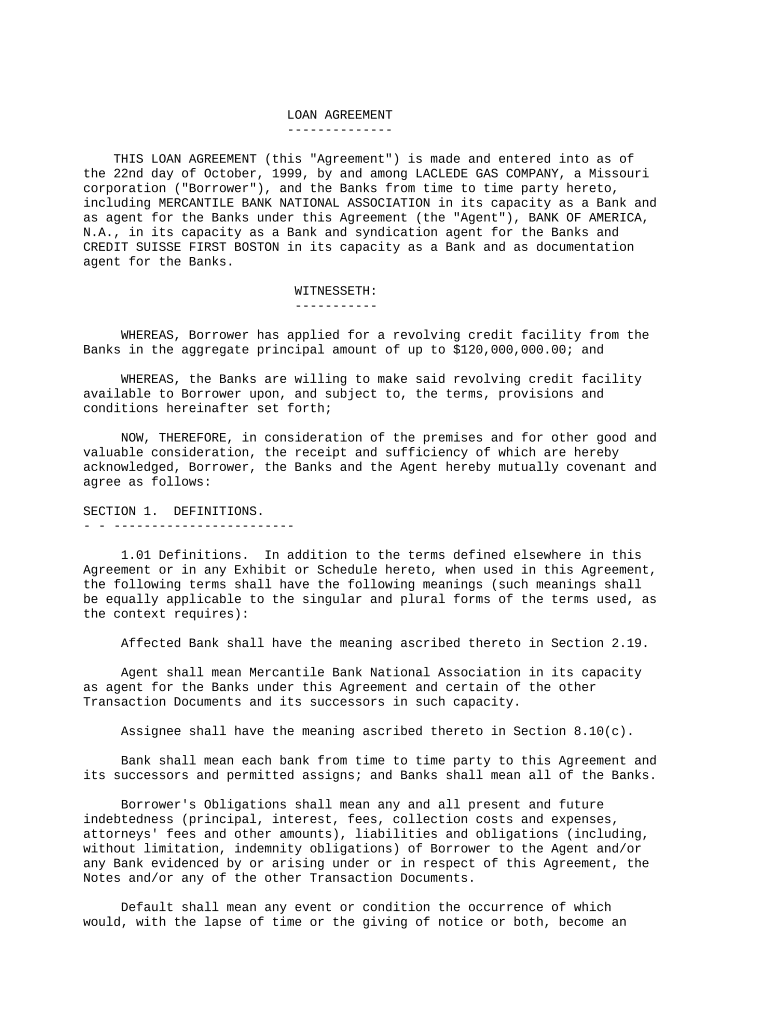
A Loan Agreement is a legally binding contract that sets the terms between a lender and a borrower, including the principal amount, interest rate, repayment schedule, security or collateral, representations and warranties, and default remedies. It governs how and when payments are made, how late or missed payments are handled, and what actions either party may take on default. In commercial and consumer contexts the document often integrates disclosure language, collateral descriptions, events of default, and governing law provisions to avoid ambiguity and support enforceability.

Why a clear Loan Agreement matters

A clear Loan Agreement reduces dispute risk, codifies payment obligations, and defines remedies for default. It creates predictable expectations for both lender and borrower and supports enforcement if collection or collateral remedies become necessary.

Why a clear Loan Agreement matters

Who typically prepares and signs Loan Agreements

Loan Agreements are used across lenders, borrowers, and advisors; the document and execution process differ by role and industry.

  • Commercial lenders and banks — prepare standardized form agreements and verify borrower credentials before funding.
  • Small-business owners and entrepreneurs — accept term loans or lines of credit and negotiate schedules and covenants.
  • In-house counsel and loan officers — adapt clauses for compliance, collateral perfection, and regulatory disclosures.

Parties should confirm signing authority and whether notarization, recording, or additional disclosures are required in the governing jurisdiction.

Essential sections to include in a professional Loan Agreement

A comprehensive Loan Agreement addresses the deal’s economic terms, the duties of each party, protections for the lender, and how the document will be governed and enforced.

Parties & Recitals

Identify each party by full legal name and capacity, and include recitals stating the loan purpose and background facts for context and interpretation.
Loan Amount

State the principal in dollars, any disbursement schedule, permitted draws, and whether the amount is fixed or subject to adjustment.

Interest & Fees

Specify the interest rate (fixed or variable), calculation method (simple or compound), late fees, and any origination or commitment fees.

Repayment Terms

Detail payment frequency, amortization, prepayment rights or penalties, and the application order for principal, interest, and fees.

Security & Collateral

Describe collateral, perfection steps (e.g., UCC-1 filing, deed recording), covenants, and any guaranty or pledge arrangements.

Default Remedies

Define events of default, cure periods, acceleration rights, repossession or foreclosure mechanics, and recovery of enforcement costs.

Core data fields lenders and borrowers must provide

Borrower Name: Full legal name
Lender Name: Full legal name
Principal Amount: Numeric dollar amount
Interest Rate: Percent value
Maturity Date: MM/DD/YYYY
Collateral: Brief description

Step-by-step: completing a Loan Agreement

Follow a consistent sequence to reduce errors: prepare terms, verify parties, complete fields, and confirm execution and retention steps.

  • 01
    Gather documents: Collect IDs, business formation records, and collateral descriptions.
  • 02
    Populate terms: Enter amount, interest, schedule, and collateral precisely.
  • 03
    Verify parties: Confirm signatory authority and legal names match IDs.
  • 04
    Execute and record: Sign, notarize if needed, and file or record security instruments.

How to set up a secure online signing workflow

Configure authentication, signing order, and retention before sending to streamline execution and maintain an audit trail.

Field Configuration
Authentication Email link or SMS code; KBA for higher risk
Signing Order Sequential or parallel as agreed by parties
Notifications Enable reminders and completion notices
Retention Store signed PDF with audit trail

Digital signing and file format requirements

Use a platform that supports common formats and strong security to preserve enforceability and evidentiary value.

  • Supported Formats: PDF, DOCX
  • Integrations: Salesforce, NetSuite, Google Workspace
  • Security: TLS 1.2/1.3; AES-256

Ensure the chosen solution provides a tamper-evident audit trail, signer attribution, and retention that meets ESIGN/UETA standards and your policy needs.

Typical online signing flow for a Loan Agreement

An established e-sign workflow reduces turnaround time and preserves authentication metadata required for enforcement.

  • Upload: Upload final agreement as PDF or DOCX.
  • Prepare: Place signature, initials, and date fields.
  • Send: Send to signers; specify authentication.
  • Complete: Signers execute; system captures audit trail.

Common dates and timelines to track

Track contractual dates and statutory timelines to avoid default triggers and preserve rights.

Payment Due Dates:

Follow the scheduled payment dates in the repayment section.

Late Payment Notices:

Issue notices per agreement; common cure periods are 10–30 days.

Acceleration Trigger:

Acceleration may occur after uncured default, per agreement terms.

Security Recording:

Record mortgages or UCC-1 financing statements promptly to perfect collateral.

Tax Reporting:

Retain records for IRS reporting and possible interest deduction review.

Key milestones from agreement to final payoff

A linear timeline helps stakeholders know when funding, servicing, and final accounting occur.

01

Offer & Acceptance

Negotiation and final mutual execution of loan terms.

02

Funding

Lender disburses principal per the disbursement schedule.

03

Repayment Period

Regular payments commence per the amortization schedule.

04

Maturity / Payoff

Final payment, release of collateral, and closing accounting.

Common mistakes when preparing Loan Agreements

  • Using informal names instead of legal entity names, which can obstruct enforcement and perfection of collateral.
  • Failing to describe collateral with sufficient detail to allow UCC filing or deed recording, causing lost security priority.
  • Omitting cure periods or unclear default definitions, leading to disputes about when remedies are available.
  • Neglecting to verify signer authority or to capture an adequate audit trail for electronically executed agreements.

Penalties and legal risks from incorrect agreements

Default Interest: Higher interest rates
Acceleration: Immediate repayment demand
Foreclosure: Loss of pledged collateral
Legal Costs: Court and attorney fees
Regulatory Risk: Consumer lending penalties
Tax Consequences: Deduction disallowance

eSignature vendor pricing and capability overview relevant to Loan Agreements

Comparison of typical starting prices and core capabilities for common eSignature vendors. Confirm vendor plans and compliance options before selecting a provider.

signNow DocuSign Adobe Sign PandaDoc HelloSign
Starting Price $8/user/mo $15/user/mo $14/user/mo $19/user/mo $15/user/mo
Free Trial 7-day free trial Varies by vendor Varies by vendor Varies by vendor Varies by vendor
Bulk Send Yes Yes Yes Yes No
Audit Trail Yes Yes Yes Yes Yes
HIPAA Compliant Yes Yes Yes No No
Envelope Cap No cap 100 envelopes/user/year Varies by plan Varies by plan Varies by plan

Real-world examples of Loan Agreement use

The following examples illustrate how organizations execute and manage loan documents in practice.

Martin Properties

Local real estate lender standardized loan forms for mobile signings

  • Reduced in-person closings by 60%
  • The company processes notices, records mortgages, and stores signed PDFs with audit trails to streamline portfolio servicing and reduce turnaround times.

BIS

Regional finance firm integrated eSigning with its ERP

  • Improved cycle time by 8%
  • The firm uses role-based signing order, templates for collateral descriptions, and retains signed records in a secure repository for compliance and audit readiness.

Practical tips to improve accuracy and enforceability

Adopt consistent drafting, verification, and retention practices to reduce disputes and ensure the agreement is enforceable.

Use legal names
Always use the borrower’s and lender’s full legal names and include entity type to avoid identity disputes and to support UCC filings or recording.
Be explicit on money terms
Specify principal, interest calculation method, compounding rules, and payment application order to prevent differing interpretations.
Verify signer authority
Confirm the signer's authority (board resolution, power of attorney) and record proof of identity to strengthen enforceability.
Keep auditable records
Retain the executed agreement, amendment history, payment ledgers, and any recorded instruments in a searchable, tamper-evident repository.

Frequently asked questions about Loan Agreements and e-signing

Answers to common questions about electronic execution, notarization, amendments, and retention for Loan Agreements in the United States.


Need help? Contact support

be ready to get more
Join over 28 million airSlate SignNow users