Establishing secure connection…Loading editor…Preparing document…

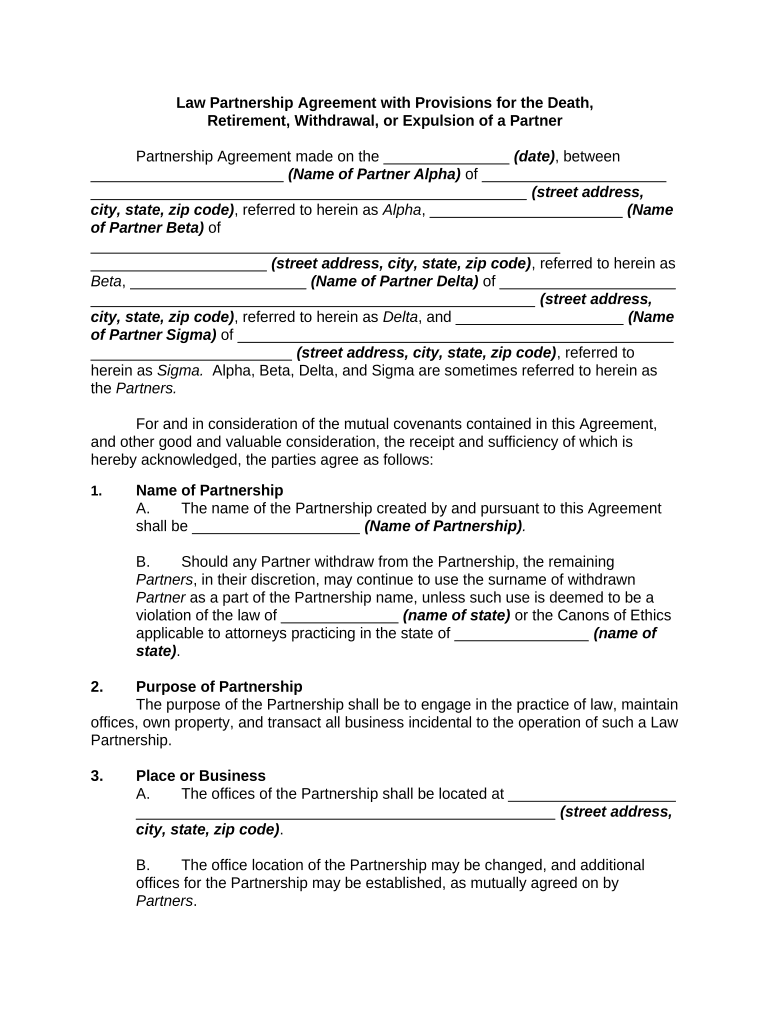
Law Partnership Agreement

This template is fully customizable. Edit the text, fill out the fields, and send it for signature. Give it a try!
Law Partnership Agreement

What a Law Partnership Agreement Covers

A Law Partnership Agreement is a written contract that defines the legal, financial, and operational relationship among partners in a law firm. It typically sets out firm name, capital contributions, profit and loss allocation, management and voting procedures, partner admission and withdrawal mechanics, fiduciary duties, confidentiality obligations, fee sharing, malpractice insurance requirements, dispute resolution, and governing law. The agreement can be standalone or part of an LLP/LLC registration package and is often accompanied by schedules for partner capital and client matter assignments.

Why a Clear Partnership Agreement Matters

A precise agreement reduces ambiguity, limits internal disputes, clarifies financial rights and obligations, and preserves client confidence. It creates predictable processes for admitting and removing partners, supports regulatory compliance, and documents governance for banks and insurers.

Why a Clear Partnership Agreement Matters

Who Typically Prepares and Signs This Agreement

Founding partners, managing partners, and firm counsel usually draft and approve the agreement before execution.

  • Small law firms forming a multi-partner practice and defining management duties
  • New partnerships after a merger or lateral admission to allocate capital and profits
  • Managing partners and firm administrators responsible for banking and governance implementations

Key Signatory Roles

Managing Partner

Typically signs on behalf of the firm for governance enactment, implements administrative provisions, and certifies bank and insurance changes. The managing partner ensures execution is consistent with board or partner approvals and maintains the official agreement record.

Outside Counsel

A transactional attorney or firm counsel reviews and endorses the agreement language, advises on conflict-of-interest protections and regulatory compliance, and may sign a certificate of legal review when required by banks or in practice transitions.

Essential Data Elements to Include

Firm Name: Full legal entity name
Effective Date: Agreement start date
Partner Names: Full legal names of partners
Capital Contributions: Amounts and payment terms
Profit Allocation: Percentage or formula
Governing Law: State chosen to interpret the agreement

How to Complete the Agreement — Step by Step

Follow these steps to prepare, execute, and archive a Law Partnership Agreement accurately.

  • 01
    Gather documents: Collect IDs, prior partnership schedules, and financial statements
  • 02
    Populate fields: Enter firm name, partners, contributions, dates, and percentages
  • 03
    Review terms: Confirm governance, malpractice coverage, and withdrawal procedures
  • 04
    Execute and store: All partners sign, notarize if required, and retain certified copies

Configuring an Online Signing Workflow

Set up a digital workflow that matches your internal approval order and authentication needs before sending for signatures.

Field Configuration
Signing order Sequential or parallel as required
Authentication Email plus optional SMS or KBA
Template variables Auto-fill partner names and capital amounts
Retention policy Save signed PDF/A with audit trail

Where to Submit or File the Executed Agreement

After execution, route copies to internal and external recipients according to governance and statutory needs.

  • Firm records: Retain original signed agreement in the firm corporate file
  • Banking: Provide certified copy to banks for account authorizations
  • State filings: File LLP/LLC registration or amendments with Secretary of State when required
  • Insurance carriers: Submit for malpractice policy updates and premium allocation

Digital Signing and Distribution Considerations

Choose a platform that supports legal e-signatures, secure storage, and the export formats your administrators need.

  • File formats: PDF and DOCX supported
  • Integrations: Connect to Google Workspace, Microsoft 365, NetSuite
  • Security: TLS/AES encryption and detailed audit log

Timelines and Notice Periods Commonly Included

Key dates affect capital payments, partner notices, and fiscal-year accounting; include clear deadlines in the agreement.

Effective date:

Specify MM/DD/YYYY to start obligations

Capital contribution due:

State payment terms, commonly 30–90 days

Withdrawal notice:

Typical notice periods: 60–90 days

Annual accounting:

Set fiscal close and profit allocation schedule

Tax record retention:

Keep financial records per IRS timelines

Frequent Preparation Errors to Avoid

  • Unclear profit allocation methods that lead to disputes and accounting ambiguity
  • Failing to list capital contribution schedules or payment deadlines for new partners
  • Using informal or inconsistent partner names that prevent bank or registry acceptance
  • Not updating the agreement after partner changes, mergers, or dissolutions

Common Risks and Consequences of Deficient Agreements

Tax exposure: Incorrect reporting leads to IRS penalties
Partner disputes: Litigation risk and costly resolution
Banking interruptions: Account access or authorization problems
Insurance gaps: Malpractice coverage disputes
Regulatory noncompliance: State filing defects or sanctions
Operational disruption: Practice instability during disputes

Core Clauses Every Law Partnership Agreement Should Include

A professional agreement organizes governance and finances; include these six core areas with precise, actionable language.

Recitals

Background context and the parties’ intent, including firm name, purpose, and effective date to frame the agreement.
Capital contributions

Detailed schedules for initial and additional contributions, valuation methods, payment timing, and consequences of default.

Profit and loss

Formula or percentage allocation, distribution timing, reserves for expenses, and handling of interim draws.

Management

Authority levels, voting thresholds, decision-making processes, and scope for day-to-day operations versus partner-level actions.

Admission & withdrawal

Procedures for admitting new partners, buy-in valuations, withdrawal notices, and buyout mechanics.

Dispute resolution

Mandatory mediation/arbitration clauses, choice of venue, and enforceable fee-shifting if appropriate.

eSignature Pricing and Feature Snapshot

Compare baseline pricing and core capabilities; signNow is listed first to show an entry-level comparison of common plan features.

signNow DocuSign Adobe Sign PandaDoc HelloSign
Starting Price $8/user/mo $15/user/mo $14/user/mo $19/user/mo $15/user/mo
Free Trial 7-day free trial, no credit card Varies by plan Varies by plan Varies by plan Varies by plan
Bulk Send Yes (Business Premium) Yes Yes Yes Varies by plan
Audit Trail Yes Yes Yes Yes Yes
HIPAA Compliant Yes (BAA available) Yes (BAA available) Yes (BAA available) No No
Envelope Cap No cap 100 envelopes/user/year Varies by plan Varies by plan Varies by plan

Practical Use Cases for a Law Partnership Agreement

Two common scenarios illustrate how a clear written agreement prevents disputes and speeds administrative tasks.

New Firm Formation

When three attorneys form a firm, they document capital, profit shares, and governance methods.

  • Define buy-in and voting rights clearly.
  • The written agreement avoids later disputes about client ownership and clarifies capital calls, which supports stable operations and bank account setup.

Partner Exit and Buyout

A withdrawing partner triggers buyout language tied to valuation timelines.

  • Use a clear valuation formula and payment schedule.
  • Having predefined buyout mechanics reduces litigation risk, simplifies accounting for retained earnings, and allows the firm to plan cash flow for transition.

Frequently Asked Questions

Answers to common questions about signing, notarization, revisions, and recordkeeping for Law Partnership Agreements.


Need help? Contact support

be ready to get more
Join over 28 million airSlate SignNow users