Establishing secure connection…Loading editor…Preparing document…

Letter Requesting Records Under FOIA

This template is fully customizable. Edit the text, fill out the fields, and send it for signature. Give it a try!
Letter Requesting Records Under FOIA

What the Letter Requesting Records Under FOIA Is

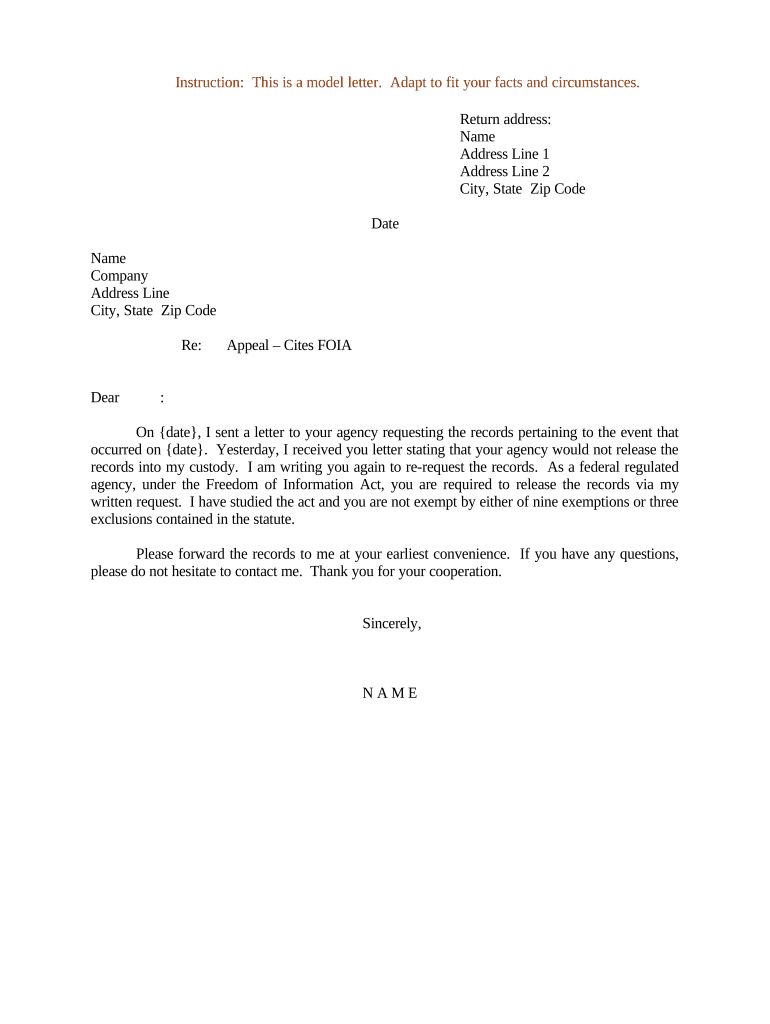
A Letter Requesting Records Under FOIA is a written request to a federal agency seeking access to records under the Freedom of Information Act (5 U.S.C. §552). The letter identifies the requester, specifies the records sought with sufficient detail to allow a search, states a preferred format and delivery method, and may request fee waivers or expedited processing where justified. It creates an administrative record of the request and is the starting point for any agency response, fee assessment, or administrative appeal.

Why this letter matters

A clear FOIA request triggers statutory rights to agency records and creates a trackable administrative record. Properly drafted requests reduce search costs, speed agency processing, and improve the chances of receiving responsive documents rather than a broad denial or an ambiguous partial release.

Why this letter matters

Who commonly prepares FOIA request letters

The same core template works for most requesters, but language should be adapted for fee waivers, expedited processing, or commercial-use designations.

  • Journalists and researchers seeking public-interest documents and background material
  • Attorneys and litigants collecting evidence for litigation or administrative review
  • Companies and consultants performing compliance checks, audits, or vendor due diligence

Step-by-step: preparing and sending your FOIA letter

Follow these core steps to produce a complete, agency-ready FOIA request letter.

  • 01
    Identify agency: Confirm the correct federal agency and component for the records.
  • 02
    Describe records: Provide precise document types, date ranges, and unique identifiers.
  • 03
    Request fees: State fee preferences, request waiver, or cap acceptable charges.
  • 04
    Submit and retain: Send by designated channel and keep a dated copy for your records.

Essential elements to include in your FOIA request letter

A professional FOIA letter combines identity, a precise records description, delivery preferences, fee instructions, and a clear signature or certification. Including these prevents routine processing questions and speeds resolution.

Addressee

Name the agency FOIA office or specific component and include a mailing address or FOIA email. Directing the request minimizes internal routing and clarifying follow-ups.
Requester identity

Provide the full name, organization, mailing address, email, and daytime phone. Accurate contact data is required for fee notifications and final deliveries.

Records sought

Describe records clearly: document types, subjects, author names, file numbers, and precise date ranges to enable a targeted search by agency staff.

Delivery format

State your preferred format (PDF, electronic files, paper copies) and delivery method. Reasonable format requests help agencies plan processing.

Fee and waiver

Indicate your fee category (commercial, educational, news media, other) and request a fee waiver if applicable with a concise justification tied to public interest.

Signature and certification

Sign and date the request. If signing electronically, include a printed name and an affirmation of truthfulness to create a clear administrative record.

Required fields to capture on the request form

Requester name: Full legal name
Organization: Company or affiliation
Contact details: Email, phone, mailing address
Records description: Types and subject matter
Date range: MM/DD/YYYY to MM/DD/YYYY
Fee instruction: Waiver/limit/commercial use

Where to file and how agency routing works

Agencies accept FOIA requests by their designated FOIA office, sometimes via a central portal. Select the correct submission channel to avoid delay.

  • Agency FOIA Office: Submit to the component listed on the agency FOIA page.
  • FOIAonline Portal: Use FOIAonline where the agency participates for tracking.
  • Agency Email: Send to the official FOIA mailbox if listed by the agency.
  • Mail or Hand Delivery: Deliver a signed hardcopy to the FOIA office if required by agency rules.

Configuring an online FOIA request workflow

If you submit electronically or use a document platform, set fields and routing to match agency requirements and preserve an audit trail.

Field Configuration
Requester contact Required; email and phone mandatory
Records description Make text searchable and field-limited
Attachments Allow supporting files (PDF preferred)
Authentication Enable signature and timestamp capture

How to deliver the letter and preserve proof of submission

When using e-signature or document platforms, configure audit trails, PDF output, and storage to meet legal retention and evidence needs.

  • Email submission: Retain sent message and server timestamp
  • Portal upload: Use agency portal receipts for tracking
  • Signed PDF: Preserve a signed PDF with timestamp

Timelines and typical processing expectations

FOIA establishes statutory response expectations, but actual delivery depends on records complexity and agency workload. Plan for administrative steps.

Acknowledgment:

Agencies often acknowledge receipt within a few business days

Statutory response:

Agency generally must respond within 20 business days (5 U.S.C. §552(a)(6)(A))

Fee estimates:

Agencies may issue a fee estimate before releasing records

Expedited requests:

Agencies decide expedited processing requests faster; standards vary

Appeals:

If denied, administrative appeal deadlines and procedures vary by agency

Key milestones in the FOIA request lifecycle

Track milestones to preserve rights and manage expectations from submission through final resolution.

01

Prepare request

Draft a precise description, specify fees and delivery preferences

02

Submit request

Send to the correct FOIA office and keep a dated copy

03

Agency review

Agency searches, reviews, redacts, and issues a release or denial

04

Appeal or litigation

File administrative appeal or seek judicial review if necessary

Common mistakes that delay or complicate FOIA requests

  • Vague descriptions that force broad agency searches and increase fees and delay
  • Addressing the wrong component or using an incorrect FOIA mailbox for the records requested
  • Failing to state fee preferences or to request a fee waiver with supporting justification
  • Not retaining a dated copy or proof of submission, which weakens appeal or litigation posture

Risks and consequences of an incomplete or incorrect letter

Processing delays: Responses may be substantially delayed
Fee charges: You may be charged search or duplication costs
Denial of request: Agency may withhold records under exemptions
Lost appeal rights: Missing procedural steps can limit appeal options
Litigation costs: Challenging denials may require counsel and fees
Privacy redactions: Personal data may be removed under exemptions

Typical eSignature vendor pricing and feature snapshot for submitting FOIA letters

Comparing eSignature vendors can help choose a platform for signing and tracking FOIA requests. signNow is listed first for clarity; plan features and pricing differ by vendor and plan tier.

signNow DocuSign Adobe Sign PandaDoc HelloSign
Starting Price $8/user/mo $15/user/mo $14/user/mo $19/user/mo $15/user/mo
Free Trial 7-day trial Varies Varies Varies Varies
Bulk Send Yes (Business Premium) Varies by plan Varies by plan Varies by plan Varies by plan
Audit Trail Yes Yes Yes Yes Yes
HIPAA Compliant Yes Yes Yes No No

Frequently asked questions about FOIA request letters

Answers to common questions about drafting, submitting, and following up on a Letter Requesting Records Under FOIA.


Need help? Contact support

be ready to get more
Join over 28 million airSlate SignNow users