Establishing secure connection…Loading editor…Preparing document…

Letter Requesting Estate Asset Information

This template is fully customizable. Edit the text, fill out the fields, and send it for signature. Give it a try!
Letter Requesting Estate Asset Information

What the Letter Requesting Estate Asset Information Is

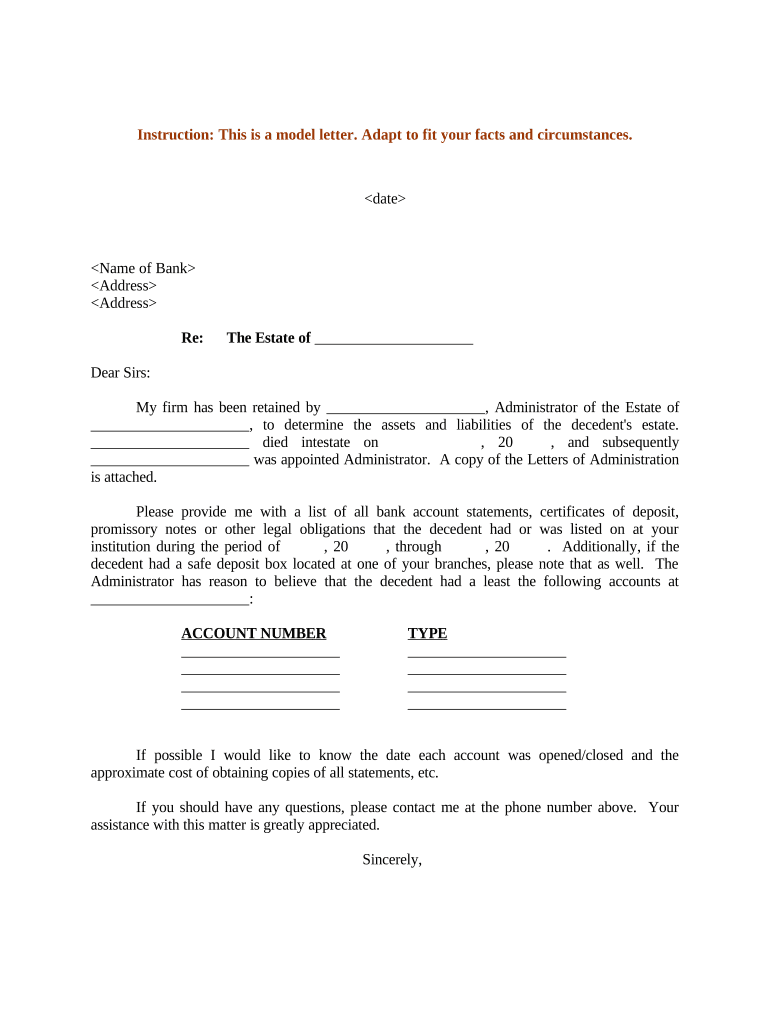
A Letter Requesting Estate Asset Information is a formal written request sent by an executor, personal representative, trustee, beneficiary, or attorney to financial institutions, custodians, insurers, or other third parties asking for details about assets owned by a decedent or estate. It identifies the estate, cites the representative's authority, lists specific account numbers or asset descriptions, requests account statements, title documents, policy information, and valuation records, and sets a reasonable response deadline. The letter helps assemble the estate inventory needed for probate, tax reporting, creditor notices, and distribution planning.

Why a Clear Request Matters for Estate Administration

Use this letter to secure accurate asset records efficiently, reduce probate delays, establish values for tax returns, and protect beneficiaries' interests. A clear, authoritative request reduces follow-up queries from institutions and creates a documented paper trail for estate administration.

Why a Clear Request Matters for Estate Administration

Who Typically Prepares and Sends This Letter

Executors, personal representatives, trustees, estate attorneys, and beneficiaries commonly prepare and send this letter when gathering estate asset details.

  • Estate executors compiling probate inventories, creditor claims, and distribution schedules.
  • Trustees conducting asset valuations, confirming titles, and administering trust distributions to beneficiaries.
  • Attorneys requesting institutional statements for tax reporting and estate settlement.

Primary Roles Who Sign or Authorize the Letter

Executor

As the decedent's appointed personal representative, the executor sends formal requests to financial institutions seeking statements, deeds, policy records, and account histories. Clear documentation of authority (letters testamentary or probate paperwork) should accompany the letter to avoid delays or refusals from custodians.

Beneficiary

A named beneficiary may request asset information when asserting distribution rights or when the executor is unresponsive. Beneficiaries should include identifying details, proof of status, and a reasonable deadline so institutions can locate accounts and comply with privacy rules.

Essential Data Elements to Include

Executor authority: Attach letters testamentary or court order
Decedent details: Full legal name, date of birth, last4 SSN
Account identifiers: Account numbers, policy IDs, property addresses
Requested documents: Statements, deeds, titles, insurance policies
Response deadline: Set a reasonable date such as 30 days
Delivery method: Certified mail, secure portal, or e-delivery

Risks and Consequences of Incomplete or Incorrect Requests

Delayed probate: Slows estate administration timeline
Tax reporting errors: Inaccurate valuation leads to penalties
Account access refusal: Institutions may refuse incomplete requests
Privacy violations: Disclose sensitive data without proper consent
Misidentification: Wrong account owner, wrong distribution
Fraud risk: Unauthorized requests can enable fraud

Common Practical Challenges When Requesting Records

  • Banks and brokerages often require original probate documents, authenticated letters, or court-issued letters testamentary before releasing account details, which can delay information gathering by weeks.
  • Institution privacy policies and state laws may restrict disclosure; institutions frequently request notarized releases, proof of authority, or verified identity before producing records.
  • Missing account numbers, prior names, or property descriptions can make locating assets difficult; include all known identifiers and cross-reference account holders.
  • Varying statement formats and electronic records across institutions require manual reconciliation, increasing administrative time and the possibility of data entry errors.

Key Components to Include in a Professional Letter

Essential elements of the Letter Requesting Estate Asset Information ensure clarity of authority, specific asset details, and a defined response mechanism for custodians and institutions.

Identification

Provide the decedent's full legal name, date of birth, last four of SSN, current and prior addresses, and file number if available so institutions can locate accounts and legal records accurately.
Authority

State the representative's title (executor, administrator, trustee), attach court-issued documentation such as letters testamentary or letters of administration, and include a copy of identification to verify authority.

Asset List

List each account, policy, or property with as much detail as possible: account numbers, institution names, property addresses, policy numbers, and approximate valuation or recent statement dates.

Document Requests

Specify exact documents requested such as monthly and annual statements, deeds of trust, title reports, insurance declarations, beneficiaries named, transaction histories, and any recent appraisals.

Deadline

Set a firm calendar date for response, suggest 30 days as customary, and note that extensions may be granted upon reasonable written request and verification of records.

Contact Information

Provide the representative's full contact details, including mailing and physical addresses, daytime phone number, secure email, and a designated point of contact for document delivery and status inquiries.

Step-by-Step: Preparing and Sending the Letter

Follow these steps to prepare and send the letter to custodians and institutions for estate asset disclosure.

  • 01
    Prepare documents: Gather probate paperwork, ID, and decedent identifiers.
  • 02
    List assets: Detail accounts, policies, properties, and identifiers.
  • 03
    Draft letter: State authority, list requested records, and deadline.
  • 04
    Send securely: Use certified mail, secure portal, or e-delivery.

How the Request Is Routed and Processed

Typical routing and response flow when requesting estate asset information from third-party custodians, including verification and document delivery.

  • Send request: Deliver the letter with authority documents attached.
  • Institution review: Custodian verifies authority and locates records.
  • Response preparation: Institution compiles statements and required documentation.
  • Return delivery: Documents returned via chosen secure method.

Configuring a Repeatable Digital Workflow

Configure a repeatable digital workflow so institutions receive properly authenticated requests and document delivery uses secure channels.

Field Configuration
Authentication method and verification level Email token, SMS code, or KBA for sensitive estates
Attach estate authority and ID documents Include letters testamentary and a government ID copy
Choose certified mail, portal, or encrypted email Select secure portal or certified mail with tracking
Record retention and audit trail settings Enable audit trail, retain communications seven years

Technical and Security Considerations for Digital Delivery

Technical considerations for sending and receiving estate asset information securely via digital channels and eSignature workflows.

  • File formats: PDF, DOCX, or scanned image files
  • Integrations: Connectors: NetSuite, Salesforce, Google Workspace
  • Security: TLS in transit, AES-256 at rest

Timing Expectations and Deadlines

Key timing expectations for requesting and receiving estate asset records from institutions and for meeting probate and tax reporting deadlines.

Response timeframe suggested:

Request response within 30 days; follow up at 45 days

Probate filing:

File inventory per court schedule after asset collection

Tax reporting:

Gather valuations for estate tax and income tax returns

Notarization windows:

Allow time for notarization or RON sessions as required

Document retention:

Keep copies for minimum three years; longer for tax records

Baseline Pricing and Feature Comparison for eSignature Vendors

Compare baseline pricing and key feature availability for common eSignature vendors focused on estate workflows and secure document exchange.

signNow DocuSign Adobe Sign PandaDoc HelloSign
Starting Price $8/user/mo $15/user/mo $14/user/mo $19/user/mo $15/user/mo
Free Trial 7-day free trial Varies by vendor Varies by vendor Varies by vendor Varies by vendor
Bulk Send Yes Yes Yes Yes No
Audit Trail Yes Yes Yes Yes Yes
HIPAA Compliant Yes Yes Yes No No

Key Milestones from Request to Inventory Update

Key milestones from drafting and sending the letter through receipt of records, reconciliation, and finalizing the estate inventory for probate.

01

Draft and Attach Authority

Prepare the letter and attach letters testamentary and ID

02

Send and Track

Send via secure channel; retain tracking or audit trail

03

Institution Response

Institution confirms scope, may request notarization or additional ID

04

Reconciliation and Update

Reconcile records with estate inventory and report to court if required

Frequently Asked Questions About Letters Requesting Estate Asset Information

Answers to frequent questions about preparing, sending, and enforcing a Letter Requesting Estate Asset Information.


Need help? Contact support

be ready to get more
Join over 28 million airSlate SignNow users