Establishing secure connection…Loading editor…Preparing document…

Letter Regarding Mortgage Priority Issue

This template is fully customizable. Edit the text, fill out the fields, and send it for signature. Give it a try!
Letter Regarding Mortgage Priority Issue

What this Letter Is and When it’s Used

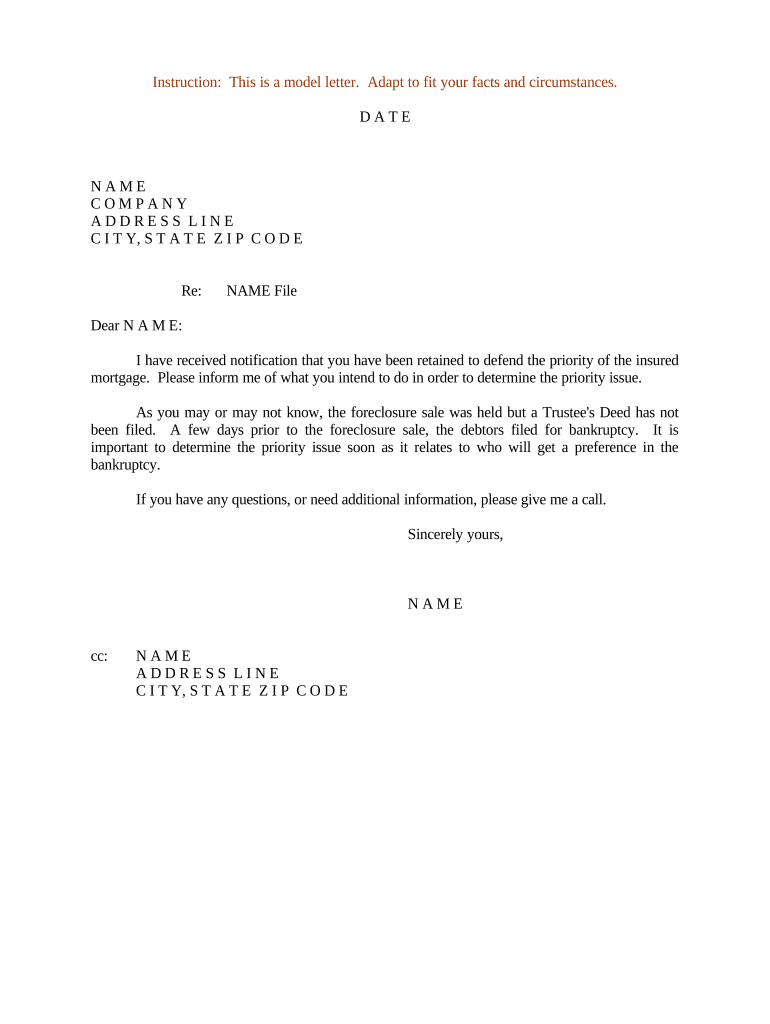
A Letter Regarding Mortgage Priority Issue is a formal written notice used to raise, clarify, or dispute the relative priority of one mortgage or lien against a property compared with another encumbrance. Typical uses include asserting a prior recorded lien, requesting corrective recording, notifying a title company or servicer about an encroaching junior lien, or asking a lender to preserve its position. The letter documents the claim, cites supporting instruments, and requests specific remedial steps such as re-recording, subordination, or indemnification.

Why this Letter Matters and its Legal Basis

A clear, well-documented letter preserves rights, creates a record of notice, and can prompt corrective action while evidence is fresh; ESIGN (15 U.S.C. ch. 96) and UETA support electronic delivery and signatures where applicable.

Why this Letter Matters and its Legal Basis

Who Typically Prepares or Receives This Letter

Common preparers and recipients include parties with a direct interest in mortgage priority and the professionals who handle title and recording matters.

  • Title companies and closing agents who must confirm lien hierarchy during closings and cures.
  • Mortgage lenders and servicers asserting or defending lien priority in loss-mitigation or foreclosure contexts.
  • Borrowers, attorneys, and property managers seeking resolution or correction of recorded instruments.

Use the letter to start a documented communication trail and to request a concrete next step such as re-recording, subordination agreement, or escrow hold.

Representative Signatories and Preparers

Title Officer — Sarah Gomez

A title officer drafts or requests the letter when a curative instrument is needed pre-closing. She attaches recorded instruments, chain-of-title excerpts, and specific recording references to support the priority claim and asks the recorder or lienholder to correct the record.

Mortgage Servicer — David Lee

A servicer issues the letter to subordinate or contest a competing lien after reviewing payment history and security instruments. The servicer identifies the loan number, recording details, and the requested remedial action, and tracks responses for loss mitigation or foreclosure defense.

Core Elements to Include for a Professional Letter

Include these six components to make the letter legally clear and operationally actionable.

Clear Identification

State the property address, legal description, parcel or tax ID, and the names of the grantor and grantee so recipients can locate the exact record in the county clerk’s index.
Recorded Instrument Details

Reference the recording county, book and page or instrument number, recording date, and filing or document ID for each mortgage or lien relevant to the priority dispute.

Priority Statement

Concise statement of the asserted priority (for example, 'Mortgage A recorded on MM/DD/YYYY has priority over Mortgage B recorded on MM/DD/YYYY') with the legal basis if known.

Supporting Attachments

Attach certified copies or clear photocopies of the mortgage, assignments, subordination agreements, reconveyances, and title report pages that show the chain of recordings.

Requested Remedy

Specify the action sought—re-recording, corrective amendment, subordination, indemnity, or escrow hold—and any proposed language or deadline for response.

Signature and Contact

Include the authorized signer’s printed name, title, company, mailing and email addresses, telephone number, and signature block dated MM/DD/YYYY.

Required Data Elements at a Glance

Borrower Name: Exact legal name
Property Address: Street, city, state, ZIP
Loan Identifier: Loan number or note reference
Recorded Instrument: Book/Page or Instrument No.
Priority Claim: Brief assertion text
Contact Details: Phone, email, mailing address

Step-by-Step: Preparing and Sending the Letter

A straightforward sequence reduces follow-up and preserves your rights: gather records, state the claim, attach evidence, and choose delivery method with proof of receipt.

  • 01
    1. Gather Records: Collect the deed, mortgages, assignments, and title report excerpts.
  • 02
    2. Draft Letter: Include property ID, recording citations, and a clear remedy.
  • 03
    3. Attach Proof: Attach copies of recorded instruments and page citations.
  • 04
    4. Deliver & Track: Send via recorded mail or eDelivery with audit trail.

Where to Send, File, or Record Your Letter

Choose recipients and delivery channels that create official notice and allow verification of receipt; different recipients serve different legal purposes.

  • County Recorder: Send if corrective recording or affidavit must be filed in land records.
  • Title Company: Send to title officer handling closing or claims for curative action.
  • Lienholder / Servicer: Deliver to the competing lender to request subordination or correction.
  • Borrower / Attorney: Serve notice to borrower or counsel to preserve dispute evidence.

Digital Signing and Delivery Considerations

Use electronic delivery and eSignatures where accepted to speed response and preserve an audit trail.

  • File Formats: PDF, DOCX accepted
  • Authentication: Email, SMS, KBA options
  • Integrations: Salesforce, NetSuite, Google Workspace

How to Configure an Online Letter Workflow

Set up a repeatable e-sign and delivery workflow so each letter includes attachments, signer roles, and retention settings.

Field Configuration
Signer Roles Primary signatory, secondary approver
Authentication Email link with SMS code
Attachments Include PDF title pages and recording citations
Retention Retain signed copy and audit trail for required period

Typical Timelines and Expected Response Windows

There is no single statutory deadline for a mortgage-priority letter; use reasonable internal deadlines and document expected response windows to manage follow-up.

Initial Sending:

Send immediately upon discovering the competing lien

Expected Reply:

Allow 30 days for acknowledgement or substantive response

Recorder Processing:

Recording timelines vary by county; ask the county clerk for typical lead times

Escalation:

If no response in 30–60 days, follow up and consider legal counsel

Statute of Limitations:

Priority disputes may affect limitation periods—consult counsel promptly

Key Milestones from Discovery to Resolution

Track milestones to preserve evidence and meet any internal or legal deadlines during dispute resolution.

01

Discovery of Competing Lien

Identify the instrument and recording details immediately.

02

Letter Preparation

Assemble attachments and specify the remedy requested.

03

Delivery and Proof

Send by certified mail or eDelivery with audit record.

04

Resolution or Escalation

Receive corrective recording, subordination, or begin legal steps.

Common Mistakes to Avoid

  • Using informal or ambiguous language that fails to identify the exact recorded instruments and recording citations.
  • Omitting supporting attachments such as the recorded mortgage or assignment that prove the asserted priority.
  • Sending without a tracked delivery method, leaving no proof of receipt or a timestamped audit trail.
  • Not confirming the signatory is authorized, which can render the letter ineffective against third parties.

Risks and Consequences of an Inaccurate Letter

Lost Priority: Subsequent lien may remain unchallenged
Delay Costs: Closing or cure delays, extra fees
Legal Exposure: Potential indemnity or litigation
Recording Errors: Incorrect re-recording can complicate title
Regulatory Risk: Compliance issues for servicers
Reputational Harm: Title insurer or lender disputes

Representative eSignature Pricing and Capability Comparison

Compare starting prices and common capability indicators for widely used eSignature vendors; signNow is listed first per this comparison.

signNow DocuSign Adobe Sign PandaDoc HelloSign
Starting Price $8/user/mo $15/user/mo $14/user/mo $19/user/mo $15/user/mo
Free Trial 7-day free trial Varies by plan Varies by plan Varies by plan Varies by plan
Bulk Send Yes Yes Yes Yes No
Audit Trail Yes Yes Yes Yes Yes
HIPAA Compliant Yes Yes Yes No No
Envelope Cap No cap 100 envelopes/user/year limit Varies by plan Varies by plan Varies by plan

Frequently Asked Questions — Common Issues and Answers

Answers to practical questions about validity, e-signing, evidence, notarization, and next steps when priority is disputed.


Need help? Contact support

be ready to get more
Join over 28 million airSlate SignNow users