Establishing secure connection…Loading editor…Preparing document…

Reward for Reporting Crime

This template is fully customizable. Edit the text, fill out the fields, and send it for signature. Give it a try!
Reward for Reporting Crime

What a Reward for Reporting Crime Is and How It Works

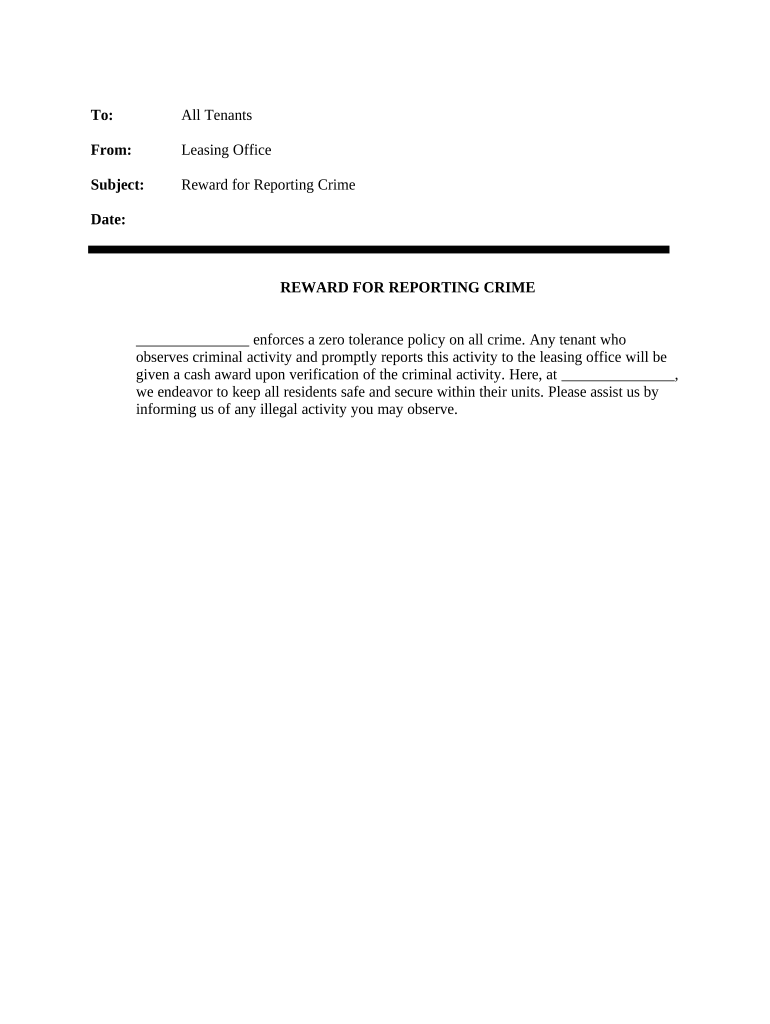
A Reward for Reporting Crime is a formal notice or offer, typically issued by a law enforcement agency, prosecutor's office, or private sponsor, that promises a monetary or non-monetary reward for information leading to the identification, arrest, or conviction of persons responsible for a specified criminal act. The document defines the eligible conduct, the amount or range of the reward, the proof required to claim payment, confidentiality assurances for informants, and any conditions or limitations. It may be published publicly or distributed selectively to target communities.

Why a Clear Reward Notice Matters

A Reward for Reporting Crime increases community reporting, assists investigations, and can accelerate case resolution while protecting informant anonymity when required. It clarifies eligibility, evidentiary standards, and payout procedures so sponsors and claimants understand expectations and limits.

Why a Clear Reward Notice Matters

Who Typically Issues or Uses Reward Notices

Typical users include law enforcement agencies, prosecutors, private sponsors, and community organizations that issue rewards to solicit tips on criminal activity.

  • Local police departments and sheriff's offices seeking witness information or evidence
  • Prosecutors and district attorneys offering case-specific rewards to encourage witness cooperation
  • Private businesses, nonprofits, or neighborhood associations sponsoring tip rewards to deter crime and aid investigations

Who Has Authority to Authorize or Fund Rewards

Police Official

A sworn law enforcement official (chief, detective, or prosecuting attorney) typically authorizes agency-issued rewards, defines eligibility criteria, coordinates evidence assessment, and approves disbursement. They must ensure compliance with agency policy, state law, and chain-of-custody requirements when evaluating claims.

Private Sponsor

A private sponsor (business owner or nonprofit director) funds rewards and sets payment conditions; they should coordinate with local law enforcement, document funding sources for transparency, and rely on defined proof standards to reduce disputes and legal exposure.

Core Elements to Include in the Reward for Reporting Crime

Core elements of a Reward for Reporting Crime document ensure clarity on eligibility, evidence standards, payment mechanics, confidentiality, claim process, and legal limitations.

Reward Amount

Specify fixed amount or tiered ranges, currency, maximum aggregate payments, and whether partial awards are permitted; include funding source and conditions that may reduce or deny payment.
Eligible Conduct

Define the crimes, incidents, timeframes, and jurisdictions covered; be explicit about whether ongoing investigations, past crimes, or cold cases qualify for rewards and any exclusions such as cooperation requirements.

Proof Required

List acceptable evidence types (physical evidence, photographs, witness testimony, digital records), standards of proof, submission formats, and chain-of-custody procedures and timelines for submission to evaluate claims.

Claim Process

Describe how to submit tips (phone, online portal, anonymous tipline), required contact details, forms, deadlines, expected timelines for decisions, and the review and appeal procedures for denied claims.

Confidentiality

State whether informant identity will be protected, exceptions for subpoenas or court proceedings, and whether anonymous submissions are accepted with limitations; describe data handling and retention practices affecting privacy.

Payment Terms

Explain payment authorization, responsible disbursing party, taxation reporting obligations, timing of payments, conditions for withholding, and required documentation for payout.

Essential Fields to Collect on a Reward Claim Form

Reporter Name: Full legal name as on ID
Contact Info: Phone number and email address
Incident Date: Enter date in MM/DD/YYYY
Location: Street, city, state, ZIP
Description: Clear summary, key details, suspects
Evidence: List attachments and chain-of-custody

Step-by-Step: Submitting a Tip and Claiming a Reward

Follow these steps to submit a tip and claim a reward; include required evidence and maintain contact details for follow-up.

  • 01
    Prepare Information: Gather dates, locations, witness names, and evidence.
  • 02
    Complete Form: Enter fields accurately and attach files.
  • 03
    Consent & Sign: Provide consent and sign electronically or in person.
  • 04
    Submit & Track: Send to agency and keep confirmation for records.

Where to Send Tips and What Happens Next

Typical submission routes and what happens after a tip is received by the issuing agency or sponsor.

  • Phone Tip: Call the designated tipline; expect intake questions.
  • Online Portal: Upload forms and evidence; receive confirmation email.
  • Anonymous Hotline: Use third-party services to preserve anonymity.
  • In-Person: Visit the agency to submit physical evidence.

Configuring an Online Reward Submission Form

Configure online submission forms and eSignature settings to collect required fields, attachments, and informed consent for reward claims.

Field Configuration
Required Fields Name, date, contact, description, evidence uploads
Authentication Email verification or SMS code recommended
File Types Allow PDF, JPG, MP4; max 50MB per file
Consent Checkbox Include ESIGN disclosure and capture timestamp

Distribution Channels and Platform Considerations

Use digital channels that meet privacy, authentication, and evidence-handling requirements when collecting tips and reward claims.

  • Integrations: CRM, RMS, cloud storage
  • Formats: PDF, DOCX, JPG, MP4
  • Authentication: Email, SMS, or advanced methods

Typical Timelines and Deadlines to Expect

Common timelines include claim filing windows, internal review periods, and statutory limitations affecting reward eligibility and payment disbursement.

Claim Filing Window:

Typically 30–180 days from incident depending on sponsor

Internal Review Period:

Agency review often completes within 60–120 days

Payment Authorization:

Payment decision and disbursement may take 30–90 days

Appeal Period:

Sponsors may allow 14–30 days to contest denials

Statute of Limitations:

Eligibility unaffected by criminal statute; consult counsel for specifics

Key Milestones from Submission to Payment

Key milestones from report submission through payment approval explain who acts and expected checkpoints in the reward claim lifecycle.

01

Report Received

Intake recorded and confirmation sent to submitter.

02

Preliminary Review

Verification of identity and evidence sufficiency begins.

03

Investigation Outcome

Investigators determine if tip leads to charge or arrest.

04

Payment Decision

Sponsor authorizes payment per stated terms and documentation.

Common Mistakes to Avoid When Preparing a Reward Offer

  • Vague eligibility criteria lead to disputes and nonpayment; be explicit about covered conduct, timeframe, and exclusions to reduce ambiguity and potential litigation.
  • Undefined proof standards increase administrative burden; specify acceptable evidence types, required corroboration, and chain-of-custody for physical or digital materials.
  • Ignoring tax and reporting obligations can expose sponsors and claimants to liabilities; document expected tax reporting and backup withholding contingencies.
  • Poor data security or public disclosures risk informant safety; limit personally identifying information and use secure channels for sensitive submissions.

Risks and Potential Legal Consequences

Tax Liability: Awards may be taxable
Perjury Risk: False statements can be prosecuted
Privacy Breach: Improper disclosure risks HIPAA/CCPA
Fraud Claims: Competing claims trigger litigation
Contract Dispute: Ambiguous terms invite lawsuits
Withholding: Sponsor may withhold pending verification

eSignature Vendor Comparison for Reward Submission Workflows

Comparison of common eSignature vendors for managing electronic reward submissions and secure evidence handling; signNow is listed first for parity.

signNow DocuSign Adobe Sign PandaDoc HelloSign
Starting Price $8/user/mo $15/user/mo $14/user/mo $19/user/mo $15/user/mo
Free Trial 7-day free trial Varies Varies Varies Varies
Bulk Send Yes Yes Yes Yes No
Audit Trail Yes Yes Yes Yes Yes
HIPAA Compliant Yes Yes Yes No No

Examples of Reward Offers in Practice

Real-world examples show how rewards support investigations while managing legal, privacy, and administrative obligations effectively.

City Police Department

A municipal police department offered a published reward to generate leads in a cold homicide investigation after traditional leads stalled.

  • One anonymous tip led to critical forensic evidence.
  • The department coordinated intake, preserved chain-of-custody for submitted items, and validated the claim against evidentiary standards before authorizing payment. The reward offer specified anonymity protections and outlined appeal steps for disputed claims.

Neighborhood Association

A neighborhood association funded a modest reward to resolve a series of vehicle burglaries after repeated incidents and low reporting.

  • Combined tips identified a suspect vehicle.
  • The group worked with local police to accept anonymous submissions, ensured funds were managed by the association treasurer, and required claimants to transfer evidence to law enforcement for verification prior to payment to avoid contractual disputes.

Practical Tips for Clear, Enforceable Reward Offers

Practical tips help sponsors design clear, enforceable reward offers that minimize legal risk and support investigations.

Draft Clear Terms
Use precise definitions for eligible conduct, proof, and payout mechanics. Specify timelines, exclusions, and whether anonymous submissions qualify. Include dispute resolution, tax reporting language, and the authority responsible for final payment approvals to reduce ambiguity.
Coordinate with Law Enforcement
Engage the investigating agency before publishing a reward. Confirm evidence transfer procedures, chain-of-custody expectations, and any required legal notices. Coordinated offers prevent interference with active investigations and ensure proper handling of physical and digital evidence.
Protect Privacy
Limit public disclosure of personally identifying information, redact sensitive data in public notices, and store contact details securely. If health data are involved, comply with HIPAA and execute a BAA before receiving any protected health information.
Document Decisions
Maintain an audit trail for all submissions, decision memos for claim approvals or denials, and financial records of disbursements. Proper documentation supports transparency, defends against challenges, and meets retention obligations under applicable statutes.

Frequently Asked Questions About Rewards for Reporting Crime

Answers to common questions about drafting, submitting, and claiming rewards clarify legal, procedural, and technical issues encountered by sponsors and claimants.


Need help? Contact support

be ready to get more
Join over 28 million airSlate SignNow users