Official Heading
Identify the estate, probate case number (if any), and contact information for the executor or trustee so recipients can verify the source.
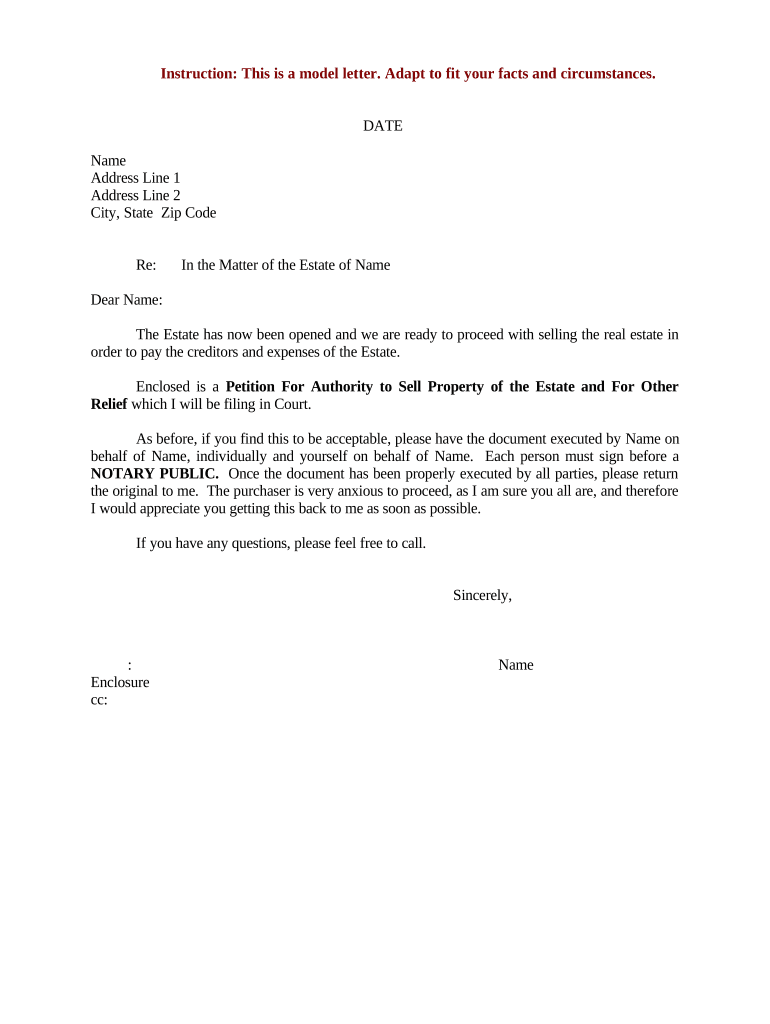
The letter provides clear notice of intent to sell, documents the estate representative's authority, protects the estate from claims based on inadequate notice, and creates a record for probate and closing. It helps coordinate buyers, lienholders, and the probate court while reducing misunderstandings about timelines and required approvals.

Executors, personal representatives, trustees, and estate attorneys commonly prepare the letter to communicate with beneficiaries, buyers, and creditors.
Sending a clear, dated letter reduces the risk of contested sales and helps ensure compliance with probate or court requirements.
Identify the estate, probate case number (if any), and contact information for the executor or trustee so recipients can verify the source.
Provide street address, legal description, parcel or tax ID, and any relevant encumbrances or liens that affect marketable title.
State the executor/trustee name and cite the court order or will provision authorizing sale; attach supporting probate documentation.
Summarize sale price, contingencies, closing date, and required approvals from beneficiaries or the court, if applicable.
List and attach the purchase agreement, deed draft, title report, probate order, and payoff statements for transparency.
Specify deadlines for objections, requests for information, or claims, and explain consequences of failing to respond in time.
| Template Field | Auto-populate estate and property fields from a saved template |
|---|---|
| Signature Placement | Add signature, date, and initial fields for executor and witness |
| Recipient Order | Set role-based signing order for beneficiaries, buyer, and title company |
| Authentication | Require email verification, SMS code, or stronger auth where needed |
| Audit Trail | Enable timestamps and IP capture for each signing event |
Use an eSignature workflow that supports authentication, audit trails, and secure document storage to preserve legal evidentiary value.
Ensure the platform meets ESIGN and UETA standards and supports retention and export formats required by your title company or court.
Specify number of days to lodge objections or claims (commonly 10–30 days)
Provide the proposed closing date using MM/DD/YYYY format
Set a date by which title defects must be cured before closing
State the cutoff date for payoff figures to be accurate at closing
Indicate when the deed will be recorded after closing
| signNow | DocuSign | Adobe Sign | PandaDoc | HelloSign | |
|---|---|---|---|---|---|
| Starting Price | $8/user/mo | $15/user/mo | $14/user/mo | $19/user/mo | $15/user/mo |
| Free Trial | 7-day free trial | Varies by plan | Varies by plan | Varies by plan | Varies by plan |
| Bulk Send | Yes | Yes | Yes | Yes | No |
| Audit Trail | Yes | Yes | Yes | Yes | Yes |
| HIPAA Compliant | Yes | Yes | Yes | No | No |
| Envelope Cap | No cap | 100 envelopes/user/year | Varies | Varies | Varies |
As a small property firm, we process closings online to keep deals moving.
A streamlined interface enabled remote counterparties to sign quickly.
The executor signs to assert authority to sell estate property. Their signature should be accompanied by a citation of the probate order or will provision and a date; this proves chain of authority for title companies and courts.
An estate attorney or closing agent may sign to certify legal review and to facilitate recordation. Their signature and contact details provide an additional verification layer for lenders and title insurers.
Assemble deed, sale letter, and probate order for signing
Ensure ID and authority are available for notary verification
Schedule in-person or RON session per state rules
Add required witnesses per state (0–2 as applicable)
Executor signs deed in notary presence
Notary completes acknowledgments and attests identity
Submit deed and required forms to county recorder
Keep signed originals, notary journal, and delivery receipts