Header and Date
Include full sender and recipient names, organization, and the date at the top so the record is identifiable and time-stamped for scheduling and contract purposes.
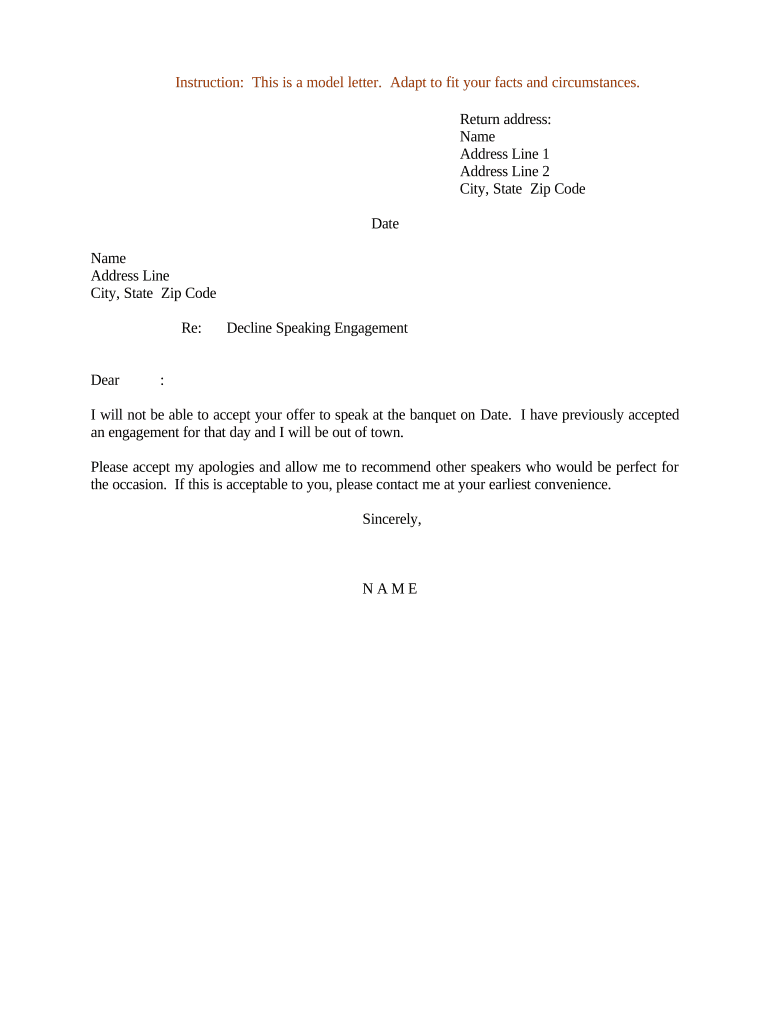
A concise, polite declination preserves professional relationships, clarifies obligations, and protects both parties from miscommunication. It provides written proof of refusal, which can limit follow-up requests, confirm any financial consequences, and help organizers secure replacement speakers efficiently.

Use this letter when a scheduled or requested speaking engagement is declined and a written record is needed by either party.
A clear written declination reduces follow-up work, supports contract management, and helps both sides move forward professionally.
Include full sender and recipient names, organization, and the date at the top so the record is identifiable and time-stamped for scheduling and contract purposes.
Open with a clear statement declining the invitation (for example, 'Thank you for the invitation. I must respectfully decline.') to avoid ambiguity about intent.
Provide a brief reason only if appropriate—avoid sensitive personal details—and keep the explanation factual to maintain a professional tone.
Address honoraria, deposits, travel arrangements, or contractual obligations to confirm whether any fees are forfeited or refundable.
If feasible, suggest alternative speakers, propose rescheduling, or offer a recorded session to preserve goodwill.
End with a typed name, title, contact information, and a handwritten or electronic signature with the date to verify authorship and timing.
Use a platform that preserves the signed record and provides audit details to show intent and attribution.
| Field | Configuration |
|---|---|
| Event Date | MM/DD/YYYY format |
| Recipient Email | Verify and set recipient-only edit |
| Signature Field | Require signer and date |
| Copy to | Add finance/contact email |
Save the signed letter as a PDF for universal compatibility and archival stability; include the audit certificate if available to preserve signing metadata.
Store the signed PDF in a centralized, access-controlled location (company drive or document management) to ensure retrieval by authorized staff.
Keep an encrypted local copy for redundancy and to support offline access in case cloud systems are unavailable.
Send a signed copy to the organizer and to your records mailbox so there is a dated delivery trail for dispute resolution.
Reply within 48–72 hours when possible
Provide 2–4 weeks' notice if you must decline after acceptance
Confirm refund status within 7–14 days
Organizers often need replacement confirmations 2–6 weeks before event
Save the dated letter immediately after sending
An organizer received a late speaker decline with unclear terms and scrambled to find a replacement
A university lecturer declined an invitation due to a schedule conflict and suggested a colleague
The organizer receives the letter, updates program schedules, and manages replacement logistics and financial reconciliations with the finance team.
The speaker or an authorized representative signs and sends the letter; the signer should match any previously negotiated contract or booking agreement to avoid disputes.