Establishing secure connection…Loading editor…Preparing document…

Letter Regarding Appointment of Trustee

This template is fully customizable. Edit the text, fill out the fields, and send it for signature. Give it a try!
Letter Regarding Appointment of Trustee

What a Letter Regarding Appointment of Trustee Is

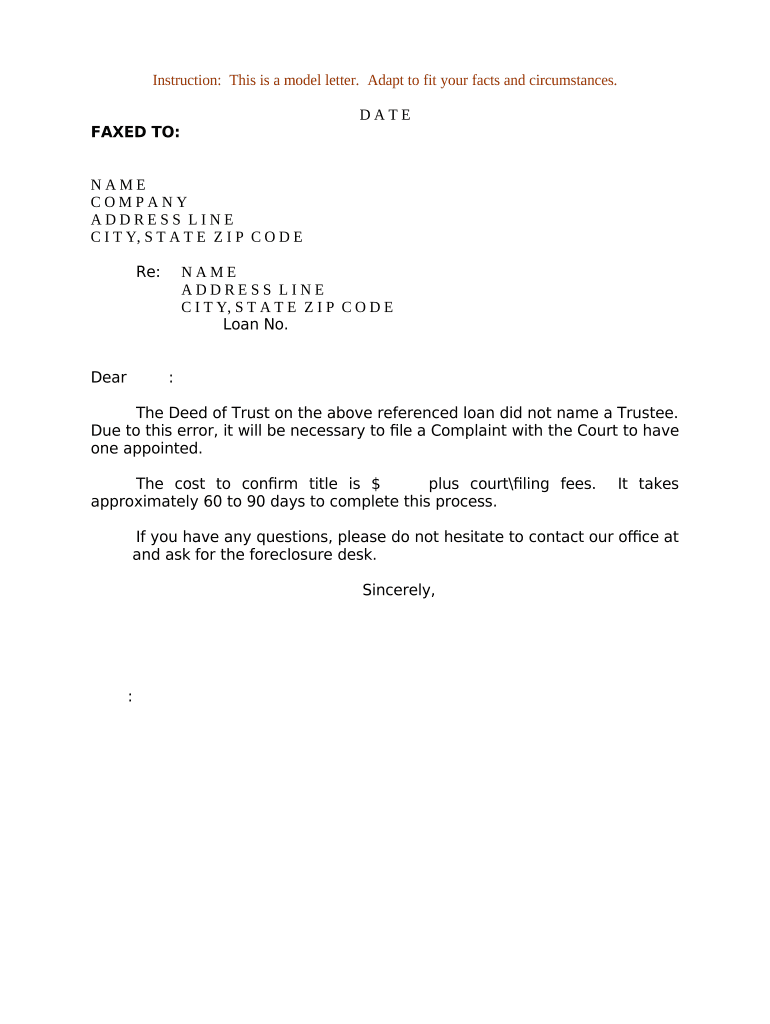
A Letter Regarding Appointment of Trustee is a written notice that formally designates an individual or institution to serve as trustee of a trust or to act as successor trustee. It records the appointee's name, effective date, scope of authority, and any limitations; it often accompanies trust amendments, successor notifications, or court orders. While the letter itself is typically a private document, it creates immediate contractual and fiduciary duties when signed and delivered by the proper parties and may be used to show authority to banks, title companies, and other third parties.

Why a Clear Appointment Letter Matters

A concise appointment letter proves who has authority to manage trust assets, reduces disputes, and speeds access to accounts and property. It clarifies duties, effective date, and contact details for trustees, beneficiaries, and institutions.

Why a Clear Appointment Letter Matters

Who Typically Prepares or Receives This Letter

The letter helps institutions and beneficiaries accept the appointee's authority without requiring immediate court filings in routine successor appointments.

  • Trust Administrators and Attorneys who draft the appointment and confirm authority with institutions.
  • Banks and Title Companies that require written proof before releasing assets or updating account signatories.
  • Beneficiaries and Heirs who need formal notification of the trustee change and contact information.

Who Signs and Why

Settlor / Grantor

When alive and legally competent, the settlor may sign to appoint or confirm a trustee; their signature evidences intent and authority to alter trust administration.

Current Trustee

A continuing trustee signs to delegate or confirm successor appointment; their signature documents the transfer of duties and supports acceptance by third parties.

Essential Elements to Include in the Letter

A professional appointment letter is concise and organized so third parties can verify authority quickly. Include identification, authority scope, effective date, signature blocks, distribution instructions, and any documents attached as proof.

Trust Identification

Full trust name, date of original trust instrument, and any amendment references to link the letter to the governing document.
Appointee Details

Full legal name of the trustee, business affiliation if applicable, mailing and email address, and preferred contact number for institutions.

Scope of Authority

Specific powers granted (investments, distributions, sale of property) and any expressly reserved or limited powers.

Effective Date

Clear MM/DD/YYYY effective date for the trustee's authority and any transitional instructions for ongoing matters.

Attachments and Proof

Attach a copy of the trust signature page, amendment, court order, or power-of-attorney document that supports the appointment.

Signature and Authentication

Signature block for the appointing party and witness/notary space if required; indicate notarization or electronic signing method used.

Step-by-Step: Complete and Issue the Appointment Letter

Follow these steps in order to produce a valid, verifiable appointment letter that third parties can accept without additional delay.

  • 01
    Draft Letter: Prepare the letter with trust ID, appointee name, scope, and effective date.
  • 02
    Attach Supporting Documents: Include trust pages, amendments, or court orders as proof of authority.
  • 03
    Authenticate: Sign, and notarize or e-sign per jurisdictional requirements and recipient policy.
  • 04
    Distribute: Send copies to beneficiaries, banks, title companies, and record-keepers.

How the Appointment Letter Gets Recognized by Institutions

Institutions use a simple verification flow when presented with an appointment letter; prepare materials to match these checkpoints to avoid requests for additional proof.

  • Document Review: Bank or title company confirms trust name and referenced dates against their records.
  • Signer Authentication: Institution checks identity via ID, notary, or electronic authentication method.
  • Authority Confirmation: Third party verifies the scope of trustee powers for requested transactions.
  • Record Update: Once accepted, accounts and title records are updated to reflect trustee authority.

Configuring an Online Workflow to Complete and Send the Letter

When you digitize the process, configure fields, signing order, and authentication to match legal and recipient expectations.

Field Configuration
Signing Order Sequential | Appointing party signs first, then trustee acknowledges
Authentication Email + SMS code | Add KBA for higher assurance where accepted
Conditional Fields Enable conditional fields for successor trustee provisions or alternate contacts
Template Save Save as reusable template for recurring trustee appointments

Digital Signing and File Format Considerations

Ensure the chosen platform preserves a tamper-evident record, supports notarization if needed, and exports a complete audit trail for recipients.

  • Integrations: Salesforce, NetSuite, Microsoft 365, Google Workspace
  • File Formats: PDF, DOCX, locked PDF/A
  • Authentication: Email, SMS, KBA, or advanced signer verification

Timing and Typical Processing Expectations

While no universal statutory deadline exists for issuing an appointment letter, parties should follow timing best practices to avoid delays with asset access.

Effective Date:

Enter MM/DD/YYYY to show when trustee authority begins.

Notify Beneficiaries:

Provide written notice promptly; many jurisdictions expect notification within a reasonable time.

Provide to Financial Institutions:

Send to banks and brokers immediately to update signatory and access rights.

Record with Trustee Files:

Place the signed letter and supporting documents in the trust's official records.

Follow Recipient Processing:

Banks or title companies may take days to weeks to accept and update records.

Key Milestones from Draft to Full Acceptance

A typical multi-step timeline helps track progress from document creation through institution acceptance.

01

Draft and Review

Prepare the letter and confirm details with counsel or trustee.

02

Sign and Authenticate

Complete signatures, notarization, or e-signature authentication as required.

03

Deliver to Institutions

Send certified copies to banks, title companies, and beneficiaries.

04

Acceptance and Update

Institutions verify and update accounts or records to reflect the trustee change.

eSignature Vendor Pricing Snapshot for This Letter

Compare common vendor starting prices and key capabilities relevant when sending trustee appointment letters; signNow appears first per vendor ordering rules.

signNow DocuSign Adobe Sign PandaDoc HelloSign
Starting Price $8/user/mo $15/user/mo $14/user/mo $19/user/mo $15/user/mo
Free Trial 7-day free trial Free trial available Free trial available Free trial available Free trial available
Bulk Send Yes Yes Yes Yes No
Audit Trail Yes Yes Yes Yes Yes
HIPAA Compliant Yes Yes Yes No No
Envelope Cap No envelope cap 100 envelopes/user/year Varies by plan Varies by plan Varies by plan

Penalties and Risks of an Incorrect or Incomplete Letter

Invalid Authority: Appointment may be ignored
Fiduciary Liability: Trustee exposure to breach claims
Tax Consequences: Incorrect reporting and withholding
Transaction Delays: Banks refuse access without proof
Asset Loss Risk: Delayed transfers can harm beneficiaries
Court Intervention: May require probate or court confirmation

Common Mistakes to Avoid When Preparing the Letter

  • Using an informal name instead of the trustee's full legal name causes institutions to reject the letter and request additional ID verification.
  • Missing an effective date or placing a future date when immediate authority is intended creates confusion about when the trustee may act.
  • Failing to attach proof of the trust instrument or amendments leads banks and title companies to require further documentation or a court order.
  • Not verifying recipient policies for e-signatures or notarization causes rejected submissions and can require costly re-execution or in-person steps.

Real-World Examples of Appointment Letters in Use

Below are two real customer scenarios where an appointment letter clarified authority and avoided administrative delays.

Optica Ventures — Trustee Change

The company needed rapid trustee recognition for a property closing

  • The bank required a notarized letter
  • Optica attached the trust amendment and notarized letter, enabling the trustee to close on schedule and avoiding a court petition that would have delayed closing.

Martin Properties — Successor Trustee

A successor trustee was named after the settlor's incapacity

  • Title insurer requested written proof
  • Martin Properties provided the appointment letter, trust excerpt, and notarization, which allowed title updates without further litigation and maintained timely rent collections.

Tips to Ensure the Letter Is Accepted and Effective

Follow these practices to reduce friction with third parties and protect trustee and beneficiary interests.

Use clear trustee identification and authority language
Write unambiguous descriptions of the trustee's powers, include effective dates, and reference the exact trust document to reduce institutional review time and limit disputes over scope.
Include supporting trust pages or amendment excerpts
Attach the relevant pages from the trust instrument or amendment showing signature blocks and authority language so banks and title companies can validate the appointment quickly.
Choose appropriate authentication and notarization
When in doubt, notarize or use remote online notarization with retained audio-video and an auditable record to meet stricter institutional or state requirements.
Keep a complete audit trail for electronic execution
Preserve signed copies, signer emails, IP addresses, timestamps, and any KBA or SMS verification records to demonstrate intent, attribution, and retention under ESIGN and UETA standards.

Security and Compliance Considerations for Electronic Execution

Encryption in Transit: TLS 1.2/1.3
Encryption at Rest: AES-256
Certifications: SOC 2 Type II
Regulatory Compliance: ESIGN and UETA compliant
Healthcare Support: HIPAA compliant (BAA required)
Audit Trail: Tamper-evident logs and timestamps

FAQs About Letters Appointing a Trustee

Answers to common questions about validity, signatures, notarization, and next steps when issuing an appointment letter.


Need help? Contact support

be ready to get more
Join over 28 million airSlate SignNow users