Establishing secure connection…Loading editor…Preparing document…

Warning About Disruptive Guests

This template is fully customizable. Edit the text, fill out the fields, and send it for signature. Give it a try!
Warning About Disruptive Guests

What the Warning About Disruptive Guests Is and When it’s Used

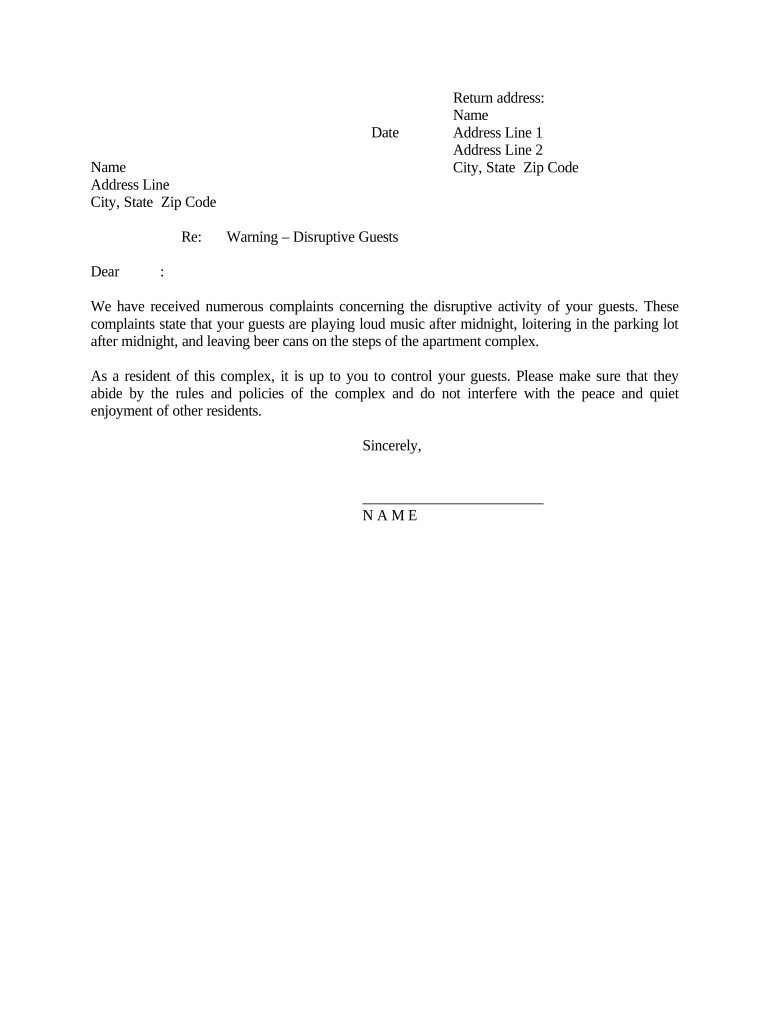
A Warning About Disruptive Guests is a written record issued by a venue, property manager, or event organizer to document and notify a guest of unacceptable conduct and any immediate corrective actions or restrictions. The form captures who, when, and where the incident occurred, specific behaviors observed, witnesses or evidence, and the corrective measure being imposed. It provides an auditable paper or electronic record that supports follow-up enforcement, security escalation, or eviction processes while preserving facts and supporting consistent treatment of similar incidents.

Why a Formal Warning Matters for Safety and Liability Control

A clear written warning documents facts, preserves evidence, reduces disputes, and demonstrates consistent policy enforcement. It helps protect staff and other guests, supports later disciplinary or legal steps, and creates a defensible record of the venue’s response to misconduct.

Why a Formal Warning Matters for Safety and Liability Control

Who Typically Issues or Receives This Warning

Organizations that routinely interact with the public use this form to document incidents and communicate consequences clearly.

  • Venue managers and supervisors who need an official incident record and follow-up documentation.
  • On-site security or event staff responsible for immediate response and reporting.
  • Property managers and landlords documenting tenant or visitor disturbances for enforcement.

Use by these roles helps standardize responses, maintain safety, and support subsequent actions such as bans, trespass notices, or eviction filings.

Core Elements to Include in a Professional Warning

A complete warning balances factual detail, clear action, and evidence so it can be relied upon later by security, management, or legal counsel.

Incident Description

Record a concise, objective account of behavior observed. Include direct quotes only if accurate, avoid opinion language, and note sequence of events to preserve clarity for later review.
Date, Time, Location

Specify the incident date, precise time frame, and exact location within the property or venue so subsequent reviewers can corroborate with shift logs, camera footage, or personnel schedules.

Parties Involved

List the guest’s full legal name, any aliases, staff names, and witness contact details. Accurate identification supports follow-up communications and legal actions.

Evidence and Witnesses

Note witness names and contact information, CCTV or audio capture references, and any physical evidence. Indicate whether recordings are available and where they are stored.

Corrective Action

Describe the immediate action taken (warning issued, escorted out, temporary ban) and any condition for reinstatement or next steps if conduct continues.

Consequences and Appeal

Explain potential penalties (trespass, permanent ban) and whether an internal appeal or review process exists, including timelines for requesting it.

Essential Data Points to Capture

Reporter Name: Full printed name
Guest Name: As shown on ID
Incident Date: MM/DD/YYYY
Incident Time: HH:MM with AM/PM
Witness Contacts: Phone or email
Recorded Evidence: CCTV or audio file ID

Step-by-Step: Completing the Warning Form

Follow these steps to produce a clear, defensible warning that can be used for internal records or formal enforcement.

  • 01
    1. Identify: Enter full legal names and contact details for all parties.
  • 02
    2. Describe: Write an objective, chronological account of observed behavior.
  • 03
    3. Attach Evidence: Link camera clips, photos, and witness statements, noting storage location.
  • 04
    4. Record Action: State the corrective step taken and any follow-up deadlines.

Digital Signing and Technical Considerations

Use secure formats and authenticated signing when issuing warnings electronically to preserve evidentiary value and audit trails.

  • File Formats: PDF or PDF/A preferred
  • Authentication: Email + SMS code commonly used
  • Integrations: Works with common CRMs

Ensure the chosen platform captures timestamp, IP, and signer attribution, stores a tamper-evident copy, and integrates with your records retention system to meet legal and operational needs.

Recommended Digital Workflow Settings

Configure signing workflows to balance ease of use with auditability and secure storage.

Field Configuration
Authentication Email + SMS code
Document Format PDF, PDF/A
Retention Setting Archive 7 years
Notifications Immediate email copies

How Electronic Submission Usually Flows

A typical eSubmission sequence preserves evidence and automates notifications for faster case handling.

  • Prepare: Upload document and attach evidence files.
  • Assign: Place signature and witness fields where required.
  • Sign: Signer authenticates and applies electronic signature.
  • Store: Signed copy plus audit trail stored securely.

Timing Rules and Recommended Deadlines

Timely issuance and retention of the warning improve its usefulness for enforcement and legal review.

Issue Promptly:

Complete and deliver the warning as soon as practical after the incident, ideally within 24 hours.

Response Window:

Allow the guest 24–72 hours to respond or appeal if your policy provides an appeal process.

Evidence Preservation:

Preserve CCTV or recording files immediately; video retention schedules vary by system.

Notarization:

Not typically required for warnings; obtain notarization only if local rules or later legal use require it.

Appeal Deadline:

Set internal appeal timelines (commonly 7–14 days) to avoid indefinite disputes.

Risks and Legal Consequences of Incomplete or Incorrect Warnings

Civil Liability: Unclear records increase liability risk
Evidence Loss: Missing timestamps may invalidate claims
Privacy Violations: Improper sharing can breach privacy laws
Tenant Disputes: Inaccurate facts may lead to challenges
Regulatory Noncompliance: Healthcare venues face HIPAA risk
Enforcement Delay: Late documentation weakens case

Common Mistakes to Avoid

  • Writing subjective judgments instead of factual observations makes the warning less defensible in disputes and hearings.
  • Failing to collect witness contact information or misrecording their details prevents corroboration during later reviews.
  • Delaying issuance until days after the event risks lost evidence such as camera footage or degraded memories.
  • Using unsigned or unsigned electronic records without an audit trail undermines attribution and may weaken legal weight.

Practical Use Cases from the Field

Real-world examples show how organizations document and act on disruptive behavior while preserving records for accountability.

Martin Properties

Martin Properties used online warning forms to document disruptive guest incidents and reduce in-person handling.

  • Faster documentation and compliance.
  • "I can process and execute all of these documents online with 100% compliance and built-in security. Whether on mobile or working offline, I can get forms back to their necessary parties efficiently."

Optica Ventures

A small events operator standardized a single-page warning form for security staff to reduce variability in reports.

  • Improved record consistency across sites.
  • "The interface is simple and easy-to-use for our team; more importantly, it is just as easy for our customers."

Practical Tips for Accurate, Efficient Warnings

Follow these recommendations to make warnings reliable, defensible, and easy to act on.

Use Objective Language
Describe observable facts and direct quotes only; avoid adjectives or conclusions which invite disputes and reduce credibility in later reviews.
Capture Evidence Immediately
Preserve camera clips and photos within hours, record witness contact details promptly, and note where digital files are stored for chain-of-custody.
Standardize the Form
Use a consistent, fillable template with required fields to reduce omissions, speed completion, and support automated reporting.
Protect Privacy
Limit distribution to necessary personnel, redact unnecessary personal data when sharing outside authorized channels, and comply with applicable privacy laws.

Comparing eSignature Vendors for Warning Workflows

Vendor pricing and core capabilities vary; choose a plan that supports audit trails, appropriate authentication, and any necessary compliance add-ons.

signNow DocuSign Adobe Sign PandaDoc HelloSign
Starting Price $8/user/mo $15/user/mo $14/user/mo $19/user/mo $15/user/mo
Free Trial Yes, 7-day free trial Varies Varies Varies Varies
Bulk Send Yes Yes Yes Yes No
Audit Trail Yes Yes Yes Yes Yes
HIPAA Compliant Yes Yes Yes No No

FAQs: Legal Validity, Electronic Signing, and Common Questions

Answers to frequent questions on enforceability, e-signatures, and recordkeeping to help you use the warning form correctly.


Need help? Contact support

be ready to get more
Join over 28 million airSlate SignNow users