Establishing secure connection…Loading editor…Preparing document…

Liquidating Trust

This template is fully customizable. Edit the text, fill out the fields, and send it for signature. Give it a try!
Liquidating Trust

What a Liquidating Trust Is and its primary role

A Liquidating Trust is a legal entity established to receive, manage, and convert the assets of an insolvent or reorganizing entity for orderly distribution to creditors and other beneficiaries. It typically arises under a confirmed bankruptcy plan (commonly Chapter 11) and operates under a trust agreement and court supervision. The trustee administers asset collection, liquidation, claims reconciliation, and distributions according to the plan and trust terms. The vehicle centralizes administration, isolates post-confirmation liabilities, and provides a mechanism to complete post-bankruptcy matters and required tax reporting for distributed proceeds.

Why a Liquidating Trust is used in insolvency workflows

A Liquidating Trust streamlines asset disposition and creditor recovery by centralizing administration, clarifying claims treatment, enabling efficient cash distributions, and providing a durable legal structure for post-confirmation wind-down activities while preserving tax and reporting continuity.

Why a Liquidating Trust is used in insolvency workflows

Who prepares, manages, or benefits from a Liquidating Trust

Parties should consult bankruptcy counsel and the confirmed plan to confirm roles, reporting obligations, and the authority to settle or distribute trust assets.

  • Bankruptcy trustees and post-confirmation trustees who administer assets, pursue claims, and make distributions to beneficiaries under the trust agreement.
  • Debtor management and special servicers who transfer assets and provide required documentation to the trust for liquidation and reporting.
  • Creditors and creditor committees that review the plan, approve trust terms through the bankruptcy process, and receive distributions according to entitlement classes.

Core components found in a professional Liquidating Trust

A robust Liquidating Trust combines legal, administrative, and reporting elements so the trustee can collect assets, resolve claims, liquidate property, and distribute proceeds under court oversight and the confirmed plan.

Trust Agreement

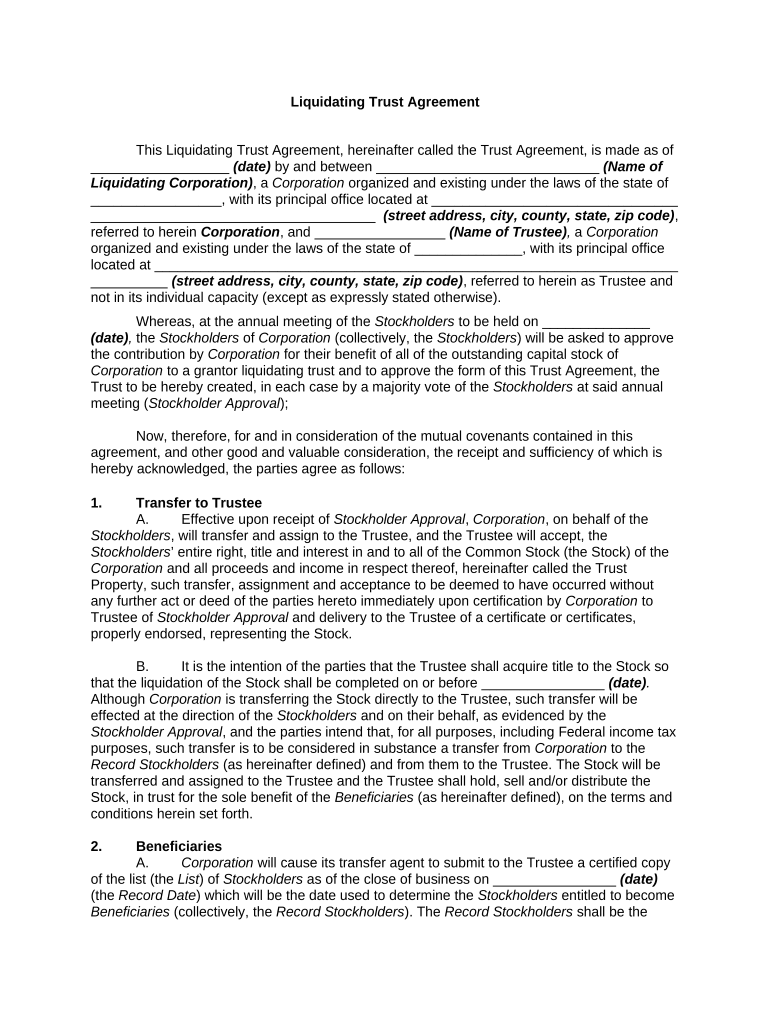
A written agreement defining trust purpose, trustee powers, beneficiary classes, distribution mechanics, and termination conditions; central legal instrument governing administration.
Trustee Powers

Explicit authorities for asset collection, settlement, litigation, tax elections, and contracting to enable practical asset realization and claims resolution.

Asset Schedule

Detailed inventory of transferred assets, encumbrances, valuation basis, and documentation needed for transfer, sale, or liquidation actions.

Claims Procedure

Rules and timelines for allowance, objection, reconciliation, and resolution of claims consistent with the confirmed bankruptcy plan and applicable court orders.

Distribution Waterfall

Priority and mechanics for allocating net proceeds among claimant classes, reserve policies, and procedures for interim and final distributions.

Reporting & Tax

Obligations for tax reporting, informational returns, and beneficiary statements required under tax law and the trust agreement.

Essential information typically required in the Liquidating Trust

Trust Name: Full legal trust name
Trustee: Named trustee or management entity
Beneficiary List: Creditor classes and identifiers
Asset Schedule: Detailed asset descriptions
Court Order: Plan confirmation reference
Tax ID: EIN or tax identifier

Step-by-step: preparing and implementing a Liquidating Trust

Follow these sequential actions to form, fund, and operate a Liquidating Trust consistent with the confirmed plan and court requirements.

  • 01
    Gather Documents: Collect plan, confirmation order, asset schedules.
  • 02
    Draft Trust: Prepare trust agreement and trustee acceptance.
  • 03
    Obtain Court Approval: File required notices and secure confirmation-based funding.
  • 04
    Administer Assets: Collect, liquidate, reconcile claims, distribute proceeds.

Configuring an online workflow for Liquidating Trust documents

When completing trust documents electronically, configure authentication, conditional fields, templates, and audit logging to match legal and court expectations.

Workflow Field Online Setting
Signer Authentication Email plus SMS code
Conditional Fields Reveal after trustee approval
Document Template Upload PDF or DOCX
Audit Trail Enable full audit logging

Where to file, deliver, or submit completed Liquidating Trust documents

Routing depends on the plan and court orders; common destinations include the trustee, the bankruptcy court docket, creditors, and tax authorities.

  • Bankruptcy Court: File notice or application per local rules.
  • Trustee: Provide executed trust, asset schedules, and funding instructions.
  • Creditors: Send beneficiary statements and distribution notices.
  • Tax Authorities: File informational returns and issue 1099s as required.

Digital signing and technical requirements for e-submission

Ensure the chosen solution provides tamper-evident signed PDFs, exportable audit logs, and the ability to retain records in a secure, searchable archive for court or tax review.

  • Supported Formats: PDF and DOCX
  • Integrations: Salesforce, NetSuite, Google Workspace
  • Authentication: Email, SMS, multifactor

Common timing items and typical deadlines to track

Key dates are case-specific. Coordinate the trust effective date and distributions with the bankruptcy schedule, confirmation order, and claims bar dates.

Trust Effective Date:

Date specified in the confirmed plan and trust agreement.

Court Confirmation Date:

Date the court enters the confirmation order.

Claims Bar Date:

Deadline for filing proofs of claim per court order.

Initial Distribution Date:

First scheduled payment to beneficiaries per waterfall.

Final Accounting Deadline:

Date by which final reports and closing occur.

Key milestones in the Liquidating Trust lifecycle

Monitor these sequential milestones to ensure compliant administration from formation through closing and final reporting.

01

Plan Confirmation

Court confirms plan and authorizes trust formation.

02

Trust Funding

Assets transfer to the trust per the plan.

03

Asset Liquidation

Trustee sells or collects assets for conversion to cash.

04

Final Distribution

Net proceeds distributed and trust is wound down.

Common preparation mistakes to avoid

  • Failing to reconcile asset schedules with docketed claims leads to disputes and delayed distributions; ensure cross-checks before funding the trust.
  • Using inconsistent party names or identifiers across documents creates title and payment errors; standardize names to court filings and tax records.
  • Neglecting required court approvals or failing to comply with confirmation conditions can render trust actions voidable or subject to objection.
  • Omitting clear reserve policies for contingent liabilities can cause unexpected shortfalls and post-distribution claims against the trustee or estate.

Key legal and financial risks of incorrect trust documents

Voidable Actions: Court may unwind distributions
Trustee Liability: Potential personal or fiduciary exposure
Tax Penalties: IRC §6721 reporting penalties
Incorrect Payments: Misallocated creditor recoveries
Late Filings: Sanctions or surcharge risk
Record Deficiencies: Objections to final accounting

Real-world examples and vendor experience

Organizations across sizes use e-signature platforms for complex, multi-party legal documents and trust workflows; two illustrative customer perspectives appear below.

Optica Ventures LLC — Brian Fitzgibbons

Enterprise finance teams needed a simple signing workflow for legal documents across stakeholders.

  • Simplicity and usability mattered most.
  • The interface is simple and easy-to-use for our team; more importantly, it is just as easy for our customers.

Xerox — Kodi-Marie Evans

A complex ERP integration required reliable signature capture tied to back-office systems.

  • Integration with core systems reduced manual steps.
  • airSlate SignNow provides us with the flexibility needed to get the right signatures on the right documents, in the right formats, based on our integration with NetSuite.

eSignature solution pricing and feature snapshot relevant to trust workflows

Compare starting price and select technical features that matter for Liquidating Trust administration; signNow appears first per vendor listing rules.

signNow DocuSign Adobe Sign PandaDoc HelloSign
Starting Price $8/user/mo $15/user/mo $14/user/mo $19/user/mo $15/user/mo
Free Trial 7-day free trial Varies by vendor Varies by vendor Varies by vendor Varies by vendor
Bulk Send Yes (Business Premium+) Yes Yes Yes No
Audit Trail Yes Yes Yes Yes Yes
HIPAA Compliant Yes (BAA) Yes Yes No No

Frequently asked questions about Liquidating Trusts and electronic execution

Answers to common practical and legal questions about forming, executing, signing, and administering a Liquidating Trust.


Need help? Contact support

be ready to get more
Join over 28 million airSlate SignNow users