Establishing secure connection…Loading editor…Preparing document…

Louisiana Motion and Order to Appoint Curator

This template is fully customizable. Edit the text, fill out the fields, and send it for signature. Give it a try!
Louisiana Motion and Order to Appoint Curator

What the Louisiana Motion and Order to Appoint Curator Is

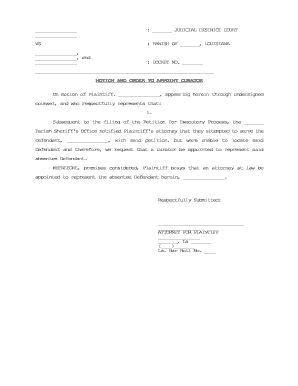
A Louisiana Motion and Order to Appoint Curator is a court filing used when a judge is asked to designate a curator to manage the person or property of an adult who is alleged to lack capacity. The motion sets out facts, medical or evidentiary support, proposed curator identity, and the scope of authority requested. The order is the judicial instrument that, if granted, names the curator, specifies powers, and may require bond or periodic accounting. This filing follows Louisiana civil law procedures and local court rules for guardianship or interdiction proceedings.

Why This Motion Matters and When It’s Appropriate

Filing a Motion and obtaining an Order to Appoint Curator secures court-authorized decision-making for health, financial, or personal matters when capacity is in dispute. It creates a clear legal authority, reduces dispute among family members, and protects the subject’s assets and legal rights under Louisiana civil procedure. The process proceeds under state court rules and is recognized within the U.S. electronic records framework (ESIGN, 15 U.S.C. ch. 96) where e-signature and e-filing are supported.

Why This Motion Matters and When It’s Appropriate

Who Typically Prepares or Files This Motion

The following parties commonly prepare and file a Motion and Order to Appoint Curator in Louisiana courts.

  • Family members or close relatives seeking court supervision and protective orders for an incapacitated adult.
  • Attorneys for petitioners or respondents preparing evidentiary support and proposed curator nominations.
  • Public administrators or social services when no suitable private curator is available and the court must appoint one.

Each filer should confirm local parish court forms, service rules, and required attachments before submitting the motion.

Step-by-Step: Filing a Motion and Order to Appoint Curator

Follow these core steps to prepare and file the motion in parish court.

  • 01
    Draft Motion: State facts, capacity concerns, and relief requested.
  • 02
    Attach Evidence: Include medical reports, affidavits, and records supporting incapacity.
  • 03
    Propose Curator: Name candidate, relationship, qualifications, and proposed powers.
  • 04
    File & Serve: File with court clerk and serve parties per local rules.

Security and Compliance Checklist for Documents and Filings

Encryption: TLS 1.2/1.3 in transit
Data at Rest: AES-256 encrypted storage
Audit Trail: Timestamped signer history
HIPAA: BAA required for PHI
21 CFR Part 11: Supported for regulated records
SOC 2: SOC 2 Type II available

Consequences of an Incorrect or Incomplete Filing

Filing Rejection: Clerk may reject for improper caption or missing fees
Delay in Protection: Delay prolongs lack of court-authorized decision-making
Contempt Risk: Failure to comply with orders may trigger sanctions
Bond Exposure: Court can require curator bond if omitted originally
Accountability: Curator subject to accounting and removal proceedings
Malpractice: Attorney errors may create malpractice liability

Common Preparation Errors to Avoid

  • Failing to attach substantive medical evidence or affidavit of incapacity leads to continuances and repeated filings.
  • Not naming a proposed curator or failing to disclose conflicts of interest can prompt the court to appoint a public curator.
  • Improper service or missing notice to interested parties often results in rehearing or vacated orders.
  • Using vague power descriptions (e.g., 'all powers necessary') creates disputes and unnecessary litigation downstream.

Essential Components of a Professional Motion and Order

A complete filing addresses the who, what, why, and how: clear motion text, supporting evidence, proposed curator details, and a concise proposed order for the judge.

Caption

Court name, case number, and parties formatted per local rules; correct caption ensures proper filing and service.
Statement of Facts

Chronological description of events and observations supporting incapacity, with dates and sources for each factual assertion.

Supporting Affidavits

Affidavits from physicians, social workers, or witnesses that summarize observations and confirm need for curator appointment.

Curator Nomination

Detailed nominee information, resume-style summary of qualifications, and full disclosure of potential conflicts or prior guardianships.

Proposed Order

Draft order that names the curator, specifies powers, bond requirements, accounting intervals, and any limitations or reporting duties.

Service Proof

Certificate of service showing how and when parties, interested persons, and agencies were notified, consistent with parish rules.

Where to File, Serve, and How the Court Processes the Motion

Filing and service steps lead into court review and a hearing; follow parish court procedures and local rules closely.

  • File with Clerk: File motion at parish court clerk’s office or via e-filing system.
  • Serve Interested Parties: Provide copies to relatives, agencies, and known creditors as required.
  • Clerk Schedules Hearing: Court assigns hearing date or issues temporary protections if urgent.
  • Judge Issues Order: After hearing judge signs order appointing curator with specified powers.

Digital Workflow Settings for Completing and Submitting the Form

Configure e-sign and document routing to match court filing, service, and retention requirements.

Field Configuration
Upload format PDF/A preferred for court submission
Signer order Petitioner then proposed curator then attorney
Authentication Email + SMS or ID verification for key signers
Retention setting Long-term archive with tamper-evident audit trail

Distribution and eSubmission Options for the Motion

Choose distribution channels that satisfy court e-filing, service, and evidence preservation requirements.

  • E-filing Systems: Use the court’s accepted PDF and signing formats
  • Email Service: Certified email for parties when authorized by local rule
  • Registered Integrations: Connectors to case-management systems and cloud storage

Confirm acceptable submission methods with the parish clerk and ensure any electronic signature method meets evidentiary and retention rules.

Typical Timelines and Scheduling Expectations

Timelines vary by parish and case complexity; below are common scheduling benchmarks to expect after filing.

Initial Filing to Hearing:

Often scheduled within 7–30 days, depending on clerk availability and urgency.

Temporary Orders:

Judge may grant immediate temporary protections in emergency circumstances.

Service Deadlines:

Service generally required before hearing; timelines set by local rules.

Post-Order Accounting:

Curator may be required to file inventories or accountings within 30–90 days.

Appeal Window:

Parties typically have a limited period after the order to seek appellate review.

Key Milestones from Filing to Curator Oversight

A sequential view of core milestones helps track obligations from petition to ongoing oversight.

01

Prepare and File

Assemble motion, exhibits, and proposed order for clerk submission.

02

Service and Notice

Serve required parties and any relevant agencies per local rule.

03

Court Hearing

Judge evaluates evidence, hears objections, and decides on appointment.

04

Curator Duties Begin

Curator takes control under court order, posts bond if required, and starts reporting.

Practical Examples of Curator Appointment Scenarios

Two brief scenarios illustrate how a well-prepared motion and order function in practice.

Case Study 1

Elderly homeowner showing progressive dementia seeks protection for assets and bills

  • Motion attached physician affidavit
  • The court appointed a family member as curator with limited power to pay bills and maintain the property, requiring quarterly accountings to the court and bond to protect creditors.

Case Study 2

Adult with serious injury lacks capacity and has no close relatives available

  • Emergency motion requested immediate temporary curator
  • The court named a public curator temporarily, ordered medical evaluations, and scheduled a full hearing within three weeks to consider a permanent appointment.

Practical Tips for Accurate and Efficient Completion

Adopt standard practices to reduce rejection risk and speed court review.

Complete Exhibits
Attach all supporting medical, financial, and witness affidavits at filing to avoid continuances and comply with evidentiary expectations.
Clear Power Descriptions
Define curator powers with specificity—avoid blanket authority language to reduce disputes and limit post-appointment litigation.
Use Local Forms
Where the parish provides a template or mandatory form, use it exactly to comply with clerk formatting and acceptance rules.
Preserve Audit Trail
When using electronic signatures or e-filing, maintain a tamper-evident audit trail and retain original signed copies per retention rules.

eSignature Solution Pricing and Feature Comparison

Compare common eSignature vendors and core pricing/features when choosing a solution to complete and route filings electronically.

signNow DocuSign Adobe Sign PandaDoc HelloSign
Starting Price $8/user/mo $15/user/mo $14/user/mo $19/user/mo $15/user/mo
Free Trial 7-day free trial Varies Varies Varies Varies
Bulk Send Yes Yes Yes Yes Varies
Audit Trail Yes Yes Yes Yes Yes
HIPAA Compliant Yes Yes Yes No No

Frequently Asked Questions and Troubleshooting

Answers to common procedural, filing, and e-sign questions about the Motion and Order to Appoint Curator.


Need help? Contact support

be ready to get more
Join over 28 million airSlate SignNow users