Establishing secure connection…Loading editor…Preparing document…

Miller Trust

This template is fully customizable. Edit the text, fill out the fields, and send it for signature. Give it a try!
Miller Trust

What a Miller Trust Is and when it’s used

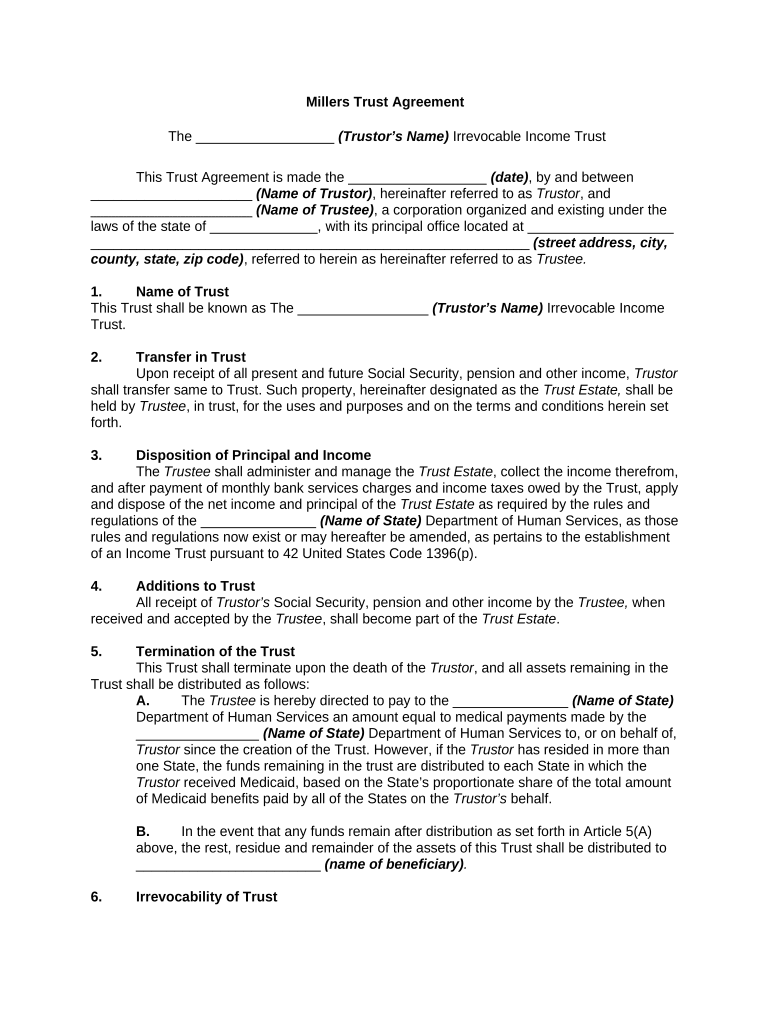
A Miller Trust, also called a Qualified Income Trust (QIT), is a court‑approved irrevocable trust used to hold a Medicaid applicant’s excess income so the individual can meet a state's income eligibility threshold for long‑term care benefits. Funds deposited into the trust are used to pay allowable expenses such as nursing facility costs and authorized administrative fees. States authorize Miller Trusts to comply with Medicaid income rules; specific drafting and funding rules vary by state and typically require trustee instructions, funding language, and a named payee for facility costs.

Why a Miller Trust matters for Medicaid eligibility

A Miller Trust lets an otherwise ineligible applicant meet Medicaid income limits by diverting excess income into a restricted trust for care costs. It preserves access to Medicaid‑covered long‑term care while protecting limited resources for the beneficiary.

Why a Miller Trust matters for Medicaid eligibility

Who typically prepares, manages, or signs a Miller Trust

Typical participants include the Medicaid applicant (beneficiary), an appointed trustee, the applicant’s attorney, and the nursing facility or payee that receives trust distributions.

  • Elder‑law attorneys and guardians: Draft and file the trust, advise on state rules and funding.
  • Family members as trustees: Manage deposits and payments when named as trustee; must follow trust restrictions.
  • Medicaid case workers and facility billing: Verify funding and accept payments from the trust for allowable charges.

Roles and responsibilities must be documented in the trust; mismatches between trustee actions and statutory rules can jeopardize benefits or trigger estate recovery.

Essential components of a compliant Miller Trust

A properly drafted Miller Trust contains defined trustee powers, mandatory funding instructions, restricted distribution rules, and end‑of‑life disposition terms. Each element must align with the state Medicaid agency’s requirements.

Trust Name

Formal name and designation as a Qualified Income Trust; identifies beneficiary and distinguishes from other family trusts with precise trust instrument language.
Beneficiary ID

Full beneficiary name, date of birth, and relevant ID (e.g., Medicaid number or SSN) to ensure payments and eligibility tracking by the Medicaid agency.

Trustee Powers

Specific trustee authorities and limits: ability to receive income, pay facility charges, maintain records, and handle routine bank transactions under Medicaid constraints.

Funding Instructions

Clear direction that all excess income is deposited into the trust and when deposits are due (monthly, upon receipt of income, or as state rule requires).

Distribution Limits

Language restricting use of funds to allowable medical/care costs, authorized administrative fees, and Medicaid‑required payee procedures; prohibits impermissible gifts.

Termination Terms

Procedure for closing the trust, paying outstanding obligations, and forwarding remaining assets to estate for Medicaid estate recovery where required.

Information commonly required within the Miller Trust

Beneficiary Name: Full legal name required
Beneficiary ID: SSN or Medicaid ID
Trustee Contact: Name, address, phone
Trust Bank Account: Account details for deposits
Funding Schedule: Monthly or per income receipt
Authorized Payee: Facility or billing agent

Key risks and legal consequences of errors

Medicaid Denial: Incorrect trust language can cause application denial
Estate Recovery: Remaining funds may be reclaimed under state law
Inadvertent Gift: Improper distributions can trigger penalties
Timing Errors: Late funding can disqualify eligibility
Trustee Misconduct: Mismanagement may cause removal or liability
Tax Issues: Income reporting mistakes can produce IRS consequences

How to prepare and file a Miller Trust — step‑by‑step

Follow a consistent sequence: draft the trust, name a trustee, fund the trust, submit to Medicaid, and follow reporting requirements.

  • 01
    Draft Trust: Use state‑specific model language or attorney drafting.
  • 02
    Name Trustee: Appoint a responsible, traceable fiduciary.
  • 03
    Fund Trust: Deposit excess income per state schedule.
  • 04
    File with Medicaid: Submit trust and proof of funding with application.

Typical administrative flow for a Miller Trust

A Miller Trust workflow moves funds from income sources to the trust, then from trust to authorized payees, with records sent to the Medicaid reviewer and the facility for billing reconciliation.

  • Income Receipt: Beneficiary receives income subject to diversion.
  • Deposit to Trust: Trustee deposits income into trust account.
  • Pay Facility: Trust pays allowable charges to the facility.
  • Report to Medicaid: Provide bank statements and deposits to case worker.

How to configure a digital workflow for the Miller Trust

Set up a consistent e‑workflow: prepare the document template, add required fields, set authentication, and define routing to trustee, attorney, and Medicaid reviewer.

Field Configuration
Template Use a vetted, state‑specific trust template
Authentication Email + optional SMS or ID verification
Routing Sequential: trustee → attorney → facility
Storage Secure, immutable PDF with audit trail

Digital signing and storage considerations

Use a signing platform that supports ESIGN/UETA compliance, secure storage, and audit logs to preserve signature attribution and document history.

  • Authentication: Email, SMS code, or stronger KBA
  • Recordkeeping: Tamper‑evident PDF and audit trail
  • Integrations: Connect to case management or billing systems

Ensure the chosen platform can provide a BAA for any PHI, supports export to PDF/A for long‑term retention, and integrates with document repositories used by the facility or attorney.

Key timing requirements and typical deadlines

Timely drafting, funding, and submission are essential; specific deadlines depend on the Medicaid application date and state processing rules.

Trust Execution Date:

Sign and date before or concurrent with Medicaid application.

Initial Funding:

Deposit excess income per state schedule, often monthly.

File with Medicaid:

Submit trust instrument with the Medicaid long‑term care application.

Annual Reporting:

Provide periodic account statements to Medicaid as requested.

Notarization When Required:

Complete notarization per state law before filing if applicable.

Milestones from drafting to approval

A typical sequence tracks drafting, execution, funding, submission, and approval — monitor each stage to prevent gaps that could affect eligibility.

01

Drafting

Attorney prepares state‑specific trust language.

02

Execution

Parties sign, and notary signs if required.

03

Funding

Trustee deposits excess income into trust account.

04

Medicaid Review

Agency reviews trust and funding for eligibility.

Practical tips for accurate, efficient Miller Trust completion

Follow standard drafting, funding, and documentation habits to reduce processing delays and eligibility risk.

Use state model language when available
Adopt template language from the state Medicaid agency or trusted legal source to reduce drafting errors and speed approval; modify only to meet specific case facts.
Maintain a dedicated trust bank account
Avoid commingling by keeping trust receipts and disbursements in a separate account; document deposits immediately and retain monthly statements for Medicaid review.
Document every deposit and payment
Retain pay stubs, deposit receipts, and payment records showing funds moved into trust and payments to providers; these documents are commonly requested during eligibility review.
Work with experienced counsel
Consult an elder‑law attorney for initial drafting and complex cases; errors discovered later can be costly and may require court corrections.

Practical examples of how Miller Trusts are used

Illustrative scenarios show common use patterns for Miller Trusts—these examples are educational, not legal advice.

Elder‑Law Clinic

An elderly applicant has monthly pension income above the Medicaid cap

  • Clinic drafts a Miller Trust and names a family member trustee
  • After monthly deposits to the trust and submission to Medicaid, long‑term care coverage was approved while payments were made from the trust to the facility.

Facility Billing Coordination

A nursing facility requests trust documentation to bill correctly

  • Facility and trustee exchange monthly statements and invoicing details
  • Regular reporting and reconciled payments prevented billing disputes and supported ongoing Medicaid eligibility.

eSignature platform comparison for signing and storing the Miller Trust

Select an eSignature vendor that supports legal authentication, secure storage, and any regulatory needs such as HIPAA. Table lists common plan features and starting price points.

signNow DocuSign Adobe Sign PandaDoc HelloSign
Starting Price $8/user/mo $15/user/mo $14/user/mo $19/user/mo $15/user/mo
Free Trial Yes, 7-day trial Varies by plan Varies by plan Varies by plan Varies by plan
Bulk Send Yes Yes Yes Yes No
Audit Trail Yes Yes Yes Yes Yes
HIPAA Compliant Yes Yes Yes No No
Envelope Cap No cap 100 envelopes/user/year Varies by plan Varies by plan Varies by plan

Frequently asked questions about Miller Trusts

Answers to common practical and legal questions about drafting, signing, funding, and maintaining a Miller Trust.


Need help? Contact support

be ready to get more
Join over 28 million airSlate SignNow users