Establishing secure connection…Loading editor…Preparing document…

Motion to Consolidate

This template is fully customizable. Edit the text, fill out the fields, and send it for signature. Give it a try!
Motion to Consolidate

What a Motion to Consolidate Is and When It Applies

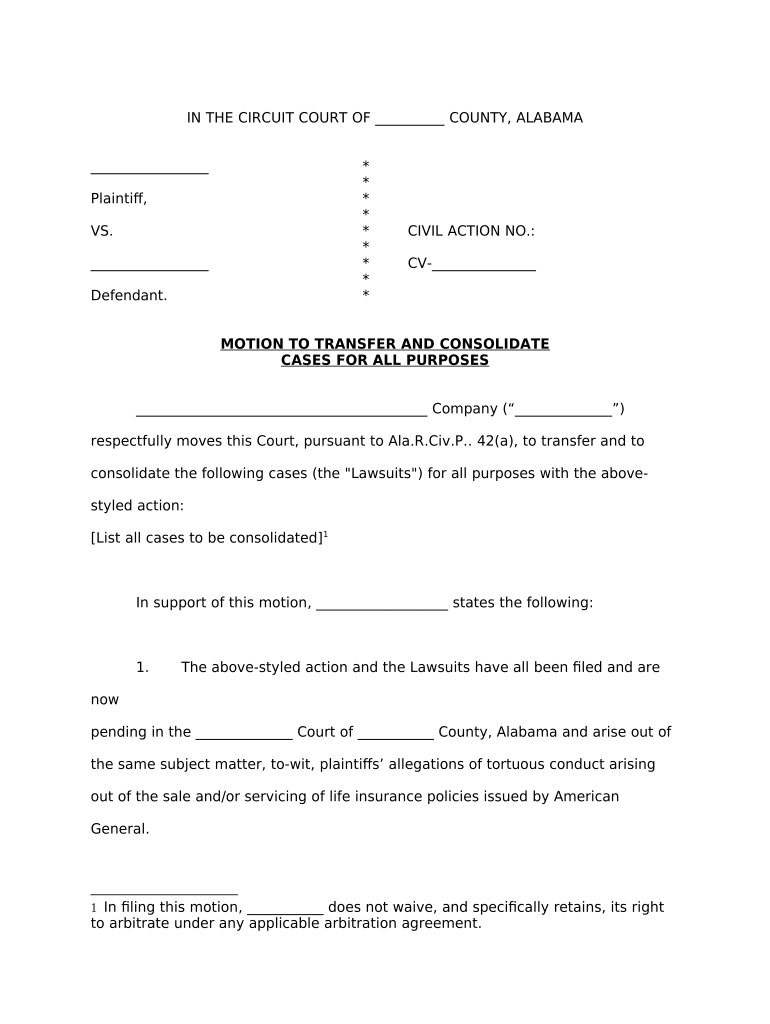
A Motion to Consolidate is a formal court filing requesting that two or more related cases be combined for pretrial proceedings or trial when they share common questions of law or fact. Parties typically file the motion in the court that has jurisdiction over the matters and must follow local rules for service, notice, and timing. Consolidation aims to reduce duplicative discovery, avoid inconsistent rulings, and efficiently allocate judicial resources, but judges exercise discretion and may deny consolidation if it would prejudice a party or impair case management.

Why Parties Seek Consolidation

Consolidation can lower litigation costs, reduce duplicative discovery, and minimize the risk of conflicting rulings. It enables coordinated scheduling and efficient use of judicial resources, though courts weigh convenience against potential prejudice to parties when deciding whether to grant the motion.

Why Parties Seek Consolidation

Who Typically Files a Motion to Consolidate

Use by plaintiffs, defendants, and their counsel when separate matters present overlapping legal or factual questions requiring coordinated resolution.

  • Civil litigants and counsel seeking efficiency in multi-district or related suits
  • Class action defendants or lead plaintiffs coordinating multiple individual claims
  • Courts, mediators, and case managers addressing scheduling and resource allocation

Essential Components to Include in the Motion to Consolidate

Core elements that a Motion to Consolidate should include to explain common issues, show efficiency gains, and satisfy procedural requirements.

Caption

State the full court caption for each matter, including court name and division, so the clerk can locate and link the dockets without clerical error.
Case Numbers

List every docket number and file identifier exactly as on the court record to allow electronic linking and prevent misfiling or administrative rejection.

Parties

Identify plaintiffs and defendants for each case and list counsel with contact information; clear identification prevents service disputes and clarifies who may object.

Legal Standard

Cite the applicable procedural rule or statute permitting consolidation (for example, Federal Rule of Civil Procedure 42(a) in federal court) and summarize the test the court applies.

Grounds

Explain specific factual and legal overlaps supporting consolidation such as common witnesses, identical legal issues, or duplicative discovery with concrete examples.

Proposed Order

Attach a proposed order specifying how dockets will be combined and how filings, discovery, and schedules will be managed after consolidation.

Step-by-Step: Prepare, File, and Serve the Motion

Sequential steps to prepare, file, and serve a Motion to Consolidate in a U.S. civil court.

  • 01
    Draft Motion: Assemble caption, grounds, and proposed order.
  • 02
    Check Local Rules: Confirm filing deadlines, notice periods, and formatting.
  • 03
    File: Submit via court e-filing portal or clerk's office.
  • 04
    Serve Parties: Provide service per rule and file proof of service.

Configuring an Online Template for Motion to Consolidate

Configure an online template to generate consistent Motions to Consolidate and automate signer routing, attachments, and filing metadata.

Field Configuration
Template Use reusable template with caption and signature fields
Signers Lead counsel, opposing counsel, court clerk if required
Authentication Email or SMS code; consider 2FA for sensitive filings
Attachments Attach pleadings, indexes, and proposed order in PDF
Submit Method E-file through court portal or print and deliver

Where to File and Who Receives the Motion

Routing and filing pathways for a Motion to Consolidate and typical recipients of the final document.

  • File to Court: Upload via e-filing system or deliver to clerk.
  • Serve Opposing: Serve counsel and parties per local rule.
  • Notify Court: Request hearing date and submit proposed order.
  • Record Entry: Clerk links dockets and updates case management.

Technical Considerations for Electronic Submission

Use these technical guidelines when preparing an electronic Motion to Consolidate for e-filing or electronic service.

  • PDF Format: Use PDF/A or court-accepted PDF.
  • Signatures: Audit trail plus printed name required.
  • Integrations: Supports court portals and cloud storage.

Common Deadlines and Timing to Expect

Timing for filing and serving a Motion to Consolidate depends on local rules; below are commonly enforced deadlines to expect.

Notice Period:

Often 14–21 days before hearing per local rule

Opposition Deadline:

Commonly 7–14 days after service; check rules

Proposed Order Submission:

Submit with motion or per court instruction

Hearing Scheduling:

Court assigns date; may require calendar call

Effective Consolidation Date:

Set in court order, may be retroactive

Milestones from Drafting to Final Ruling

Key milestones from drafting through final consolidation are often sequential; track these stages to meet service and hearing requirements.

01

Draft and Review

Prepare motion and gather supporting pleadings and exhibits.

02

Filing and Payment

File with clerk or e-file and pay applicable fees.

03

Service and Proof

Serve all parties and file proof of service promptly.

04

Hearing and Ruling

Attend hearing; court issues consolidation order or denial.

Consequences of an Incorrect or Defective Motion

Denial of Motion: Consolidation request rejected
Sanctions Risk: Unnecessary filings may prompt sanctions
Jurisdictional Defect: Improper venue can void consolidation
Waiver of Arguments: Late filing can forfeit claims
Scheduling Delays: Merged docket can lengthen individual timetables
Increased Complexity: Consolidation may combine divergent issues

Common Mistakes to Avoid When Preparing the Motion

  • Failing to serve every affected party before filing often leads to denial or the need to re-serve, causing wasted time and additional costs.
  • Submitting a motion with generalized similarity claims without concrete factual linkage usually fails because judges require specific, demonstrable overlap between matters.
  • Not attaching a clear proposed consolidation order forces clerks to prepare one and may delay judicial consideration or invite procedural rejection.
  • Assuming another forum's rules apply risks missing timing, formatting, or service requirements unique to the court where consolidation is sought.

Key Security and Compliance Considerations for Electronic Filings

Encryption: TLS 1.2/1.3 in transit
Data at Rest: AES-256 encrypted storage
Certifications: SOC 2 Type II; ISO 27001
Regulatory: ESIGN, UETA compliant
Healthcare: HIPAA compliant with BAA
Audit Trail: Detailed timestamp and IP logs

Who Typically Signs and Submits the Motion

Litigation Attorney

A litigation attorney prepares and files Motions to Consolidate to reduce redundancy, coordinate discovery, and protect client interests. They evaluate factual overlap, draft supporting affidavits, and ensure compliance with local procedural rules and service requirements.

Court Clerk

A court clerk processes consolidation filings, checks caption accuracy, assigns dockets, and enforces format and fee requirements. Clerks also assist with e-filing procedures and may return defective submissions for correction.

eSignature Vendor Pricing and Capability Comparison for Filing Documents

A concise vendor price and capability comparison for electronic signing when preparing and executing a Motion to Consolidate.

signNow DocuSign Adobe Sign PandaDoc HelloSign
Starting Price $8/user/mo $15/user/mo $14/user/mo $19/user/mo $15/user/mo
Free Trial 7-day trial Varies Varies Varies Varies
Bulk Send Yes Yes Yes Yes No
Audit Trail Yes Yes Yes Yes Yes
HIPAA Compliant Yes Yes Yes No No

Frequently Asked Questions About Motions to Consolidate

Answers to frequent questions about preparing, filing, and electronically submitting a Motion to Consolidate in U.S. courts.


Need help? Contact support

be ready to get more
Join over 28 million airSlate SignNow users