Establishing secure connection…Loading editor…Preparing document…

Motion to Intervene Mississippi

This template is fully customizable. Edit the text, fill out the fields, and send it for signature. Give it a try!
Motion to Intervene Mississippi

What the Motion to Intervene Mississippi Is and When It Applies

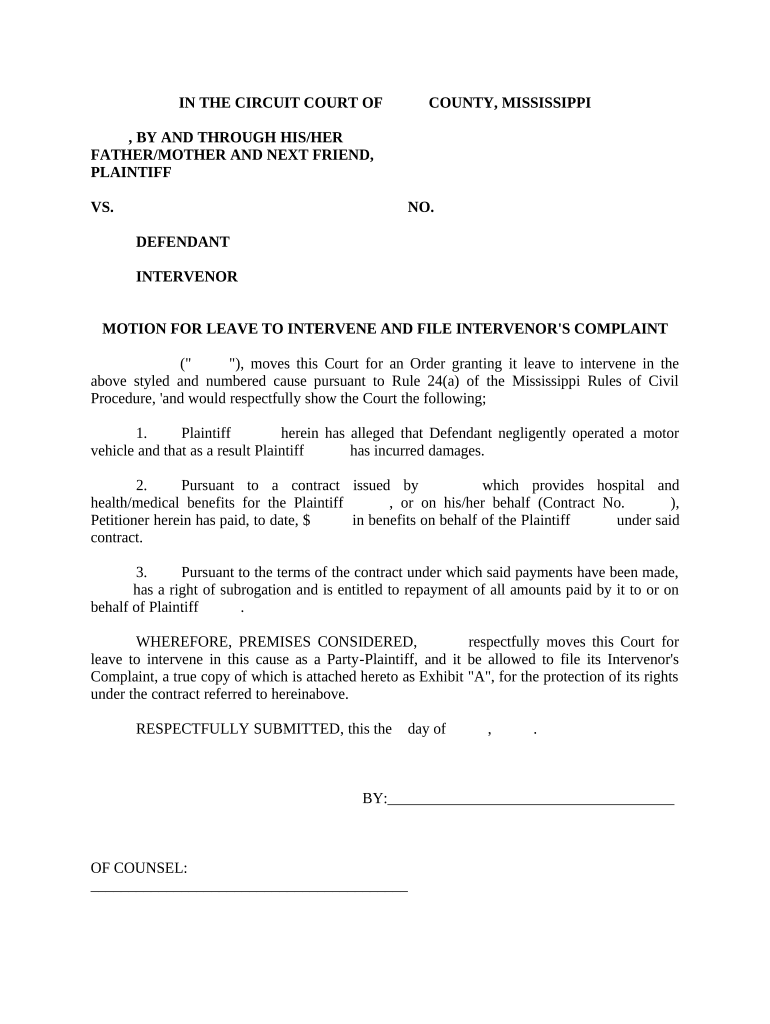
A Motion to Intervene Mississippi is a formal petition filed in a Mississippi state or federal court asking permission for a non-party to join ongoing litigation because that person or entity has a legal interest that could be impaired by the lawsuit's outcome. Typical grounds include protecting a contractual or property interest, preserving regulatory or statutory rights, or defending governmental or public interests. The motion frames the intervenor's identity, legal interest, factual basis, and proposed relief and asks the court for either intervention as of right or permissive intervention under applicable procedural rules.

Why Filing a Motion to Intervene May Be Important

Intervention lets affected parties protect their legal rights, ensure their evidence and arguments are heard, and avoid adverse collateral consequences if they remain outside the case.

Why Filing a Motion to Intervene May Be Important

Who Typically Seeks Intervention and How they Participate

Parties should evaluate standing, timeliness, and whether intervention will meaningfully protect their interests before filing a motion.

  • Private businesses with contractual or property interests at stake in the litigation.
  • Government agencies or regulators asserting statutory or public-law interests.
  • Nonprofit or advocacy groups seeking to protect public or environmental interests.

Representative Roles That File or Sign Motions

Agency Counsel

A government attorney or in-house counsel who represents a public agency filing to protect regulatory interests; typically provides statutory authority and an officer affidavit showing the agency's interest and authorization to intervene.

Corporate Representative

In-house counsel or an outside litigation attorney who files on behalf of a private company with contractual or property rights at risk; usually attaches corporate resolution or power of attorney to demonstrate signing authority.

Essential filing data and authentication details

Case Caption: Court name, docket number
Intervenor Identity: Full legal name, entity type
Legal Basis: Statutory or rule citation
Facts Summary: Concise factual support
Relief Requested: Specific orders sought
Certificate of Service: Proof of notice to parties

Consequences of Filing an Insufficient or Untimely Motion

Denial of Motion: Court refuses intervention
Sanctions: Monetary sanctions possible
Fee Shifting: Liability for opposing counsel fees
Waiver Risks: Loss of rights if delayed
Evidentiary Limits: Restricted participation in certain issues
Collateral Preclusion: Adverse preclusion effects

Common Preparation Challenges to Avoid

  • Late filing or failure to explain timeliness often leads to denial or limited participation.
  • Insufficient demonstration of a direct, protectable legal interest weakens the motion's legal basis.
  • Inadequate service or failure to attach a proper certificate of service can void the filing under local rules.
  • Overly broad proposed relief without factual support increases the chance the court will limit intervention.

Step-by-Step: Completing a Motion to Intervene in Mississippi

Follow these core steps to assemble and submit a compliant motion to intervene in Mississippi state or federal court.

  • 01
    Identify Interest: Document the specific legal or factual interest at risk.
  • 02
    Draft Motion: State grounds, facts, and relief sought clearly and concisely.
  • 03
    Attach Evidence: Include declarations, contracts, or statutory references.
  • 04
    Serve Parties: File with clerk and serve all existing parties per rules.

Filing Flow: From Draft to Court Action

The typical filing flow shows preparatory steps, filing, service, and potential court response.

  • Prepare Motion: Draft motion and gather supporting exhibits.
  • File with Court: Submit to clerk per local procedures.
  • Serve Parties: Deliver copies to all counsel and pro se parties.
  • Court Response: Oppositions, replies, and hearing may follow.

How to Configure an Online Motion Package

Configure an electronic filing packet to include the motion, supporting exhibits, and a service certificate for efficient e-filing.

Document Type Motion to Intervene | PDF
Exhibit Handling Attach as separate, bookmarked PDFs
Signature Block Attorney name, bar number, signature field
Certificate of Service Auto-generate with service method and date
Filing Method e-File or clerk drop-off per court

Digital Filing and eSignature Considerations

Ensure your chosen eSignature provider supports ESIGN and UETA compliance, audit trails, and court-acceptable PDF output.

  • File Formats: PDF, DOCX supported
  • Authentication: Email, SMS, or stronger options
  • Integrations: Salesforce, NetSuite, Google Workspace

Timing and Deadlines to Watch for When Seeking Intervention

Timeliness is central: file early enough to protect interests and before critical pretrial deadlines. Local rules set additional filing and response timelines.

Filing Window:

Before judgment or significant proceedings

Response Time:

Opposition deadlines per local rule

Hearing Schedule:

Court may set expedited hearing

Service Period:

Serve parties at time of filing

Local Rule Check:

Confirm county or district-specific deadlines

Practical Tips for a Clear, Court-Ready Motion

Follow these drafting and procedural practices to reduce risk of denial or procedural setbacks.

Be Concise and Specific
Limit the motion to necessary facts, cite the precise legal basis, and avoid broad or speculative claims that the court may reject.
Attach Supporting Evidence
Include declarations, contracts, or records as exhibits with exhibit tabs and a clear exhibit index to aid the court's review.
Confirm Timeliness
Explain why the motion is timely and identify any pretrial or dispositive deadlines affected by intervention.
Check Local Rules
Review county or district local rules for formatting, page limits, e-filing requirements, and certificate of service specifics.

Comparing eSignature and eFiling Options for Motion Documents

When preparing filings and signature workflows, consider vendor pricing and core features such as starting price, free trial availability, bulk send capability, and HIPAA support.

signNow DocuSign Adobe Sign PandaDoc HelloSign
Starting Price $8/user/mo $15/user/mo $14/user/mo $19/user/mo $15/user/mo
Free Trial 7-day free trial Varies Varies Varies Varies
Bulk Send Yes Yes Yes Yes No
Audit Trail Yes Yes Yes Yes Yes
HIPAA Compliant Yes Yes Yes No No

Practical Intervention Scenarios and How Filings Differ

Two representative scenarios show how a Motion to Intervene is tailored to distinct interests and evidence.

Environmental Group Intervention

A nonprofit seeks to protect water quality rules based on permit challenges and local impacts.

  • The motion focuses on statutory and procedural rights to participate.
  • The filing includes an organizational declaration, local impact exhibits, and a narrowly tailored proposed intervenor complaint to preserve party standing without disrupting core claims.

Contract Holder Intervention

A private company with a contract affecting litigation outcomes files to protect commercial rights.

  • The motion highlights contractual language and risk of impairment if excluded.
  • The packet attaches the contract, sworn declaration of interest, and a concise explanation of relief needed to prevent irreparable harm.

Frequently Asked Questions About Motions to Intervene in Mississippi

Answers to common procedural and practical questions about preparing, filing, and serving a Motion to Intervene in Mississippi.


Need help? Contact support

be ready to get more
Join over 28 million airSlate SignNow users