Establishing secure connection… Loading editor… Preparing document…
Navigation

Fill and Sign the Motion Parte Form

Fill and Sign the Motion Parte Form

How it works

Open the document and fill out all its fields.
Apply your legally-binding eSignature.
Save and invite other recipients to sign it.

Rate template

4.5
51 votes
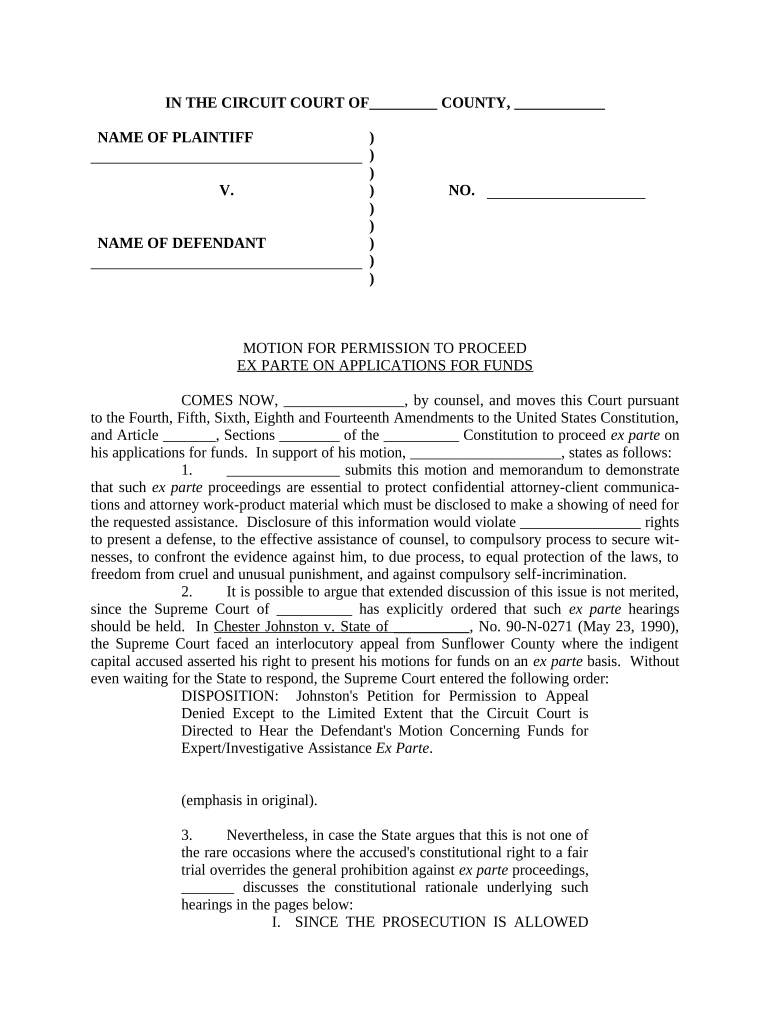
IN THE CIRCUIT COURT OF_________ COUNTY, ____________ NAME OF PLAINTIFF )       ) ) V. ) NO. ) ) NAME OF DEFENDANT )       ) ) MOTION FOR PERMISSION TO PROCEED EX PARTE ON APPLICATIONS FOR FUNDS COMES NOW, ________________, by counsel, and moves this Court pursuant to the Fourth, Fifth, Sixth, Eighth and Fourteenth Amendments to the United States Constitution, and Article _______, Sections ________ of the __________ Constitution to proceed ex parte on his applications for funds. In support of his motion, ____________________, states as follows: 1. _______________ submits this motion and memorandum to demon strate that such ex parte proceedings are essential to protect confi den tial attor ney-client commu nica - tions and attor ney work-product material which must be disclosed to make a showing of need for the re quested assistance. Disclo sure of this infor ma tion would violate ________________ rights to present a de fense, to the effective assis tance of counsel, to compul sory process to secure wit - nesses, to con front the evidence against him, to due process, to equal protection of the laws, to freedom from cruel and unusu al pun ishment, and against compulso ry self - incrimina tion. 2. It is possible to argue that extended discussion of this issue is not merited, since the Supreme Court of __________ has explicitly ordered that such ex parte hearings should be held. In Chester Johnston v. State of __________ , No. 90-N-0271 (May 23, 1990), the Supreme Court faced an interlocutory appeal from Sunflower County where the indigent capital accused asserted his right to present his motions for funds on an ex parte basis. Without even waiting for the State to respond, the Supreme Court entered the following order: DISPOSITION: Johnston's Petition for Permis sion to Appeal Denied Except to the Limited Extent that the Circuit Court is Directed to Hear the Defendant's Motion Concerning Funds for Expert/Investigative Assistance Ex Parte . (emphasis in original). 3. Nevertheless, in case the State argues that this is not one of the rare occasions where the accused's constitutional right to a fair trial overrides the general prohibition against ex parte proceedings, _______ discusses the constitutional rationale underlying such hearings in the pages below: I. SINCE THE PROSECUTION IS ALLOWED TO ENGAGE IN EX PARTE MATTERS, THE DEFENSE SHOULD BE ALLOWED THE SAME RIGHT: WHAT IS SAUCE FOR THE PROVERBIAL GOOSE MUST ALSO BE SAUCE FOR THE PROVERBIAL GANDER. 4. Certain parts of the criminal process are carried out ex parte . For example, _________________ has not been consulted by the District Attorney to assist in the decision as to which Assistant District Attorneys should be involved in this case. Neither ________________ nor his counsel was summoned to the grand jury when the prosecu tion was presenting its case for indictment. They were not invited to hear the testimony, cross - examine any of the witnesses or make any state ments to assist the grand jurors in their delib erations. To this day, the proceedings before the grand jury remain a secret. 5. Nor has __________________ or his counsel been asked to help the prose cution determine which inves tigators to use or what experts to employ in the prosecution of the case against her. Similarly, an applica tion for an arrest or search warrant is usually pres ented to a judicial officer ex parte without notifi cation to the accused or his counsel. Certain interests of the criminal jus tice system are served by these ex parte proceedings involv ing the prosecu tion function. 6. Where the prosecution may partake of ex parte proceed ings without making disclosures to the defense, it is not just the logic of an aphorism which compels the conclu sion that the de fense may do the same: "the Due Process Clause . . . forbids enforcement of . . . rules unless reciprocal rights are given to criminal defendants." Wardius v. Oregon , 412 U.S. 470, 472, 93 S. Ct. 2208, 37 L. Ed. 2d 82 (1973). 7. Indeed, it is now well established that ex parte pro ceed ings relat ing to the defense function are equally essential to protect a number of important constitutional rights of an indigent ac cused as well as other vital interests of the criminal justice system. In this motion and memorandum, __________________ will review the circum stances, principles and precedents, which re quire ex parte appli cations and pro ceed ings. II. EX PARTE PROCEEDINGS ARE INDISPENSABLE TO THE PROPER FUNC TIONING OF THE ADVERSARY SYSTEM AND TO PROTECT THE RIGHTS OF THE ACCUSED. 8. It is now well established that when a state brings its judi - cial power to bear on an indigent defendant in a criminal case "it must take steps to assure that the defendant has a fair opportunity to present his defense." Almond v. State , 180 Ga. App. 475, 349 S.E.2d 482, 485 - 86 (1986) ( quoting Ake v. Oklahoma , 470 U.S. 68, 105 S. Ct. 1087, 84 L. Ed. 2d 53 (1985)). In Ake , the United States Supreme Court held that where the assistance of an expert is needed to prepare to present a defense, an indigent defendant has a con stitutional right to the services of an inde pendent expert at state expense: [When a] question . . . [is] likely to be a significant factor in his defense . . . [the defendant is] entitled to the assistance of [an expert] on this issue and the denial of that assistance deprive[s] him of due process. 470 U.S. at 86 - 87. Ake involved the denial of an independent psychiatrist in a capital case, which presented issues of insanity and future dangerousness. In analyzing under what circumstances expert assistance is constitutionally required, the Court explic itly held that a showing of need was to be made ex parte : When the defendant is able to make an ex parte threshold showing to the trial court that his sanity is likely to be a significant factor in his defense, the need for the as sistance of a psychiatrist is readily appar ent . . . . [The State must [then], at a mini mum, assure the defendant access to a compe tent psychia trist who will conduct an appro priate examina tion and assist in evalua tion, preparation, and presentation of the de fense. Id . at 82 - 83 (emphasis added). 9. Every court, which has considered the issue, has deter - mined that such hearings should be held on an ex parte basis. See , e.g. , Johnston v. State , __________ Supreme Court Order, No. 90- M-0271 (May 23, 199O); McGregor v. State , 733 P.2d 416, 416- 17 (Okl. Cr. 1987), conviction rev'd after remand , 754 P.2d 1216, 1217 (Okla. Cr. 1988) (in tention of Ake majority that hearings be held ex parte is "mani fest"); Brooks v. State , 385 S.E.2d 81, 82- 84 (Ga. 1989); People v. Loyer , 169 Mich. App. 105, 425 N.W.2d 714, 721-22 (1989); State v. Hickey , 346 S.E.2d 646, 654 (N.C. 1986) ( dicta ); State v. Poulsen , 45 Wash. App. 706, 726 P. 2d 10361038 (1986) ( dicta ); Wall v. State , 289 Ark. 570, 715 S.W.2d 208, 209 (1986) ( dicta ); People v. Thornton , 80 Mich. App. 746, 265 N.W.2d 35, 38-39 (1978) ( dicta ); Lindsey v. State , 330 S.E.2d 563, 566 (Ga. 1985) (find ings of Ake expert privi - leged to defendant). Other juris dictions have preserved the constitutional rights of the accused through a statute, which expressly allows ex parte appli cations to the trial judge. See , e.g. Minn. Stat.  611.21 (1982) ; Nev. Rev. Stat.  7.135 (1983) ; N.Y. County Law  722-C (McKinney Supp. 1984-85) ; Kan. Stat. Ann.  22-4508 (Supp. 1981) ; Tenn. Code Ann.  40-14-207 (1988) ; Cal. Pen. Code  987.9 (1983) (allowing an ex parte hearing before a different judge than the trial judge to preserve the accused's right). No reported decision of any appellate court has held that the constitution does not require such ex parte hearings. 10. In the following sections, we first demonstrate that because of the showing, which a defendant is required to make to secure specific expert assistance, and because of the nature of the services sought, disclosure to the prosecution would be prejudi cial to the defense and thus requires ex parte consider ation. We then discuss the various constitutional guarantees that would be violated by such dis closure. (a) The nature and scope of the request requires that the application be made ex parte . 11. The Supreme Court's decision in Ake was based on its recog nition that to deny an indigent accused basic, critical expert assistance while the State may utilize the services of virtually any expert of its choosing would render a criminal trial funda mentally unfair. The truth finding function of the adversary process would also be lost if the prosecution were allowed simply to overwhelm the impover ished defendant with the wealth of its resources: We recognized long ago that mere access to the courthouse doors does not by itself assure a proper functioning of the adversary process, and that a criminal trial is fundamentally unfair if the State proceeds against an in digent defendant with out making certain that he has access to the raw materials inte gral to the building of an effective defense. . . . [This Court] has often reaffirmed that funda mental fairness entitles indigent defendants to "an adequate opportunity to present their claims fairly within the adversary system." 470 U.S. at 77 ( quoting Ross v. Moffitt , 417 U.S. 600, 612, 94 S. Ct. 2437, 41 L. Ed. 2d 341 (1974)). Due process and fundamen tal fairness thus forbid the State from "legitimately assert[ing] an interest in maintenance of a strategic advantage over the de fense, if the result of that advantage is to cast a pall on the accuracy of the verdict obtained." Ake , 470 U.S. at 79. 12. However, Ake provides that an indigent defendant is entitled to de fense services at state expense only upon a thres hold showing that such assistance is required to deal with a significant factor in the defense of the case. Ake , 470 U.S. at 86 - 87. See also Caldwell v. __________ , 472 U.S. 320, 323 n.1, 105 S. Ct. 2633, 86 L. Ed. 2d 231 (1985) (defendant must support request for investi gator and fingerprint and ballistics experts with some thing more than general statement of need). In order to demonstrate his entitlement to an expert or investigative assis tance, the defendant must reveal to the court the theory of the defense, the results of any investi gation and witness consulta tion that has already taken place and other work product, and the information that is anticipated from the services sought. Moore v. Kemp , 809 F.2d 702, 710-12 (11th Cir. 1987) (en banc); Messer v. Kemp , 831 F.2d 946 (11th Cir. 1987) (en banc). Obviously, of necessity, this showing must require disclosure of information obtained in attorney - client interviews. 13. Such discovery is expressly forbidden by Rule 4.06 , which provides that the trial court may not order disclosure of "re cords, corre spondence, reports, or memoranda to the extent that they contain the opin ions, theories or conclu sions of the . . . defense attorney or members of legal staff." Miss. Unif. Crim. R. Cir. Ct. 4.06 (b) (1). Even without the clear rule that we already have, ___________________ adversary, the District Attorney, should have no more right to disclosure of the intimate attorney-client discus sions which precede the development of the defense strategy than __________________ should have a voice in what police officers inves ti gate his case or how the prosecution plans to develop its case. (b) The Equal Protection Clause forbids requiring indigent defendants to disclose his defense to secure the expert assistance which would be readily available to a defendant of means without any disclosures. 14. The United States Supreme Court has long since recog - nized that "[t]here can be no equal justice where the kind of trial a man gets depends on the amount of money he has." Griffin v. Illinois , 351 U.S. 12, 19, 76 S. Ct. 585, 100 L. Ed. 891 (1956). To the contrary, "all people charged with crime must, so far as the law is con cerned, 'stand on an equality before the bar of justice in every American court.'" Id. at 17. In analyzing whether the prosecution may attend ____________________ applications of funds, it must be borne in mind that were ____________________ financially inde pendent he would obtain inves ti gative and other services without informing the prosecu tion of whose assis tance he was seeking or why. Penal izing the impover ished defendants by requiring them to announce privileged infor mation and their trial strategy, as a prerequi site to inves tigat ing and presenting a defense would obviously con stitute invidious dis crimination. See United States v. Tate , 419 F.2d 131, 132 (6th Cir. 1969); United States v. Theriault , 440 F.2d 713, 716 (5th Cir. 1973) (Wisdom, J., con - curring); State v. Hamilton , 448 So.2d 1007, 1008 - 09 (Fla. 1984). 15. In Blazo v. Superior Court , 315 N.E.2d 857 (Mass. 1974), the court held that "[the reason ex parte applica tion is allowed is that, just as a defendant able to foot the costs need not explain to anyone his reasons for summon ing a given witness, so an impe cu nious defen dant should be able to summon his wit nesses without explana tion that will reach the adversary." Id. at 860 n.8. This, as the court held in People v. Loyer , 169 Mich. App. 105, 425 N.W.2d 714 (1989): potentially exposes defendant's defense to prosecutorial review when a monied defendant's defense would remain inviolate. * * * When such an advantage is to be reaped by the pros ecution only when the defendant is poor and therefore cannot afford to pay the . . . fees of his witnesses, it seems undeniable to us that such a defendant is not the recipient of equal justice under law. Id. at 722. 16. In federal prosecutions, a defendant is protected by express statutory provisions in the Criminal Justice Act which require that an indigent's request for expert assistance be considered ex parte . See 18 U.S.C. 3006A (e) ; Fed. R. Crim. P. 17 (b) . See also H.R.Rep. No. 864, 88th Cong., 2d Sess (1963) reprinted in 2 U.S.Code Cong. & Ad. News 2990 (1964) (Criminal Justice Act's ex parte procedure "prevents the possibility that an open hearing may cause a defen dant to reveal his defense"); S.Rep. No. 346, 88th Cong., 1st Sess. 3 (1963) ( ex parte re quire ment included in Criminal Justice Act "in order to protect the accused from pre - mature disclosure of his case."). Judicial interpretations of the ex parte requirement have made clear that its function is to protect the accused from having to make prema ture disclosure of confidential information to the State, the kind of disclosure which would not have to be made by a defendant of means. 17. As the Fifth Circuit held in United States v. Meri wether , 486 F.2d 498 (5th Cir. 1973), cert. denied , 417 U.S. 948 (1974): When an indigent defendant's case is sub jected to pre - trial scrutiny by the prose cu tor, while the monied defendant is able to proceed without such scrutiny, serious equal protection questions are raised. See also United States v. Holden , 393 F.2d 276 (1st Cir. 1968). In Marshall v. United States , 423 F.2d 1315 (10th Cir. 1970), the court overturned a conviction when the accused was subject to an adversarial rather than ex parte hear ing on his need for investi - gative aid, observing that "the mani fest purpose of re quiring that the inquiry be ex parte is to insure that the defen dant will not have to make a premature disclosure of his case." Id. at 1318; see also Williams v. United States , 310 A.2d 244 (D.C. App. 1973) (purpose of ex parte hearing is to ensure that defendant need not make premature disclosure of case in order to obtain access to expert services); Gaither v. United States , 391 A.2d 1364, 1367 n.4 (D.C. App. 1978) (eligibility and need for defense service must be deter mined in ex parte proceeding to afford accused opportunity to present request without prematurely disclosing merits of defense to prosecu tion); United States v. Sutton , 464 F.2d 552, 553 (5th Cir. 1972). (c) The denial of an ex parte hearing on an applica - tion for funds would force an indigent defendant to disclose matters without reciprocal disclosure by the prosecution, in violation of the Due Process Clause. 18. It is one thing to require the defense to submit recip rocal discovery pursuant to Rule 4.06. Such rules are reciprocal and, therefore, constitutional. Williams v. Florida , 399 U.S. 78, 90 S. Ct. 1893, 26 L. Ed. 2d 446 (1970). However, "the Due Process Clause . . . forbids enforcement of [discovery] rules unless reciprocal rights are given to criminal defen dants." Wardius v. Oregon , 412 U.S. 470, 472, 93 S. Ct. 2208, 37 L. Ed. 2d 82 (1973). 19. What are the limits of the prosecution's discovery obligation? The prosecution is bound by Rule 4.06 to disclose the names and addresses of all witnesses in chief who will be called at trial, as well as a copy of crime lab reports on the examina tion of physical evidence. Miss. Unif. Crim. R. Cir. Ct.  4.06 (a) (1), (4). However, the trial court is expressly forbidden from order ing disclosure of "records, correspondence, reports, or memoranda to the extent that they contain the opinions, theories or conclu sions of the prosecuting . . . attorney or members of legal staff." Id. at (b) (1) . It would be just such a disclosure that would be re quired of the defense, absent permission to proceed ex parte on applications for funds. 20. It is impor tant to note that the application for funds will come in the early stages of the development of the proposed defense. The right identified in Ake is to funds for "the assis tance of a competent [expert] in preparing the defense." Lindsey v. State , 330 S.E.2d 563, 566 (Ga. 1985) (emphasis supplied). The expert's "services embrace pretrial and trial assistance to the defense, as well as potential testimony." United States v. Bass , 477 F.2d 723, 725-26 (9th Cir. 1973). In order to show why such assistance in preparation will be necessary, the defense will be asked to disclose more than the results of whatever expert testing is done: The defense must show how such testing fits into the plan of defense. As stated by the United States Court of Appeals for the Fifth Circuit, proceeding must be held ex parte because "[dis - semin ation of information critical to the defense permits the govern ment to enjoy unauthorized discovery which is forbidden under our concept of criminal procedure . . . ." United States v. Edwards , 488 F.2d 1154, 1162 (5th Cir. 1974); see also United States v. Greschner , 802 F.2d 373, 379 - 80 (10th Cir. 1986), cert. denied , 480 U.S. 908 (1987) (although waived by defense, court of appeals notes on its own motion that it was error for trial court to allow govern ment attorneys to attend hearing on application for penologist, pathologist, bloodtests and subpoenas at which defendants were required to disclose their theory of self - defense in support of their applica tions); United States v. Meriwether , 486 F.2d 498, 506 (5th Cir. 1973) (intent of ex parte provision is to shield theory of defense from prosecutor's scrutiny). 21. The same considerations apply with even greater force to this capi tal prosecution. To require ______________ to dis close the nature of his defense, the names of persons with whom he seeks to consult, and the purposes for which he seeks such assis - tance would compromise his right to present a defense and to prepare his case in confidence with counsel. (d) Applications for defense expenses must be made on an ex parte basis to protect the Accused's right to counsel. 22. As the Supreme Court observed in Ake , the appointment of an expert may be necessary to help the accused gather facts, advise counsel on how to question opposing witnesses and inter pret their answers, and generally "__________l" his defense. Id. , 470 U.S. at 80. To provide effective assistance an attorney must ade quately investigate and prepare his or her client's case. Goodwin v. Balkcom , 684 F.2d 794, 805 (11th Cir. 1982) (at heart of effec tive representation is independent duty to investigate and prepare); see also McQueen v. Swenson , 498 F.2d 207, 217 (8th Cir. 1974) (attorney who does not seek out all facts rele vant to client’s case will not be prepared at trial). Where investiga tive and other services are necessary to the preparation and presentation of an adequate defense, the denial of access to those services may also deprive a defendant of the minimally effective assistance of counsel guaranteed by the Sixth and Fourteenth Amendments. Blake v. Kemp , 758 F.2d 523, 531 (11th Cir. 1985); Pedrero v. Wain wright , 590 F.2d 1383, 1396 (5th Cir. 1979); United States v. Fessel , 531 F.2d 1275 (5th Cir. 1976); see also Mason v. Arizona , 504 F.2d 1345, 1352 (9th Cir. 1974), cert. denied , 420 U.S. 936 (1975) (failure to provide investi gative assistance when neces sary to defense constitutes ineffec tive performance). 23. _______________________ counsel will not be prepared to rebut the State's evidence without meaningful consultation with ex perts for the defense. Nor can counsel appropriately investi gate aspects of their client's case without the type of assis tance that any attorney would obtain for a financially able defendant. Such assistance is essential for proper functioning of the adversary system, in which it is rarely justifiable that one party have exclusive access to the means of understanding, pre senting, and explaining relevant facts: [The defense] expert fills a different role. He supplies expert services "necessary to an adequate defense," which em braces pre - trial and trial assistance to the defense as well as availability to testify. His con clu sions need not be reported to either the court or the prosecution. United States v. Theriault , 440 F.2d 713, 715 (5th Cir. 1971), cert . denied , 411 U.S. 984 (1973); see also United States v. Bass 477 F.2d 723, 725 - 26 (9th Cir. 1973) (expert may be partisan witness whose services include pretrial and trial assistance to the defense); Ford v. Wainwright , 477 U.S. 399, 414, 106 S. Ct. 2595, 91 L. Ed. 2d 335 (1986) ("without any adversarial assis tance from the [defendant's] representative . . . the fact finder loses the substantial benefit of potentially proba tive informa tion"). 24. The expert ap pointed pursuant to Ake is expected to "assist the defense by aiding defense counsel in the cross - exam ination and rebuttal of the state's . . . experts," and thereby protect his Sixth Amend ment right to confront the evidence against him. Lindsey v. State , 330 S.E.2d 563, 567 (Ga. 1985); see also United States v. Fessel , 781 F.2d 826, 834 (10th Cir. 1986) (services of expert appointed in ex parte proceeding in clude those necessary for cross- examination of government wit nesses as well as presenta tion of defense expertise). Thus, "[j]ust as an indigent defendant has a right to ap pointed counsel to serve him as a loyal advocate he has a simi lar right under properly proven circumstances to investiga tive aid that will serve him unfettered by an inescapable con flict of inter est." United States v. Marshall , 423 F.2d 1315, 1319 (10th Cir. 1970) (error to deny ex parte hearing on need for investiga tive assistance, and appointment of F.B.I. agent cannot suffice to satisfy request). 25. The failure to allow ex parte applications for assis tance would inevitably deprive ______________________ of the bene fit of effec tive coun sel such as a non-indigent defendant might expect to receive. Counsel will be forced either to forgo an applica tion for assis tance in order to keep attorney - cli ent communica tions, work-product and trial strategy confidential or make the needed re - quest, breach his duty of confidentiality and premature ly reveal matters no competent attorney would disclose prior to trial. See State v. Hamilton , 448 So.2d 1007, 1008 - 09 (Fla. 1984) (basis for request for expert founded on communications between lawyer and client; inquiry into basis would violate attorney - client privi lege). An ex parte procedure obviates the need for such an untenable choice. In contrast, it would be error for this Court to give the State a voice in deciding whether __________________ was enti - tled to certain investi gators or expert witnesses or in determin ing who should provide that assistance. (e) Applications for defense expenses must be ex parte to pro tect ___________________'s right to freedom from self-in crim ina tion. 26. Ex parte proceedings on the need for defense assistance are necessary to protect ___________________'s right to freedom from self - incrim ina tion. The privilege against self - incrimi nation is secured only when a criminal defen dant has the right "to remain silent unless he chooses to speak in the unfettered exercise of his own will, and to suffer no penal ty ... for such silence." Estelle v. Smith , 451 U.S. 454, 468, 101 S. Ct. 1866, 68 L. Ed. 2d 359 (1981) ( quoting Malloy v. Hogan , 378 U.S. 1, 8, 84 S. Ct. 1489, 12 L. Ed. 2d 653 (1964)). If _________________ or his attor ney is compelled to disclose confidential facts in order to obtain financial assistance, the defendant surely cannot be said to have exercised his own will. Nor can the failure to justify the request for aid be deemed anything but a penalty for si lence. 27. This was made abundantly clear in Marshall v. United States , 423 F.2d 1315 (10th Cir. 1970). The defendant in that case was compelled to justify his need for investigative assis tance before the prosecuting attorney. As a result, the State was able to locate a witness of whom it had previously been unaware who then testified against the defendant. In reversing the conviction, the court emphasized: Certainly the movant cannot be said to "waive" disclosure of his case and his con comitant rights against self - incrimination and to due process by [requesting services] . . . [That request cannot] be used . . . as a means of frustrating the fifth amend ment right pro hibiting self - incrimination. Id . at 1318 - 19. __________________ cannot be called on to sacrifice one set of consti tutional rights in order to receive the benefit of another. Bordenkircher v. Hayes , 434 U.S. 357, 363 (1978); see also State v. Armstead , 152 Ga. App. 56, 262 S.E.2d 233 (1979). His motions for the "raw materials integral" to his defense must be considered ex parte . (f) The involvement of the Executive Arm--the Dis trict At torney--in decisions which are fundamentally Judicial in nature violates the Separation of Powers doctrine. 28. The authority of the judiciary cannot not be curtailed by any other branch, just as "the whole of the legislative power has been vested in the legis lature . . . [and] the whole of the executive power has been vested in a separate and distinct [exec utive] department of our government. . . ." Alexan der v. State by and through Allain , 441 So.2d 1329, 1339 (Miss. 1983); accord Dye v. State ex rel. Hale , 507 So.2d 332, 342-43 (Miss. 1987). One facet of the doctrine of Separation of Powers is that there may be no confusion of power and authority between the branches of the government. As a member of the judicial branch, a judge may not mix and match au thority as a deputy sheriff--a member of the Executive branch. Vaughn v. State , 160 Ga. App. 283, 284, 287 S.E.2d 277, 288 (1981). A judge may not discuss "strategy" with a prosecutor--another member of the Executive branch. State v. Guhl , 140 Ga. App. 23, 230 S.E.2d 22 (1976); see also Thomason v. State , 148 Ga. App. 513, 251 S.E.2d 598 (1978); McAllister v. State , 157 Ga. App. 158, 276 S.E.2d 669, 671 (1981). Indeed, the authority of the judiciary may not be usurp ed even in part by another branch of govern ment even where there is "a laudable purpose" for doing so. Glenn v. Her ring , 415 So.2d 695, 696 (Miss. 1982) (legisla ture cannot tell trial judges to render an opinion within six months). 29. As Ake makes clear, it is one of the court's functions to deter mine whether funds will be allowed for expert assistance in a capital case. The granting of funds is an obvious attribute of the judicial authority, for it "is the duty of this Court to assure such financing so its agen cies can discharge the 'juris diction and lawful powers as are necessary to conduct a proper and speedy disposition of any complaint'. . . ." In the Matter of the __________ State Bar , 361 So.2d 503, 506 (Miss. 1978). For the reasons stated herein, __________________ is entitled to proceed ex parte , with a sealed record, in his applications for the funds neces sary for his defense. Respectfully submitted, ____________________ ____________________ Attorney for Defendant CERTIFICATE I, ________________, do hereby certify that I have on this day delivered, by hand, a true and correct copy of the foregoing Motion to __________________. This _____ day of _________, _____. ____________________ ____________________

Practical advice on finalizing your ‘Motion Parte’ online

Are you fed up with the inconvenience of managing paperwork? Look no further than airSlate SignNow, the premier digital signature solution for individuals and businesses. Say farewell to the lengthy process of printing and scanning documents. With airSlate SignNow, you can easily complete and sign paperwork online. Utilize the extensive features integrated into this user-friendly and affordable platform and transform your method of document administration. Whether you need to authorize forms or gather eSignatures, airSlate SignNow manages it all effortlessly, with just a few clicks.

Follow this comprehensive guide:

  1. Sign in to your account or initiate a free trial with our service.
  2. Click +Create to upload a document from your device, cloud storage, or our form library.
  3. Open your ‘Motion Parte’ in the editor.
  4. Click Me (Fill Out Now) to set up the form on your end.
  5. Add and assign fillable fields for others (if necessary).
  6. Continue with the Send Invite settings to request eSignatures from others.
  7. Save, print your copy, or convert it into a reusable template.

No need to worry if you need to collaborate with others on your Motion Parte or send it for notarization—our solution offers everything you require to accomplish such tasks. Sign up with airSlate SignNow today and take your document management to the next level!

Here is a list of the most common customer questions. If you can’t find an answer to your question, please don’t hesitate to reach out to us.

Need help? Contact Support

The best way to complete and sign your motion parte form

Save time on document management with airSlate SignNow and get your motion parte form eSigned quickly from anywhere with our fully compliant eSignature tool.

How to Sign a PDF Online How to Sign a PDF Online

How to fill out and sign documents online

Previously, dealing with paperwork took lots of time and effort. But with airSlate SignNow, document management is quick and easy. Our powerful and user-friendly eSignature solution allows you to easily complete and eSign your motion parte form online from any internet-connected device.

Follow the step-by-step guide to eSign your motion parte form template online:

  • 1.Sign up for a free trial with airSlate SignNow or log in to your account with password credentials or SSO authorization option.
  • 2.Click Upload or Create and add a form for eSigning from your device, the cloud, or our form collection.
  • 3.Click on the document name to open it in the editor and utilize the left-side menu to fill out all the empty fields appropriately.
  • 4.Place the My Signature field where you need to approve your form. Provide your name, draw, or upload a picture of your handwritten signature.
  • 5.Click Save and Close to finish modifying your completed form.

After your motion parte form template is ready, download it to your device, export it to the cloud, or invite other parties to electronically sign it. With airSlate SignNow, the eSigning process only takes several clicks. Use our powerful eSignature solution wherever you are to handle your paperwork successfully!

How to Sign a PDF Using Google Chrome How to Sign a PDF Using Google Chrome

How to fill out and sign documents in Google Chrome

Completing and signing documents is simple with the airSlate SignNow extension for Google Chrome. Installing it to your browser is a quick and beneficial way to deal with your paperwork online. Sign your motion parte form sample with a legally-binding electronic signature in a few clicks without switching between applications and tabs.

Follow the step-by-step guidelines to eSign your motion parte form template in Google Chrome:

  • 1.Navigate to the Chrome Web Store, find the airSlate SignNow extension for Chrome, and install it to your browser.
  • 2.Right-click on the link to a document you need to sign and choose Open in airSlate SignNow.
  • 3.Log in to your account with your password or Google/Facebook sign-in buttons. If you don’t have one, sign up for a free trial.
  • 4.Utilize the Edit & Sign toolbar on the left to fill out your template, then drag and drop the My Signature option.
  • 5.Add an image of your handwritten signature, draw it, or simply enter your full name to eSign.
  • 6.Make sure all data is correct and click Save and Close to finish modifying your form.

Now, you can save your motion parte form sample to your device or cloud storage, send the copy to other people, or invite them to electronically sign your form via an email request or a protected Signing Link. The airSlate SignNow extension for Google Chrome improves your document workflows with minimum time and effort. Start using airSlate SignNow today!

How to Sign a PDF in Gmail How to Sign a PDF in Gmail How to Sign a PDF in Gmail

How to fill out and sign forms in Gmail

Every time you get an email containing the motion parte form for signing, there’s no need to print and scan a file or save and re-upload it to a different tool. There’s a much better solution if you use Gmail. Try the airSlate SignNow add-on to quickly eSign any documents right from your inbox.

Follow the step-by-step guidelines to eSign your motion parte form in Gmail:

  • 1.Navigate to the Google Workplace Marketplace and look for a airSlate SignNow add-on for Gmail.
  • 2.Set up the program with a related button and grant the tool access to your Google account.
  • 3.Open an email with an attached file that needs signing and use the S sign on the right panel to launch the add-on.
  • 4.Log in to your airSlate SignNow account. Select Send to Sign to forward the document to other parties for approval or click Upload to open it in the editor.
  • 5.Put the My Signature field where you need to eSign: type, draw, or import your signature.

This eSigning process saves time and only requires a couple of clicks. Use the airSlate SignNow add-on for Gmail to update your motion parte form with fillable fields, sign documents legally, and invite other people to eSign them al without leaving your inbox. Boost your signature workflows now!

How to Sign a PDF on a Mobile Device How to Sign a PDF on a Mobile Device How to Sign a PDF on a Mobile Device

How to fill out and sign documents in a mobile browser

Need to rapidly fill out and sign your motion parte form on a mobile phone while doing your work on the go? airSlate SignNow can help without the need to set up extra software applications. Open our airSlate SignNow tool from any browser on your mobile device and add legally-binding electronic signatures on the go, 24/7.

Follow the step-by-step guidelines to eSign your motion parte form in a browser:

  • 1.Open any browser on your device and follow the link www.signnow.com
  • 2.Register for an account with a free trial or log in with your password credentials or SSO option.
  • 3.Click Upload or Create and import a file that needs to be completed from a cloud, your device, or our form library with ready-to go templates.
  • 4.Open the form and fill out the blank fields with tools from Edit & Sign menu on the left.
  • 5.Place the My Signature field to the sample, then enter your name, draw, or upload your signature.

In a few easy clicks, your motion parte form is completed from wherever you are. As soon as you're finished editing, you can save the file on your device, generate a reusable template for it, email it to other individuals, or invite them eSign it. Make your paperwork on the go prompt and effective with airSlate SignNow!

How to Sign a PDF on iPhone How to Sign a PDF on iPhone

How to fill out and sign paperwork on iOS

In today’s corporate environment, tasks must be accomplished rapidly even when you’re away from your computer. With the airSlate SignNow mobile app, you can organize your paperwork and approve your motion parte form with a legally-binding eSignature right on your iPhone or iPad. Set it up on your device to close deals and manage forms from anyplace 24/7.

Follow the step-by-step guide to eSign your motion parte form on iOS devices:

  • 1.Open the App Store, search for the airSlate SignNow app by airSlate, and set it up on your device.
  • 2.Launch the application, tap Create to upload a template, and select Myself.
  • 3.Choose Signature at the bottom toolbar and simply draw your signature with a finger or stylus to eSign the form.
  • 4.Tap Done -> Save right after signing the sample.
  • 5.Tap Save or utilize the Make Template option to re-use this document in the future.

This process is so easy your motion parte form is completed and signed in a few taps. The airSlate SignNow app works in the cloud so all the forms on your mobile device remain in your account and are available any time you need them. Use airSlate SignNow for iOS to improve your document management and eSignature workflows!

How to Sign a PDF on Android How to Sign a PDF on Android

How to complete and sign documents on Android

With airSlate SignNow, it’s easy to sign your motion parte form on the go. Set up its mobile application for Android OS on your device and start enhancing eSignature workflows right on your smartphone or tablet.

Follow the step-by-step guidelines to eSign your motion parte form on Android:

  • 1.Navigate to Google Play, find the airSlate SignNow application from airSlate, and install it on your device.
  • 2.Sign in to your account or register it with a free trial, then upload a file with a ➕ option on the bottom of you screen.
  • 3.Tap on the imported file and choose Open in Editor from the dropdown menu.
  • 4.Tap on Tools tab -> Signature, then draw or type your name to eSign the sample. Fill out blank fields with other tools on the bottom if required.
  • 5.Utilize the ✔ button, then tap on the Save option to end up with editing.

With an intuitive interface and total compliance with primary eSignature standards, the airSlate SignNow application is the best tool for signing your motion parte form. It even operates without internet and updates all form changes once your internet connection is restored and the tool is synced. Complete and eSign forms, send them for eSigning, and make re-usable templates anytime and from anywhere with airSlate SignNow.

Sign up and try Motion parte form
  • Close deals faster
  • Improve productivity
  • Delight customers
  • Increase revenue
  • Save time & money
  • Reduce payment cycles