Establishing secure connection…Loading editor…Preparing document…

Washington Minor Name Change Packet

This template is fully customizable. Edit the text, fill out the fields, and send it for signature. Give it a try!
Washington Minor Name Change Packet

Overview of the Washington Minor Name Change Packet

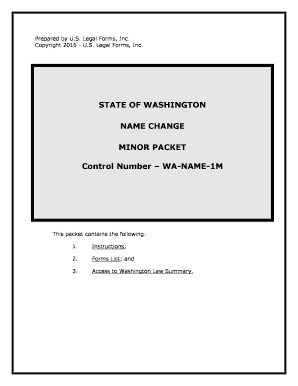
The Washington Minor Name Change Packet is a set of court forms and instructions used to request a legal name change for a child under age 18 in Washington State. It typically includes a petition, parental consent or notice forms, a proposed order, and instructions for filing at the county superior court. The packet explains evidence to submit (birth certificate, identification, court reports when required), any required background checks, and the court hearing process so guardians and parents can complete a compliant filing.

Why this packet matters for caregivers and guardians

A properly assembled packet reduces court rejections, clarifies consent requirements, and helps preserve legal continuity for the minor. It ensures filings meet Washington superior court expectations and documents required supporting evidence.

Why this packet matters for caregivers and guardians

Who typically completes the Washington Minor Name Change Packet

Use the packet to collect required evidence, confirm jurisdiction, and prepare for the hearing or clerk review.

  • Parents filing jointly where both legal parents consent and appear on the child’s birth record.
  • Single parent or guardian petitioners who must show legal authority or submit notice to other parents.
  • Attorneys or legal advocates preparing the filing, supporting documents, and court presentation.

Who can sign and file

Petitioner — Parent/Guardian

The petitioner is usually a custodial parent or court-appointed guardian who signs the petition and certifies facts. If another parent has legal rights, the petitioner must provide proof of notice or consent, or show why notice is excused.

Attorney — Filing Representative

An attorney may prepare and sign the filing on the petitioner’s behalf, submit required declarations, and represent the minor at hearing; the petitioner still must authorize the attorney in writing.

Core components included in the packet

The packet organizes forms, instructions, and example orders so filers know what to submit to the superior court and how to present evidence supporting the name change.

Petition

Formal request to the court stating the minor’s current name, requested new name, reasons for the change, and petitioner relationship to the child.
Consent Forms

Parental consent or acknowledgment forms for any parent whose rights are not being terminated; explains how to obtain and file consent or provide notice.

Proposed Order

Draft order for the judge’s signature that contains the new legal name, effective date, and instructions for updating records after entry of judgment.

Service Instructions

Guidance on how to notify nonconsenting or absent parents, including methods of service and timelines required by local court rules.

Supporting Documents

List of attachments commonly required: minor’s birth certificate, proof of petitioner identity, custody orders, and any guardian appointment records.

Filing Checklist

Step-by-step checklist for county filing procedures, fee waiver options, typical hearing scheduling, and clerk filing acceptance criteria.

Step-by-step: completing and filing the packet

Follow these sequential steps to prepare a complete filing and reduce the chance of clerk rejection or hearing continuance.

  • 01
    Gather documents: Collect birth certificate, IDs, custody orders, and any consent forms.
  • 02
    Complete petition: Fill all fields accurately and attach supporting exhibits.
  • 03
    Sign and notarize: Sign where required and obtain notarization for declarations.
  • 04
    File with court: Submit to county superior court and pay filing fee or request a fee waiver.

How to set up an online completion workflow

Configure your digital workflow to collect signatures, manage attachments, and generate a certified package for filing.

Field Mapping Map form fields to your intake database for consistency.
Signer Order Set sequence: petitioner, other parent, guardian, then notary if required.
Authentication Use email verification or SMS code for signer attribution.
Attachment Rules Require upload of birth certificate and ID before submission.
Storage Location Save completed packet to encrypted cloud storage with access controls.

Where to file and how submissions move through the court

Understand filing destinations, clerk review, and the hearing sequence to anticipate next steps after submission.

  • County Superior Court: Official filing location for minor name change petitions in Washington.
  • Clerk Review: Clerk verifies completeness and assigns a hearing date when required.
  • Service of Process: Provide notice to other parents or interested parties per local rules.
  • Judicial Decision: Judge signs final order changing the minor’s legal name.

Digital signing and eSubmission considerations

Ensure the platform supports tamper-evident PDFs, audit trails, and exportable records to satisfy ESIGN/UETA requirements for electronic transactions.

  • Accepted Formats: PDF, DOCX for attachments.
  • Authentication Methods: Email link, SMS code, or stronger KBA.
  • Integration Targets: Cloud storage and court e-filing portals.

Typical timelines and processing expectations

Processing times and required notice periods vary by county; below are common ranges to plan around.

Filing to Clerk Acceptance:

Same day to 7 business days depending on clerk workload.

Service / Notice Period:

Typically 14 to 30 days for notice to absent parents.

Hearing Scheduling:

Usually 4 to 8 weeks from filing when a hearing is required.

Order Entry:

Judge signs order at hearing or on submission; entry within days.

Record Update:

Vital records updates may take 2 to 12 weeks after order entry.

Key milestones in the name change process

Track these sequential milestones from preparation through updating records after the court order.

01

Prepare Packet

Assemble petition, consents, and supporting documents for filing.

02

File Petition

Submit forms to county superior court and pay fees or request waiver.

03

Serve Notice

Provide required notice to nonfiling parents or file proof of service.

04

Attend Hearing

Appear at scheduled hearing for judge to review and sign the order.

Essential information elements to include

Petitioner Name: Full legal name
Minor Name: Current legal name
Requested Name: Proposed new full name
Birth Details: Date and place of birth
Consent Status: Consent or notice provided
Supporting IDs: Birth certificate and petitioner ID

Consequences of incomplete or incorrect submissions

Clerk Rejection: Filing returned or delayed
Hearing Continuance: Case rescheduled, extra time and cost
Denial: Judge may deny for lack of jurisdiction or consent
Perjury Risk: False statements may carry legal penalties
Record Mismatch: Vital record update complications
Additional Costs: Repeat filing and attorney fees

Common mistakes to avoid when preparing the packet

  • Submitting incomplete supporting documents, such as a missing birth certificate, which causes clerk rejection or delay.
  • Failing to provide required notice to absent parents, resulting in additional service steps or hearing complications.
  • Using inconsistent name spellings across forms and attachments, creating mismatches for vital records updates.
  • Skipping notarization where required or using noncompliant electronic signatures that the court does not accept.

Practical tips for accurate and efficient filing

Adopt these best practices to reduce processing time and avoid common administrative issues.

Verify names and dates
Cross-check names and dates on the petition against government IDs and the birth certificate. Consistency avoids rework when updating records after entry of the order.
Obtain clear consents
Secure written parental consent or document service attempts thoroughly. Courts closely review consent and notice to protect parental rights.
Prepare certified copies
Order certified copies of the final order immediately after entry to expedite updates to the child’s birth certificate, Social Security record, and school records.
Confirm local rules
Check the county superior court’s local forms and filing procedures; local clerk pages often list hearing timelines and any additional required declarations.

Practical examples of common use cases

Two example scenarios show how the packet supports routine filings and special circumstances.

Joint-Parent Petition

A married couple petitions together for a minor name change to align family surnames

  • Both parents sign consent and file jointly
  • The court entered the order at the scheduled hearing and the family obtained certified copies to update the child’s records.

Sole Custody Guardian

A court-appointed guardian files a petition after custody was established by prior order

  • Guardian attaches custody documentation and proof of service to absent parent
  • The judge reviewed the guardian’s authority, granted the change, and directed vital record amendment.

eSignature solution comparison for completing the packet

Basic vendor pricing and feature availability to consider when choosing an e-signature platform for completing form packets. Pricing reflects typical starting plans and common features.

signNow DocuSign Adobe Sign PandaDoc HelloSign
Starting Price $8/user/mo $15/user/mo $14/user/mo $19/user/mo $15/user/mo
Free Trial Yes, 7-day trial No No Yes, limited Yes, limited
Bulk Send Yes Yes Yes Yes No
Audit Trail Yes Yes Yes Yes Yes
HIPAA Compliant Yes Yes Yes No No

Frequently asked questions about the packet

Answers to common questions about who signs, what to file, and how digital signatures are treated in Washington courts.


Need help? Contact support

be ready to get more
Join over 28 million airSlate SignNow users