Establishing secure connection… Loading editor… Preparing document…
Navigation

Fill and Sign the New York Easement 497321659 Form

Fill and Sign the New York Easement 497321659 Form

How it works

Open the document and fill out all its fields.
Apply your legally-binding eSignature.
Save and invite other recipients to sign it.

Rate template

4.7
38 votes
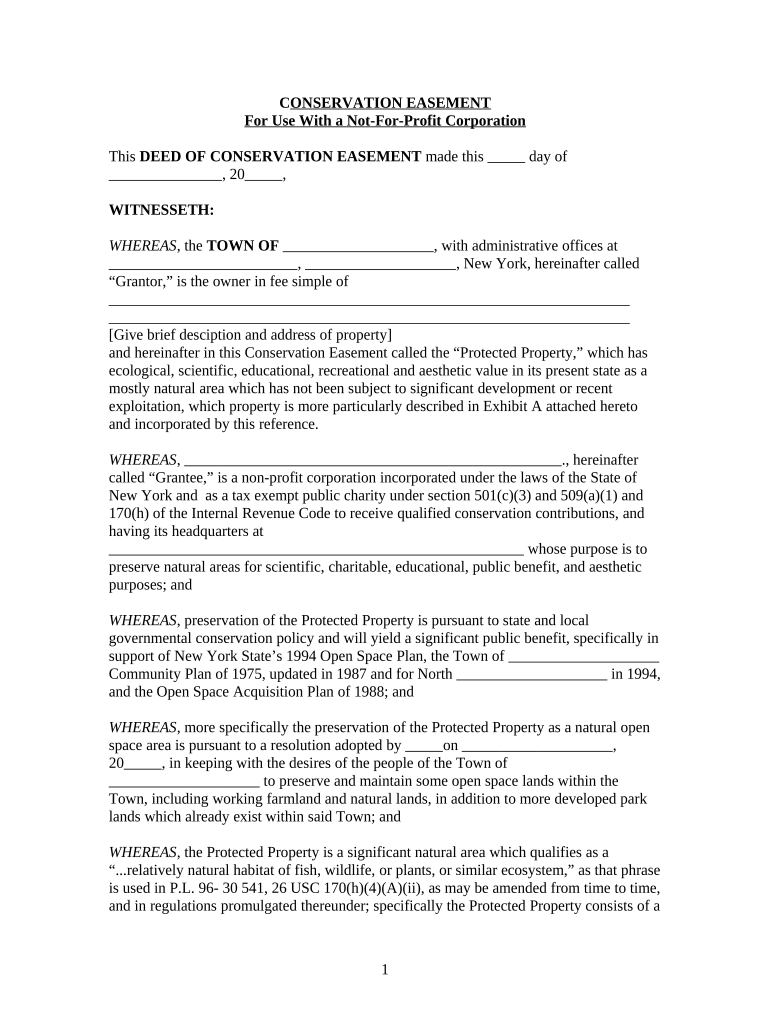
C ONSERVATION EASEMENT For Use With a Not-For-Profit Corporation This DEED OF CONSERVATION EASEMENT made this       day of                   , 20       , WITNESSETH: WHEREAS , the TOWN OF                         , with administrative offices at                               ,                         , New York, hereinafter called “Grantor,” is the owner in fee simple of _____________________________________________________________________ _____________________________________________________________________ [Give brief desciption and address of property] and hereinafter in this Conservation Easement called the “Protected Property,” which has ecological, scientific, educational, recreational and aesthetic value in its present state as a mostly natural area which has not been subject to significant development or recent exploitation, which property is more particularly described in Exhibit A attached hereto and incorporated by this reference. WHEREAS ,                                                             ., hereinafter called “Grantee,” is a non-profit corporation incorporated under the laws of the State of New York and as a tax exempt public charity under section 501(c)(3) and 509(a)(1) and 170(h) of the Internal Revenue Code to receive qualified conservation contributions, and having its headquarters at                                                                   whose purpose is to preserve natural areas for scientific, charitable, educational, public benefit, and aesthetic purposes; and WHEREAS , preservation of the Protected Property is pursuant to state and local governmental conservation policy and will yield a significant public benefit, specifically in support of New York State’s 1994 Open Space Plan, the Town of                         Community Plan of 1975, updated in 1987 and for North                         in 1994, and the Open Space Acquisition Plan of 1988; and WHEREAS , more specifically the preservation of the Protected Property as a natural open space area is pursuant to a resolution adopted by       on                         , 20       , in keeping with the desires of the people of the Town of                         to preserve and maintain some open space lands within the Town, including working farmland and natural lands, in addition to more developed park lands which already exist within said Town; and WHEREAS , the Protected Property is a significant natural area which qualifies as a “...relatively natural habitat of fish, wildlife, or plants, or similar ecosystem,” as that phrase is used in P.L. 96- 30 541, 26 USC 170(h)(4)(A)(ii), as may be amended from time to time, and in regulations promulgated thereunder; specifically the Protected Property consists of a 1 series of natural communities existing as a mosaic of wetlands and moist uplands, mostly mature shrublands and younger forest, providing habitat for migratory songbirds and other birds, particularly effective because of its location close to the Niagara River, and a variety of mammals, reptiles, and amphibians; and supporting a variety of herbaceous and woody plants including shagbark hickory, bitternut hickory, American beech, sugar, red, and silver maple, basswood, black cherry, yellow birch, black, white, and green ash, red oak, white oak, bur oak, pin oak, American elm, slippery elm, Eastern cottonwood, black willow, quaking aspen, spicebush, and other trees and shrubs, potentially including shellbark hickory (rated rare in New York State); WHEREAS , the Protected Property possesses open space, scenic, wetlands, and natural habitat values (collectively, “Conservation Values”) of significance to Grantor and the Grantee, the people of the Town of                         in Erie County, and the people of the State of New York; and WHEREAS, the Protected Property is expected to remain in its natural condition with minimal human modifications except for those necessary to protect public health and welfare, and any trails and similar means of access developed to direct and control human use of and travel through the Protected Property for recreation purposes; and WHEREAS , preservation of the Protected Property provides land areas for outdoor recreation by, and the education of, the general public, including but not confined to such activities as hiking, birdwatching, nature photography, plant and wildlife observation, and ecosystem studies (collectively, "Recreation Values"); and WHEREAS , the Protected Property provides significant benefit as a place where natural ecological communities can exist and develop, even though the specific communities may change through the coming years; and WHEREAS , the Protected Property as a large open space, natural area can be expected to provide many other significant benefits to the people of the Town of                         for now and in the years to come, such as passive recreation in a reasonably natural setting, nutrient cycling, and water regulation; and WHEREAS , Grantor and Grantee have the common purpose of conserving the above- described Conservation Values of the Protected Property in perpetuity; and WHEREAS , it is the intention of the Grantor to develop and periodically update a Management Plan for the Protected Property which will describe and prescribe the Grantor's detailed plans consistent with the purpose and reserved rights and restrictions of this Conservation Easement; and WHEREAS , the State of New York has authorized the creation of Conservation Easements pursuant to Environmental Conservation Law 49-0301-0311 and Grantor and Grantee wish to avail themselves of the provisions of that law; 2 1. Purpose. It is the purpose of this Conservation Easement to assure that the Protected Property will be retained forever in its predominantly un-built and natural open space condition: to provide a place where the climax and successional forest and other native ecological communities can continue to recover and grow predominantly unhampered and unaltered by direct human activities; to provide a natural setting for educational and passive recreational opportunities for the general public; and to prevent any use of the Protected Property that will interfere with the Conservation Values and Recreation Values of the Protected Property as described above. Furthermore, to accomplish and maintain a balance between protecting the natural character of the Protected Property with the inevitable disturbances which will result from direct use of the Protected Property by the general public as referenced above, and including to minimize such disturbances, it is the purpose and intent of this Conservation Easement to provide a set of principles and a framework for defining limits for the use of this Protected Property, within which more specific, relatively short-term plans for projects, activities, and others uses and impacts will be formulated according to and embodied in a periodically reviewed and revised Management Plan. Finally, Grantor intends that this Conservation Easement will confine the use of the Protected Property to such activities as are consistent with the purpose of this Conservation Easement and as are allowed and not prohibited below. 2. Restricted Uses. Any non-emergency activity on or use of the Protected Property inconsistent with the purpose of this Conservation Easement is prohibited. Without limiting the generality of the foregoing, the following activities and uses are expressly prohibited except as noted and/or as provided for in paragraph 3 below: 2.1 Management Plan. Specific uses of, and activities on, the Protected Property shall be governed by standards, specific procedures and directives, and other guidance set forth in a Management Plan for the Protected Property. The first version of said Management Plan shall be written and implemented within two (2) years after the date of this grant. Failure to complete and implement the Management Plan within the specified period shall in no way restrict, impair, invalidate, or terminate the Conservation Easement or alter the purposes for which said Conservation Easement is established. If the Management Plan is not completed within two (2) years, Grantor may request that Grantee prepare a brief Interim Management Plan which shall serve as the (official) Management Plan until such time as the formal Management Plan is completed and approved by the                         Town Board. Said Interim Management Plan shall be limited to those management activities and functions agreed upon jointly by the Grantor and the Grantee to allow for the continued natural succession of ecological communities on the Protected Property to the greatest extent possible and to provide for the necessary monitoring by Grante e. The terms of this and all subsequent versions of said Management Plan must be consistent with the Purpose of this Conservation Easement, and must not violate the terms and conditions of said Conservation Easement. Furthermore, all activities on and uses of the Protected Property must be provided for by specific sections or provisions of said Management Plan. (a) Prohibited Uses. Not withstanding any other prohibited uses described elsewhere in this Conservation Easement, the following uses are specifically prohibited by this 3 Conservation Easement in accordance with actions of the Grantor in its Resolution of July 19, 1999: i. Human health care institutions providing in-patient care, ii. Airports, iii. Churches, synagogues or any other place of public worship, iv. Public and private schools, v. Public utility stations and exchanges, vi. Other civic uses, including museums, libraries, senior centers, youth centers, places for public assembly, fraternal organizations, private clubs and civic associations, vii. 1-2.1.13 The following recreational uses, whether publicly or privately owned: 1. golf courses and country clubs, 2. tennis, racquet and handball facilities, 3. basketball, baseball and football facilities, 4. swimming facilities, 5. ice-skating facilities, viii. Day-care centers ix. Accessory structures and uses, x. Uses and structures customarily instrumental to the above, xi. Private and parochial schools and day-care centers, accredited when required by New York State, when accessory to a church or synagogue or other place of public worship, xii. Residences for custodians or staff. (b) Review, Additions, and Revisions. The Management Plan shall be updated and approved by the Grantor at least once every twenty (20) years, starting from the date when the aforementioned Management Plan is first put into effect. The Plan, however, may be updated and approved more frequently. Failure to review or update the Management Plan shall in no way restrict, impair, invalidate, terminate or nullify this Conservation Easement or alter the purposes for which it is established. (c) Parties Involved. At a minimum, the periodic review of, and any additions and revisions made to, the Management Plan shall be undertaken jointly, at least by notice in accordance with Paragraph 4.6, by representatives of both Grantor and Grantee. 2.2 General Disturbances. General disturbances and manipulations by or on behalf of Grantor or Grantee on the Protected Property shall be kept to a minimum, and in any case shall not be effected [during any one hundred (100)-year period] on more than fifteen (15%) percent of the total Protected Property area. For purposes of this calculation, the allowed disturbance is based on the percentage of the total area of all parcels formally designated as                   or any successor designation. Disturbances or manipulations, either performed or specifically planned, in conjunction with obligations and agreements in effect at the time of this grant, such as the contract specified in Paragraph 3.6 and the existing gas pipeline right-of-way will not be included in the measured or calculated area of the Grantor's disturbance. Included in the permissible fifteen percent figure are periodic disturbances associated with construction and maintenance of roadways, ditches, and trails as outlined in Paragraphs 3.1b, 3.1c, and 3.4, respectively; wetland impact mitigation by the Grantor as described in Paragraph 3.6, or 4 other ground disturbing habitat enhancement or restoration projects proposed and planned in conjunction with the Management Plan in effect at the time. Excluded from said fifteen percent limit are permitted activities associated with the contract obligation referenced in Paragraph 3.6, disturbances made in conjunction with officially declared emergencies such as a large fire, and habitat restoration efforts following certain large-scale disasters as specified in Paragraphs 2.5 and 3. For the purpose of this Conservation Easement, mowing, clipping, brush management and other vegetation management practices on currently open or early successional shrub areas are notconsidered disturbances or manipulations provided such practices are prescribed in the Management Plan. Disturbances related to Eminent Domain actions or condemnation do not count in the total percentage of disturbance. 2.3 Structures. There shall be no construction or placement of any building or buildings inconsistent with the Management Plan and the general limitation on total area of permitted disturbance. Certain structures or facilities are specifically prohibited without the mutual consent of the Grantor and the Grantee including: fences or signs (other than those required for appropriate identification and management of the Protected Property under the Management Plan); asphalt or concrete pavement (except as required and specified by Paragraph 3.1b); antennae, utility poles, towers, conduit, below or above ground natural gas and other utility lines and pipelines (except those present under agreements in effect at the time of this grant), high intensity lighting more than 200 feet from the public roads surrounding the Protected Property, or any other temporary or permanent structure or facility on or above the premise s; excepting a small, rustic educational building and an associated parking lot of appropriate size for said building, if necessary; and excepting small parking lots associated with trail heads, the total area of said parking lots not to exceed five (5) acre s. 2.4 Soil and Mineral Alterations. There shall be no additional ditching, draining, diking, filling, excavating, dredging, mining or drilling, removal of topsoil, sand, gravel, rock, minerals or other materials, nor any building of roads or changes in the topography of the land in any manner except as necessary for roadway, existing ditch, and trail development and maintenance consistent with the Management Plan and as provided for in Paragraphs 3.1b, 3.1c, and 3.4; and except as necessary and allowed by Paragraphs 2.2, 3.6 and 3.7. 2.5 Biota (Alterations). There shall be no removal, destruction or cutting of native trees, shrubs or other plants, planting of non-native trees, shrubs or other plants; use of fertilizers; introduction of non-native animals; grazing or browsing of domestic animals, or any grazing or browsing by herds of native species kept on the land for that purpose; or disturbance or change in the natural habitat in any manner except as necessary for protection of trails as provided for in Grantor’s Reserved Rights section 3.4 and for the maintenance of drainage and vegetation as provided in Section 2.2, and pest managemen t, or as required for implementation of the Management Plan or to protect the general health safety and welfare of the communit y, or unless required by a public emergency or mandated by a County, State or Federal agency. 2.6 Chemical and Other Control Agents. With the exception of pest control programs as provided for in Paragraph 3.5, there shall be no use of indiscriminate devices commonly known as “bug-zappers,” nor shall any pesticides or other biocides (including but not 5 limited to insecticides, fungicides, rodenticides, and herbicides) be used except as direct (non-broadcast), targeted applications for control of invasive, non-native and/or serious pest species if deemed appropriate by the Grantor in consultation with the Grantee and applied under the supervision of the Grantor or its agent unless required by a public emergency or mandated by a County, State, or Federal agency. 2.7 Fill and Material Storage. There shall be no storage or dumping of ashes, trash, garbage, or other unsightly or offensive material, hazardous substance, or toxic waste, nor any placement of storage tanks, pipes, or septic systems except as associated with a permitted activity in, on, or under the Protected Property; there shall be no changing of the topography through the placing of soil or other substance or material such as land fill or dredging spoils unless specifically approved by regulatory agencies in consultation with the Grantor and notification of the Grantee, except in conjunction with building and maintenance of roadways as provided for in Paragraph 3.1b.. Culverts for trail maintenance and ditch crossings are not considered pipes. Drainage improvements associated with structures called for in the Management Plan, and not expressly prohibited by this easement, are also permitted. This section shall not prohibit the Grantor from storing materials naturally occurring on the site. 2.8 Water Quality. There shall be no pollution, depletion or extraction of surface water, nor shall there be any alteration or manipulation of natural water courses, streams, swales, ponds, marshes, subsurface water or any other water bodies on the Protected Property inconsistent with the Management Plan and the reserved rights of the Grantor as provided for in paragraph 3 and 2.2 This paragraph does not prohibit short-term re-direction of water for irrigation, water management, drainage or wetland restoration or mitigation consistent with the Management Plan and other provisions of this Conservation Easement. 2.9 Vehicles and Transportation. Except on duly approved and designated trails and/or roadways in accordance with the Management Plan and except for emergency and policing purposes or to meet accessibility requirements, there shall be no horseback riding or operation of mountain or other bicycles, snowmobiles, dune buggies, motorcycles, all- terrain vehicles, hang gliders, aircraft or any other types of mechanized or motorized vehicles. 2.10 Education and Research. Major education and research programs and activities are prohibited without prior permission of the Grantor in association with procedures and criteria set forth in the Management Plan. Grantor shall notify Grantee of all proposals which may result in any disturbance or manipulation of the Protected Property inconsistent with the Management Plan. Said programs to be approved must conform to the terms and conditions of this Conservation Easement, in particular those in Paragraph 2.2. 2.11 Parcel Integrity. The Protected Property may not be divided, partitioned, or subdivided, nor conveyed except in its current configuration as an entity. Furthermore, any additional parcels, which are officially added to said Town-owned                   property in the future, become subject to the terms and conditions of this Conservation Easement. 6 2.12 Code Compliance. Nothing in this agreement will inhibit the Grantor from compliance with Town codes and ordinances, provided such ordinances do not impair or limit the application and enforcement of this Conservation Easement. 3. Grantor’s Responsibilities and Reserved Rights . Grantor has and retains primary management responsibilities associated with the Protected Property. Said responsibilities include monitoring of activities with respect to the status and effects of policies for and actions on the Protected Property. Grantor reserves any and all rights and uses not specifically conveyed or restricted including but not limited to the following: 3.1 Conveyance. The right to sell, give, lease, assign a significant management responsibility, or otherwise convey the Protected Property to a local municipal organization, foundation, or locally established land trust or conservancy provided such conveyance is subject to the terms of this Conservation Easement and written notice is provided to Grantee in accordance with paragraph 17.8 below. Such conveyance or assignment will not have any effect on Grantee’s rights or obligations under this agreement. 3.2 Continuance of Ongoing Activities. The right to undertake or continue any activity or use of the Protected Property not prohibited by or inconsistent with this Conservation Easement. Prior to making any change in the use of the Protected Property, Grantor shall advise the Grantee in writing in accordance with Paragraphs 4.6 and 17.8. In keeping with municipal responsibilities and authorities, Grantor retains its right and obligation to engage in certain routine maintenan ce activities and emergency actions as identified in this agreement and included in the Management Plan, which are necessary to protect public health and welfare with reasonable post-emergency notification of Grantee. a) Fire. Specifically included in said emergency actions are those associated with fire protection and other life threatening emergencie s, provided such actions are authorized by the appropriate individuals and in performed conjunction with acceptable procedures existing at the time. b) Roadways. Grantor specifically reserves the right to maintain and improve, if necessary, existing access roadways which run along and provide access to officially designated Town Ditches and their existing branches, as referenced in the Management Plan and on official Town maps in existence at the time of this Easement, for the purposes of maintaining said Ditches and providing suitable access routes for authorized emergency and policing vehicles to use in the performance of their duties. The total number and total length of such roadways shall be kept to the minimum absolutely necessary to accomplish the functions permitted above and shall also be in compliance with the requirements of the Americans with Disabilities Act (hereinafter “A.D.A.”) to the greatest extent possible; Roadways may be established to provide for emergency vehicle access according to the existing standard that no trails officially in use shall be further than 1000 feet from an existing roadway passable to at least those emergency vehicles capable of traveling on 7 unpaved, single-lane roadways, so long as Grantor continues to maintain said standard. Any new roadways built for this purpose shall be located in such a manner as to minimize the impact to natural areas, and to minimize the length of roadway needed to accomplish said standard. Use of said roadways within the Protected Property and as described above shall not be for general vehicular access and use by the public. c) Ditches. Continued maintenance of certain ditches is allowed. Included are the following: Continued and periodic maintenance or improvement of all official Town Ditches or other drainageways conducting stormwater and similar drainage flows through the Protected Property; continued and periodic maintenance of ditches that conduct drainage into the Protected Property from adjacent property (subject to review and approval by Grantee and permitting by regulatory agencies where appropriate); and continued and periodic maintenance of minor ditches directly responsible for drainage problems on adjacent properties (subject to review and approval by Grantee and permitting by regulatory agencies where appropriate) 3.3 Cutting and Removal of Trees. Cutting or removing of trees, shrubs, or other plants is prohibite d; except for trees growing in the existing seedling nursery or as provided for in the Management Plan or authorized elsewhere in this Conservation Easement. The Grantor reserves the right to limited pruning and/or felling of damaged trees as necessary to protect people walking on trails, to protect other plant or animal life, and to provide necessary access for authorized vehicles and people on maintenance/emergency access roadway s. Removal of more than twenty (20) trees per year or two hundred (200) trees over a ten- year period for the above identified trail maintenance purpose and any other cutting and/or removal of vegetation is subject to the prior written approval of Grantee pursuant to paragraph 4.6 below except as may be necessary under the Grantor’s emergency authorities for the protection of public health and welfare. Trees shall be defined as woody perennial plants, dead or alive, with a diameter at breast height (DBH) of six (6) inches or more or as defined per                   Town Code, whichever may be smaller. Shrubs shall include any trees or other woody vegetation smaller in size than vegetation defined as a tree and shall include sapling trees which have not reached the defined tree size. Non- native trees and shrubs are not subject to this prohibition but management of such non- native species shall remain subject to the Management Plan. 3.4 Trails. The right to develop trails, boardwalks, and non-paved walkways in order to accommodate public, pedestrian access and such recreational uses as may be appropriate for a substantially natural, wooded wetland and wooded upland area. Grantor shall consult with Grantee regarding the position, design, and extent of any new trail system(s) prior to installation and Grantor remains responsible for any permits which may be required to allow trail development and maintenance. Trees shall not be cut to establish or maintain the trail system except as provided for in paragraph 4.5 below. Permissible trail construction materials shall include but are not be limited to materials such as bark mulch and wood chips, crushed stone or pea gravel, stabilized asphalt millings, naturally rot- resistant or low toxicity pressure treated timber, except where other materials are required by existing regulations, for example ADA access. Engineering fabric matting is permitted if required by soil conditions and/or for trail durability. Trail development and 8 maintenance shall not result in the placement of any asphalt, concrete, brick, slag, or any construction and demolition debris of any kind as fill within any part of the Protected Property. No more than twenty (20) miles of trails (exclusive of any roadways used also as ADA accessible trails), shall be constructed and in existence at any particular time The Grantor reserves the right to construct trails for use by persons confined to wheelchairs or otherwise physically limited. The Grantor agrees to comply with current ADA regulations and standards at the time of planning and construction for ADA access. Any and all bridges and any boardwalks greater than 15 feet in length shall be designed and constructed according to plans prepared and/or approved by a licensed engineer. All trails must be identified with some form of signage, and frequency of said signage shall be determined with consideration to concerns and needs of emergency personnel. Said trail signage shall be in compliance with existing town ordinances and signage requirements of the Americans with Disabilities Act where appropriate. 3.5 Pest Management . The right, but not the obligation, to continue or initiate programs to manage and control species which pose serious and significant threats either to the health and welfare of the public or to the well being and integrity of the natural communities within the Protected Property. Said management by Grantor shall use the best available technologies and similar approved methodology necessary to control pests in the interests of protecting health and human safety both on a regular basis in the case of Grantor- confirmed chronic problems, without consultation with the Grantee, and for emergency purposes. Pest control efforts may include allowance for pest breeding habitat management consistent with necessary analysis and specific management plans, permitting by regulatory agencies, and emergency needs; and may include temporary limiting of access by the public to problem areas until the problem there has been cured or minimized to the satisfaction of both Grantor and Grantee. 3.6 Wetland Mitigation. The Grantor and Grantee hereby recognize and shall honor the right of the New York State Urban Development Corporation (d.b.a. Empire State Development Corporation) and its successors and assigns, according to a contract between said Corporation and the Town of                         and dated                         , 20       and executed by the aforementioned parties on                         , 20       and on                         , 20       , respectively, to use a portion of the Protected Property for mitigation purposes associated with wetland fill or other regulated impacts as required and approved by the appropriate regulatory agencies. This right extends only to the amount absolutely required by said contract, and including the limitation expressed in said contract that the development for which the mitigation would be needed is confined to lands south of North French Road, north of Dodge Road, east of Sweet Home Road, and west of Campbell Boulevard, and no others. Furthermore, the Protected Property shall not be used for any other private wetland mitigation plans or efforts beyond that provided for under the NYSUDC agreement. The Grantor reserves the right to conduct ground disturbing wetland mitigation projects on the Protected Property specifically to mitigate impacts of the Grantor’s activities on other lands owned and managed by the Grantor. The area impacted by any such wetland mitigation shall count toward the total allowed area of disturbance on the Protected Property and shall be consistent with the Management Plan in effect at the time of the 9 mitigation. Nothing in this paragraph shall limit the right of the Grantor to except cash payments associated with private or public wetland mitigation activities and to direct such funds towards management activities on the Protected Property. 3.7 Restoration Following Disasters. The right to carry out a habitat restoration plan and program following destruction of the Protected Property by disasters such as fire or severe blowdown or serious pest infestations. Such habitat restoration shall be performed according to the Management Plan in effect at the time, and shall be consistent with the terms and conditions of this Conservation Easement. 4. Grantee’s Responsibilities and Rights. To accomplish the purpose of this Conservation Easement and in recognition of the Grantee's expertise and experience in the area of natural area protection, the Grantee will act in the capacity of advisor to the Grantor for monitoring the Conservation Easement and providing input in Management Plan development and implementation. Consistent with this role, the following responsibilities and rights are conveyed to Grantee by this Conservation Easement: 4.1 Responsibilities. Grantee is responsible for review of proposals and policies associated with the Management Plan to ensure said proposals and policies are consistent with the Conservation Easement; for monitoring of the Protected Property to ensure the policies, activities, management efforts, and maintenance as performed are consistent with the purpose of the Conservation Easement and the protection of the Conservation Values of the Protected Property; and for bringing non-compliant activities to the attention of the Grantor in order correct situations which are not in compliance with said Conservation Easement. As part of its monitoring effort, Grantee shall prepare annual monitoring reports for the Grantor. Said monitoring reports shall contain information on the condition of the Protected Property, including the state of the road and trail system, the current covertypes and ecological communities, and any observed problems or conflicts with current management programs or problems; and in general, the compliance with the terms and conditions of the Conservation Easement. Failure to produce an annual monitoring report does not nullify this Conservation Easement in whole or in part, nor void any terms or conditions of said Conservation Easement, but does allow Grantor to issue notification to Grantee requiring completion of the monitoring report. Following such notification Grantee must provide the monitoring report to Grantor within two (2) months or shall hire a sub-contractor to complete the report within the calendar year of notification. Further, any and all activities of the Grantee shall be in compliance with this Conservation Easement and shall not interfere with the Conservation Values of the Protected Property. 4.2 Right to Enforce and Defend. The right to enjoin any activity on or use of the Protected Property that is inconsistent with the purpose of this Conservation Easement or detrimental to the Conservation Values. Further, the right to enforce the restoration provisions of the Conservation Easement for such areas or features of the Protected Property damaged by any inconsistent activity or use. Said rights may be exercised pursuant to remedies set forth in paragraph 10. 10 4.3 Right of Entry. The right to enter the Protected Property via the established rights of way or other agreed upon routes at all reasonable times and, without prior notice for the purpose of: (a) Inspecting the Protected Property to determine if usage and conditions are in compliance with the covenants and purposes of this Conservation Easement; (b) Enforcing the terms of this Conservation Easement; (c) Taking actions with respect to the Protected Property, to remedy or abate violations hereof; (d) Scientific and educational observations and studies and taking samples consistent with the Management Plan and with consent of the Grantor and in such a manner as willnot disturb the quiet enjoyment of the Protected Property by Grantor and the general public; and (e) Monitoring and management as described below. 4.4 Monitoring and Management. The right to place small, inconspicuous, permanent or semi-permanent markers at official monitoring points consistent with the Management Plan. The right to monitor the condition of the rare plant and animal populations, plant communities, and natural habitats on the Protected Property, and to participate in the management of the same, when requested by the Grantor, to ensure their continued presence and viability on the Protected Property. Such activities shall be in accordance with monitoring practices of the Grantee, which may include but are not limited to activities set forth in the Management Plan prepared by Grantor in consultation with Grantee. No further rights of management are conveyed. 5. Costs and Liabilities. Grantor retains all responsibilities and shall bear all costs and liabilities of any kind related to the ownership, operation, upkeep and maintenance of the Protected Property. Grantor shall keep the Grantee’s interest in the Protected Property free of any liens arising out of any work performed for, materials furnished to or obligations incurred by Grantor. Grantor agrees to release, hold harmless, and indemnify Grantee from any and all liabilities including, but not limited to, injury, losses, damages, judgments, costs, expenses and fees which Grantee may suffer or incur as a result of or arising out of the activities of Grantor on the Protected Property. Grantee agrees to release, hold harmless, and indemnify Grantor from any and all liabilities including, but not limited to, injury, losses, damages, judgments, costs, expenses and fees which Grantor may suffer or incur as a result of or arising out of the activities of Grantee on the Protected Property. Grantee shall maintain appropriate liability insurance to cover its activities on the Protected Property. Grantee's proof of insurance shall normally be provided along with the annual monitoring report. 6. Title. Grantor covenants and represents that Grantor is the sole owner and is seized of the Protected Property in fee simple and has the right to grant and convey the aforesaid Conservation Easement; that the Protected Property is free and clear of any and all encumbrances, including but not limited to, any mortgages not subordinated to this Conservation Easement, all the foregoing of which is subject to rights, reservations, restrictions and agreements recorded or otherwise, and, in particular, the rights of the New 11 York State Urban Development Corporation or its successors and assigns, according to a contract between said Corporation and the Town of                         and dated June 15 th , 1992 and executed by the aforementioned parties on                               ,       and on                               ,             , and that Grantee shall have the use of and enjoy all of the benefits derived from and arising out of the aforesaid Conservation Easement. 7. Hazardous Waste. The Grantee accepts the Conservation Easement on the Protected Property as is. 8. Grantee’s Remedies. In the event that Grantee becomes aware of a violation of the terms of this Conservation Easement, Grantee shall give notice to Grantor, at Grantor’s last known post office address, of such violation via certified mail, return receipt requested, and request corrective action sufficient to abate such violation and restore the Protected Property to its condition at the time of the most recent monitoring report. Grantor agrees that the Baseline Documentation Report and subsequent annual monitoring reports shall be deemed to provide objective information concerning the Protected Property’s condition. Failure by Grantor to cause discontinuance, abatement or such other corrective action as may be requested by Grantee within ninety (90) days after receipt of such notice shall entitle Grantee to bring an action at law or equity in a court of competent jurisdiction to enforce the terms of this Conservation Easemen t; to require the restoration of the property to its previous condition; to enjoin such non-compliance by temporary or permanent injunction in a court of competent jurisdictio n; and/or to recover any court assessed damages arising from such noncomplianc e. Such damages, when recovered, must be applied by the Grantee to the extent required for corrective action on the Protected Property. If such court determines that either party has failed to comply with the terms and conditions of this Conservation Easement, the non-complying party shall reimburse the other party for its reasonable costs of enforcement, including costs of restoration, court costs and reasonable attorney’s fees, in addition to any other payments ordered by such court. 8.1 Emergency Enforcement. The Grantee has no policing authority on the Protected Property beyond the right to monitor changes and notify the Grantor of any easement violations. With due notice to the Grantor, if the Grantee, by official action of authorized representatives, determines that circumstances require immediate action to prevent or mitigate significant damage to the conservation values of the Protected Property, Grantee may, in addition to pursuing its remedies under this paragraph without waiting for the period for cure to expire, request immediate intervention by the Grantor's policing authorities or, if necessary, may seek injunction or other intervention to prevent further damages. 8.2 Failure to Act or Delay. Grantee does not waive or forfeit the right to take action as may be necessary to insure compliance with this Conservation Easement by any prior failure to act and Grantor hereby waives any defense of laches with respect to any delay by Grantee, its successors or assigns, in acting to enforce any restriction or exercise any rights under this Conservation Easement. 12 8.3 Violations Due to Causes Beyond Grantor’s Control. Nothing herein shall be construed to entitle Grantee to institute any enforcement proceedings against Grantor for any changes to the Protected Property due to causes beyond Grantor’s control, such as changes caused by pest infestations, fire, flood, storm, earthquake or the unauthorized wrongful acts of third persons. 9. Parties Subject to Easement. The covenants agreed to and the terms, conditions, and restrictions imposed by this grant shall not only be binding upon both the Grantor and the Grantee but also upon their respective lessees, agents, personal representatives, successors and assigns, and all other successors to Grantor and Grantee in interest and shall continue as a servitude running in perpetuity with the Protected Property. 10. Subsequent Transfers. Grantor agree that the terms, conditions, restrictions and purposes of this grant or reference thereto will be inserted by Grantor in any subsequent deed or other legal instrument by which Grantor divests either the fee simple title or possessory interest in the Protected Property including transfer to local agency or land trust; and Grantor further agrees to notify Grantee of any pending transfer at least ninety (90) days in advance. The Grantee also agrees to notify the Grantor of any similar pending transfer or assignment of its interest in the Protected Property at least ninety (90) days. Such transfer shall be subject to approval of the Grantor, approval of which shall not be unreasonably withheld. 11. Assignment. This easement is only assignable with the consent of the Grantor, which consent cannot be unreasonably withheld. Grantee hereby covenants and agrees that in the event it transfers or assigns the easement it holds under this indenture, the organization receiving the interest will be a qualified organization as that term is defined in Section 170(h)(3) of the Internal Revenue Code of 1986 (or any successor section) and the regulations promulgated thereunder, which is organized and operated primarily for one of the conservation purposes specified in Section 170(h)(A) of the Internal Revenue Code, and Grantee further covenants and agrees that the terms of the transfer or assignment will be such that the transferee or assignee will be required to continue to carry out in perpetuity the conservation purposes which the contribution was originally intended to advance. Such assignment may include transfer or assignment of the easement or significant management and monitoring responsibilities to a local agency, organization, or land trust 12. Modification and Amendment. Grantor and Grantee have the right to agree to allow certain otherwise prohibited activities under Paragraph 2 above, if, based on unforeseen or changed circumstances, any of the activities listed in Paragraph 2 are deemed desirable by Grantor and Grantee. Such agreement shall be in writing and shall describe the proposed activity in sufficient detail to allow the parties to judge the consistency of the proposed activity with the purpose of this Conservation Easemen t. The parties may authorize such modifications only if they determine that the proposed activities: 13 (1) do not violate the Purpose of this Conservation Easement, and (2) either enhance or do not impair any significant Conservation Values associated with the Protected Property. In the event that such proposed modifications are determined to be significant and/or permanent. The parties are also free to jointly amend the Conservation Easement. Any such amendment shall be recorded. Notwithstanding the foregoing, Grantee and Grantor have no right or power to agree to any activities on the protected properties that would result in the termination of this Conservation Easement. However, nothing shall prevent the parties from entering into a settlement agreement as a result of any litigation hereunder. 13. Extinguishment. If a change in conditions takes place which makes impossible any continued protection of the Protected Property or any portion thereof, for conservation purposes, this Conservation Easement can only be terminated or extinguished, whether in whole or in part, through mutual agreement of Grantor and Grantee followed by judicial proceedings, if required, in a court of competent jurisdiction. The parties agree that the Grantee shall be entitled to the fair market value, if any, of the Conservation Easement at the time of termination or extinguishment. Grantor hereby agrees that at the time of the conveyance of the Conservation Easement to Grantee, the Conservation Easement gives rise to a real property right, immediately vested in Grantee. Any proceeds resulting from extinquishment shall be placed in a trust or escrow account for exclusive use in acquiring, protecting, restoring or managing suitable property within the Town of                         in a manner consistent with the conservation purposes set forth herein or for the protection of a "relatively natural habitat of fish, wildlife, or plants or similar ecosystem,” as that phrase is used in and defined under P.L. 96-541, 26 USC 170(h)(4)(A)(ii), as amended and in regulations promulgated thereunder. Terms of this easement would extend to the greatest extent possible to any newly acquired property. 14. Eminent Domain. Whenever all or part of the Protected Property is taken in exercise of eminent domain by public, corporate, or other authority so as to abrogate the restrictions imposed by this Conservation Easement, Grantor and Grantee shall join in appropriate actions at the time of such taking to recover the full value, if any, of the taking and all incidental or direct damages resulting from the taking. The proceeds, if any, attributed to Grantee’s interest in the Protected Property shall be used as specified above in paragraph 13 for the acquisition or protection of open space property within the Town of                         . Nothing herein is intended to limit Grantor's powers under the eminent domain law of New York State. 15. Miscellaneous Provisions. 15.1 Severability. If any provision of this Conservation Easement or the application thereof to any person or circumstance is found to be invalid, the remainder of the provisions of this Conservation Easement and the application of such provisions to persons or circumstances other than those as to which it is found to be invalid shall not be affected thereby. 14 15.2 Successors and Assigns. The term “Grantor” shall include Grantor and Grantor’s heirs, executors, administrators, successors and assigns and shall also mean the masculine, feminine,corporate, singular or plural form of the word as needed in the context of its use. The term “Grantee” shall include The Western New York Land Conservancy, Inc. and its successors and assigns. 15.3 Execution. Grantee and Grantor agree to execute and record or file any further instruments or documents necessary to accomplish the intent and ensure the perpetual enforceability of this Conservation Easement. 15.4 Captions. The captions herein have been inserted solely for convenience of reference and are not a part of this Conservation Easement and shall have no effect upon construction or interpretation. 15.5 Counterparts. The parties may execute this instrument in two or more counterparts, which shall, in the aggregate, be signed by both parties; each counterpart shall be deemed an original instrument as against any party who has signed it. In the event of a disparity between the counterparts produced, the recorded counterpart shall be controlling. 15.6 Reserved. 15.7 Reserved. 15.8 Notices. Any notices required in this Conservation Easement shall be sent by registered or certified mail, or similar receipt acknowledged form of communication, to the following address or such addresses as may be hereafter specified by notice in writing: Granto r: Town of                                                                                                 Grantee :                                           , Inc.                                                                         TO HAVE AND TO HOLD the said Conservation Easement unto the said Grantee forever. IN WITNESS WHEREO F, Grantor has executed and sealed this document the day and year first above written. Witness:                                     Grantor: 15                                     Town of                         , New York                                     witness                                     signature                                     signature                                     title Witness:                                     Grantee:                                                                         , Inc.                                     witness                                     signature                                     signature                                     title STATE OF NEW YORK ) COUNTY OF                               ) SS.: On this       day of                               in the year             before me, the undersigned personally appeared                               , personally known to me or proved to me on the basis of satisfactory evidence to be the individual whose name is subscribed to the within instrument and acknowledged to me that he executed the same in his capacity, and that by his signature on the instrument, the individual, or the person upon behalf of which the individual acted, executed the instrument. 16                                                 STATE OF NEW YORK ) COUNTY OF                         ) SS. On this       day of                               in the year       before me, the undersigned personally appeared                               , personally known to me or proved to me on the basis of satisfactory evidence to be the individual whose name is subscribed to the within instrument and acknowledged to me that he executed the same in his capacity, and that by his signature on the instrument, the individual, or the person upon behalf of which the individual acted, executed the instrument.                                                       17

Useful tips on finalizing your ‘New York Easement 497321659’ online

Are you fed up with the inconvenience of handling paperwork? Look no further than airSlate SignNow, the premier eSignature solution for individuals and businesses. Wave goodbye to the tedious routine of printing and scanning documents. With airSlate SignNow, you can effortlessly complete and sign forms online. Take advantage of the extensive features embedded within this intuitive and budget-friendly platform and transform your document handling. Whether you need to complete forms or collect electronic signatures, airSlate SignNow takes care of it all with ease, needing only a few clicks.

Follow this detailed guide:

  1. Sign in to your account or register for a free trial with our service.
  2. Press +Create to upload a document from your device, cloud storage, or our template library.
  3. Open your ‘New York Easement 497321659’ in the editor.
  4. Click Me (Fill Out Now) to set up the document on your end.
  5. Insert and designate fillable fields for others (if required).
  6. Proceed with the Send Invite options to solicit eSignatures from others.
  7. Download, print your copy, or convert it into a reusable template.

Don't worry if you need to work with your teammates on your New York Easement 497321659 or send it for notarization—our platform offers all the tools necessary for such tasks. Create an account with airSlate SignNow today and enhance your document management to a new height!

Here is a list of the most common customer questions. If you can’t find an answer to your question, please don’t hesitate to reach out to us.

Need help? Contact Support

The best way to complete and sign your new york easement 497321659 form

Save time on document management with airSlate SignNow and get your new york easement 497321659 form eSigned quickly from anywhere with our fully compliant eSignature tool.

How to Sign a PDF Online How to Sign a PDF Online

How to complete and sign forms online

Previously, coping with paperwork took lots of time and effort. But with airSlate SignNow, document management is easy and fast. Our powerful and easy-to-use eSignature solution enables you to easily complete and electronically sign your new york easement 497321659 form online from any internet-connected device.

Follow the step-by-step guide to eSign your new york easement 497321659 form template online:

  • 1.Sign up for a free trial with airSlate SignNow or log in to your account with password credentials or SSO authorization option.
  • 2.Click Upload or Create and import a form for eSigning from your device, the cloud, or our form collection.
  • 3.Click on the document name to open it in the editor and use the left-side menu to complete all the empty areas appropriately.
  • 4.Drop the My Signature field where you need to approve your sample. Provide your name, draw, or import a photo of your handwritten signature.
  • 5.Click Save and Close to accomplish modifying your completed document.

After your new york easement 497321659 form template is ready, download it to your device, save it to the cloud, or invite other individuals to electronically sign it. With airSlate SignNow, the eSigning process only takes a few clicks. Use our powerful eSignature solution wherever you are to handle your paperwork efficiently!

How to Sign a PDF Using Google Chrome How to Sign a PDF Using Google Chrome

How to complete and sign paperwork in Google Chrome

Completing and signing paperwork is simple with the airSlate SignNow extension for Google Chrome. Installing it to your browser is a fast and beneficial way to deal with your forms online. Sign your new york easement 497321659 form template with a legally-binding electronic signature in a few clicks without switching between tools and tabs.

Follow the step-by-step guide to eSign your new york easement 497321659 form template in Google Chrome:

  • 1.Navigate to the Chrome Web Store, search for the airSlate SignNow extension for Chrome, and add it to your browser.
  • 2.Right-click on the link to a form you need to approve and choose Open in airSlate SignNow.
  • 3.Log in to your account using your password or Google/Facebook sign-in option. If you don’t have one, sign up for a free trial.
  • 4.Use the Edit & Sign menu on the left to fill out your template, then drag and drop the My Signature field.
  • 5.Add a picture of your handwritten signature, draw it, or simply type in your full name to eSign.
  • 6.Verify all information is correct and click Save and Close to finish editing your form.

Now, you can save your new york easement 497321659 form sample to your device or cloud storage, send the copy to other individuals, or invite them to eSign your form with an email request or a secure Signing Link. The airSlate SignNow extension for Google Chrome enhances your document processes with minimum effort and time. Try airSlate SignNow today!

How to Sign a PDF in Gmail How to Sign a PDF in Gmail How to Sign a PDF in Gmail

How to fill out and sign paperwork in Gmail

When you get an email containing the new york easement 497321659 form for approval, there’s no need to print and scan a file or save and re-upload it to a different tool. There’s a better solution if you use Gmail. Try the airSlate SignNow add-on to promptly eSign any documents right from your inbox.

Follow the step-by-step guidelines to eSign your new york easement 497321659 form in Gmail:

  • 1.Visit the Google Workplace Marketplace and locate a airSlate SignNow add-on for Gmail.
  • 2.Install the program with a corresponding button and grant the tool access to your Google account.
  • 3.Open an email with an attachment that needs approval and use the S sign on the right panel to launch the add-on.
  • 4.Log in to your airSlate SignNow account. Choose Send to Sign to forward the file to other people for approval or click Upload to open it in the editor.
  • 5.Drop the My Signature field where you need to eSign: type, draw, or upload your signature.

This eSigning process saves time and only requires a few clicks. Use the airSlate SignNow add-on for Gmail to update your new york easement 497321659 form with fillable fields, sign documents legally, and invite other parties to eSign them al without leaving your mailbox. Enhance your signature workflows now!

How to Sign a PDF on a Mobile Device How to Sign a PDF on a Mobile Device How to Sign a PDF on a Mobile Device

How to fill out and sign paperwork in a mobile browser

Need to rapidly submit and sign your new york easement 497321659 form on a mobile phone while doing your work on the go? airSlate SignNow can help without the need to install additional software applications. Open our airSlate SignNow solution from any browser on your mobile device and add legally-binding electronic signatures on the go, 24/7.

Follow the step-by-step guide to eSign your new york easement 497321659 form in a browser:

  • 1.Open any browser on your device and go to the www.signnow.com
  • 2.Sign up for an account with a free trial or log in with your password credentials or SSO authentication.
  • 3.Click Upload or Create and pick a file that needs to be completed from a cloud, your device, or our form collection with ready-to go templates.
  • 4.Open the form and fill out the empty fields with tools from Edit & Sign menu on the left.
  • 5.Place the My Signature area to the sample, then enter your name, draw, or upload your signature.

In a few easy clicks, your new york easement 497321659 form is completed from wherever you are. When you're done with editing, you can save the document on your device, build a reusable template for it, email it to other people, or ask them to eSign it. Make your documents on the go quick and efficient with airSlate SignNow!

How to Sign a PDF on iPhone How to Sign a PDF on iPhone

How to fill out and sign documents on iOS

In today’s corporate environment, tasks must be done quickly even when you’re away from your computer. With the airSlate SignNow mobile app, you can organize your paperwork and sign your new york easement 497321659 form with a legally-binding eSignature right on your iPhone or iPad. Set it up on your device to conclude agreements and manage documents from anyplace 24/7.

Follow the step-by-step guide to eSign your new york easement 497321659 form on iOS devices:

  • 1.Open the App Store, find the airSlate SignNow app by airSlate, and install it on your device.
  • 2.Open the application, tap Create to upload a form, and choose Myself.
  • 3.Select Signature at the bottom toolbar and simply draw your autograph with a finger or stylus to eSign the form.
  • 4.Tap Done -> Save after signing the sample.
  • 5.Tap Save or use the Make Template option to re-use this document later on.

This method is so simple your new york easement 497321659 form is completed and signed in just a couple of taps. The airSlate SignNow application works in the cloud so all the forms on your mobile device are kept in your account and are available any time you need them. Use airSlate SignNow for iOS to boost your document management and eSignature workflows!

How to Sign a PDF on Android How to Sign a PDF on Android

How to fill out and sign documents on Android

With airSlate SignNow, it’s easy to sign your new york easement 497321659 form on the go. Install its mobile app for Android OS on your device and start improving eSignature workflows right on your smartphone or tablet.

Follow the step-by-step guide to eSign your new york easement 497321659 form on Android:

  • 1.Open Google Play, find the airSlate SignNow app from airSlate, and install it on your device.
  • 2.Sign in to your account or register it with a free trial, then import a file with a ➕ button on the bottom of you screen.
  • 3.Tap on the uploaded file and choose Open in Editor from the dropdown menu.
  • 4.Tap on Tools tab -> Signature, then draw or type your name to electronically sign the sample. Fill out blank fields with other tools on the bottom if required.
  • 5.Utilize the ✔ key, then tap on the Save option to finish editing.

With an easy-to-use interface and full compliance with primary eSignature standards, the airSlate SignNow application is the perfect tool for signing your new york easement 497321659 form. It even works without internet and updates all form modifications when your internet connection is restored and the tool is synced. Fill out and eSign forms, send them for approval, and generate re-usable templates anytime and from anywhere with airSlate SignNow.

Sign up and try New york easement 497321659 form
  • Close deals faster
  • Improve productivity
  • Delight customers
  • Increase revenue
  • Save time & money
  • Reduce payment cycles