Establishing secure connection…Loading editor…Preparing document…
New York Lien
This template is fully customizable. Edit the text, fill out the fields, and send it for signature. Give it a try!
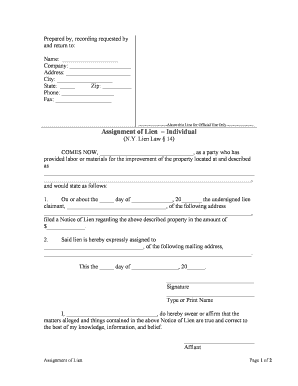
What the New York Lien Is and when it applies
Why a properly prepared New York Lien matters
Using a properly prepared New York Lien protects payment rights, alerts buyers and lenders to outstanding claims, and preserves enforcement options including foreclosure or judgment enforcement. Accurate filing reduces dispute risk and supports priority in insolvency, sale, or refinancing situations.

Who commonly files or responds to a New York Lien
The New York Lien is used by contractors, suppliers, property owners, and judgment creditors to secure payment or preserve priority against title transfers.
- General contractors and subcontractors filing mechanic's liens after nonpayment on construction projects.
- Suppliers and material vendors documenting unpaid deliveries that improved a property.
- Judgment creditors and lien claimants using recorded liens to enforce collection against debtor assets.
Step-by-step: preparing and recording a New York Lien
-
01Prepare: Gather contracts, invoices, legal description, and calculation affidavit.
-
02Serve Notice: Serve required notices to owners, contractors, and lenders per statute.
-
03File: Submit lien affidavit to county clerk with required fee.
-
04Record: Ensure recording and indexing; obtain certified copies for enforcement.
Where and how a New York Lien is submitted
-
County Clerk: File original affidavit or certificate per local clerk procedures.
-
Electronic Filing: Use accepted e-filing portals or county systems where supported.
-
Certified Copies: Order certified copies for litigation or enforcement purposes.
-
Recording Index: Confirm proper indexing under property and claimant names.
Recommended electronic workflow settings for eSubmission
| Field | Configuration |
|---|---|
| Signer authentication and signature method | Email OTP, SMS, or RON where available. |
| Required attachments and exhibits | Attach invoices, contracts, and calculation affidavit PDF. |
| Notarization and recording workflow | Enable in-person or remote notarization and archive A/V. |
| Retention and audit trail settings | Capture timestamps, IPs, signer emails, and certificate of completion. |
Technical requirements for platforms used with New York Liens
Platforms used to prepare and submit New York Liens should support PDF, fillable fields, secure storage, and audit trails.
- File formats: PDF, DOCX, and image support.
- Integrations: Connect to NetSuite, Salesforce, and cloud storage.
- Authentication: Email link, SMS code, or SSO options.
Penalties and common risks with incorrect lien filings
Late Filing:
Loss of lien priority.
Incorrect Amount:
Lien may be invalidated.
Improper Service:
Court may dismiss enforcement.
False Statement:
Potential civil and criminal penalties.
Missed Deadline:
Statute of limitations bars claim.
Recording Errors:
Title issues and transfer delays.
Common preparation mistakes to avoid
- Vague property descriptions leading to ambiguity and rejection; always use legal descriptions or tax parcel numbers when available to prevent recording errors and enforcement disputes.
- Entering the claimant's name incorrectly or using a DBA instead of the legal entity can complicate service, reduce enforceability, or lead to administrative rejection.
- Failing to provide statutorily required notices to owners, lenders, or contractors often voids lien rights; track deadlines and proof of service carefully.
- Using the wrong county clerk office or filing after statutory deadlines typically results in rejection or loss of priority for the claim.
Practical best practices for accurate New York Lien filings
Verify claimant identity and authority before filing
Confirm the claimant is the correct legal entity or authorized agent, obtain corporate resolutions or assignment documents when required, and ensure signatures match recorded authority. Mistakes can lead to judicial invalidation and reimbursement of costs.
Use precise property descriptions and supporting documentation
Attach plats, tax parcel numbers, or recorded deed references. Cross-check addresses against county records. Clear, verifiable property data shortens clerk review time, reduces administrative rejections, and strengthens the lien's standing in later foreclosure or enforcement proceedings.
Document calculation of amounts and include invoices
Provide a supplemental page showing invoices, dates, quantities, rates, payments received, and interest calculations. A transparent audit trail reduces creditor-defendant disputes and supports summary judgment or default remedies in court.
Confirm service and proof of notice per statute
Obtain and retain signed service affidavits, certified mail receipts, or process server returns. Courts require proof of notice for enforcement; lacking evidence often leads to dismissal or denial of foreclosure relief.
eSignature provider comparison for managing New York Lien documents
| signNow | DocuSign | Adobe Sign | PandaDoc | HelloSign | |
|---|---|---|---|---|---|
| Starting Price | $8/user/mo | $15/user/mo | $14/user/mo | $19/user/mo | $15/user/mo |
| Free Trial | 7-day free trial | Varies | Varies | Varies | Varies |
| Envelope Cap | No envelope cap | 100 envelopes/user/year | Varies | Varies | Varies |
| Audit Trail | Yes | Yes | Yes | Yes | Yes |
| HIPAA Compliant | Yes | Yes | Yes | No | No |
FAQs and troubleshooting for New York Lien filings
-
Can a lien be filed electronically?
Yes; New York recognizes electronic records under the New York ESRA and federal ESIGN Act (15 U.S.C. §7001). Ensure electronic filing meets county clerk or recording office acceptance and retain a reproducible record showing consent and attribution.
-
Is notarization required for all lien types?
Not always; notary requirements depend on lien type and local rules. Some filings require notarized affidavits or acknowledgements—confirm with the county clerk or statute. Remote online notarization may be permitted where state law allows.
-
How long to file a mechanic's lien?
Filing deadlines vary by lien type and contract. For construction mechanic's liens in New York, statutory notice and filing windows are specific; check the applicable statute or consult counsel to determine the exact deadline for your claim.
-
What happens if details are incorrect?
Errors in amounts, names, or property descriptions can result in administrative rejection, loss of priority, or court invalidation. Correct mistakes promptly and consider filing an amended or released lien where statute and local practice permit.
-
Can signNow be used to eSign liens?
Yes; signNow supports ESIGN-compliant electronic signatures and audit trails. When county clerks accept electronic submissions, signNow can capture attribution, timestamps, and documents for retention; ensure local recording offices accept e-files.
-
How to cancel or release a lien?
File a lien release or satisfaction document with the recording office and serve relevant parties. Follow statutory procedures for releasing a lien; retain proof of recording and service to prevent future disputes.
be ready to get more
Join over 28 million airSlate SignNow users