Identification
Name of filer, claimant, claim number, and accounting ledger reference included for precise routing and traceability.
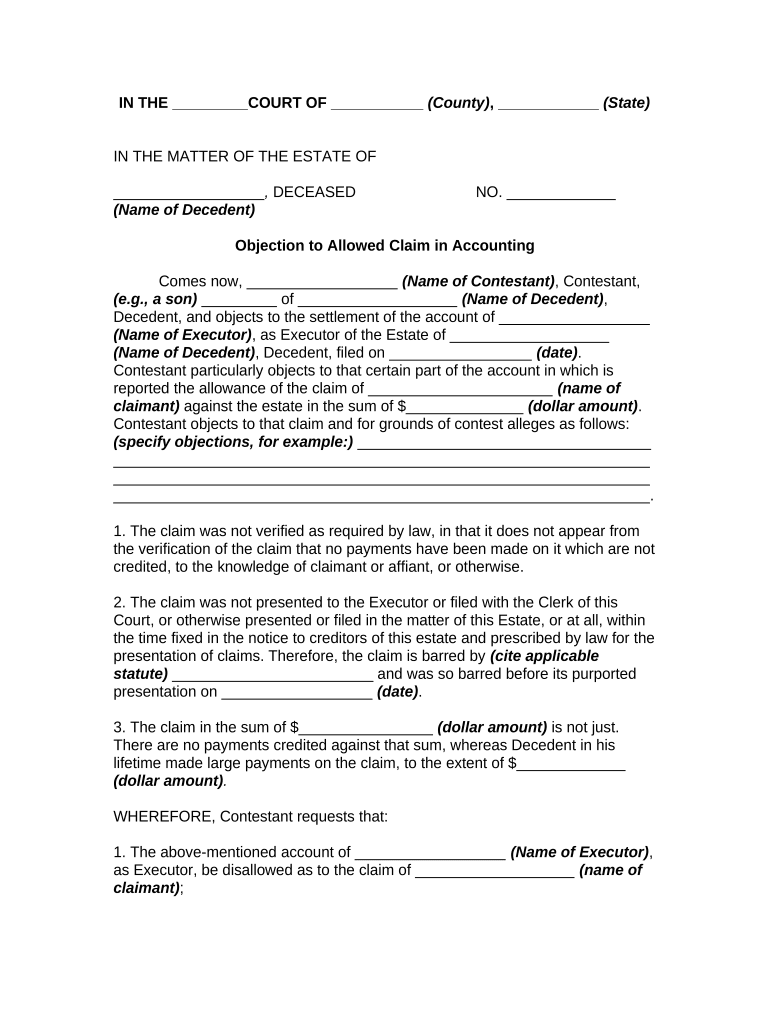
A well-structured objection protects the filer’s financial position, creates an auditable record of dispute, and triggers formal review procedures that can correct overstated liabilities or prevent improper disbursements.

Typical preparers include corporate accounting teams, creditors, legal counsel, and claims administrators who require a formal record to dispute an allowed claim.
Who signs or files depends on authority: authorized signatories, counsel, or an appointed claims agent usually finalize and submit the objection.
Name of filer, claimant, claim number, and accounting ledger reference included for precise routing and traceability.
Concise request (disallow, reduce amount, reclassify) stating exactly what corrective action is sought from the reviewer.
Factual and legal basis for the dispute: contract clauses, improper calculations, duplicate claims, or lack of documentation.
Attach invoices, payment records, correspondence, contracts, and reconciliations numbered as exhibits to support each asserted point.
Signature block with printed name, title, company, and a dated certification of truth and completeness under penalty of perjury where required.
Designate a contact person, preferred delivery method, and requested deadline for response or follow-up reconciliation.
| Field | Configuration |
|---|---|
| Claim Number Field | Required, single-line, exact-match validation |
| Exhibits Upload | Allow multiple PDFs, limit 20MB per file |
| Reviewer Routing | Role-based routing to accounting then legal |
| Notifications | Email and audit-log entry on each status change |
Ensure your chosen platform supports secure attachments, audit trails, and signer authentication suitable to the document’s sensitivity.
Platforms with integrations to accounting systems and robust audit trails help automate ledger updates and preserve evidentiary records.
File as soon as the discrepancy is discovered to preserve rights.
Claims processes often set specific objection windows—check the claims notice or plan documentation.
Timing depends on venue: bankruptcy rules, insurer policies, or corporate bylaws.
Expect review and potential requests for additional info within 14–60 days.
Adverse determinations may permit appeal or judicial review per governing procedure.
| signNow | DocuSign | Adobe Sign | PandaDoc | HelloSign | |
|---|---|---|---|---|---|
| Starting Price | $8/user/mo | $15/user/mo | $14/user/mo | $19/user/mo | $15/user/mo |
| Free Trial | 7-day free trial | Varies by vendor | Varies by vendor | Varies by vendor | Varies by vendor |
| Bulk Send | Yes | Yes | Yes | Yes | Varies |
| Audit Trail | Yes | Yes | Yes | Yes | Yes |
| HIPAA Compliant | Yes | Yes | Yes | No | No |
A mid-market investment firm identified duplicate invoices related to a vendor payment and filed an objection with exhibits including remittance advices and bank statements.
A property manager disputed a claim for tenant improvement costs by providing signed lease amendments and vendor receipts.