Establishing secure connection…Loading editor…Preparing document…

Petition for Change of Name

This template is fully customizable. Edit the text, fill out the fields, and send it for signature. Give it a try!
Petition for Change of Name

What the Petition for Change of Name Is and how it functions

A Petition for Change of Name is a court filing that asks a state court to legally replace an individual's current name with a new name. The petition typically identifies the petitioner, lists reasons for the requested change, discloses any relevant criminal or bankruptcy history when required, and requests a judicial order. Courts review petitions for public safety and procedural compliance before issuing an order; some jurisdictions require notice to creditors, publication, or a hearing. Once granted, the court issues a signed name-change order that serves as the legal basis for updating identity records.

Why filing a formal petition matters

A court-ordered name change provides recognized legal authority to update government IDs, financial accounts, and professional records, reducing future disputes. The petition ensures the change is documented in public records and helps unify identity across documents for employment, travel, and benefits.

Why filing a formal petition matters

Who typically files or prepares a name-change petition

Different people use the petition for predictable reasons and outcomes.

  • Individuals changing name for marriage, divorce, gender transition, or personal reasons; they prepare the petition and supporting ID.
  • Parents or guardians seeking a name change for a minor, often required to show custody or consent information.
  • Attorneys, paralegals, or court clerks who draft petitions, verify local rules, and manage filings and notices.

In many cases, a basic petition can be self-prepared, but local court rules and publication requirements vary and may call for legal help.

Step-by-step: completing and filing the petition

A clear sequence reduces filing errors and shortens processing time.

  • 01
    Gather documents: Collect ID, certified birth certificate, and proof of residence.
  • 02
    Complete petition: Fill all fields accurately and attach required exhibits.
  • 03
    File with court: Submit petition and pay filing fee to the appropriate county court.
  • 04
    Attend hearing: Appear if required; judge may sign the name-change order.

How filing and document routing typically proceed

Most name-change workflows follow a predictable path from preparation to final order.

  • Prepare: Complete petition, assemble exhibits, and secure notarizations if needed.
  • Submit: File in person, by mail, or via the court's e-filing system where available.
  • Serve / Publish: Complete any required service on interested parties or statutory publication.
  • Finalize: Receive signed order and obtain certified copies for record updates.

Digital filing and eSignature considerations

If you plan to prepare or sign online, confirm court and state acceptance of electronic petitions and e-signatures.

  • File types: PDF or PDF/A are widely accepted for uploaded petitions.
  • Authentication: Use two-factor or verified IDs when stronger signer identity is required.
  • Integrations: Common integrations include Microsoft 365, Google Workspace, and case management systems.

Verify local court e-filing rules before relying on electronic submission and preserve certified copies or notarized originals if the court requires them.

Essential parts of a professionally prepared petition

A complete petition presents identity, jurisdictional facts, and the relief requested in court-friendly form.

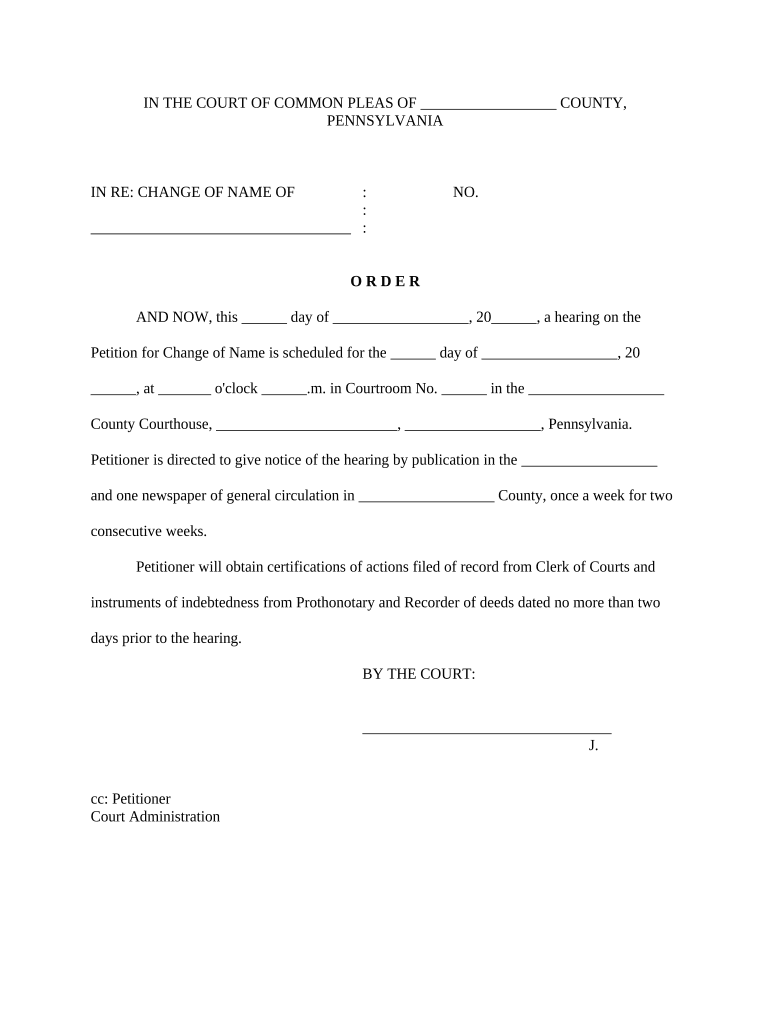
Caption

Court caption identifies the jurisdiction and case number area; use the precise county and court name required by local rules to avoid jurisdictional defects.
Petitioner Details

Full legal name, aliases, date of birth, and address appear here; include identification numbers only if the court form requires them.

Statement of Grounds

Clear factual basis for the change (e.g., marriage, divorce, identity reasons); avoid unnecessary personal detail while satisfying statutory standards.

Request for Relief

A concise prayer asking the court to change the name and issue an order for certified copies to be issued for official use.

Verification and Signature

Signed under penalty of perjury or verified per local rules; some jurisdictions require notarization or court staff signature.

Certificate of Service

Shows who received notice and how it was delivered; required when statutes mandate service on interested parties or agencies.

Sensitive data to protect when filing

Social Security: Avoid public SSN disclosure
Date of Birth: Limit exposure in public filings
Identification Numbers: Use only as required
Court Case Number: Keep private when possible
Signature: Authenticate per court rules
Certified Copies: Store securely, limit distribution

Common errors that delay or invalidate a petition

  • Entering a name that does not match government ID or court records, causing identity verification failures or rejection.
  • Omitting required attachments such as a certified birth certificate or court-ordered divorce decree when forms specify them.
  • Filing in the wrong county or court division, which can result in dismissal for lack of jurisdiction and require refiling.
  • Failing to complete publication or service requirements where statute or local rule mandates notice to the public or interested parties.

Consequences of an incorrect or fraudulent petition

Dismissal: Court may deny petition
Filing Delays: Repeat filings and extra costs
Fees: Additional court or service fees
Identity Mismatch: Problems updating official records
Perjury: False statements risk criminal exposure
Privacy Risk: Unredacted SSN exposure in public file

Supporting documents and notices usually required

Courts commonly require evidence and follow-up actions; prepare certified copies and proof of service in advance.

Certified Birth Certificate

Official birth record or acceptable substitute used to verify identity and birth details required by many courts.

Proof of Divorce or Marriage

Provide final divorce decree or marriage certificate when the name change relates to marital status changes.

Criminal Background Disclosure

Some jurisdictions require disclosure of felony convictions or pending criminal matters; nondisclosure can invalidate the petition.

Publication/Service Proof

When publication is required, retain affidavits, receipts, and publisher statements to prove compliance.

Practical tips to complete the petition accurately and efficiently

Follow these best practices to reduce rework and protect personal data throughout the process.

Verify spelling and name order
Confirm the exact spelling, punctuation, and order of names on government IDs and use that same format consistently across the petition and attachments to avoid identity-matching problems at the clerk's office.
Redact or limit SSN usage
Only include the full Social Security number when explicitly required by the court; otherwise use the last four digits or redact the SSN from public filings to minimize identity-theft exposure.
Obtain certified copies early
Order certified birth or marriage certificates before filing; waiting until after the hearing can delay final registry updates and increase overall time to update other records.
Check local publication and service rules
Confirm whether your county requires statutory newspaper publication or service on specific agencies and budget for those steps in time and cost estimates.

Realistic use cases and outcomes

These examples illustrate common scenarios and the court outcomes a petitioner can expect.

Adult name change after divorce

A petitioner files to resume a maiden name after divorce

  • The court schedules a short hearing or waives appearance if paperwork is complete
  • The judge signs a name-change order; petitioner obtains certified copies and uses them to update passport, Social Security, and bank accounts.

Minor name change by parents

Parents file on a child's behalf following custody change or adoption

  • The court requires consent from both parents or notice to the noncustodial parent
  • The judge issues an order; certified copies are provided to schools and agencies to update records.

Frequently asked questions about petitions and e-signing

Answers to common procedural and technical questions to help avoid rejections or delays.


Need help? Contact support

be ready to get more
Join over 28 million airSlate SignNow users