Establishing secure connection…Loading editor…Preparing document…

Employee Policies Memorandum

This template is fully customizable. Edit the text, fill out the fields, and send it for signature. Give it a try!
Employee Policies Memorandum

What the Employee Policies Memorandum Is and When It’s Used

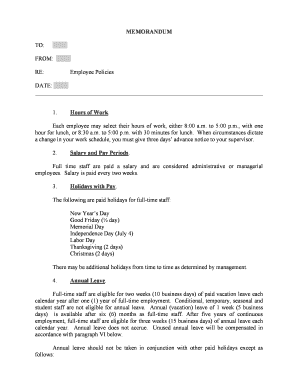
An Employee Policies Memorandum is a written notice from an employer that outlines workplace policies, expectations, and any material changes to handbook provisions or employment rules. It typically summarizes scope, effective date, affected groups, and required actions by employees. Organizations use memoranda to document policy distribution, provide legally cognizable notice, and create a dated record that can be retained for compliance, disciplinary, or audit purposes. The memorandum is not a contract unless it contains offer-and-acceptance language and consideration specific to employment terms.

Why an Employee Policies Memorandum Matters

A clear memorandum reduces misunderstandings, documents employer notice obligations, and helps meet regulatory or contractual communication requirements. It supports consistent application of policy changes and provides evidence of notice in disputes or audits.

Why an Employee Policies Memorandum Matters

Who Typically Issues and Receives This Memorandum

Recipients should acknowledge receipt where required; signatures or e-sign confirmations create a clear audit trail and help demonstrate that notice was provided.

  • HR teams notifying staff about handbook revisions or procedural updates
  • Managers informing direct reports about department-specific rules or schedules
  • Legal or compliance teams distributing policy changes tied to regulatory obligations

Step-by-Step: Preparing and Issuing the Memorandum

A straightforward sequence helps ensure accuracy and compliance when issuing an Employee Policies Memorandum.

  • 01
    Draft Content: Write clear policy language and summarize changes.
  • 02
    Legal Review: Have counsel check for statutory or contractual conflicts.
  • 03
    Select Recipients: Identify employee classes and distribution lists.
  • 04
    Distribute and Track: Send notice, collect acknowledgments, and retain proof.

Essential Elements of a Professional Memorandum

Include standard sections so the memorandum is complete, enforceable where applicable, and easy to reference in audits or disputes.

Header

Date, issuer name and title, department, and a clear subject line identifying the memorandum purpose.
Scope

Specify which employee groups are covered and whether contractors or temporary staff are included.

Policy Text

Present the new or revised rules in numbered paragraphs or bullets for clarity and future reference.

Effective Date

State the date policy takes effect and any transitional provisions or grace periods.

Acknowledgment

Provide a signature block or an e-sign mechanism for employees to confirm receipt and understanding.

Retention Note

Indicate where the memorandum will be stored and how long acknowledgments will be retained for compliance.

Required Data Elements and Compliance Notes

Employee Name: Full legal name
Employee ID: HR system identifier
Department: Organizational unit
Date Signed: MM/DD/YYYY
Signature Method: E-sign or handwritten
Retention Location: Records repository

Common Preparation Errors to Avoid

  • Failing to specify the effective date, which creates implementation ambiguity.
  • Using vague language that leaves disciplinary standards unclear.
  • Not segmenting recipients, leading to over- or under-inclusive distribution.
  • Neglecting to record acknowledgments, weakening proof of notice.

Consequences of Incorrect or Missing Memoranda

Contract Risk: Disputes over enforceability
Regulatory Risk: Potential agency inquiries
Disciplinary Limits: Limits on corrective action
Tax/Benefits: Errors affecting payroll or benefits
Recordkeeping Failures: Loss of audit evidence
I-9 Exposure: Potential fines for documentation errors

Where to Send and How to Route the Memorandum

Establish a consistent routing process so distribution and acknowledgments are captured and stored in the right systems.

  • HR System: Upload final memorandum to HRIS or personnel file
  • Employee Email: Send direct notice with acknowledgment link
  • Managers: Inform supervisors for local enforcement
  • Records Archive: Store signed copies in retention repository

How to Configure an Online Distribution Workflow

A typical digital workflow reduces manual steps and preserves an audit trail for each recipient.

Field Configuration
Upload Document Use PDF or DOCX
Add Recipients CSV import for large batches
Set Fields Signature, date, initials
Enable Authentication Email link or SMS code

Digital Distribution and eSignature Considerations

For sensitive employee data, ensure HIPAA or other sector-specific protections apply and include a record-retention plan consistent with regulatory requirements.

  • Authentication: Email link, SMS code, or stronger ID proofing
  • Audit Trail: Timestamps, IP, and action log
  • Storage: Encrypted repository with access controls

Timelines and Deadlines to Track

Plan distribution so employees have reasonable time to review and acknowledge and to allow for record retention and any notice periods required by law or contract.

Notice Period:

Specify any advance notice the policy requires

Acknowledgment Deadline:

Set a clear due date for signatures

Retention Start:

Retention begins on effective date

Review Cycle:

Schedule periodic policy reviews

Record Disposal:

Follow retention timeline before deletion

Real-World Examples of Memoranda in Practice

These brief customer stories show how organizations use memoranda to communicate policy changes and capture evidence of notice.

Optica Ventures (COO)

The interface is simple for our team to use and for customers to receive.

  • The memorandum was distributed to all staff in one workflow.
  • As a result, HR documented acknowledgments centrally and reduced follow-up time for compliance checks.

Martin Properties (Founder)

We process and execute documents online with full compliance.

  • A single memorandum alerted onsite and remote staff.
  • Signed acknowledgments were stored securely and were available immediately during a property compliance review.

How This Memorandum Differs from Related Documents

Compare the Employee Policies Memorandum with similar documents so you use the correct instrument for the intended legal effect.

Document Type Purpose Legal Effect
Employee Policies Memorandum notice usually not a contract
Employee Handbook comprehensive rules may imply policies
Individual Employment Agreement terms of employment contractual obligations
Disciplinary Notice specific action potential disciplinary record

eSignature Vendor Comparison for Distributing Employee Memoranda

Platform choice affects per-user cost, bulk-distribution features, compliance options, and envelope limits for high-volume employee programs.

signNow DocuSign Adobe Sign PandaDoc HelloSign
Starting Price $8/user/mo $15/user/mo $14/user/mo $19/user/mo $15/user/mo
Free Trial 7-day free trial, no credit card Varies by vendor Varies by vendor Varies by vendor Varies by vendor
Bulk Send Yes (Business Premium) Yes Yes Yes No
Audit Trail Yes Yes Yes Yes Yes
Envelope Cap No envelope cap 100 envelopes/user/year Varies Varies Varies

Who Signs and Approves the Memorandum

HR Manager

HR managers prepare and authorize distribution of the memorandum, coordinate legal review, and maintain the central record of signed acknowledgments for compliance and audit purposes.

Employees

Employees or affected recipients must acknowledge receipt and understanding; their signed acknowledgment serves as proof of notice and may be retained in personnel files.

Practical Tips for Accurate and Efficient Distribution

Adopt simple practices that reduce errors and improve compliance when issuing policy memoranda.

Use Clear Language
Write in plain terms, avoid legalese, and highlight actions employees must take to reduce confusion and disputes.
Segment Recipients
Target distribution lists by role or location to ensure relevance and reduce unnecessary acknowledgments.
Capture Audit Data
Record timestamps, IP addresses, and signer identity to support future audits or HR actions.
Keep a Version History
Retain prior versions and change logs to document evolution and avoid conflicting instructions.

Frequently Asked Questions About Employee Policies Memoranda

Answers to common questions about validity, signatures, and recordkeeping help avoid mistakes and ensure enforceable distribution.


Need help? Contact support

be ready to get more
Join over 28 million airSlate SignNow users