Establishing secure connection…Loading editor…Preparing document…

Investment Letter for Private Sale of Securities

This template is fully customizable. Edit the text, fill out the fields, and send it for signature. Give it a try!
Investment Letter for Private Sale of Securities

What the Investment Letter for Private Sale of Securities Is and When It’s Used

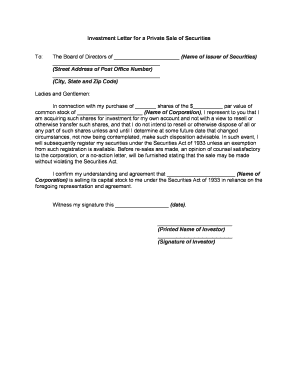
An Investment Letter for Private Sale of Securities is a signed written statement used in exempt private placements to document an investor’s status, qualifications, or reliance on a securities exemption. The letter typically confirms the investor meets criteria such as accredited investor status, investor sophistication, or a purchaser’s representation required by Rule 506(b) or 506(c) under Regulation D. Issuers use these letters to support reliance on federal and state exemptions, create an audit trail, and limit resale risk. The letter is usually executed before or at the time securities are transferred.

Why an Investment Letter Matters for Compliance and Risk Management

The Investment Letter documents the investor’s representations needed to rely on private offering exemptions and helps establish an evidentiary record in the event of regulatory review or dispute.

Why an Investment Letter Matters for Compliance and Risk Management

Who typically completes and relies on this Investment Letter

Typical users include issuer counsel, placement agents, accredited investors, and compliance teams preparing offering materials.

  • Issuers and issuers’ counsel who need a written representation from purchasers prior to closing.
  • Placement agents and broker-dealers documenting investor qualification and suitability for a private placement.
  • Accredited and sophisticated investors confirming status and acknowledging resale restrictions.

Representative signers and their roles

Purchaser

An individual or entity buying securities who signs to confirm investor status, provide identifying details, and accept resale limitations. The purchaser’s authorized officer or natural person must sign if an entity is involved. Accurate identity data supports anti-fraud defenses and issuer due diligence.

Issuer Representative

An officer, general counsel, or placement agent who countersigns or retains the letter as evidence the issuer documented investor representations and complied with offering procedures. This role supports record retention and regulatory defense if the exemption is questioned.

Step-by-step: completing the Investment Letter for a private securities sale

Follow these concise steps to ensure the letter supports the offering exemption and closing.

  • 01
    1. Gather investor info: Collect legal name, entity type, address, and identification.
  • 02
    2. Determine status: Confirm accredited or sophisticated status and supporting evidence.
  • 03
    3. Populate letter: Complete fillable fields with matching documentation references.
  • 04
    4. Sign and retain: Obtain signatures and store copies with offering records.

How an Investment Letter fits into the private placement workflow

The letter is a documented investor representation step inserted into offering workflows to support exemption reliance and closing mechanics.

  • Submission: Investor returns completed letter before or at subscription.
  • Verification: Issuer or agent reviews supporting documents and flags discrepancies.
  • Acceptance: Issuer countersigns and approves subscription once satisfied.
  • Recordkeeping: Retain the executed letter with offering files and closing binder.

Configuring an online workflow for Investment Letters

Set up a secure digital workflow to collect, authenticate, and preserve investor letters and supporting evidence.

Field Configuration
Investor Name Field Required, autofill from subscriber form
Accredited Status Dropdown Conditional field showing documentation checklist
Supporting Docs Upload Require PDF upload; limit file types
Signature Field Enable eSignature and timestamping

Digital signing and retention considerations for investment letters

Maintain exportable copies and an immutable audit log to support regulatory review and possible investor disputes.

  • Authentication: Email, SMS code, or stronger KBA when required
  • Audit Trail: IP, timestamp, and action log preserved
  • Document Formats: PDF and DOCX support for archival

Core elements to include in a professional Investment Letter

A complete investment letter combines clear investor representations, identification, transaction details, and signature metadata to support exemption reliance and downstream transfer restrictions.

Investor Representations

Explicit statements confirming accredited status, investment intent, and understanding of resale restrictions help issuers rely on Regulation D exemptions and limit secondary market complications.
Transaction Details

Include the number and type of securities, purchase price, and effective date so the letter links directly to the subscription and closing records.

Supporting Evidence

List or attach documentation such as tax returns, brokerage statements, or corporate formation documents used to verify accredited or institutional status.

Regulatory Language

Reference the specific exemption relied upon (for example, Rule 506(b) or 506(c) under Regulation D) to clarify the legal basis for the reliance.

Resale Limitations

State the lock-up or legend requirements and any transfer restrictions that affect the investor’s right to resell the securities.

Signature and Attestation

Include printed name, title, signature, date, and a statement of authority for entity signers to ensure enforceability and traceability.

Required data fields at a glance

Investor Name: Legal name
Entity Type: Individual or entity
Address: Full street address
Accredited Basis: Income/net worth
Transaction Date: MM/DD/YYYY
Signature: Signed and dated

Penalties and risks of an incorrect or missing Investment Letter

Loss of Exemption: Offering could lose Regulation D protection
Rescission Risk: Investors may seek contract rescission
Regulatory Review: SEC inquiry or state blue-sky scrutiny
Civil Liability: Potential private damages claims
Secondary Market Holds: Transfers may be blocked by legend
Reputational Harm: Issuer credibility may suffer

Common mistakes to avoid when preparing the letter

  • Using informal or abbreviated legal names that don’t match supporting documents and impede verification.
  • Failing to attach or index supporting evidence such as bank statements or tax returns required to substantiate accredited status.
  • Ambiguous dated fields or missing effective date that create uncertainty about when representations apply relative to closing.
  • Accepting unsigned or improperly authorized entity signatures without viewable proof of signatory authority or corporate resolution.

Real-world examples of how investment letters are used

These short case summaries show typical uses across issuers and intermediaries.

Early-Stage Startup

A seed-stage issuer required representative accredited investor letters from convertible note buyers to document exemption reliance.

  • The letters included supporting bank statements.
  • The issuer retained signed letters and evidence in the closing binder, which supported its exemption when counsel reviewed the file during due diligence for a later financing.

Private Placement With Broker

A placement agent collected investment letters from institutional buyers to confirm suitability under their internal policy.

  • Letters referenced entity formation documents.
  • The agent stored the executed letters in the secure document repository and provided them to transfer agent for accurate shareholder ledger updates.

Timing considerations and typical deadlines

Track key dates to ensure representations apply at closing and records meet retention expectations.

Representation Effective Date:

Set as closing date or subscription date

Document Collection Deadline:

Collect prior to funding or share issuance

Record Retention Start:

Begins at closing or document creation

Investor Notification Window:

Promptly notify if additional info requested

Audit Production Time:

Produce records within regulator timeframe

eSignature vendor comparison for collecting Investment Letters (pricing and key limits)

Basic pricing and plan-level constraints affect cost and volume when digitizing investment letter collection; signNow is listed first for direct comparison.

signNow DocuSign Adobe Sign PandaDoc HelloSign
Starting Price $8/user/mo $15/user/mo $14/user/mo $19/user/mo $15/user/mo
Free Trial 7-day free trial Varies by plan Varies by plan Varies by plan Varies by plan
Bulk Send Available (Business Premium) Available Available Available Varies
Audit Trail Yes Yes Yes Yes Yes
Envelope Cap No envelope cap 100 envelopes/user/year limit Varies by plan Varies by plan Varies by plan

Common questions about Investment Letters for private securities sales

Answers to frequent questions about validity, signatures, records, and post-closing issues for investor letters.


Need help? Contact support

be ready to get more
Join over 28 million airSlate SignNow users