Establishing secure connection…Loading editor…Preparing document…

Letter Regarding Proof of Claim in Bankruptcy

This template is fully customizable. Edit the text, fill out the fields, and send it for signature. Give it a try!
Letter Regarding Proof of Claim in Bankruptcy

What the Letter Regarding Proof of Claim in Bankruptcy Is

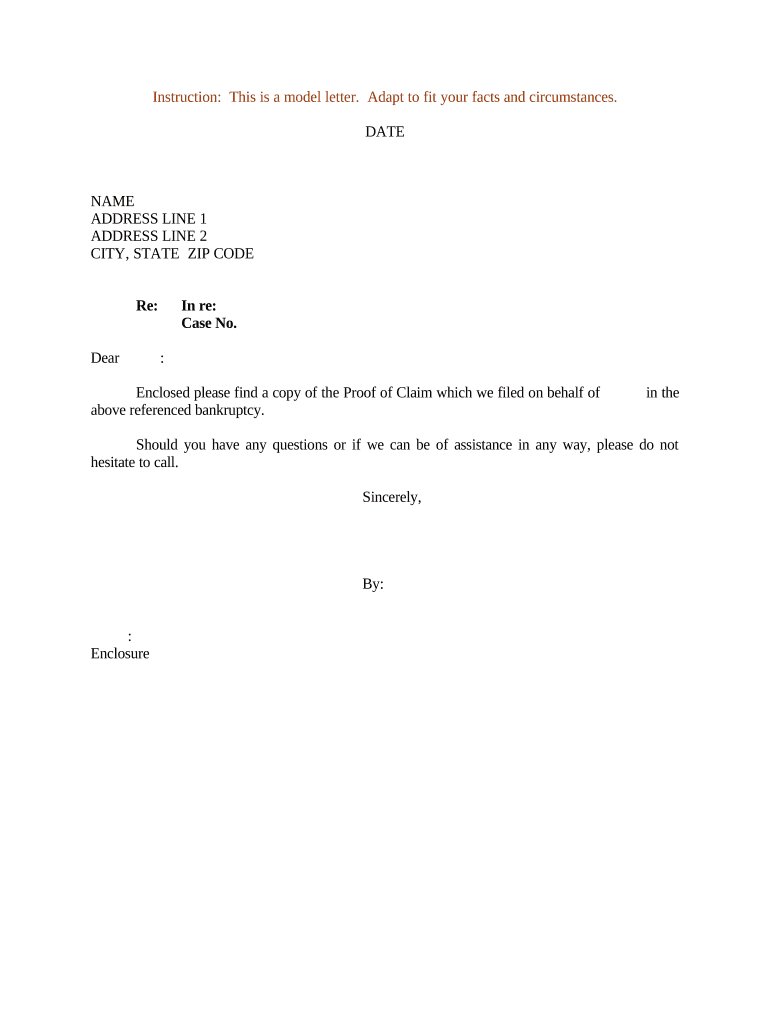
A Letter Regarding Proof of Claim in Bankruptcy is a concise, formal cover letter submitted by a creditor alongside a Proof of Claim (or to accompany correspondence with the bankruptcy court, trustee, or debtor). It summarizes the creditor's identity, the basis and amount of the claim, reference to the bankruptcy case number and docket, and a list of supporting attachments such as invoices, contracts, security agreements, or lien documentation. The letter clarifies asserted priority, any secured interest, and contact information for claim inquiries so the court and trustee can docket and process the claim efficiently.

Why a Clear Letter Improves Your Proof of Claim

A focused letter reduces confusion, speeds docketing, and helps trustees and creditors understand the factual and legal basis for the claim.

Why a Clear Letter Improves Your Proof of Claim

Who Typically Prepares and Sends This Letter

Creditors, collections teams, and law firms draft this letter to accompany a formal Proof of Claim or to respond to trustee inquiries.

  • In-house creditor teams handling receivables and secured liens who need to assert priority quickly.
  • Outside bankruptcy counsel preparing formal filings, evidence summaries, and legal argumentation for allowance.
  • Vendors and service providers documenting unpaid invoices and attaching proof of delivery or contracts.

The sender varies by organization size and claim complexity; attorneys usually handle contested or large-dollar claims, while creditors may file straightforward claims directly.

Primary Signers and Preparers

Creditor — Accounts Receivable

Accounts receivable managers prepare claims for routine unpaid invoices and include detailed billing records, purchase orders, and delivery receipts to establish the factual basis and amount claimed; they coordinate with legal counsel only when a claim is disputed.

Bankruptcy Counsel — Attorney

Bankruptcy attorneys draft claim letters when legal priority, secured interests, or complex contractual obligations are involved, attaching arguments, security documentation, and legal citations under 11 U.S.C. §502 when seeking allowance or relief.

Step-by-Step: Preparing and Submitting the Letter

Follow these steps in order to prepare a professional letter and ensure timely filing with the clerk and trustee.

  • 01
    Gather Documents: Collect invoices, contracts, security agreements, and UCC filings supporting the claim.
  • 02
    Draft Letter: Write a concise cover letter referencing the case caption, claim amount, and attachments.
  • 03
    Attach Proof: Assemble exhibits with consistent labels and include a table of contents.
  • 04
    File/Serve: E-file via the court's ECF system or mail to the trustee and serve required parties per local rules.

How Filing and Processing Typically Work

This sequence explains how a letter accompanies a Proof of Claim and how trustees and the court process it.

  • Prepare Packet: Combine the Proof of Claim, letter, and attachments into a single organized packet.
  • Submit to Court: E-file via the court's ECF system or mail per the local bankruptcy rules.
  • Serve Parties: Serve the trustee, debtor counsel, and other required parties to preserve rights.
  • Monitor Docket: Watch for objections, allowance orders, or trustee requests for additional information.

Digital Workflow Settings for Online Completion

Configure these settings when using an eSignature or document platform to prepare, sign, and submit the letter and attachments.

Field Configuration
Document Upload Support PDF/A format and combine exhibits into a single PDF.
Signature Method Allow typed, drawn, or cryptographic signatures per court acceptance.
Authentication Enable email or SMS verification for signer attribution and audit trail.
Docketing Notes Add a metadata field for the bankruptcy case number to facilitate ECF upload.

Technical Considerations for eSubmission and eSignatures

Ensure the platform you use supports court-acceptable PDF output, strong signer attribution, and an exportable audit trail.

  • File Formats: PDF, PDF/A, and DOCX supported for drafting and final export.
  • Integrations: Connectors for Google Workspace, Microsoft 365, and document storage speed filing.
  • Authentication: Email and SMS codes or higher-strength options for signer verification.

Preserve the audit trail and export a signed, tamper-evident PDF for ECF or court submission; include contact and signature timestamps for later evidentiary use.

Key Filing Deadlines to Watch

Bankruptcy courts set a claims bar date for each case; observe the docket and the court’s notice for date specifics and extension rules.

Claims Bar Date:

File by the court-issued bar date shown on the debtor's claims notice or risk disallowance.

New Claims After Bar Date:

Late claims require court permission and a showing of excusable neglect under Fed. R. Bankr. P. 9006(b).

Objection Deadlines:

Trustee or debtor objections typically follow local rules; monitor the docket for objection and response deadlines.

Service Deadlines:

Serve trustees and creditors per local rules immediately after filing to preserve rights.

Document Retention:

Keep originals and signed PDFs; courts or trustees may request originals during proceedings.

Milestone Timeline for a Typical Claim Submission

These numbered stages show a common timeline from preparation through monitoring after filing.

01

Stage One — Prepare

Assemble proof, invoices, contracts, and the cover letter with case caption.

02

Stage Two — File

E-file the Proof of Claim and upload the letter and exhibits to the court ECF system.

03

Stage Three — Serve

Serve the trustee, debtor counsel, and other required parties promptly after filing.

04

Stage Four — Monitor

Check the docket for allowance orders, adversary proceedings, or trustee requests for more information.

Essential Elements to Include in the Letter

A professional Letter Regarding Proof of Claim in Bankruptcy contains standard items that let the court and trustee quickly verify and docket your claim.

Case Caption

Full debtor name, court name, and case number at the top to ensure correct docket association and avoid misfiling.
Creditor Contact

Complete creditor name, mailing address, phone number, and email so the trustee and debtor counsel can communicate regarding the claim.

Claim Amount

Precise dollar amount and classification of the claim (secured, unsecured, priority) with any applicable interest or escrow figures.

Legal Basis

Short statement of why the claim exists (contract, breach, judgment) referencing relevant contractual sections or judgments.

Supporting Attachments

Index all exhibits—invoice numbers, dates, contracts, security instruments, UCC filings—with exhibit labels matching the PDF bookmarks.

Signature Block

Signature, printed name, title, and date; include electronic signature audit trail details when e-signed for attribution.

Practical Examples of Letter Use

Two concise examples illustrate how different creditors document and present claims and evidence to the court and trustee.

Vendor Claim

A supplier files a Proof of Claim with a cover letter summarizing three overdue invoices and shipping receipts

  • The point: attach invoices and proof of delivery
  • The outcome: clear labeling and concise explanation enabled the trustee to process the claim quickly and reduced follow-up requests for documentation by clarifying dates, amounts, and contract terms upfront.

Secured Lender Claim

A secured lender submits a letter citing the security agreement, UCC-1 financing statement, and collateral valuation

  • The point: emphasize lien priority and include recorded instrument reference
  • The outcome: authoritative documentation and precise exhibit references helped preserve lien priority during confirmation and simplified allowance discussions with the trustee.

Common Mistakes to Avoid

  • Omitting the bankruptcy case number or using an incorrect caption, leading to misdocketed documents and processing delays.
  • Failing to attach the underlying invoices or contracts referenced in the letter, forcing trustees to issue requests for production.
  • Using vague language about amounts or security (e.g., 'approximate balance') instead of stating the exact claimed sum.
  • Not serving required parties after filing, which can forfeit rights to assert or enforce certain claims.

Consequences of an Incorrect or Late Letter

Claim Disallowance: 11 U.S.C. §502 — court may disallow claims lacking sufficient proof or filed late.
Loss of Priority: Incorrectly classified claims can lose secured or priority status.
Delayed Recovery: Insufficient documentation increases time to resolution and distributions.
Sanctions Risk: Misleading statements may expose the filer to sanctions under court rules.
Increased Costs: Additional attorney time and responses to objections increase expenses.
Preservation Failure: Failure to serve timely may forfeit voting or distribution rights.

Frequently Asked Questions About Letters and Proofs of Claim

Answers to common questions about preparing, signing, filing, and correcting a Letter Regarding Proof of Claim in Bankruptcy.


Need help? Contact support

Select eSignature Pricing and Feature Comparison for Preparing and Signing Claim Letters

Comparison of baseline pricing and common features for eSignature providers; signNow is listed first to reflect plan and feature details used for document assembly and signing.

signNow DocuSign Adobe Sign PandaDoc HelloSign
Starting Price $8/user/mo $15/user/mo $14/user/mo $19/user/mo $15/user/mo
Free Trial 7-day free trial, no credit card required Varies by vendor Varies by vendor Varies by vendor Varies by vendor
Bulk Send Yes (Business Premium) Yes Yes Yes No
Audit Trail Yes Yes Yes Yes Yes
HIPAA Compliant Yes Yes Yes No No
Envelope Cap No envelope cap 100 envelopes/user/year Varies Varies Varies
be ready to get more
Join over 28 million airSlate SignNow users