Establishing secure connection…Loading editor…Preparing document…

Registration Rights Agreement

This template is fully customizable. Edit the text, fill out the fields, and send it for signature. Give it a try!
Registration Rights Agreement

What a Registration Rights Agreement Is and when it matters

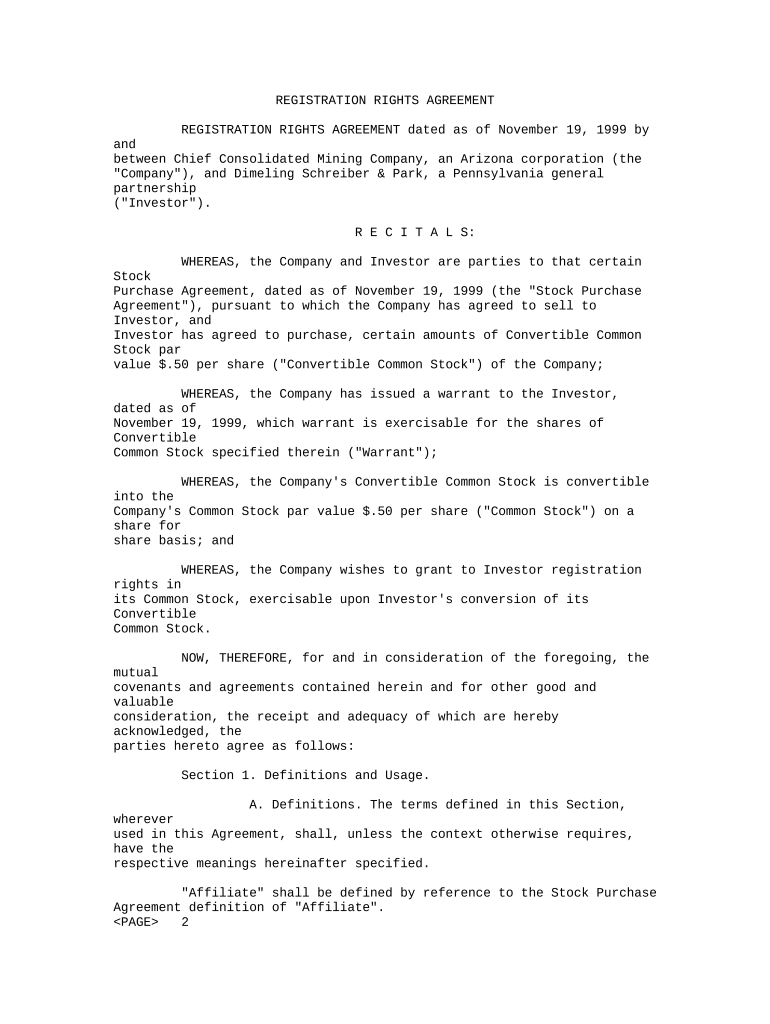
A Registration Rights Agreement is a contract between an issuer and security holders that allocates rights and obligations around registering privately held securities for resale under the Securities Act of 1933. Typical provisions include demand registration, piggyback registration, Form S-3 or shelf eligibility, allocation of registration expenses, underwriter indemnities, cutback and holdback mechanics, and timings for filings. These agreements are common in venture financings, private placements, and transactions where investors require a contractual path to liquidity by compelling or participating in a public registration.

Why a Registration Rights Agreement matters and its legal footing

Registration rights provide investors a contractual route to convert private holdings into publicly tradable shares and allocate who bears offering costs or indemnities. Electronic execution and delivery of these agreements are generally enforceable under the federal ESIGN Act (15 U.S.C. ch. 96) and state UETA statutes, subject to narrow statutory exceptions and agreement-specific formalities.

Why a Registration Rights Agreement matters and its legal footing

Who commonly negotiates and signs these agreements

The Registration Rights Agreement is used by investors, founders, and corporate counsel involved in private securities transactions; roles and motivations differ by party.

  • Venture investors and private equity funds protecting exit liquidity and resale paths for portfolio holdings.
  • Founders and early shareholders seeking predictable resale mechanics and clear obligations for public offerings.
  • Company counsel and outside securities lawyers drafting enforceable provisions that align with SEC filing mechanics.

Typical signatories and their perspectives

Venture Investor — General Partner

A GP negotiates registration rights to secure timely resale options and to allocate offering costs and indemnities. They seek clear demand triggers, cutback rules, and protections against issuer delays; the GP will evaluate registration mechanics against exit timing, liquidity objectives, and potential underwriting constraints.

Founder — Chief Executive Officer

A founder reviews registration covenants to balance investor liquidity with company control over public offerings and disclosure timing. Founders typically prefer limits on demand frequency, carve-outs for confidential product launches, and reasonable expense-sharing to avoid operational disruption.

How to complete a Registration Rights Agreement step by step

Follow these sequential steps to prepare, review, and finalize registration rights provisions before signing and filing related SEC documents.

  • 01
    Identify securities: List each registrable class and holder precisely for coverage.
  • 02
    Set registration types: Choose demand, piggyback, shelf, and S-3 eligibility specifics.
  • 03
    Allocate costs: Define which offering expenses issuer or holders will bear.
  • 04
    Execute and deliver: Obtain authorized signatures and distribute executed copies to parties.

Online workflow settings for efficient execution

Configure an electronic workflow to collect signatures, authenticate signers, and store completed agreements with audit trails.

Field Configuration
Signature fields Add signer, date, and initial fields for each party.
Authentication method Use email link, SMS code, or KBA for higher assurance.
Bulk send setting Enable when multiple holders sign identical forms.
Retention policy Enable secure storage and exportable audit trail.

Technical considerations for digital completion

Choose a platform that supports required file formats, signer authentication, and secure storage with exportable audit trails.

  • Integrations: Salesforce, NetSuite, Google Workspace supported
  • File formats: PDF, DOCX, HTML, Excel supported
  • Authentication: Email, SMS, KBA, and advanced options

Typical e-signature flow for registration documents

A concise digital signing workflow speeds execution and preserves an evidentiary audit trail for regulatory and contractual needs.

  • Upload document: Load the finalized agreement into the signing platform.
  • Place fields: Assign signature, date, and initial fields per party.
  • Authenticate signer: Confirm identity with email, SMS, or higher-assurance method.
  • Complete & archive: Capture signed PDF and audit trail for records.

Common timing elements to track in registration rights

Registration rights often create interlocking timing obligations; document and calendar each trigger to avoid missed windows and disputes.

Demand notice window:

Period parties may give formal notice to require registration.

SEC comment cycle:

Time between filing and SEC comments on registration statements.

Effectiveness target:

Target date for registration statement effectiveness.

Cutback allocation:

Timeline to apply pro rata reductions among holders.

Termination date:

When registration rights expire or convert.

Common drafting and execution pitfalls to avoid

  • Vague description of registrable securities that leads to disputes about which classes are covered and whether conversions or options are included.
  • Unclear timing or frequency clauses that allow repeated demands, creating operational burdens and potential conflicts with planned public offerings.
  • Missing or ambiguous expense allocation and indemnity language that leaves parties litigating who pays underwriting discounts or SEC-related costs.
  • Failure to coordinate registration mechanics with transfer restrictions, lockups, and underwriter cutbacks, causing unintended barriers to resale.

Security, compliance, and technical guarantees to document

Encryption in transit: TLS 1.2/1.3
Encryption at rest: AES-256
SOC 2 Type II: Attestation available on request
ISO 27001: Certified
HIPAA support: BAA required for PHI
21 CFR Part 11: Compliant controls available

Contractual risks and potential consequences

Indemnity obligations: Holders may require issuer indemnity
Expense exposure: Issuer may bear substantial offering costs
Delay penalties: Contract damages or reputation harm
Transfer limits: Restrictions can impair liquidity timing
Underwriter cutbacks: Pro rata reductions in selling allotments
Enforcement costs: Litigation or arbitration expenses

eSignature provider comparison for executing registration agreements

Compare common feature and pricing dimensions across providers relevant to legally executing Registration Rights Agreements; signNow is listed first per platform availability.

signNow DocuSign Adobe Sign PandaDoc HelloSign
Starting Price $8/user/mo $15/user/mo $14/user/mo $19/user/mo $15/user/mo
Free Trial 7-day free trial Varies Varies Varies Varies
Bulk Send Yes (Business Premium) Varies Varies Varies Varies
Audit Trail Yes Yes Yes Yes Yes
HIPAA Compliant Yes Yes Yes No No

Frequently asked questions about Registration Rights Agreements

Answers to frequent execution, enforceability, and operational questions when preparing, signing, or enforcing registration rights provisions.


Need help? Contact support

be ready to get more
Join over 28 million airSlate SignNow users