Case Identification
Court name, docket or case number, judge’s name, and filing county. These details let clerks and recipients locate the ruling quickly and avoid administrative delays.
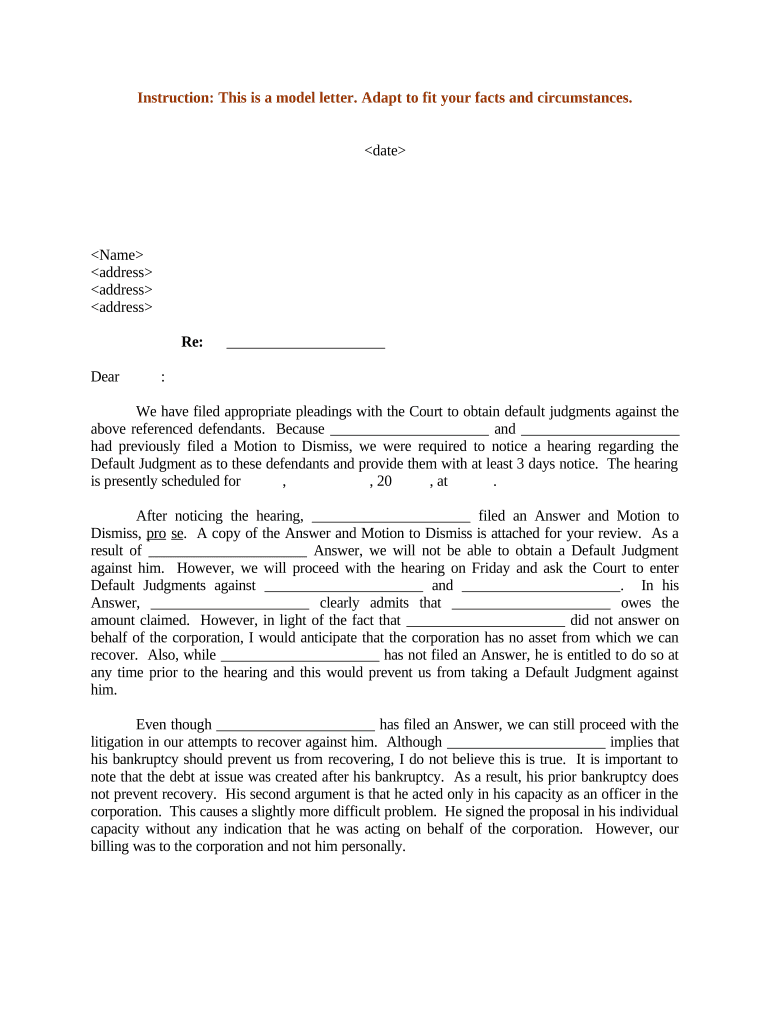
A precise letter documents the judgment, reduces disputes about notice, and preserves enforcement options. It also creates a clear record for courts, creditors, and third parties when pursuing collections or recording liens.

Use this letter when an official default judgment exists and you need to provide formal notice, request records, or initiate enforcement; consult counsel when jurisdiction-specific steps are required.
The plaintiff or the plaintiff’s licensed attorney typically has authority to sign and send the letter. The signer should identify their role, bar number if applicable, and include contact information to support service and verification.
A documented agent such as a collection firm or designated representative may sign when granted written authority. Keep the agent authorization on file to prove standing in subsequent enforcement or filing actions.
Court name, docket or case number, judge’s name, and filing county. These details let clerks and recipients locate the ruling quickly and avoid administrative delays.
State the judgment amount, date entered, interest rate, and any awarded costs. A clear summary reduces disputes about amounts owed and enforcement scope.
Reference how the defendant was served and attach proof of service or affidavit to verify procedural compliance and preserve enforceability.
Specify the purpose: recording lien, initiating garnishment, requesting payoff statement, or confirming satisfaction. Explicit requests produce faster responses.
Attach certified judgment, writs, costs itemization, and proof of service. Attachments substantiate claims and are often required by third parties.
Include printed name, title, firm, mailing address, phone, email, and a dated signature. Signatory identity supports attribution and legal strength of the notice.
| Field | Configuration |
|---|---|
| Authentication | Email + SMS code or stronger KBA as required |
| Signature Type | Electronic signature with audit trail |
| Template | Create reusable template with conditional fields |
| Retention | Enable reproducible PDF and audit log retention |
Keep proof of transmission and delivery for the case file; some courts accept electronic filings and RON-signed documents where permitted.
Interest usually starts from judgment date.
Record promptly per county rules to perfect lien.
States vary for judgment renewal periods.
Keep service records for statute of limitations.
Follow local rules for writs and garnishment timing.
The team digitized judgment notices for remote enforcement to streamline follow-up.
Xerox integrated signed judgment letters into NetSuite for automated processing.
| signNow | DocuSign | Adobe Sign | PandaDoc | HelloSign | |
|---|---|---|---|---|---|
| Starting Price | $8/user/mo | $15/user/mo | $14/user/mo | $19/user/mo | $15/user/mo |
| Free Trial | Yes, 7-day free trial | Varies by plan | Varies by plan | Varies by plan | Varies by plan |
| Bulk Send | Yes | Yes | Yes | Yes | No |
| Audit Trail | Yes | Yes | Yes | Yes | Yes |
| HIPAA Compliant | Yes | Yes | Yes | No | No |