Establishing secure connection…Loading editor…Preparing document…

Request for Salary Increase Letter

This template is fully customizable. Edit the text, fill out the fields, and send it for signature. Give it a try!
Request for Salary Increase Letter

What a Request for Salary Increase Letter Is and When to Use It

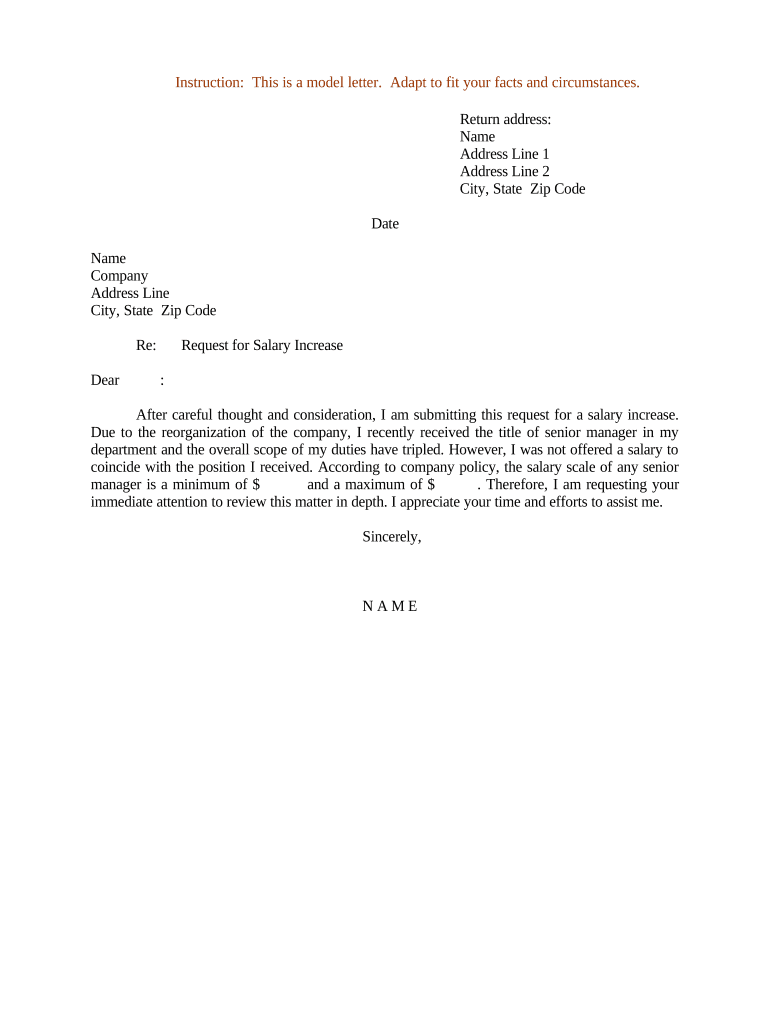
A Request for Salary Increase Letter is a concise, written request from an employee to their manager or HR asking for a pay adjustment. It typically summarizes the employee's role, accomplishments, market research or benchmarking, the requested salary or range, and a proposed effective date. The letter serves as a formal record that starts an internal review, aligns expectations, and supports consistent HR decision-making. Use this letter when you seek a raise outside routine performance reviews or to document a raise request after taking on sustained additional responsibilities.

Why a Formal Written Request Matters

A written request clarifies the employee's rationale, creates an auditable record for HR, and helps managers evaluate compensation against documented performance and market data. It reduces misunderstandings and supports equitable decisions across teams and business units.

Why a Formal Written Request Matters

Who Typically Prepares or Receives This Letter

The letter is usually prepared by the employee, or by HR on behalf of the employee in special cases, and routed to the employee's direct manager and HR business partner.

  • Individual contributors seeking market- or performance-based adjustments within their current role.
  • Managers compiling requests for salary committee review and budget approval.
  • HR professionals who log, review, and retain salary request records for compliance.

Essential Parts of a Professional Salary Increase Request

A structured letter increases the chance of a fair review. Include context, evidence, and a clear requested outcome to make the decision straightforward for approvers.

Opening

State your purpose in one sentence: request a salary review or raise, include job title and current compensation summary to anchor the request.
Justification

Summarize achievements, measurable outcomes, and added responsibilities with dates and metrics where possible to show sustained contribution.

Market Data

Provide salary benchmarks or ranges from reliable sources and explain how your current compensation compares to the market and internal peers.

Requested Amount

State a specific target salary, range, or percentage increase and propose an effective date for any adjustment.

Supporting Docs

Attach performance reviews, target-attainment records, client feedback, or external salary reports to substantiate the request.

Closing

Offer to discuss details, indicate flexibility, and request a timeframe for the manager's response to set mutual expectations.

Required Information and Fields at a Glance

Employee Name: Full legal name
Job Title: Current title
Department: Team or unit
Current Salary: Base pay amount
Requested Salary: Target amount
Effective Date: MM/DD/YYYY

Step-by-Step: How to Complete the Letter

Follow these steps to prepare a focused, professional request that HR and your manager can evaluate efficiently.

  • 01
    Draft opening: State purpose, job title, and current compensation.
  • 02
    List achievements: Provide 3–5 measurable accomplishments with dates.
  • 03
    Add market data: Include sources and comparative ranges.
  • 04
    Propose outcome: State the requested amount and effective date.

How to Customize and Complete the Letter Online

Configure a digital template with fields for employee details, justification, attachments, and routing to streamline submissions and approvals.

Field Configuration
Employee Details Single-line text fields; required validation on names and email
Requested Amount Numeric field with currency formatting and range hints
Attachments Accept PDFs or DOCX; limit 10 MB per file
Routing Sequential approval workflow: manager → HR → compensation committee

Where to Send the Letter and Typical Routing

A clear routing path ensures timely review and consistent recordkeeping across manager, HR, and compensation teams.

  • Direct Manager: First reviewer for performance context and initial recommendation.
  • HR Business Partner: Validates policy, budget eligibility, and documentation completeness.
  • Compensation Approver: Confirms budget impact and approves final amount.
  • Payroll: Implements approved salary changes and schedules effective date.

Digital Distribution and eSubmission Options

Use secure internal channels or an eSignature-enabled platform to route and store requests while preserving audit trails and attachments.

  • Email: Common but less auditable
  • HR System: Preferred for tracking and reporting
  • eSignature Platform: Provides audit trail

Typical Timelines and Expected Response Windows

Processing times vary by employer size; set clear expectations in the letter for when you expect a response and when changes would take effect.

Manager Response Window:

Ask for acknowledgment within 7–10 business days

HR Review Period:

Allow 10–30 business days for policy and budget checks

Compensation Decision:

Allow 2–6 weeks if committee review is required

Payroll Implementation:

One full payroll cycle after approval is common

Effective Date:

Specify MM/DD/YYYY to align with payroll cutoff

Common Mistakes to Avoid

  • Being vague about the requested amount or range — unclear requests delay approval and create extra back-and-forth.
  • Failing to provide supporting metrics or documentation — unsubstantiated requests rely on memory and are harder to approve.
  • Skipping internal policy checks — ignoring budget windows or eligibility rules can result in automatic denial.
  • Using informal channels with no audit trail — undocumented verbal requests lead to disputes and recordkeeping gaps.

Risks and Consequences of Incorrect or Incomplete Requests

Denied Request: Incomplete info may cause denial
Payroll Errors: Wrong amounts trigger corrections
Tax Withholding: Incorrect pay impacts withholding
Record Discrepancy: Poor records hinder future claims
Equity Issues: Inconsistent approvals create pay inequity
Delayed Action: Missing dates postpone increases

eSignature Provider Comparison for Salary Increase Workflows

Compare common plan features and starting prices for popular eSignature services. signNow appears first and pricing reflects typical annual billing tiers.

signNow DocuSign Adobe Sign PandaDoc HelloSign
Starting Price $8/user/mo $15/user/mo $14/user/mo $19/user/mo $15/user/mo
Free Trial 7-day free trial No No Yes, limited Yes, limited
Bulk Send Yes Yes Yes Yes No
Audit Trail Yes Yes Yes Yes Yes
HIPAA Compliant Yes Yes Yes No No

Sample Scenarios: Request Letters That Worked

These anonymized examples show concise requests with measurable justification and clear outcomes to guide your own letter.

Case Study 1

An account manager documented 12 months of quota overachievement and expanded responsibilities

  • Requested a 10% base increase supported by three quarterly reports
  • HR approved a 7% increase plus a short-term bonus; payroll implemented the change at the next cycle and documented the rationale for future reviews.

Case Study 2

A software engineer outlined critical feature ownership and market salary data for the role

  • Requested a salary to align with median market range
  • Manager escalated to compensation committee; the employer adjusted the salary to the requested midpoint and set a six-month follow-up for equity review.

FAQs — Common Questions About Salary Increase Requests

Answers to frequent practical and procedural questions about preparing, submitting, and following up on a salary increase request.


Need help? Contact support

be ready to get more
Join over 28 million airSlate SignNow users