Establishing secure connection…Loading editor…Preparing document…

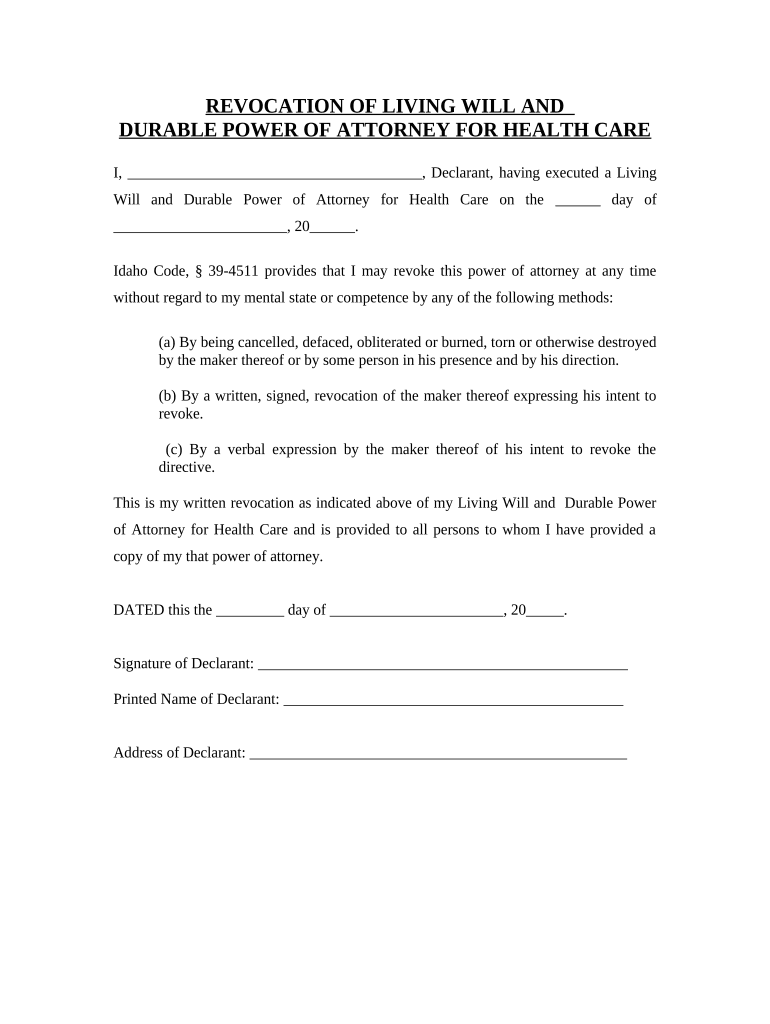
Revocation of Statutory Living Will and Durable Power of Attorney for Health Care

This template is fully customizable. Edit the text, fill out the fields, and send it for signature. Give it a try!
Revocation of Statutory Living Will and Durable Power of Attorney for Health Care

What this revocation document does and when it applies

A Revocation of Statutory Living Will and Durable Power of Attorney for Health Care is a signed statement by the principal that cancels an earlier advance directive and health-care power of attorney. It informs health-care providers and previously appointed agents that the principal no longer authorizes the prior document, and it identifies any new instructions or agents. State law governs formality and delivery requirements; federal e-signature frameworks (ESIGN Act, 15 U.S.C. §7001) and UETA apply where electronic execution is permitted.

Why you might create a formal revocation

A clear, signed revocation prevents ambiguity about who may make health-care decisions and which advance instructions apply. It reduces the risk of unwanted treatment and clarifies records for providers, hospitals, and family members.

Why you might create a formal revocation

Who completes or receives this revocation

After execution, copies should be distributed promptly to the former agent, current providers, and any state registry where the original was filed.

  • Principals revoking documents: Individuals who previously executed an advance directive or durable power of attorney and now wish to cancel it.
  • Health-care agents and alternates: People named in prior documents who must be notified to prevent unauthorized decision-making.
  • Healthcare providers and institutions: Hospitals, clinics, and long-term care facilities that maintain advance directive records.

Core elements included in a professional revocation form

A complete revocation form combines identification, a clear revocation statement, signature blocks, and delivery instructions so providers and agents can act on the principal's intent without delay.

Principal identification

Full legal name, date of birth, and optionally government-issued ID number to match the original document.
Clear revocation clause

Explicit statement revoking the named living will and durable power of attorney for health care, naming the earlier document date if known.

New instructions

Optional space to state any new agent appointments or directives replacing the prior document.

Signature and date

Principal signature and execution date; indicate if signed electronically under ESIGN/UETA or physically.

Witness/notary block

Witness signature lines and/or notary acknowledgement per applicable state law for authentication.

Delivery directions

Instructions for who receives copies (former agent, health providers, state registry) and how to confirm receipt.

Step-by-step: executing and distributing a revocation

Follow these steps to complete the revocation and communicate it to relevant parties so the cancellation takes effect without delay.

  • 01
    Confirm intent: Decide and document that you wish to revoke the prior living will and POA.
  • 02
    Complete form: Fill in identification, name the documents being revoked, sign, and date the revocation.
  • 03
    Authenticate: Add required witnesses or notarization per state law to meet execution requirements.
  • 04
    Distribute copies: Deliver signed copies to the former agent, new agent (if any), all treating providers, and any state registry.

Where to send copies and how the revocation takes effect

Proper delivery ensures third parties learn about the revocation; methods vary by recipient and state rules.

  • Former agent: Provide a signed copy so the person stops acting under the revoked authority.
  • Health-care providers: Give copies to hospitals, primary care, and any long-term care facilities maintaining advance directives.
  • State registries: If your state offers an advance directive registry, submit a copy per that registry's procedure.
  • Family and caregivers: Share the document with key family members to minimize confusion at a critical moment.

Digital workflow settings to use when completing online

Configure authentication, notarization options, and retention settings in your e-signature platform before sending to ensure legal compliance.

Field Configuration
Authentication Email link + SMS code or stronger KBA where available
Signature type Simple electronic or PKI-based digital signature for higher assurance
Notary integration Enable RON session or add local notary step per state rules
Retention Enable audit trail, download PDF/A, and store per HIPAA/record policies

Digital signing and eSubmission: technical considerations

Confirm the platform complies with ESIGN (15 U.S.C. §7001) and state notarization requirements before relying on electronic execution.

  • Authentication: Support for email, SMS, or knowledge-based authentication
  • Notarization: Integration with RON or export for in-person notarization
  • Storage: Encrypted storage (AES-256) and exportable audit trail

Timing and practical deadlines to observe

There is no universal federal filing deadline; act promptly to notify agents and providers so the revocation is recognized when needed.

Effective date:

Revocation takes effect on the date signed unless the document specifies otherwise.

Provider notification:

Deliver copies immediately to treating providers to prevent overlap with old directives.

Registry submission:

Submit to state registries as soon as possible when available to update public records.

Notary scheduling:

Arrange notarization or RON session in advance; RON sessions may require identity proofing steps.

Record retention:

Keep executed copies indefinitely; follow applicable retention rules for health records.

Common mistakes to avoid when preparing a revocation

  • Failing to identify the prior document clearly, which can leave providers uncertain which instrument is revoked and delay care decisions.
  • Not notifying the former agent and health providers promptly, allowing the previous agent to act under the mistaken belief authority remains.
  • Omitting required witness or notary authentication under state law, which can render the revocation ineffective in later disputes.
  • Relying on informal methods (oral statements, email) without a signed document and proper distribution, increasing litigation risk.

Legal risks and consequences of an incorrect revocation

Invalid revocation: May leave prior agent authority intact
Medical decision conflict: Care teams may follow older directive during disputes
Probate litigation: Family disputes can lead to court intervention
Privacy exposure: Improper distribution can reveal sensitive health information
Notary noncompliance: Improper notarization can void authentication
Recordkeeping gaps: Absent copies may complicate enforcement

Essential information fields and what they should contain

Principal Name: Full legal name
Principal DOB: MM/DD/YYYY
Document Revoked: Title and execution date
Signature: Principal signature and date
Witness/Notary: Witness names or notary block
Distribution List: Recipients and delivery method

Realistic scenarios showing how revocations are used

Practical examples illustrate typical reasons for revoking and the distribution steps that follow.

Changing a designated agent

A principal moved and selected a new health-care agent

  • The previous agent was formally notified in writing
  • Copies were delivered to the new agent and all treating providers, avoiding conflicting decisions and clarifying records for hospital staff.

Updating treatment preferences

A principal revised end-of-life care preferences following medical changes

  • The living will was revoked and replaced with updated instructions
  • The signed revocation and new directive were sent to the primary care physician, hospital medical records, and family members to ensure the new wishes were followed.

Practical tips for clear, enforceable revocations

Follow these best practices to reduce disputes and ensure the revocation is recognized by providers and courts.

Be precise about the document
Identify the specific living will and durable POA being revoked by title and date to avoid ambiguity; include the principal's full legal name and birth date to match medical records and prior filings.
Authenticate per state law
Follow witness and notary rules applicable in your jurisdiction; when in doubt, obtain notarization or use a RON session with retained audio-video and identity proofing to strengthen evidentiary weight.
Distribute broadly and keep proof
Deliver signed copies to former agent, new agent (if any), all treating providers, and any state registry; retain delivery receipts or email confirmations as proof of notice.
Record version changes
Attach the revocation to the original directive in medical records, and note the revocation date in patient charts so care teams can verify which instruction governs treatment.

Frequently asked questions about revoking health-care directives

Answers to common execution and enforcement questions, including electronic signing and notarization concerns.


Need help? Contact support

be ready to get more
Join over 28 million airSlate SignNow users