Establishing secure connection… Loading editor… Preparing document…
Navigation

Fill and Sign the Rules of an Association Form

Fill and Sign the Rules of an Association Form

How it works

Open the document and fill out all its fields.
Apply your legally-binding eSignature.
Save and invite other recipients to sign it.

Rate template

4.7
58 votes
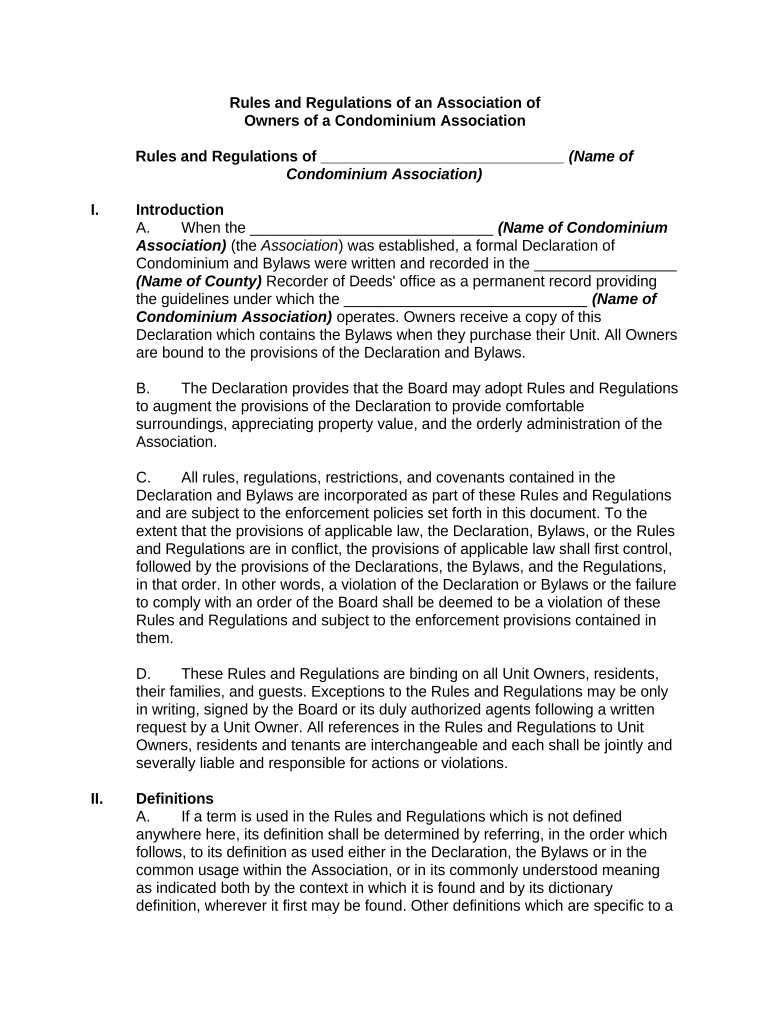
Rules and Regulations of an Association of Owners of a Condominium Association Rules and Regulations of _____________________________ (Name of Condominium Association) I. Introduction A. When the _____________________________ (Name of Condominium Association) (the Association ) was established, a formal Declaration of Condominium and Bylaws were written and recorded in the _________________ (Name of County) Recorder of Deeds' office as a permanent record providing the guidelines under which the _____________________________ (Name of Condominium Association) operates. Owners receive a copy of this Declaration which contains the Bylaws when they purchase their Unit. All Owners are bound to the provisions of the Declaration and Bylaws. B. The Declaration provides that the Board may adopt Rules and Regulations to augment the provisions of the Declaration to provide comfortable surroundings, appreciating property value, and the orderly administration of the Association. C. All rules, regulations, restrictions, and covenants contained in the Declaration and Bylaws are incorporated as part of these Rules and Regulations and are subject to the enforcement policies set forth in this document. To the extent that the provisions of applicable law, the Declaration, Bylaws, or the Rules and Regulations are in conflict, the provisions of applicable law shall first control, followed by the provisions of the Declarations, the Bylaws, and the Regulations, in that order. In other words, a violation of the Declaration or Bylaws or the failure to comply with an order of the Board shall be deemed to be a violation of these Rules and Regulations and subject to the enforcement provisions contained in them. D. These Rules and Regulations are binding on all Unit Owners, residents, their families, and guests. Exceptions to the Rules and Regulations may be only in writing, signed by the Board or its duly authorized agents following a written request by a Unit Owner. All references in the Rules and Regulations to Unit Owners, residents and tenants are interchangeable and each shall be jointly and severally liable and responsible for actions or violations. II. Definitions A. If a term is used in the Rules and Regulations which is not defined anywhere here, its definition shall be determined by referring, in the order which follows, to its definition as used either in the Declaration, the Bylaws or in the common usage within the Association, or in its commonly understood meaning as indicated both by the context in which it is found and by its dictionary definition, wherever it first may be found. Other definitions which are specific to a particular Rule are contained within that Rule. 1. Act: The _____________________ (state condominium statute) . 2. Assessment or Monthly Maintenance Assessment — Any amount which the Board may assess or levy against a Unit Owner, either individually or collectively, including regular monthly assessments, special assessments and charges or expenses or assessments, which are levied pursuant to the Declaration, Bylaws or the Rules and Regulations. 3. Association —The _______________________ (Name of Condominium Association) . 4. Board — The Board of Directors of the ___________________ _______________ (Name of Condominium Association) . 5. Bylaws — The Bylaws of the __________________________ (Name of Condominium Association) and as properly amended from time to time subsequently. 6. Common Elements or Common Property — The common elements defined in the Declaration. 7. Declaration — The Declaration of Covenants, Conditions and Restrictions of __________________________________ (Name of Condominium Association) which was recorded in the Office of the Recorder of Deeds of ________________ (county) , on ______________ (date) , document number ________________ (number) and as properly amended from time to time subsequently. 8. Limited Common Element — A portion of the common elements reserved for the use of a certain Unit or Units to the exclusion of other Units. The balconies, door stoops, porches, porch lights, windows, window boxes, and window frames, entrance door, storm doors, patio doors, garage doors, soil stacks, chimneys, and furnace flues and any improvement or alteration to the Common Elements by a Unit Owner or resident, appurtenant to one or more Units are limited common elements of such Unit or Units, consisting of the exclusive right of the Owner of such Unit or Units to use those Limited Common Elements. The cost of maintenance, repairs, or replacements of the Limited Common Elements may be assessed in whole or in part to the Unit to which the limited common element is assigned. Further, the Board may direct the Owners in their name and accounts, to arrange for maintenance, repairs and replacements of the Limited Common Elements and to pay the cost of them, and procure and deliver to the Board such lien waivers and contractor's and subcontractor's sworn statements as may be required to protect the property from all mechanic's or materialmen's lien claims that may arise from them. All such maintenance, repairs and replacements shall be in conformity with rules adopted by the Board. 9. Manager or Management Firm or Managing Agent — The person or entity, if any, which has been employed by the Association to manage the day to day administration of the property in the manner directed by the Board. 10. Owner or Unit Owner — The person or persons whose estates or interests individually or collectively aggregate fee simple absolute Ownership of a Unit. 11. Property — All the real property against which the Declaration has been recorded, including any improvements on it. 12. Resident — Any person who resides on the property, including families of Unit Owners and tenant or tenants of Unit Owner(s) and including a Unit Owner if the context so indicates. 13. Rules or Rules and Regulations — The Rules and Regulations of the Association, as adopted pursuant to the powers available to the Board and the Association. 14. Unit — A part of a single condominium including one or more rooms occupying one or more floors or parts of a floor, designed or intended for independent use as a single-family dwelling and delineated on the plat attached to the Deed of Condominium with respect to the single condominium. III. Policy Concerning Monthly Maintenance Assessments A. The monthly payments required of all Unit Owners are essential for the orderly and proper management of the buildings and common areas. The payments must be made on time, made payable to the ___________________ ________________ (Name of Condominium Association) and mailed to the designated depository on or before the first day of each month. B. The Board determines the monthly maintenance assessments due based on the annual budget and the percentage of Ownership of each Unit. The budget covers the standard calendar year and is approved by ______________ (date) of the previous year. The budget includes current operating expenses as well as reserves for repair and replacement of common elements. C. Other items which might be included in an Owner's monthly assessment fee would include any fines assessed, attorney's fees for collecting delinquent assessments from that Owner, and the charges incurred by the Association in repairing or replacing limited common elements. D. Owners of record or beneficiaries of a land trust are ultimately responsible for the payment of the assessment. The Board has established the following rules and procedures to handle the collection of the monthly maintenance assessments: E. All assessments are due the first of each month. The Manager shall provide a monthly statement to each Owner showing the current amount of the assessment, any past due assessments, and any late fee charges and any known fines or other charges incurred prior to the first of the month. F. Assessments received after the ______ (day) of the month are deemed late. An administrative fee (late charge) of $_________ will be automatically assessed to the account of each Unit Owner whose assessment is not received by the due date. G. Any payment of less than the full amount of the assessment and other charges due in any given month also shall be deemed late and subject to the $_________ administrative (late) fee. H. The administrative (late) fee of $________ will be cumulatively assessed for each succeeding month that the monthly assessment and fees remain unpaid. I. Assessments paid with a check that is returned by the financial institution of the person paying the assessment as uncollectable due to non-sufficient funds or other reason shall incur an additional fine of $_________ to be added to any financial institution charge and the Association's administrative (late) fee. J. Any payments received must be applied to the oldest outstanding charges first. All late fees, legal fees, and fines collected shall be credited to the operating fund. K. Owners who are delinquent in the payment of their monthly assessments due to illness, job loss, or similar cause are encouraged to maintain frequent contact with Management. The Association's attorney may arrange a payment plan after the amount is reviewed with the Board. Payment plans are arranged on an individual basis at the request of the delinquent Owner. L. The Board may waive administrative (late) fees under appropriate circumstances as determined by the Board. M. The Manager will assess the $________ administrative (late) fees and commence appropriate action to collect delinquent assessments the day after the assessment is due. Delinquent assessments may be referred automatically for collection to the Association's attorney or a collection agency, as appropriate, for prompt action. Time of referral is at the discretion of the Board and may be for a delinquency of as little as one month. This is especially likely in the case of repeated delinquencies N. In addition to any legal action undertaken by the Board to collect delinquent assessments and other charges, the Owner's delinquency may be reported to the two largest credit reporting agencies in the __________________ (Name of City) metropolitan area. O. Unit Owners who are delinquent in assessments and/or other charges shall be subject to legal action in accordance with the provisions of the Declaration and By-laws. Once collection action has commenced, the Unit Owner shall be liable for all costs involved in the collection process, including Association attorney's fees. The Unit Owner shall remain in default of his or her obligations until the assessments, the administrative fees and the costs of collection and any other charges are paid in full. P. Legal action to be undertaken on behalf of the Association may include, but is not limited to, obtaining a judgment for the monies due, obtaining a judgment for possession of the Unit, evicting the Owner from the Unit, placing a lien against the Unit and/or instituting a foreclosure action. Q. Any Owner who enters into a payment plan for past due assessments and who violates any term of that payment plan shall be liable for immediate payment of all outstanding obligations and other charges. Also, that Owner shall be ineligible for participation in any future payment plan without the express authorization of the Board. R. Any legal or other charges incurred in the collection process will be borne by the Unit Owner. IV. Policy on Prosecution of Vandalism and Trespass A. The Board recognizes that it has an obligation to protect the Association's property and residents from vandalism and trespass. To further this goal, the Board will provide rewards supplying information leading to the conviction of any person involved in vandalism or trespass on the property. B. The Board offers a reward of $_________ for anyone providing information or evidence leading to the conviction in a court of law of any individual who vandalizes any portion of the common elements. In the instance of more than one individual providing the evidence or testimony, the reward shall be shared unless the conviction payment to the Association of more than the costs of repair of the vandalism and other associated costs. C. The Board offers a reward of $__________ for anyone giving information or evidence leading to the conviction in a court of law of any individual who trespasses on Association property. In the instance of several individuals providing testimony or evidence, the reward shall be shared. D. The Board will reimburse individuals providing evidence or testimony related to either of the above offenses for reasonable travel expenses. V. Appearance and Use of the Property A. Buildings 1. Nothing may be attached, added or altered to or on the common elements, including building exteriors, without the written permission of the Board or its duly authorized agent acting at the direction of the Board. 2. Metal entrance doors must be of a style approved by the Board and may not be replaced, painted or otherwise altered without prior written permission from the Board or its duly authorized agent acting at the direction of the Board. Any damage to the entrance doors is the responsibility of the Unit Owner. 3. All storm doors must be white in color and cross-buck in design. Residents must secure written permission from the Board or its duly authorized agent acting at the direction of the Board before installing a new or replacing an old storm door. 4. Storm doors must be maintained in good repair by the Unit Owner. Once a storm door is installed, maintenance of the storm door becomes the responsibility of the Unit Owner. 5. Unit Owners are responsible for maintaining both interior and storm windows. All windows must be maintained in good repair with the appropriate number of panes and colors specified for the particular building and Unit. Broken panes of glass or ripped screens must be repaired promptly. To prevent damage to buildings, storm windows shall be closed whenever it rains or snows. No window air conditioners or other equipment may be installed or placed so as to extend beyond the window frame. 6. Replacement windows must be of the style and colors currently specified for that particular building and Unit type. Owners must secure prior written permission from the Board or its duly authorized agent acting at the direction or the Board before replacing any window. 7. Garage doors and frames must be maintained in good condition, and garage doors are to be kept fully closed except when in use for entering and exiting the garage or for any other reasonable purpose. Any damage to the garage door or frame will be repaired by the Association and the Unit Owner will be charged for the repair. 8. Unit Owners are responsible for maintaining the balcony doors on those types of Units. Prior to any alteration or replacement of a balcony door, the Unit Owner must secure written permission from the Board or its duly authorized agent acting at the direction of the Board. 9. Permanent window treatments must be installed no later than ___________________ (number) months from the effective date of these Rules or within ___________________ (number) months after a resident moves in. Until permanent ___________________ (type) window treatments are installed, only white or off-white sheets or paper may be used as a temporary means of providing privacy. 10. The Association has installed permanent and uniform mailboxes for each Unit. No other mailbox may be used. Unit Owners may request prior permission to install a mail slot in the Unit's garage door from the Board or its duly authorized agent acting at the direction of the Board. 11. All exterior maintenance requests will be handled by the Board or its duly authorized agent. 12. The front porch light fixtures may not be replaced without prior written permission of the Board or its duly authorized agent acting at the direction of the Board. The lights must be of a style consistent with the originally installed light fixture and the light bulb and glass or plastic in the fixture shall be clear, white, or amber in color. 13. No outdoor decorations are permitted except for decorations which can be placed on the Unit's door. No decorations which create a safety or fire hazard are permitted. 14. Outside water hoses or other attachments must be removed from the outside spigots no later than ___________________ (date) of each year and shall remain off of the spigot until ___________________ (date) of the following year. Expenses incurred for repair of the spigot shall be borne by the responsible Unit Owner, unless it can be shown that the damage to the spigot was not caused by an improper attachment. 15. No one is permitted on any building roof for any reason without express written permission of the Board or its duly authorized agent. As this is a safety hazard, a fine of $_________ per involved person shall be levied against the Owner/and or resident of the applicable Unit. Additionally any person supplying the Board or Management with information which results in the levying and collection of such fine(s) shall receive a $___________ reward to be paid by the Board. The Unit Owner shall be responsible for costs associated with any damage and inspection fee. Also the Unit Owner shall be responsible for the roof warranty should the roofer deny warranty protection due to such roof activity. 16. Working smoke detectors must be installed on each floor of the Unit. Owners must comply with all governmental required safety equipment or standards. 17. Any internal alterations to a Unit performed by an Owner or resident must be completed in conformance with all applicable building codes. Owners are responsible for obtaining any applicable building permits. 18. Unit Owners and/or residents must maintain the interior of the Unit and all appliances and equipment in such a manner that no health or safety hazards occur. Plumbing shall be maintained so as not to incur unwarranted water usage. 19. The Units or property cannot be used for any illegal activities. Conviction in a court of law for any illegal act which was committed on Association property shall result in a fine of $__________ to be paid by the offender or the Owner of the property associated with the offense. This does not apply to the victim of any illegal act which was committed on the property, only the perpetrator. The Association may institute proceedings against any person who, on the basis of this conviction, is deemed a threat to any person or property. 20. Owners and/or residents must comply with all governmental orders affecting water usage, utilities, and the like. Following notice of any restrictions to all residents, an immediate fine of $_________ will be imposed on the violator or the Unit Owner associated with the violation. Additionally, the violator will be responsible for any fine or fee assessed by a governmental body for such violation. 21. Toxic chemicals may not be used in any area where it might affect other residents or the common elements. 22. Disposable diapers and other items which may clog drains may not be discharged into the sewer system via the toilets or any other sewer entrance. 23. On or before ___________________ (date) of each even- numbered year beginning with ___________________ (date) , every Unit Owner having a fireplace in their Unit shall provide the Board or the Managing Agent with a receipt verifying that the fireplace and chimney (including gas starters) have been checked and cleaned as needed. If no receipt has been received by that date, the Association shall arrange for such a check and cleaning at the Owner's expense and/or assess a $__________ fine. Unit Owners who fail to provide a receipt will be subject to a fine of $__________ a week until such proof is received. This is in addition to the initial $__________. B. Common Property 1. Storage of any kind is prohibited on the common property, except that stoops and balconies may be used for storage of seasonal items such as barbecue grills, lawn chairs and other items usually associated with stoops and balconies. 2. Picnic tables and similar items may be kept on the common elements in front of an Owner's or resident's Unit. All such items must be moved to the sidewalk, or asphalt or Owner's garage on lawn mowing days. Such items shall be kept in good repair and appearance. During the winter months such items must be moved to the garage or to an area which will not interfere with snow removal activities. Any damage caused to the common elements by these items is the responsibility of the Unit Owner. 3. All toys, recreation equipment, bicycles, and similar items must be removed from the common elements by sunset and stored either in the garage or neatly on the front stoop or balcony. Care should be taken to prevent accidents involving toys or other items on the sidewalk or asphalt areas. 4. Toddler playground equipment or toddler sandboxes are restricted to the front stoops or areas immediately adjacent to the Unit's front door stoop. Any damage caused to the common areas by this equipment or activity is the responsibility of the Unit Owner. 5. Stoops and balconies may not be decorated, enclosed, altered or the appearance changed in any way without the prior written permission of the Board or its duly authorized agent acting at the direction of the Board. 6. Unit Owners and residents must keep stoops orderly and free from clutter. 7. No awning, sunroof, canopy, or shutter of any type is permitted on the buildings or common elements. 8. Unit Owners may not enclose any portion of the common elements with a fence, tent, or any other boundary or structure without the prior written permission of the Board or its duly authorized agent acting at the direction of the Board. 9. Stoops and balconies must not be used as pet runs. 10. Clothing, sheets, blankets, laundry, and similar objects shall not be hung out or exposed on stoops, balconies, or other common property. 11. Any games or other activities which create a nuisance, damage any common elements or individual Units, or disrupt the peace are prohibited on or in any portion of the common elements. 12. Unit Owners are responsible for their family members, tenants, guests, invitees, and pets and their activities. Any common property (including sod) damaged by the neglect or abuse of a Unit Owner, family member, tenant, guest, invitee, or pet shall be repaired at the expense of the responsible Unit Owner. 13. Acts of vandalism to any portion of the common elements will result in the institution of an immediate $_________ fine per involved person. This fine shall be in addition to the payment by the Owner for all expenses incurred in repairing the damage caused by the vandalism. A second act of vandalism related to that Owner will result in the doubling of the fine. Any subsequent violation will result in the institution of eviction proceedings. Any person supplying the Board or Management with information which results in the levying and collection of such fine(s), shall receive a minimum of $_________ reward to be paid by the Board. Additionally, criminal charges shall be filed against the alleged perpetrator(s) of the vandalism. 14. Littering on the common elements is not permitted 15. The cost of repairing any damage to the common elements will be assessed to the Unit Owner responsible for such damage or associated with those causing it. In determining responsibility it shall be presumed that any damage immediately outside a Unit was caused by the residents in it or others associated with that Unit unless it can be shown that no one associated with that Unit was responsible for the damage. C. Flowers l. Flowers are the only type of landscaping that residents may plant without obtaining prior permission of the Board or its duly authorized agent acting at the direction of the Board. 2. Private flower beds must be limited to original non-sodded areas around the exterior of the Units. All other plantings shall be subject to prior approval by the Board or its duly appointed agent acting at the discretion of the Board. A drawing of suggested additional plants must be submitted to the Board as a precondition to the Board's consideration of the request. 3. Owners and residents may not enlarge the original non-sodded areas by removing sod. 4. All flower beds or gardens must be planted in such a way so as not to interfere with the maintenance equipment used on the property, such as mowers and snow removal equipment. Therefore, edging and the like must not be more than ___________ (number) inches higher than the ground. 5. Unit Owners are responsible for the care and maintenance of any flower beds or gardens they plant. 6. Vegetable gardens and fruit trees are not permitted. 7. Once an approved flower bed or garden has been planted, the Association is no longer responsible for replacing sod in that area. 8. Any trees, shrubs, or plants to be installed on the property must be approved by the Board or its duly authorized agents, unless otherwise authorized in these Rules and Regulations. 9. Unit Owners are responsible for keeping lawn areas immediately surrounding their Units clean and free from debris. Any damage done to this area by pets, residents, guests, etc. shall be repaired immediately by the Owner or resident, or such repair shall be made by the Association and the Owner charged for the work. D. Seasonal Decorations 1. Seasonal decorations are permitted, provided that they can be placed on the Unit's door, front door, front stoop, or balcony. No nails, screws, or other devices that puncture the siding or other building material may be used to hang or secure the seasonal decorations. Any damage caused by seasonal decorations shall be repaired by the Unit Owner or the repair will be performed by the Association with the Unit Owner charged for the repair. 2. Seasonal decorations may not be installed any earlier than _________ (number) days before the holiday, and must be removed no later than _______ (number) days after the date of the holiday. 3. Seasonal decorative lights are permitted on the front stoop and adjacent trim, on the balcony and adjacent trim and the trees and shrubs directly in front of or next to a Unit. No nails, screws, or other devices that puncture the wood, aluminum, masonite or other building materials may be used to hang or secure the decorative lights. The Association will not be responsible for any damage done to decorative lights or other decorative items due to seasonal maintenance of the property. 4. Owners and residents who install decorative lights must exercise extreme care not to cause a safety or fire hazard. Only properly rated UL- approved equipment may be used. Unit Owners and/or residents assume liability for any situations arising out of the use of decorative lights or any other decorative item. E. Signs 1. Advertising signs for business or commercial activities are prohibited everywhere on the property. However, one "For Sale" sign may be displayed in the window of a Unit. The sign shall be limited to a maximum size of ________________ (maximum size of sign) . 2. Signs may not be attached to any exterior portion of the Unit including the garage. 3. Directional signs for an open house and/or similar events are permitted with the following provisions. a. The signs shall be posted only on the day of the event. b. Unit Owners or residents are limited to _________ (number) directional signs; _________ (number) at the entrance to the cul de sac and ________ (number) within the cul de sac. c. The Owner or resident posting the sign(s) shall be responsible for any damage caused to the property by its installation. 4. Violation of the sign rule will be subject to an immediate $___________ fine to be assessed against the Unit's Owner. F. Waste Disposal 1. Household garbage must be placed in plastic bags and placed outside the Unit's garage no earlier than dark the night before pick- up. No trash cans or similar containers may be used. 2. Residents are encouraged to take care in placing garbage so that it is not blown or scattered about. Residents are encouraged to pick up any litter around the property. 3. Prior to placing large items out for disposal pick-up, residents must contact management to arrange for such disposal. 4. Large items left outside for pick-up without prior arrangements will not be picked up. Management will arrange for a special pick-up, and the Unit Owner associated with this special pick-up shall be responsible for the costs of the special service. 5. Any dumping of items on the common elements will result in an immediate fine of $___________. Also, to encourage proper reporting of dumping, the individual(s) reporting the dumping will receive the collected fine. VI. Permitted Vehicles, Driving, and Parking A. General Rules 1. Only those vehicles defined in Section C below are permitted to be parked on the premises by Owners tenants or guests. 2. Parking is permitted in only those paved areas specified in Sections D and E below. 3. Unit Owners and residents are responsible for their own and their guests' vehicles while they are on the premises. This includes any commercial vehicles on the property for the purpose of providing a service to any resident. Unit Owners and residents are personally liable for any damage to the premises caused by their own or guests' vehicles. Unit Owners have ultimate liability for any damage caused to the common elements by their own, their guests' or their tenants' vehicles. 4. No repairs or service to any vehicle will be permitted on the premises. Emergency service such as tire and battery repairs is permitted. Toxic fluids from vehicles, such as anti-freeze, may not be discharged into the sewer or drainage systems. 5. Vehicles of Owners and residents only may be washed and polished in appropriate paved areas. The area must be thoroughly cleaned following the procedure. Vehicles of non-residents may not be washed or polished on the premises. 6. The Association provides annual stickers for each vehicle of residents. The stickers are numbered for easy identification by cul de sac . Failure to secure a vehicle sticker for each vehicle shall be considered a violation of the Association's rules, subject to warning notices and fines. See Section F for more complete information on vehicle stickers. Forms requested by the Board in relation to vehicles must be returned by the date stipulated. Failure to do so will result in the levying of a $__________ administrative fee with the second request. Failure to respond to this second request shall result in the levying of a $____________ fine. 7. Enforcement of all vehicle and parking rules is accomplished through stickering, towing, and the general Association fine structure, as appropriate. See Article 9 and specific vehicle and parking sections for detailed information. 8. Vehicles may not be "warmed up" while in the confines of the garage. Such vehicles must be removed from the garage area to such a location as to prevent any exhaust fumes from entering any garage or Unit. 9. Any vehicle that has an alarm must be properly maintained so as to not cause "false alarms" or unwarranted repeat alarms that disturbs residents. B. Speed Limit -- _______ (number) m.p.h. 1. Vehicles may not exceed ______ (number) miles per hour within the cul de sacs. 2. Drivers must use extreme caution and watch for children playing in the cul de sacs . C. Vehicles 1. Permitted vehicles. The following types of vehicles may be permitted in appropriate paved parking areas. a. Passenger automobiles having no more than four entry doors and/or five-door station wagons. Also permitted are vehicles classified as mini-vans or sport utility vehicles and bearing current license plates. Such vehicles must display current vehicle registration documentation (license plates with current stickers). The vehicles shall display a current Association sticker. b. Lightweight recreational motor vehicles, excluding campers, having no more than four wheels. Such vehicle shall have a curb weight of less than _______ (number) pounds, an overall length of less than ______ (number) feet and an overall width of less than _______ (number) feet. Such vehicles shall display current vehicle registration documentation (license plates with current stickers) showing the vehicle to be of a "B" or "RV" class or other passenger vehicle. The vehicle must display a current Association sticker. c. Motorbikes and motorcycles that is currently registered and licensed to be ridden on ________________ (state) roads and highways. The vehicles must display a current Association sticker. d. Vehicles as described above, but belonging to guests of residents and without an Association sticker. These vehicles may remain on the property while guests are visiting a resident. This is to be a short-term arrangement (less than _______ (number) week(s). Longer term parking arrangements require authorization by the property manager and/or the Board depending on total length of time involved. e. Emergency vehicles, such as ambulance, police, and fire vehicles or other health and safety vehicles, being used for emergency purposes on the property. f. Service vehicles on the property at the invitation of a resident, Owner or management in the performance of a specific service or task. The vehicle shall not be permitted to remain overnight without the authorization of the property manager. 2. Prohibited Vehicles. The following types of vehicles are not permitted to park anywhere on the property, except inside a resident's closed garage. These vehicles shall be towed from the property ______ (number) week(s) after a stickered warning notice or other notice is issued. The Owner of a towed vehicle or the Owner or the Unit associated with the towed vehicle is responsible for all towing, storage and associated costs. a. Any vehicle without current state license plates and sticker and/or required Association or vehicle sticker. b. All vehicles not included in the Permitted Vehicles section. c. Campers, trailers, boats, ATVs, dirt bikes, snowmobiles or similar equipment. The use of or driving of any such vehicle on the property shall result in a fine of $__________ to be levied against the Owner/resident of the Unit associated with the prohibited vehicle. In addition, any damage to the common elements resulting from use or driving of the above vehicles shall be the liability of the Owner/resident of the Unit associated with the prohibited vehicle. d. Any commercially marked truck or van. Residents who own this type of vehicle may request Board authorization to park the vehicle on the property with appropriate covering of the commercial markings. 3. Stored or abandoned vehicles. Stored or abandoned vehicles are not permitted on the property, except inside a resident's closed garage. These vehicles shall be towed off the property ______ (number) week(s) after a stickered warning notice or other notice is issued. The Owner of the towed vehicle or the Owner of the Unit associated with the towed vehicle shall be responsible for all towing storage and associated costs. The following vehicles will be deemed stored or abandoned: a. Any vehicle that is in a state of disrepair rendering it incapable of being driven in that condition, or threatens the safety of the residents of any Unit is deemed abandoned. The vehicle may be removed by the Association immediately and without notice at the expense of the vehicle Owner or Unit Owner associated with that vehicle. Except in emergency situations an attempt will be made to notify the vehicle's Owner. b. Any vehicle that has not been used or moved for at least ______ (number) consecutive days. Residents who will be away for more than _____ (number) days should notify the manager of the dates and that the vehicle will be parked on the property during that time. c. Any vehicle for which the acts of the Owner and/or the condition of the vehicle are clearly indicative of abandonment. The Association has contracted with the following firm for the towing of vehicles: ________________________ (Name of towing service) . D. Parking 1. Parking of permitted vehicles will be confined to the following areas. a. Vehicles may be parked in the resident's garage. b. Permitted vehicles may be parked on the garage apron immediately in front of the resident's garage. c. Permitted vehicles may be parked in designated parking areas. Residents and their guests are restricted to parking in the cul de sac parking area of the cul de sac in which they reside. 2. The following are prohibited parking areas and vehicles may not be parked in these areas at any time. a. Any vehicle parked at the entrance to any cul de sac shall be towed, without notice, at anytime at the expense of the vehicle Owner or the Unit Owner associated with that vehicle. b. No vehicle may be parked within _______ (number) feet of any fire hydrant. c. No vehicle may be parked or driven on any unpaved surface on the property. d. No vehicle may be parked so as to interfere or block any sidewalk or the entrance to or exit from any Unit. e. No vehicle may be parked so as to interfere or obstruct passage of other vehicles on the property, including entering or exiting a garage or parking space. f. No vehicle may be parked in a manner which is considered to be interfering with entering or leaving a Unit for emergency purposes including protection, health, fire, and snow removal. g. No vehicle may be parked in any area except that which is specified as a parking area. The vehicle shall be deemed to be parked in the emergency corridor and may be towed immediately by the Association or appropriate public enforcement agency without notice at the expense of the vehicle Owner or Unit Owner associated with that vehicle. h. No vehicle may be parked in front of any garage other than the resident's own garage without the express permission of the Owner or resident of that Unit and garage. The vehicle shall be deemed to be parked so as to interfere with access to the Unit for emergency purposes and may be removed by the Association or appropriate public enforcement agency without notice at the expense of the vehicle Owner or Unit Owner associated with that vehicle. i. Damage to the common elements paved or unpaved caused by any vehicle must be repaired by the Association and the Owner and/or resident of the Unit associated with that vehicle will be responsible for all costs involved in the repairs. This is in addition to any applicable warnings and fines. E. Parking during Winter Months 1. No vehicle may be parked in the areas designated snow dump at any time during the winter months' period, which is defined as the period from ________________ (date) to ________________ (date) . 2. When snow is forecast, vehicles may not be parked in front of garage doors so as to enable the snowplows to properly remove snow from the garage aprons. 3. Any vehicle parked in violation of subparagraph 1 or 2 above will be deemed to be interfering with the ingress to or egress from a Unit for emergency purposes and may be removed by the Association, plowing contractor, or appropriate public enforcement agency without notice at the expense of the vehicle Owner or Owner associated with that vehicle. 4. Other remedies may be used to provide proper plowing when vehicles are parked in violation of subparagraph 1 or 2 above. The plower may return to properly plow the involved area with such costs being borne by the Unit Owner in violation. Also, snow may be piled around a vehicle parked in violation of these rules. 5. The Association assumes no liability for damage to vehicles parked in violation of subparagraph 1 or 2. 6. Owners of vehicles that are properly parked are encouraged to move their vehicles when that area is being plowed. This assistance will provide for the best possible snow removal for all residents. F. Enforcement of Vehicle and Parking Rules 1. The Association vehicle identification sticker. a. In _____________ (month) of each year, the Association will request vehicle registration information, including license plate number, from each resident for each vehicle owned and/or operated by the residents of that Unit. b. On receipt of this information, the Association will furnish a vehicle identification sticker for the resident. Requests by the residents for an additional identification sticker must be made to the Board stating the reason for the request. As a part of the request for additional stickers, the Owner/resident must provide copies of all vehicle registration cards for which stickers are requested showing that each vehicle is registered to that address. Generally, Board approval is based on the availability of parking spaces. On Board approval, the additional sticker will be issued. c. Forms requested by the Board in relation to vehicles must be returned by the date stipulated. Failure to do so will result in the levying of a $___________ administrative fee with the second request. Failure to respond to the second request will result in the levying of a $___________ fine. d. Residents must display the Association identification sticker on the driver's side rear window or, if appropriate, the rear side window on the driver's side of the vehicle. e. Failure to display the sticker may result in the vehicle being stickered with a warning notice and/or towed with all expenses being borne by the Owner or Unit Owner associated with that vehicle. 2. Violation Notice/Warning Sticker a. In the event of a violation of these Vehicle, Driving, and Parking Rules, the Board or its duly authorized agents may affix a Violation Notice/Warning sticker to the side window on the driver's side of the window. b. The notice will contain such information as the Board deems appropriate for the violation. c. Any failure to protest a Violation Notice/Warning sticker within ______ (number) days will be deemed an admission of the violation and may result in the costs and expenses being assessed to the Unit Owner. Protests will be directed to the Manager and will be treated as a request for a hearing before the Board. d. In addition to any penalty noted above in this Article, any violation will be deemed a violation of the Rules and Regulations and appropriate penalties shall be assessed pursuant to the fine schedule contained in Article 9, Section C . VII. Pets A. No animals, other than dogs, cats, or other animals reasonably considered to be household pets, may be raised, bred, or kept anywhere on the property, nor may any animals be kept, bred, or maintained for any commercial purpose. B. Pets must be licensed by ________________ (county) and vaccinations kept up to date. Documents to prove this must be made available to the Board or management upon request. Pet Owners must comply with all state and local laws or ordinances pertaining to pets and/or their ownership. C. Pets must be maintained in a clean, safe, and quiet manner. D. All pets must be leashed while being walked outdoors and pet walkers must use the perimeter path for walking pets. Pet walkers must clean up after pets wherever the pet defecates. Pet walkers shall carry a means to pick-up pet litter whenever walking the pet on the property. E. No pet will be allowed to create a threat, nuisance, or unreasonable disturbance to any person or to cause damage to any common property or the property of any other resident. Pets must be controlled at all times when out of the Unit. F. Pets may not be tied to any common element or stationary object on it. Pets may not be left unattended out of the Unit at any time. G. All Unit Owners and/or residents are responsible for the actions of pets of anyone residing in or visiting the Unit. A pet violation by a guest shall be the responsibility of the Unit Owner/resident in whose Unit that person was a guest. H. The cost of repairing any damage to the common elements caused by a pet shall be assessed to the Unit Owner responsible. In determining responsibility, it will be presumed that any pet damage immediately outside the Unit of a pet Owner was caused by the pet in it unless evidence is presented to the contrary by the Unit Owner/resident. I. The conduct of all pets must be such as to not interfere with the rights and privileges of the neighbors of the pet Owner. VIII. Swimming Pools Rules and Regulations A. These Rules and Regulations are for the protection and benefit of all residents. Adherence to these Rules and Regulations will assure the safe and sanitary operation of the pool facilities. B. Swimming pool hours are _____________ (time) to ___________ (time) , daily, weather and pool conditions permitting. C. Entrance to the pool areas is by key only. Each Unit has been issued __________ (number) key(s). Replacement keys may be obtained from management for a $______________ fee. D. All persons using the pools or pool areas do so at their own risk and sole responsibility. The Association and/or management does not assume responsibility for any accident or injury in connection with such use. Residents agree to make no claim against the Association and/or management for or on account of any loss or damage to life or property sustained, and further to indemnify and hold harmless the Association and/or management from any claim arising out of injury sustained by any guest using the pools. E. Persons violating any of the following rules will be subject to a $___________ fine per person to be levied against the Owner(s) and or/resident(s) of the Unit(s) where the violator(s) reside(s) or is a guest. A second violation may result in the doubling of the fine to $___________ per person. Any subsequent violation will result in the institution of eviction proceedings. Additionally, violators will be barred from pool areas for the remainder of the season. Any person providing the Board or management with information which results in the levying and collection of such fine(s) will receive a minimum of $___________reward to be paid by the Board. 1. No person may enter the pool area alone or swim alone. 2. No person under the age of ________ (number) years of age may enter the pool area (not just the pool) without an adult [age ________ (number) or older] in attendance and responsible for their behavior and safety. 3. No fighting, disorderly conduct or vandalism, or similar conduct is permitted within the pool area. 4. No alcoholic beverages are permitted within the pool area at any time. 5. Wheeled baby carriages, strollers, or similar equipment are not permitted within the pool area. 6. No person is permitted in the pool area when it is not open for general use for any reason. F. The following rules are subject to the enforcement provisions contained in Article 9 of the Association's Rules, except that no warning notice will be issued and the first offense will result in a fine of $_________. Additionally, violators may be barred form the pool area for a period of up to the remainder of the season. 1. All guests must be accompanied by an adult resident [age ________ (number) or older]. There is a limit of ______ (number) guest(s) per Unit. Relatives are guests unless they are actually living with the resident, for an extended period of time. 2. Persons suffering from contagious diseases or any condition which has the appearance of being infectious may not use the pools. 3. Only persons wearing proper swimming attire are permitted in the pool area. Only swim suits or trunks are considered proper swimming attire; no cut-offs. Tee shirts are allowed for sunburned bodies. 4. Street shoes are not permitted anywhere in the pool. 5. Toddlers with disposable diapers are not allowed in the water; cloth diapers and protective plastic pants must be worn. 6. All persons (male and female) with long hair—chin length or longer -- must wear bathing caps while in the pool. No braiding, ponytails, or headbands are allowed. 7. All swimmers must take a shower with soap and water in the shower room before entering the pool. Suntan oil must be showered off before entering the water. 8. Roughness and rowdyism are not permitted. 9. Balls, toys and games, and diving are permitted only when conditions allow, and their use does not interfere with the swimming rights of others. 10. Standing, jumping, or sitting on the rope barrier, or removal of the rope barrier, is not permitted. 11. No abusive or profane language or breach of the peace will be tolerated. Loud music is not permitted. Radios, tape decks, and all similar "stereo equipment" must be used with headphones. 12. Personal conduct in the pools and shower rooms must be such that the safety of anyone is not jeopardized. 13. No food, gum, or beverages are permitted in the pool areas. Breakable materials, such as bottles or glasses, also are not permitted in the pool enclosure areas. 14. Smoking is permitted in designated areas only. 15. Residents are encouraged to bring their own deck chairs. Chairs and/or baby carriers cannot block access to the pool, or obstruct walkways. 16. Absolutely no animals are allowed in the shower rooms or pool areas at any time. G. The cost of any property damage will be charged to the Owner and/or resident associated with the property damage. H. The pools may be closed at any time due to any mechanical or operational difficulties. I. These rules may be revised or additional rules established at any time with proper notification to Owners and residents using the pools. J. Because of their size and usage by many unrelated people, the pools are considered semi-private. This status requires the pools and the swimmers conform with state and county regulations, as well as water testing. The state and county have final authority on opening and closing the pools. K. It is not the intention of the Association to deprive any resident of the use of the pools, but the pools must be operated in accordance with all laws, ordinances, and the Rules and Regulations. Violations will be treated seriously. IX. Enforcement Policy for the Rules and Regulations A. The Filing of a Complaint 1. A complaint which alleges a violation of the Declaration, the Bylaws, or Rules and Regulations may be initiated by any resident or by the Manager based on the Manager's personal observation. 2. Any complaint which alleges a violation of the Declaration, Bylaws, or Rules and Regulations shall be made in writing to the managing agent of the Association. The complaint shall include the following: a. The name, address, and phone number of the complaining witness. b. The Unit Owner's name and Unit number or the address of the Unit where the person or resident against whom the complaint is being filed. c. The specific details or description of the violation, including the date, time, and location where the violation occurred. d. If possible, photographs showing the violation. e. The signature and address of the complaining witness and the date on which the complaint is made. f. Complaints should be made as soon after the violation occurred as possible. g. To the extent possible, complaints will be kept confidential. In the event of a hearing, the complainant may be required to provide testimony or evidence related to the violation. h. No oral complaints will be accepted. 3. The willful filing of a false complaint or complaints under these rules or the repeated filing of frivolous complaints shall be deemed a violation of these Rules and Regulations and subject to the enforcement provisions contained in them. The use of these Rules and Regulations in a manner deemed to be a harassment of other residents shall also be deemed a violation of these Rules and Regulations and subject to the enforcement provisions contained in these Rules and Regulations. 4. Harassment of, or retaliation against any alleged complainant by the alleged violator or other associated with the alleged violator shall be deemed a violation of these Rules and Regulations and subject to the enforcement provisions contained in these Rules and Regulations. B. Violations and Notices of Violations 1. The Owner of record or beneficiary of a land trust ultimately is liable for any actions by the Board in relation to violations of the Declaration, Bylaws, or Rules and Regulations committed by a resident, guest, tenant, service person, or other person or animal associated with the Unit. 2. On receipt of a complaint or observation of a violation by the manager, the Association's manager will notify the Unit Owner/resident of the violation by letter. If the Owner is a non-resident, the Owner and resident will each be notified of the violation. 3. The notice of violation will provide specific details of the violation including the date, time, and location where the alleged violation occurred. Other pertinent information may be included by the manager as deemed appropriate. 4. The notice of violation will include information on the fine that may be levied and the date by which the levied fine must be paid if no hearing is requested. 5. The notice of violation will include information on how the alleged violator may request a hearing before the Board concerning the violation and/or fine. The notice will also contain the last date a request for a hearing may be received by the manager. The date will be no less than _______ (number) days from the date of the notice of violation. C. Fine Schedule 1. Except as otherwise provided in these rules, the following schedule of fines will apply to violations of the Rules and Regulations, the Declaration, the Bylaws, or a direct order of the Board.  First Violation Written Warning Notice  Second Violation $________________  Third Violation $________________  Fourth Violation $________________  Fifth Violation Initiation of Eviction Proceedings 2. In addition to, or in place of the above schedule, certain safety violations provide for the institution of an immediate fine. 3. Blatant disregard of the Rules and Regulations, the Declaration or the Bylaws, or direct order of the Board or what is deemed to be common sense and/or courtesy will result in an immediate fine of $_____________. 4. Violations will accumulate on a calendar year basis. Once a violation of any rule has occurred, any subsequent violation of any rule will initiate a fine, not just a second violation of the same rule. 5. In addition to any fine assessed, the Unit Owner/resident will be responsible for the costs associated with the violation, including but not limited to repair of damaged property and any attorney's fees or other fee incurred by the Board which may be associated with the violation. 6. Fines and assessments for damage must be assessed to the monthly maintenance assessment statement and must be paid along with that monthly assessment no later than the _________ (day) of that month. Failure to pay the fine and/or monthly assessment by the ________ (day) of the month will result in administrative (late) fee charges. D. Procedures to Request a Hearing 1. Owners/residents may request a hearing before the Board at the next appropriate Board meeting. 2. As a part of the notice of violation, a date is specified by which a hearing must be requested. The Owner/resident must prepare a request for a hearing and mail the request to the manager in sufficient time to arrive no later than the last date stipulated in the notice of violation. 3. On receipt of the request for a hearing, the manager will notify the President of the Association of the violation and request for a hearing and provide copies of all pertinent correspondence relating to this matter. 4. The President of the Association will schedule a hearing before the Board at the next regular Board meeting if time permits the proper notification to the alleged violator and complainant. If there is not sufficient time for such notification, the hearing will be scheduled for the following regular Board meeting. 5. Once the President has determined when the hearing will be conducted, the manager will notify the alleged violator and the complainant of the date and time of the meeting during which the hearing will be conducted. The hearing will be conducted in "Executive Session" at a regular or special meeting of the Board. 6. At the hearing, the Board will hear and consider arguments, evidence, or statements regarding the alleged violation. The complainant may be required to provide evidence and testimony related to the violation. Following a hearing and due consideration, the Board will issue its determination regarding the alleged violation. The decision of the Board will be final and binding on the alleged violator and complainant. 7. Any fine that may be levied for which a hearing has been requested will not become due until the Board has held a hearing and determined whether a violation has occurred and whether a fine shall be levied. However, other legal or equitable remedies may be pursued by the Board during this time. Generally, the Board will make its determination immediately following the hearing and advise the alleged violator of its decision at that time. However, if additional information or an opinion from the Association's attorney is needed, the determination will be made at a later date and the alleged violator and complainant will be notified of the determination at a later date in writing. 8. If no request for a hearing is filed within the prescribed period of time, a hearing will be considered waived and the allegations contained in the notice of violation will be deemed admitted and any prescribed remedy will be instituted. 9. Failure of an alleged violator to attend a requested hearing without advance request to change the hearing date will be deemed a waiver of the hearing and the allegations contained in the notice of violation will be deemed admitted and any prescribed remedy will be instituted. E. If any clause, phrase, provisions, or portion of these rules or the application of them to any person or circumstances shall be invalid or unenforceable under applicable law, such event shall not affect, impair or render invalid or unenforceable the remainder of these rules nor any other clause, phrase, provision or portion of these rules, nor shall it affect the application of any clause, phrase, provision, or portion of these rules to other permitted persons or circumstances. X. General Information A. The Association is located at _________________________________ (street address, city, state, zip code) . B. As a part of a township government, ________________ (town) provides snow removal and road repair for ________________ (name of street) ; the Association is responsible for any work on the cul de sacs. The ______________ (town) offices are located at __________________________________ (street address, city, state, zip code) . The telephone number is ________________ (telephone number of town) . C. The ________________ (Name of Condominium) is located on __________ (number) acres and contains __________ (number) cul de sacs . Each condominium is governed by a three-member Board of managers. The Master Association is composed of _________ (number) members and is responsible for the entire development. Elections are conducted on ________________ (date) of each year. There are ___________ (number) buildings containing __________ (number) Units in the development. There is one play lot and __________ (number) swimming pools located on the property. D. No parking is permitted on _____________________________________ _______ (street address, city, state, zip code) . However, permission for guest parking on _______________________________________________________ (street address, city, state, zip code) , may be obtained by contacting ___________________ (Name of appropriate employee of town or city) . XI. Major Areas of Service Performed by the Association A. Landscape Maintenance The Association provides landscape maintenance for all common elements of the property. This maintenance includes weekly lawn mowings, shrub and tree trimming, lawn edging, and spring and fall cleanups. The Association does not water but encourages residents to water the trees and shrubs and new sod when there is no rainfall. B. Snow Removal The Association is responsible for the snow removal from the cul de sacs, sidewalks and stoops. The normal procedure is to open a drivable path through each of the cul de sacs for early morning travel by residents. After the initial plowing, once most residents have left, the plows return to remove snow from the remainder of the paved areas. Sidewalks and stoops are cleared as quickly as possible. Snow removal is normally accomplished after a fall of ________ (number) inches or more. In this connection, it should be noted that vehicles may not be parked in front of garages until the snow has been removed as provided by the winter parking rule. This rule also provides that no vehicle may be parked in the snow dump areas from ________________ (date) through ________________ (date) . Residents are encouraged to assist in the snow removal by moving their vehicles from parking areas when the plows come through on the clean-up phase. C. Trash Removal The Association contracts for trash removal by a private trash-collector. Securely closed garbage bags (no containers are to be used) should be placed outside the Unit's garage no earlier than dark the night before pick-up. No large items or an unusually large amount of trash may be placed outside the garage for pick-up without prior authorization.

Useful tips for finalizing your ‘Rules Of An Association’ online

Are you fed up with the burden of managing paperwork? Look no further than airSlate SignNow, the leading electronic signature platform for individuals and organizations. Bid farewell to the tedious routine of printing and scanning documents. With airSlate SignNow, you can effortlessly fill out and sign paperwork online. Take advantage of the robust features included in this user-friendly and cost-effective platform and transform your approach to document management. Whether you need to authorize forms or collect electronic signatures, airSlate SignNow simplifies the entire process with just a few clicks.

Follow this comprehensive guide:

  1. Sign in to your account or sign up for a complimentary trial with our service.
  2. Click +Create to upload a file from your device, cloud, or our template collection.
  3. Open your ‘Rules Of An Association’ in the editor.
  4. Click Me (Fill Out Now) to finalize the document on your end.
  5. Add and designate fillable fields for others (if necessary).
  6. Proceed with the Send Invite settings to request eSignatures from others.
  7. Save, print your version, or convert it into a reusable template.

Don't stress if you need to collaborate with others on your Rules Of An Association or send it for notarization—our platform provides everything you need to achieve such goals. Create an account with airSlate SignNow today and elevate your document management to new levels!

Here is a list of the most common customer questions. If you can’t find an answer to your question, please don’t hesitate to reach out to us.

Need help? Contact Support
Rules of an association pdf
Rules of an association examples
Sample rules and regulations of an association
Rules and regulations of an Association pdf
Association membership Rules
10 rules in organization
Sample of rules and regulations of a group
List of rules and regulations
Rules of an association examples
Rules of an association pdf
Sample homeowners association rules and regulations
Sample Homeowners Association Rules and regulations pdf

The best way to complete and sign your rules of an association form

Save time on document management with airSlate SignNow and get your rules of an association form eSigned quickly from anywhere with our fully compliant eSignature tool.

How to Sign a PDF Online How to Sign a PDF Online

How to complete and sign paperwork online

In the past, working with paperwork took pretty much time and effort. But with airSlate SignNow, document management is quick and easy. Our robust and easy-to-use eSignature solution allows you to easily complete and eSign your rules of an association form online from any internet-connected device.

Follow the step-by-step guidelines to eSign your rules of an association form template online:

  • 1.Sign up for a free trial with airSlate SignNow or log in to your account with password credentials or SSO authorization option.
  • 2.Click Upload or Create and add a file for eSigning from your device, the cloud, or our form catalogue.
  • 3.Click on the document name to open it in the editor and utilize the left-side toolbar to complete all the blank fields properly.
  • 4.Place the My Signature field where you need to approve your form. Type your name, draw, or import a picture of your regular signature.
  • 5.Click Save and Close to finish modifying your completed form.

Once your rules of an association form template is ready, download it to your device, export it to the cloud, or invite other people to eSign it. With airSlate SignNow, the eSigning process only requires several clicks. Use our powerful eSignature tool wherever you are to manage your paperwork productively!

How to Sign a PDF Using Google Chrome How to Sign a PDF Using Google Chrome

How to fill out and sign documents in Google Chrome

Completing and signing documents is simple with the airSlate SignNow extension for Google Chrome. Adding it to your browser is a fast and beneficial way to deal with your forms online. Sign your rules of an association form sample with a legally-binding eSignature in a couple of clicks without switching between programs and tabs.

Follow the step-by-step guide to eSign your rules of an association form in Google Chrome:

  • 1.Navigate to the Chrome Web Store, search for the airSlate SignNow extension for Chrome, and install it to your browser.
  • 2.Right-click on the link to a document you need to approve and choose Open in airSlate SignNow.
  • 3.Log in to your account with your credentials or Google/Facebook sign-in option. If you don’t have one, you can start a free trial.
  • 4.Utilize the Edit & Sign toolbar on the left to fill out your sample, then drag and drop the My Signature option.
  • 5.Insert a picture of your handwritten signature, draw it, or simply enter your full name to eSign.
  • 6.Verify all information is correct and click Save and Close to finish editing your paperwork.

Now, you can save your rules of an association form sample to your device or cloud storage, send the copy to other individuals, or invite them to electronically sign your form with an email request or a secure Signing Link. The airSlate SignNow extension for Google Chrome improves your document workflows with minimum time and effort. Try airSlate SignNow today!

How to Sign a PDF in Gmail How to Sign a PDF in Gmail How to Sign a PDF in Gmail

How to complete and sign documents in Gmail

Every time you receive an email with the rules of an association form for approval, there’s no need to print and scan a file or download and re-upload it to a different program. There’s a much better solution if you use Gmail. Try the airSlate SignNow add-on to promptly eSign any documents right from your inbox.

Follow the step-by-step guidelines to eSign your rules of an association form in Gmail:

  • 1.Visit the Google Workplace Marketplace and look for a airSlate SignNow add-on for Gmail.
  • 2.Install the program with a related button and grant the tool access to your Google account.
  • 3.Open an email with an attachment that needs approval and utilize the S key on the right panel to launch the add-on.
  • 4.Log in to your airSlate SignNow account. Choose Send to Sign to forward the document to other parties for approval or click Upload to open it in the editor.
  • 5.Drop the My Signature option where you need to eSign: type, draw, or import your signature.

This eSigning process saves time and only requires a couple of clicks. Utilize the airSlate SignNow add-on for Gmail to adjust your rules of an association form with fillable fields, sign forms legally, and invite other individuals to eSign them al without leaving your mailbox. Boost your signature workflows now!

How to Sign a PDF on a Mobile Device How to Sign a PDF on a Mobile Device How to Sign a PDF on a Mobile Device

How to fill out and sign forms in a mobile browser

Need to quickly complete and sign your rules of an association form on a smartphone while working on the go? airSlate SignNow can help without needing to set up additional software applications. Open our airSlate SignNow tool from any browser on your mobile device and add legally-binding electronic signatures on the go, 24/7.

Follow the step-by-step guidelines to eSign your rules of an association form in a browser:

  • 1.Open any browser on your device and follow the link www.signnow.com
  • 2.Create an account with a free trial or log in with your password credentials or SSO authentication.
  • 3.Click Upload or Create and pick a file that needs to be completed from a cloud, your device, or our form catalogue with ready-to go templates.
  • 4.Open the form and fill out the blank fields with tools from Edit & Sign menu on the left.
  • 5.Place the My Signature field to the form, then enter your name, draw, or upload your signature.

In a few easy clicks, your rules of an association form is completed from wherever you are. As soon as you're done with editing, you can save the file on your device, create a reusable template for it, email it to other people, or ask them to eSign it. Make your documents on the go speedy and efficient with airSlate SignNow!

How to Sign a PDF on iPhone How to Sign a PDF on iPhone

How to fill out and sign paperwork on iOS

In today’s business community, tasks must be accomplished rapidly even when you’re away from your computer. Using the airSlate SignNow app, you can organize your paperwork and sign your rules of an association form with a legally-binding eSignature right on your iPhone or iPad. Set it up on your device to conclude contracts and manage forms from anyplace 24/7.

Follow the step-by-step guidelines to eSign your rules of an association form on iOS devices:

  • 1.Open the App Store, search for the airSlate SignNow app by airSlate, and set it up on your device.
  • 2.Launch the application, tap Create to add a form, and select Myself.
  • 3.Select Signature at the bottom toolbar and simply draw your autograph with a finger or stylus to eSign the form.
  • 4.Tap Done -> Save after signing the sample.
  • 5.Tap Save or use the Make Template option to re-use this paperwork in the future.

This process is so straightforward your rules of an association form is completed and signed in just a few taps. The airSlate SignNow application works in the cloud so all the forms on your mobile device are kept in your account and are available whenever you need them. Use airSlate SignNow for iOS to enhance your document management and eSignature workflows!

How to Sign a PDF on Android How to Sign a PDF on Android

How to fill out and sign paperwork on Android

With airSlate SignNow, it’s easy to sign your rules of an association form on the go. Set up its mobile app for Android OS on your device and start enhancing eSignature workflows right on your smartphone or tablet.

Follow the step-by-step guidelines to eSign your rules of an association form on Android:

  • 1.Go to Google Play, find the airSlate SignNow app from airSlate, and install it on your device.
  • 2.Sign in to your account or create it with a free trial, then add a file with a ➕ key on the bottom of you screen.
  • 3.Tap on the uploaded file and choose Open in Editor from the dropdown menu.
  • 4.Tap on Tools tab -> Signature, then draw or type your name to electronically sign the template. Fill out blank fields with other tools on the bottom if required.
  • 5.Utilize the ✔ button, then tap on the Save option to finish editing.

With an easy-to-use interface and full compliance with primary eSignature requirements, the airSlate SignNow app is the best tool for signing your rules of an association form. It even operates without internet and updates all document modifications when your internet connection is restored and the tool is synced. Complete and eSign forms, send them for approval, and create multi-usable templates anytime and from anyplace with airSlate SignNow.

Sign up and try Rules of an association form
  • Close deals faster
  • Improve productivity
  • Delight customers
  • Increase revenue
  • Save time & money
  • Reduce payment cycles