Establishing secure connection…Loading editor…Preparing document…

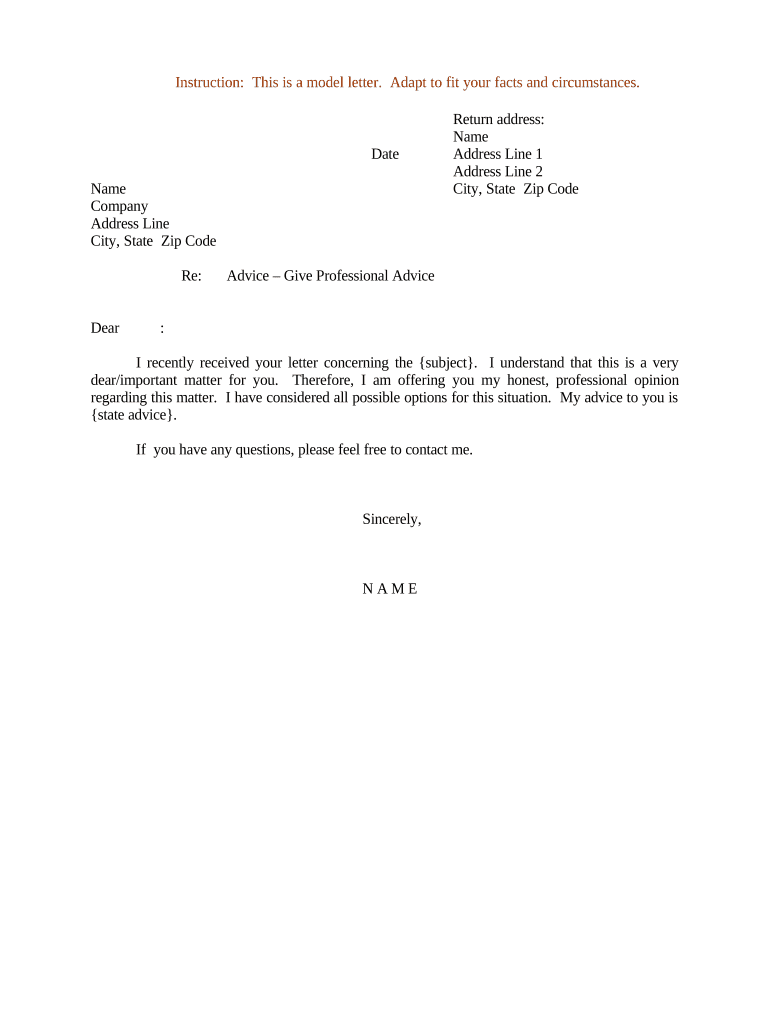
Letter Providing Professional Advice

This template is fully customizable. Edit the text, fill out the fields, and send it for signature. Give it a try!
Letter Providing Professional Advice

What a Letter Providing Professional Advice Is

A Letter Providing Professional Advice is a written, signed communication from a licensed professional that explains analysis, recommendations, or conclusions on a specific matter. It typically identifies the client, scope of engagement, facts considered, applicable standards or laws, the advisor's conclusions, and any limitations or disclaimers. Such letters may be requested by clients, regulators, or third parties and are often used as evidence in transactions, compliance reviews, or disputes. Accuracy, clear scope, and proper signature and retention practices determine the letter's legal and evidentiary value.

Why a Formal Advisory Letter Matters

Use a Letter Providing Professional Advice to document expert analysis, create a clear record of recommendations, and establish professional accountability. Well-drafted letters reduce ambiguity for clients and third parties, support compliance or due diligence, and can help prevent or defend against professional liability claims.

Why a Formal Advisory Letter Matters

Who Typically Prepares or Requests These Letters

Typical users include licensed professionals, corporate counsel, compliance officers, and clients seeking documented expert opinions for transactions or disputes.

  • Attorneys who need formal expert statements to support litigation or settlement negotiations.
  • Healthcare providers documenting clinical opinions for patients, insurers, or regulatory reviews.
  • Financial advisors or appraisers providing valuation opinions for transactions, audits, or lenders.

Step-by-Step: Prepare, Sign, and Deliver the Letter

Follow these steps to prepare, sign, and distribute a Letter Providing Professional Advice accurately and securely.

  • 01
    Gather Details: Collect client identity, engagement scope, facts, and documents to be reviewed.
  • 02
    Draft Letter: State purpose, analysis, conclusions, limitations, and supporting references clearly.
  • 03
    Review & Approve: Have a licensed reviewer verify accuracy and professional compliance.
  • 04
    Sign & Distribute: Obtain signature, notarize if required, and send to intended recipients.

Key Elements to Include in the Letter

Core parts of the Letter Providing Professional Advice explain scope, facts, reasoning, conclusions, limitations, and signature details for clarity and enforceability.

Header

State the document title, date, recipient, and sender credentials. A clear header helps verify authorship and locate the letter in records or audits and supports chain-of-custody.
Engagement Scope

Define the question asked, tasks agreed, exclusions, and any limitations. Precise scope prevents misunderstandings, limits liability exposure, and clarifies deliverables for all parties and timeframes.

Facts & Methods

Summarize factual inputs, data sources, analytical methods, and any assumptions relied upon. Transparent methods strengthen credibility and allow third-party review or replication.

Conclusions

Provide clear, numbered conclusions or recommendations tied to the facts and methods. Distinguish opinion from fact and specify degrees of certainty where appropriate.

Limitations

State constraints, scope exclusions, reliance on provided information, and any conflicts of interest. Limitations protect against overstating certainty and legal exposure.

Signature

Include professional credentials, license number, printed name, signature, and date. Note whether the signature is electronic, notarized, or witnessed per jurisdictional requirements.

Configuring a Digital Workflow for the Letter

Configure a digital workflow to collect signatures, capture audit trails, and store the signed letter securely.

Field Configuration
Signer Authentication and Access Settings Email link, SMS, or KBA; stronger for high-risk cases.
Field Validation and Conditional Logic Use required fields and conditional fields to prevent incomplete submissions.
Audit Trail and Timestamp Options Capture IP, timestamp, and action history for each signer.
Storage Location and Retention Settings Choose encrypted storage and retention periods aligned with compliance.

How Electronic Signing Typically Works

Typical e-signing workflow for delivering a Letter Providing Professional Advice clarified step by step to ensure auditability.

  • Upload Document: Upload final PDF or DOCX and confirm formatting.
  • Place Fields: Add signature, date, initials, and conditional fields.
  • Set Recipients: Assign signing order and authentication methods per signer.
  • Send & Track: Send signing link; monitor completion and download audit trail.

Platform and Format Considerations

Electronic delivery and eSigning require compatible file formats, secure transmission, access controls, and clear recipient authentication options.

  • File Formats: PDF or DOCX preferred.
  • Integrations: Connect to CRM, storage, or ERP.
  • Authentication: Email, SMS, SSO options available.

eSignature Pricing and Feature Snapshot

Comparison of common eSignature plans and core capabilities relevant to signing and distributing letters of professional advice.

signNow DocuSign Adobe Sign PandaDoc HelloSign
Starting Price $8/user/mo $15/user/mo $14/user/mo $19/user/mo $15/user/mo
Free Trial 7-day free trial Varies Varies Varies Varies
Bulk Send Yes Yes Yes Yes Varies
Audit Trail Yes Yes Yes Yes Yes
HIPAA Compliant Yes Yes Yes No No
Envelope Cap No cap 100 envelopes/user/year Varies Varies Varies

Security and Compliance Snapshot

Encryption in Transit: TLS 1.2/1.3 in transit
Encryption at Rest: AES-256 encryption at rest
HIPAA: Compliant; BAA required for PHI
SOC 2: SOC 2 Type II certified
21 CFR Part 11: Compliant for FDA-regulated records
GDPR & CCPA: Privacy controls and data processing terms

Key Penalties and Risks to Watch

Professional Liability: Malpractice claims possible
Contract Invalidity: Ambiguous scope risks unenforceability
Regulatory Sanctions: Disciplinary action for misconduct
Tax Consequences: Incorrect statements trigger penalties
Privacy Breach: HIPAA violations and fines
Lost Evidence: Poor retention weakens defense

Common Mistakes to Avoid

  • Failing to define scope or assumptions, which can produce conflicting interpretations and expand liability beyond the intended engagement.
  • Using unsigned or improperly signed letters that lack authentication, leading recipients to question authorship or enforceability.
  • Omitting key supporting documents or data sources, making conclusions difficult to verify during audits or disputes.
  • Neglecting privacy requirements when letters include protected information, which can cause regulatory breaches and financial penalties.

Practical Drafting and Signing Best Practices

Adopt consistent drafting, signature, and retention practices to protect both professional and client interests when issuing advisory letters.

Use Plain Language and Numbered Conclusions
Write conclusions as numbered points, avoid legal or technical jargon where possible, and highlight assumptions. Numbering aids reference in contracts, correspondence, and litigation when the opinion is relied upon.
Confirm Identity and Authority Before Signing
Verify signer's identity, professional credentials, and authorization to represent the firm. Record verification steps in the audit trail to support attribution and defend against challenges to signature validity.
Keep Comprehensive Supporting Records and Data Files
Archive cited documents, datasets, correspondence, and analysis files. Maintain version control and link exhibits directly to conclusions to facilitate audits and future updates or investigations.
Limit Reliance and Provide Clear Disclaimers
State intended recipients, permitted uses, and reliance limitations. Include conflict disclosures and specify whether third-party reliance is allowed to reduce downstream disputes.

Real-World Examples of Use

Brief examples show how professionals use signed advisory letters across industries and transactions for compliance and closing processes.

Optica Ventures — Brian Fitzgibbons

Optica Ventures used a signed advisory letter to document due diligence on a potential investment, summarizing findings for partners and auditors.

  • Enabled faster investment committee decisions.
  • The signed, timestamped letter provided a clear record of the analyst's assumptions and data sources, reducing follow-up questions and simplifying audit trails during subsequent financial reviews and external investor inquiries.

Martin Properties — Tim Martin

Martin Properties attached a signed advisory letter to a lease negotiation to clarify repair obligations and inspection results for both landlord and tenant.

  • Reduced disputes at closing and during tenancy.
  • Having a dated, signed opinion helped the parties resolve ambiguous repair responsibilities without litigation; the letter served as a concise reference at closing and later for lease enforcement and insurance claims.

Who Signs and Who Authorizes These Letters

Managing Partner — Law Firm

A managing partner authorizes formal advisory letters for litigation support, client opinion letters, and expert reports. They ensure engagement terms, billing, and privilege considerations are documented and coordinate counsel review to preserve confidentiality and professional standards.

Clinical Director — Healthcare Clinic

A clinical director signs clinical opinion letters, verifies that PHI handling complies with HIPAA, and confirms that Business Associate Agreements are in place for eSign workflows. They also ensure retention for six years under 45 CFR §164.530(j).

Timelines and Typical Deadlines

Key time expectations for drafting, approving, signing, and archiving a Letter Providing Professional Advice in client engagements.

Initial Delivery Deadline:

Deliver draft within mutually agreed timeframe, commonly 7–30 days.

Signature Turnaround Window:

Allow 48–72 hours for signer response on average.

RON Scheduling Lead Time:

Schedule remote notarization 24–72 hours in advance.

Retention Start Date:

Retention begins on the effective date or signature date.

Revision Request Period:

Respond to correction requests within 14 days unless agreed otherwise.

Frequently Asked Questions

Answers to common questions about preparing, authenticating, and retaining Letters Providing Professional Advice in U.S. practice settings.


Need help? Contact support

be ready to get more
Join over 28 million airSlate SignNow users