Establishing secure connection…Loading editor…Preparing document…

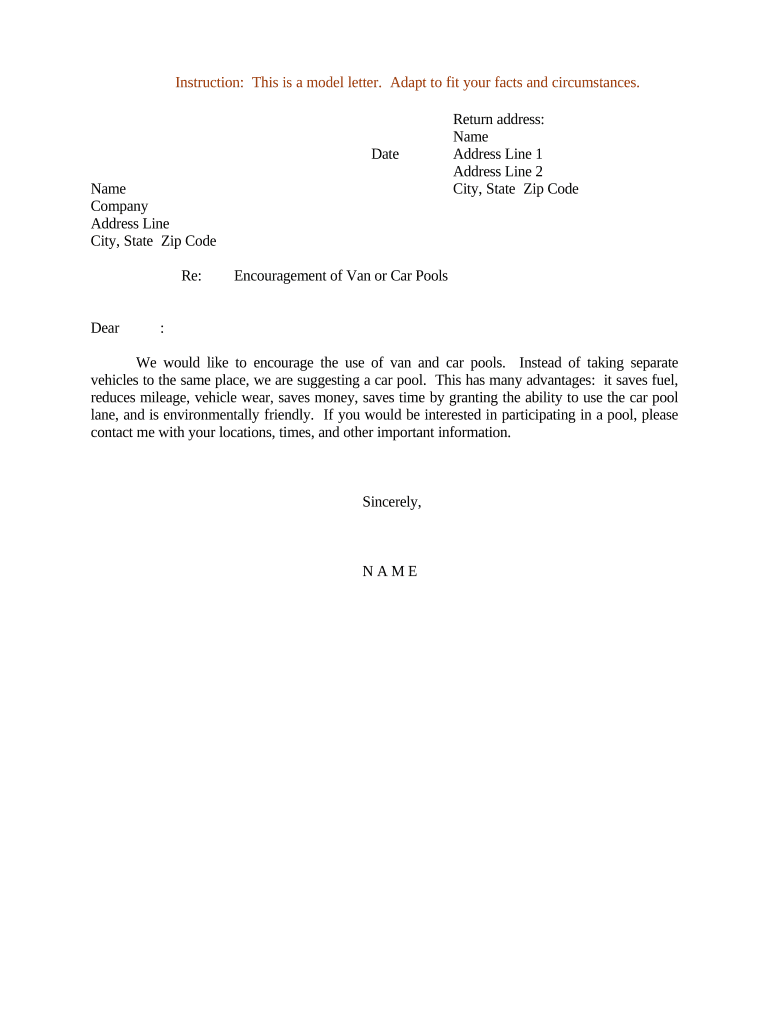
Letter Encouraging Van or Car Pools

This template is fully customizable. Edit the text, fill out the fields, and send it for signature. Give it a try!
Letter Encouraging Van or Car Pools

What the Letter Encouraging Van or Car Pools Is and when it’s used

A Letter Encouraging Van or Car Pools is a written communication, usually from an employer, community group, or transportation coordinator, that invites employees or residents to join shared vehicle commutes. It explains the program's purpose, participant expectations, scheduling and pickup points, liability disclaimers, and any incentives. The letter can be distributed in print or electronically, and when used for official programs it should state start dates, recurring trip cadence, and contact details for coordination and safety questions.

Why issuing a clear encouragement letter matters

A concise, well-structured letter increases participation, clarifies expectations, and reduces administrative follow-up while documenting outreach efforts for compliance or grant reporting.

Why issuing a clear encouragement letter matters

Who typically sends and who receives this letter

Recipients include staff, volunteers, residents, and contractors who may opt into the van or car pool program and must acknowledge policies.

  • Employers and HR teams seeking to reduce parking demand and commuting emissions.
  • Community organizations or homeowner associations organizing neighborhood ride-sharing.
  • Municipal transportation offices or transit agencies promoting first/last-mile options.

Step-by-step: drafting and distributing the letter

Follow these sequential steps to create, review, and send an accurate, enforceable letter that supports a van or car pool program.

  • 01
    Draft the letter: Compose purpose, schedule, pickup points, and terms.
  • 02
    Review for liability: Have HR or legal check insurance and liability language.
  • 03
    Collect signups: Provide a paper or electronic sign-up form for participants.
  • 04
    Distribute and retain: Send via email or internal portal and archive a copy.

How electronic completion and tracking typically works

Use this simple workflow when moving from a paper letter to an online, trackable distribution to capture consent and attendance reliably.

  • Prepare template: Upload letter to e-sign or document platform.
  • Insert fields: Add signature, name, date, and checkbox fields.
  • Send to recipients: Email or share a signing link to participants.
  • Record completion: Platform captures timestamps and audit trail.

Essential components to include in a professional encouragement letter

A complete letter balances clarity, safety, and administrative detail so participants understand commitments and the organization creates a defensible record of outreach.

Program overview

A short description of the van or car pool program purpose, expected benefits, and how the program fits the organization’s policies and goals.
Eligibility rules

Who may participate, any driver qualification requirements, background checks if required, vehicle standards, and insurance coverage expectations.

Schedule and routing

Planned pickup times, frequency, designated stops, and guidance on punctuality and cancellation procedures for riders and drivers.

Cost and incentives

Any fare or cost-sharing details, parking credit, transit subsidy, or incentives tied to participation and how payments are collected.

Liability and safety

Disclaimers about insurance, required safety practices, rules about seat belts and COVID-19 or other health-related precautions.

How to enroll

Clear submission instructions for sign-up, contact person, deadlines, and how the organizer will confirm rides and assignments.

Data and security details to include or consider

Encryption: TLS 1.2/1.3 in transit
Data at rest: AES-256 encryption
HIPAA: BAA required for PHI
Audit trail: Capture timestamps and IP
Access controls: Role-based permissions
Certifications: SOC 2 Type II, ISO 27001

Key risks and consequences to note

Liability exposure: Potential claims if negligent vetting occurs
Privacy breach: Improperly shared PHI or contact data
Regulatory issues: Failure to meet state transportation rules
Incorrect terms: Unclear cost terms may cause disputes
Missing consent: No signed acknowledgment reduces enforceability
Recordkeeping gaps: Lost documentation complicates incident response

Common mistakes when preparing a van or car-pool encouragement letter

  • Vague pickup descriptions lead to missed rides and churn; specify street addresses or prominent landmarks to prevent confusion and extra coordination work.
  • Failing to state driver insurance and vetting requirements clearly can create unmet expectations and legal exposure if an incident occurs during a pooled trip.
  • Not collecting signed participant acknowledgements or electronic consent undermines enforcement of rules and complicates responses to complaints or liability claims.
  • Omitting a clear start date or enrollment deadline causes administrative delays and may result in underused capacity or scheduling conflicts.

Platform and file-format considerations for electronic delivery

Prefer platforms that provide audit trails, role-based access, and exportable signed copies for reliable recordkeeping and compliance.

  • Integrations: Salesforce, Microsoft 365, NetSuite
  • File types: PDF, DOCX, HTML supported
  • Authentication: Email, SMS, or advanced methods

Pricing and core feature comparison for common eSignature providers

Below is a concise comparison of starting prices and common features across major eSignature vendors; signNow is listed first per comparative convention.

signNow DocuSign Adobe Sign PandaDoc HelloSign
Starting Price $8/user/mo $15/user/mo $14/user/mo $19/user/mo $15/user/mo
Free Trial 7-day free trial No No Yes, limited Yes, limited
Bulk Send Yes Yes Yes Yes No
Audit Trail Yes Yes Yes Yes Yes
HIPAA Compliant Yes Yes Yes No No

Practical examples of how organizations use this letter

Two brief examples show common program setups and outcomes to help shape your own letter content.

Case Study 1

A mid-size employer launched a voluntary vanpool program to reduce parking demand and commute times.

  • They offered a transit stipend and weekly pickup coordination.
  • After six months, participation stabilized and the employer documented outreach and signed participant acknowledgements for records and incident response.

Case Study 2

A neighborhood association organized a shared ride roster to connect residents with the commuter rail station.

  • Volunteers acted as drivers and rotated responsibilities.
  • The association used a signed electronic waiver and a schedule matrix to reduce no-shows and maintain a clear point of contact.

Typical timing and deadlines tied to program launch and enrollment

Establish clear deadlines for enrollment, driver vetting, and start dates to manage capacity and satisfy grant or employer reporting.

Enrollment Deadline:

Set a firm sign-up deadline before the program start

Driver Vetting:

Allow time for background checks and insurance confirmation

Confirmation Notice:

Send assignments at least 7 days before first ride

Start Date:

Use MM/DD/YYYY format and communicate clearly

Ongoing Updates:

Periodically re-confirm rosters and contact details

Frequently asked questions about creating and using the letter

Answers to common questions about legality, signatures, notarization, and recordkeeping for a Letter Encouraging Van or Car Pools.


Need help? Contact support

be ready to get more
Join over 28 million airSlate SignNow users