Establishing secure connection…Loading editor…Preparing document…

Letter to Boss Regarding Integrity Compromise

This template is fully customizable. Edit the text, fill out the fields, and send it for signature. Give it a try!
Letter to Boss Regarding Integrity Compromise

What a Letter to Boss Regarding Integrity Compromise Is

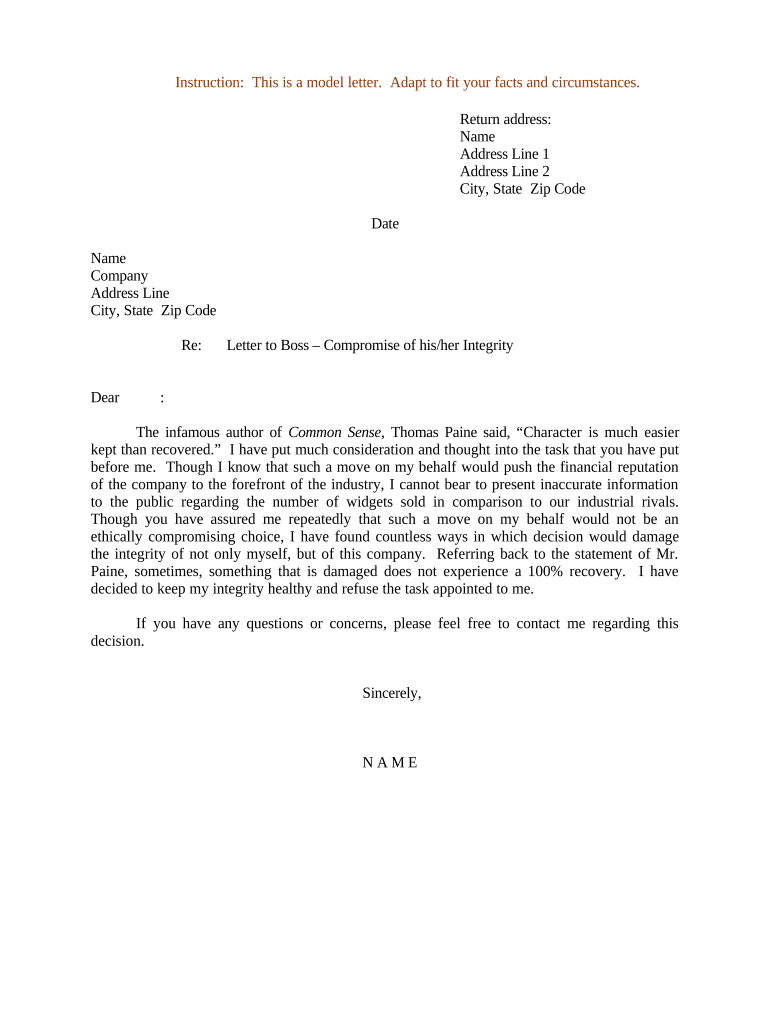
A Letter to Boss Regarding Integrity Compromise is a formal written notification from an employee or colleague that reports a suspected or confirmed breach of ethical standards, policy violations, or misconduct affecting trust and compliance. The letter sets out factual observations, relevant dates, involved parties, and any supporting evidence, and it requests an investigation or specific corrective steps. It is intended to create an official record, preserve confidentiality when appropriate, and trigger the employer’s internal procedures for investigation, discipline, or escalation to legal or compliance teams.

Why this Letter Matters for Accountability and Records

A clear, factual letter preserves contemporaneous evidence, reduces ambiguity about what was observed, and initiates formal review processes; it helps employers meet internal compliance, HR, and legal obligations while protecting employee rights.

Why this Letter Matters for Accountability and Records

Who Typically Prepares or Receives This Letter

Use the appropriate internal channel and follow any company reporting policies to ensure the matter is routed to the correct reviewer and logged.

  • Employee or coworker raising an issue internally with specifics and evidence.
  • HR or compliance officer documenting an allegation for investigation tracking.
  • Direct manager or senior leader receiving notice and coordinating next steps.

Who Signs or Approves These Letters

Reporting Employee

The individual who observed or learned of the integrity issue. Their statement should be factual, dated, and signed; anonymous submissions are sometimes permitted but may limit investigatory options and follow-up.

HR / Compliance

Human Resources or Compliance often acknowledges receipt and may reformat or sign an intake acknowledgement. That office typically records the submission, assigns an investigator, and tracks outcomes according to policy.

Step-by-step: Drafting the Letter

Follow a short, factual sequence to ensure clarity, evidence preservation, and appropriate routing when drafting this letter.

  • 01
    Identify Parties: List names, titles, and departments involved.
  • 02
    State Dates: Give specific dates and times of observed events.
  • 03
    Describe Facts: Provide a concise, objective chronology of what happened.
  • 04
    Attach Evidence: Reference and include emails, screenshots, or documents.

How to Configure an Internal Submission Workflow

Set up a simple routing workflow so the letter reaches the right reviewers and creates a searchable record.

Field Configuration
Intake Form Name Integrity Complaint Intake
Routing HR → Compliance → Legal
Authentication Employee login or verified email
Retention Store for required retention period

Typical Submission and Review Flow

This arrow-style sequence shows who receives the letter and how it advances through review steps.

  • Submit: Employee submits letter to HR or compliance
  • Acknowledge: HR confirms receipt and logs the case
  • Investigate: Assigned investigator gathers evidence and interviews
  • Resolve: Outcome, corrective action, and documentation

Digital Tools and Integration Considerations

Choose platforms that meet your organization’s compliance needs and enable searchable, auditable records across systems.

  • File Formats: PDF and DOCX supported
  • Integrations: CRM and HR integrations available
  • Authentication: Email, SSO, or multifactor

Key Security and Privacy Elements to Include

Encryption: TLS 1.2/1.3, AES-256
Audit Trail: Timestamps and IP logs
Access Controls: Role-based access
HIPAA BAA: Required for PHI handling
Retention Policy: Secure archival and deletion
Authentication: MFA and identity proofing

Risks and Consequences of an Inaccurate Letter

Defamation Risk: False claims risk legal exposure
Investigation Delay: Incomplete facts impede review
HIPAA Violation: Unauthorized PHI disclosure risk
Employment Action: Possible discipline if allegations false
Evidence Loss: Late reporting may destroy proof
Record Retention: Failure to preserve records harms defense

Common Preparation Pitfalls to Avoid

  • Mixing facts and opinion makes investigation harder; separate observed actions from your interpretation or feelings.
  • Providing vague dates or locations slows evidence collection; include precise timestamps and context when available.
  • Attaching unredacted sensitive data can breach privacy rules; redact unrelated personal identifiers before sharing.
  • Using informal channels (text or social media) can weaken the official record; submit via formal HR or compliance systems.

Essential Elements to Include in a Professional Letter

A well-structured letter helps HR and investigators act quickly; include these six elements to ensure clarity and usefulness.

Heading

A clear subject line such as 'Report of Potential Integrity Compromise' plus the date and recipient to frame the issue for reviewers.
Statement of Facts

A chronological, objective account listing times, locations, people, and actions observed; avoid speculative language or conclusions.

Supporting Evidence

Enumerate and attach verifiable items such as emails, logs, screenshots, or documents; describe each attachment for examiner reference.

Impact Summary

Describe how the conduct affected operations, compliance, finances, or safety to help prioritize investigative urgency and resourcing.

Requested Action

State whether you seek an internal investigation, temporary reassignment, confidentiality, or referral to legal/ethics channels.

Signature Block

Include your printed name, title, contact details, signature, and date; note whether you consent to follow-up or want anonymity.

Practical Tips for Accuracy and Efficiency

Follow these practical measures to keep your submission clear, defensible, and efficient for investigators.

Be Objective and Concise
Stick to verifiable facts, avoid emotional language, and keep the narrative focused; long, unfocused letters slow review and introduce ambiguity.
Preserve Originals
Save original files, emails, and timestamps in secure storage. Do not alter files; investigators need original metadata for verification.
Maintain Confidentiality
Share details only through official channels and with authorized reviewers to protect privacy and the integrity of the investigation.
Use Secure eSignature
When signing electronically, use platforms that provide audit trails and comply with ESIGN/UETA and applicable industry rules.

Typical Timelines and Practical Deadlines

Timely submission and response improve investigatory outcomes; these are common internal timing milestones to set or expect.

Initial Report:

Submit as soon as possible; immediate reporting preserves perishable evidence.

Acknowledgement:

HR or compliance typically acknowledges within 48–72 hours of receipt.

Preliminary Review:

A triage or preliminary assessment often occurs within 7 calendar days.

Full Investigation:

Complete investigations vary; many close within 30–90 days depending on complexity.

Record Retention:

Retain records per legal and policy timelines after case closure.

Key Milestones in the Review Process

A sequential milestone view helps track progress from receipt to resolution and archival.

01

Receipt Logged

The intake is recorded in the case management system with a unique ID.

02

Preliminary Assessment

Reviewer determines whether full investigation is warranted.

03

Evidence Collection

Investigators gather documents, interview witnesses, and secure data.

04

Resolution and Closure

Final report documents findings, actions taken, and retention instructions.

How This Letter Differs From a Formal Complaint

Compare a direct letter to a boss with filing a formal complaint to clarify expectations and outcomes.

Criteria Letter to Boss Formal Complaint
Formality informal formal
Record Status internal note formal case file
Potential Public Record possible
Typical Timeline faster procedural

eSignature Vendor Comparison for Submitting and Signing the Letter

Compare common eSignature vendors for capacity, compliance, and pricing when selecting a platform to execute or archive the letter.

signNow DocuSign Adobe Sign PandaDoc HelloSign
Starting Price $8/user/mo $15/user/mo $14/user/mo $19/user/mo $15/user/mo
Free Trial 7-day trial Varies Varies Varies Varies
Bulk Send Yes Yes Yes Yes Varies
Audit Trail Yes Yes Yes Yes Yes
HIPAA Compliant Yes Yes Yes No No

Realistic Use Scenarios

Two concise scenarios show how a factual letter can trigger investigation or protective steps.

Internal Misconduct Report

An employee documents a series of suspicious expense submissions with dates and attachments

  • The report highlights immediate operational impact
  • HR logs the case, secures records, interviews witnesses, and issues interim controls pending investigation results.

Data Handling Concern

A staff member observes potential data export outside approved channels and records timestamps

  • Evidence includes server logs and an email thread
  • Compliance uses the letter to request IT preservation, begin forensic review, and assess regulatory notification needs.

Frequently Asked Questions About Submitting This Letter

Answers to common questions about format, confidentiality, eSigning, and next steps when reporting an integrity concern.


Need help? Contact support

be ready to get more
Join over 28 million airSlate SignNow users