Establishing secure connection…Loading editor…Preparing document…

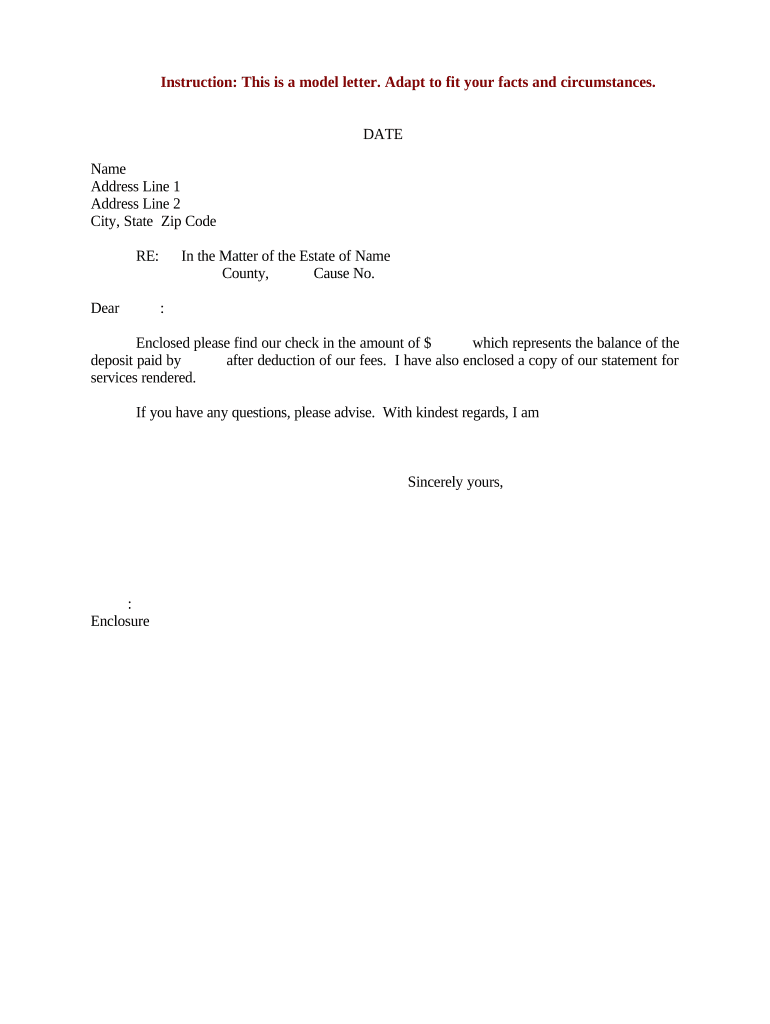
Letter Regarding Estate Deposit Balance

This template is fully customizable. Edit the text, fill out the fields, and send it for signature. Give it a try!
Letter Regarding Estate Deposit Balance

What a Letter Regarding Estate Deposit Balance Is

A Letter Regarding Estate Deposit Balance is a written notification sent to a financial institution or custodian to confirm the remaining funds held under a decedent's estate account, trust, or payable-on-death arrangement. The letter identifies the estate or account, states the current cash or deposit balance as of a specific date, and explains who is authorized to access or transfer the funds. It is commonly used by executors, personal representatives, trustees, and bank officers during probate, trust administration, and account reconciliation to trigger disbursement or close an account.

Why this letter matters for estate administration

The letter documents the estate's cash position, establishes authority to collect or transfer funds, and creates a written record used by banks and probate courts. Clear, accurate letters reduce processing delays, limit disputes about balances, and help meet probate or fiduciary duties.

Why this letter matters for estate administration

Who typically prepares and receives this letter

Clear role definition speeds processing and reduces the risk of rejected requests or repeated information submissions.

  • Bank or credit union trust officers who verify account balances and confirm payee instructions to release funds.
  • Executors or personal representatives who request the balance to complete probate accounting and distributions.
  • Estate attorneys who prepare or review the letter as part of closing estate assets and ensuring compliance.

Primary signers and their responsibilities

Bank Trust Officer

A bank trust officer confirms ledger balances, validates account ownership, and processes disbursement instructions under the institution's internal controls and signature authority matrix.

Estate Executor

The executor provides identification, probate documentation, and a signature attesting to their authority; they are responsible for accurate account reconciliation and timely distributions to beneficiaries.

Key data and security elements to include

Account Identifier: Include full account number or last four digits.
Decedent Details: Full legal name and date of death.
Balance Statement: Exact amount in USD, with currency noted.
Authority Proof: Probate case number or trust citation.
Signer Identity: Name, title, and contact information.
Retention Note: Record retention instructions for the bank.

Consequences of errors or missing information

Rejected Request: Missing probate proof prevents release.
Delayed Distribution: Incomplete data extends administration time.
Tax Exposure: Incorrect balances affect estate tax filings.
Liability Risk: Fiduciary errors may cause personal liability.
Backup Withholding: Missing TIN can trigger 24% withholding.
Recordkeeping Failure: Poor retention may complicate audits.

Common pitfalls to avoid when preparing the letter

  • Using informal account references rather than the institution's official account number, which can cause delays and mismatches.
  • Failing to attach probate or letters testamentary so the bank cannot verify the signer's authority to request funds.
  • Stating an estimated balance instead of an exact figure and date, producing reconciliation disputes with custodians.
  • Omitting contact details or notary acknowledgment when required, which may force the bank to refuse the request.

Step-by-step: preparing the letter

Follow these steps to prepare a clear, bank-ready Letter Regarding Estate Deposit Balance.

  • 01
    Gather documents: Collect death certificate, letters testamentary, and account statements.
  • 02
    Identify account: Use the institution's full account number and account title.
  • 03
    State the balance: Provide exact amount in USD and the balance date.
  • 04
    Attach proof: Attach probate documents and sign with authorized signature.

How to set up a digital workflow for submission

A digital workflow standardizes submission, authentication, and archival for faster bank processing.

Step Configuration
Upload Document PDF with attached probate documents
Assign Roles Executor signs; bank receives a copy
Signer Authentication Email link or SMS code verification
Save Template Store for repeated estate-account requests

Typical processing flow at a financial institution

Understanding the institution's processing steps helps you supply the right documents and format the letter correctly.

  • Submission: Executor or attorney sends the completed letter and attachments.
  • Verification: Bank validates identity, probate documents, and account details.
  • Balance Confirmation: Bank provides a dated balance or statement confirmation.
  • Disbursement: Funds are released or transferred per fiduciary instructions.

Digital submission and platform considerations

Ensure the chosen vendor can produce a tamper-evident signed PDF and retain records consistent with legal retention requirements.

  • File formats: PDF and DOCX are widely accepted.
  • Authentication: Email, SMS, or stronger ID verification.
  • Audit trail: Timestamp, IP, and action log required.

Timelines and expected processing windows

Processing times vary by institution but follow common staging from receipt to release; plan for verification and potential hold periods.

Receipt Acknowledgement:

Banks typically acknowledge receipt within 1–3 business days.

Document Review:

Verification of probate and identity can take 3–10 business days.

Balance Confirmation:

Statement or balance letter issuance often within 5–15 business days.

Funds Hold Period:

Some institutions place a 3–7 business day hold before disbursement.

Escalation Timeline:

If incomplete, expect additional 7–14 business days for resolution.

Key milestones from request to distribution

A sequential checklist helps track progress and manage expectations throughout administration.

01

Prepare Letter

Complete letter and attach probate documents before submission.

02

Submit to Bank

Send via secure upload or certified mail and confirm receipt.

03

Bank Verification

Bank validates authority, account, and balance details.

04

Disbursement/Closure

Bank releases funds or closes the account per instructions.

Essential elements to include in a professional letter

A complete letter contains identification, authority statements, precise balance information, and supporting documentation for prompt bank processing.

Header

Date, bank name, branch address, and clear subject line referencing the estate account and decedent.
Decedent Details

Full legal name, date of death, and any relevant alias or DBA used on the account.

Account Information

Full account number, account title, and type (trust, custodial, POD, TDA).

Balance Statement

Exact deposit amount and the date the balance was verified or the statement date.

Authority Citation

Reference letters testamentary, letters of administration, or trust citation authorizing the requester.

Attachments

Include death certificate, court-issued authority, and recent account statement as PDF attachments.

Real-world examples of similar document use

These concise examples show how organizations adapt signed documents and confirmations to close accounts or finalize distributions.

Optica Ventures example

A small investment firm standardized estate balance letters to reconcile client accounts quickly.

  • The change reduced back-and-forth with custodians.
  • Brian Fitzgibbons, COO of Optica Ventures LLC, noted the interface is simple and easy-to-use for the team and customers, improving turnaround on estate account confirmations while keeping documentation consistent.

Martin Properties example

A real estate operator used documented balance confirmations to clear escrow and release proceeds.

  • Consistent forms prevented delays at closing.
  • Tim Martin, Founder of Martin Properties, said he can process and execute all documents online with compliance and built-in security, enabling efficient returns to beneficiaries and faster closings.

Typical eSignature vendor pricing and capabilities to consider

Compare starting prices and essential capabilities when selecting an eSignature provider for secure submission and recordkeeping; signNow is listed first for reference.

signNow DocuSign Adobe Sign PandaDoc HelloSign
Starting Price $8/user/mo $15/user/mo $14/user/mo $19/user/mo $15/user/mo
Free Trial 7-day trial Varies Varies Varies Varies
Bulk Send Yes (Premium) Yes Yes Yes No
Audit Trail Yes Yes Yes Yes Yes
HIPAA Compliant Yes Yes Yes No No

Frequently asked questions about the letter and digital submission

Answers to common questions about preparing, signing, and submitting a Letter Regarding Estate Deposit Balance.


Need help? Contact support

be ready to get more
Join over 28 million airSlate SignNow users