Establishing secure connection…Loading editor…Preparing document…

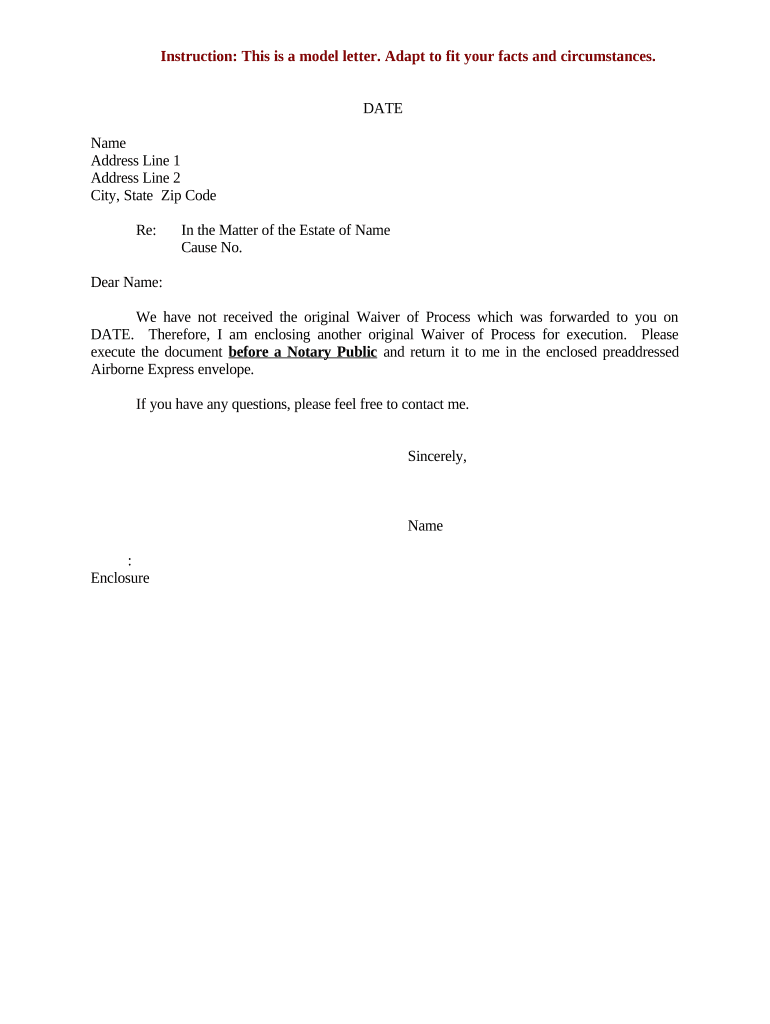
Letter Requesting Execution of Waiver of Process

This template is fully customizable. Edit the text, fill out the fields, and send it for signature. Give it a try!
Letter Requesting Execution of Waiver of Process

What the Letter Requesting Execution of Waiver of Process Is

A Letter Requesting Execution of Waiver of Process is a formal written request asking a named party to waive formal service of process in a civil matter and accept service by signing a waiver. Common in federal and state civil litigation, the letter identifies the case caption, the party requesting waiver, the documents to be accepted, and a deadline for return. When properly executed and recorded, the waiver can reduce filing costs, eliminate in-person service attempts, and create written evidence of consent to service that courts generally recognize under ESIGN and state e-signature law.

Why a Clear Waiver Request Matters

A concise waiver letter speeds litigation by avoiding multiple service attempts, lowers process-server and court filing costs, and creates a traceable record of acceptance. Proper wording supports enforceability under the ESIGN Act and UETA when electronic consent and retention requirements are met.

Why a Clear Waiver Request Matters

Who Typically Prepares or Receives This Letter

Legal professionals and corporate representatives most often prepare and send waiver requests to streamline service and evidence acceptance.

  • Plaintiff counsel sending waiver to a defendant for convenience and cost savings.
  • In-house counsel asking a corporate agent or registered agent to accept service.
  • Opposing counsel or settlement administrators acknowledging acceptance on behalf of clients.

The recipient should be someone with authority to accept service (individual party, registered agent, or authorized corporate officer).

Typical Signers and Their Roles

Plaintiff Attorney

Prepares the waiver language, attaches the complaint or pleading, and defines the return method and deadline. The attorney keeps the signed waiver as proof of service in the case file and may file a certificate of service if required by local rules.

Corporate Agent

An authorized officer or registered agent who can accept service on behalf of a corporate defendant. Their signature binds the corporation to acceptance and should be accompanied by title and contact information to establish authority.

Key Legal and Security Considerations

ESIGN / UETA: Complies with ESIGN and UETA requirements
HIPAA: BAA required for PHI transmission
Audit Trail: Captures IP, timestamp, and actions
Encryption: TLS 1.2/1.3 and AES-256 at rest
Certifications: SOC 2 Type II and ISO 27001
Access Controls: SSO and role-based permissions

Common Legal Risks and Consequences

Service Defect: Case dismissal risk
Incorrect Signer: Waiver may be invalid
Missing Attachments: Court may refuse filing
Notarization Omitted: State-specific invalidity
Late Response: Statute window impacted
Data Exposure: Regulatory penalties possible

Avoidable Preparation Errors

  • Failing to include the full case caption and docket number, which can cause courts to reject the submission or misfile the waiver.
  • Sending to the wrong recipient or an unauthorized signer, producing a waiver that the opposing party or court may not accept.
  • Using vague waiver language that does not reference specific pleadings or the date of the filing being accepted for service.
  • Neglecting to set a clear deadline and method of return, which invites disputes over whether and when service was accepted.

Real-World Examples of Use

Two brief scenarios show how waiver letters are used to streamline service and preserve evidence without needless process-server expense.

Small-Claims Settlement

Plaintiff's representative sends a waiver with the complaint attached and a 14-day return deadline.

  • Defendant signs to accept service by email.
  • The signed waiver avoids in-person service, is retained in the file, and supports an agreed joint status report to the court.

Corporate Litigation

Counsel for a vendor requests waiver from a corporate registered agent with the complaint attached.

  • Agent signs using an e-signature and provides title.
  • The executed waiver is uploaded to the docket and evidences constructive service for purposes of scheduling and default-analysis.

Step-by-Step: Preparing and Sending the Waiver Letter

Follow these sequential steps to prepare a complete and enforceable waiver letter that courts will recognize.

  • 01
    Draft Letter: Include caption, documents list, clear waiver language, and return instructions.
  • 02
    Attach Pleadings: Attach the complaint or pleading the recipient is waiving service of.
  • 03
    Select Delivery: Choose email, certified mail, or e-sign delivery depending on authority.
  • 04
    Record Acceptance: Retain signed copy and audit trail for filing and proof.

Typical Electronic Workflow for Completing a Waiver

An electronic workflow reduces friction and ensures a verifiable record of the waiver and acceptance.

  • Upload: Add the letter and attachments in PDF or DOCX format.
  • Assign Signer: Specify recipient name, email, and signer role.
  • Authenticate: Use email links, SMS codes, or stronger authentication as needed.
  • Complete: Signer executes; system captures timestamp and audit trail.

Core Elements to Include in Every Waiver Letter

Ensure the letter contains standardized elements so it can be accepted by courts and opposing counsel without dispute.

Case Caption

Full case caption and docket number placed at the top to precisely identify the action and avoid misfiling or ambiguity in court records.

Waiver Language

Explicit text stating the recipient agrees to accept service of specified pleadings in lieu of formal process, and identifying the documents being accepted.

Return Instructions

Clear method and deadline for returning the signed waiver, including email address or physical mailing instructions and format requirements.

Signature Block

Name, title, and contact information of signer plus date; if signing for an entity, include corporate title or agent designation.

Practical Tips for an Accurate Waiver Request

Small drafting choices improve enforceability and reduce procedural risk—use these best practices consistently.

Use explicit acceptance language
State precisely which pleadings are being accepted and that the recipient waives formal service, to avoid ambiguity that could lead to a challenge.
Verify signer authority
Confirm the recipient has authority to bind the party (registered agent or corporate officer), and collect title or agent documentation when needed.
Time and method clarity
Set a reasonable return deadline and specify acceptable return formats and delivery methods to prevent disputes about timing or form.
Maintain evidentiary records
Keep signed copies, email headers, IP/timestamp data, and any notarization or RON recordings as part of the case file.

Key Milestones from Draft to Filing

Track milestones in order to ensure the waiver is effective and usable for court filings and scheduling.

01

Draft Complete

Finalize caption, waiver language, attachments, and return instructions before sending.

02

Send to Recipient

Deliver by chosen method and log delivery details immediately.

03

Receive Signed Waiver

Confirm signature, signer authority, and capture audit data and any notarization.

04

File or Record

File with the court or retain for certificate of service per local rules.

Time-Sensitive Requirements to Watch

Certain timing rules and retention obligations affect how a waiver functions in litigation; note these commonly relevant deadlines.

Response Deadline for Return:

Set a specific date; courts may consider the timing when determining valid service.

Statute of Limitations Impact:

Delayed acceptance may affect timely filing or tolling; confirm deadlines before sending.

RON Recording Retention:

Audio-video recordings of RON sessions are often retained 5–10 years per state rules.

Evidence Preservation:

Retain signed waiver and audit trail immediately after receipt to prevent spoliation.

Court Filing Window:

Local rules may require filing a certificate of service or notice within a specified period after acceptance.

Complete Checklist: Required Sections and Language

Use this checklist to verify the waiver letter contains all items judges and opposing counsel commonly expect.

Letter Header

Identify sender and recipient with full contact details and reference the court and docket number at the top of the page for precise identification.
Case Caption

Place the full case caption and docket number prominently to link the waiver to the correct action and prevent clerical errors.

Waiver Clause

Include explicit text stating the recipient accepts service of the identified pleadings and waives formal service requirements for those documents.

Signature Block

Provide full printed name, title, organization, date, and contact information for the signer to evidence authority and identity.

Notary / RON

If state law or local rule requires notarization, include a notary block or use a compliant RON process with recording retention.

Attachments

Attach the complaint, summons template, and any exhibits the recipient is agreeing to accept to avoid later disputes.

Recommended Electronic Workflow Settings

Configure your e-signature workflow to capture the necessary evidence and ensure signer authentication.

Field Configuration
Signer Role Primary signer | optional secondary signer
Authentication Email link, SMS code, or KBA per case sensitivity
Document Format PDF/A preferred for preservation and court submission
Record Retention Retain audit trail and any RON recordings as required

Technical Requirements for Electronic Execution

Electronic execution requires supported formats, authentication, and secure storage to preserve legal effect.

  • File Formats: PDF, DOCX, and HTML are commonly supported
  • Integrations: Salesforce, NetSuite, Google Workspace, and others integrate for case management
  • Authentication: Options include email links, SMS codes, and KBA

Maintain access to the signed document and audit data; ensure the platform meets ESIGN/UETA standards and applicable industry compliance.

eSignature Pricing and Feature Comparison (signNow first)

Compare baseline pricing and key capability indicators relevant to executing waiver letters and storing evidence; signNow appears first per vendor ordering rules.

signNow DocuSign Adobe Sign PandaDoc HelloSign
Starting Price $8/user/mo $15/user/mo $14/user/mo $19/user/mo $15/user/mo
Free Trial 7-day free trial Varies by vendor Varies by vendor Varies by vendor Varies by vendor
Bulk Send Yes (plan-dependent) Yes (plan-dependent) Yes (plan-dependent) Yes (plan-dependent) Varies
Audit Trail Yes Yes Yes Yes Yes
HIPAA Compliant Yes (BAA available) Varies by plan Varies by plan Varies by plan Varies by plan

Common Questions About Waiver Letters and Electronic Execution

Answers to frequently asked procedural and legal questions encountered when preparing, sending, and recording waiver of process letters.


Need help? Contact support

be ready to get more
Join over 28 million airSlate SignNow users