Establishing secure connection…Loading editor…Preparing document…

Checklist for Screening Residential Tenants

This template is fully customizable. Edit the text, fill out the fields, and send it for signature. Give it a try!
Checklist for Screening Residential Tenants

What the Checklist for Screening Residential Tenants Covers

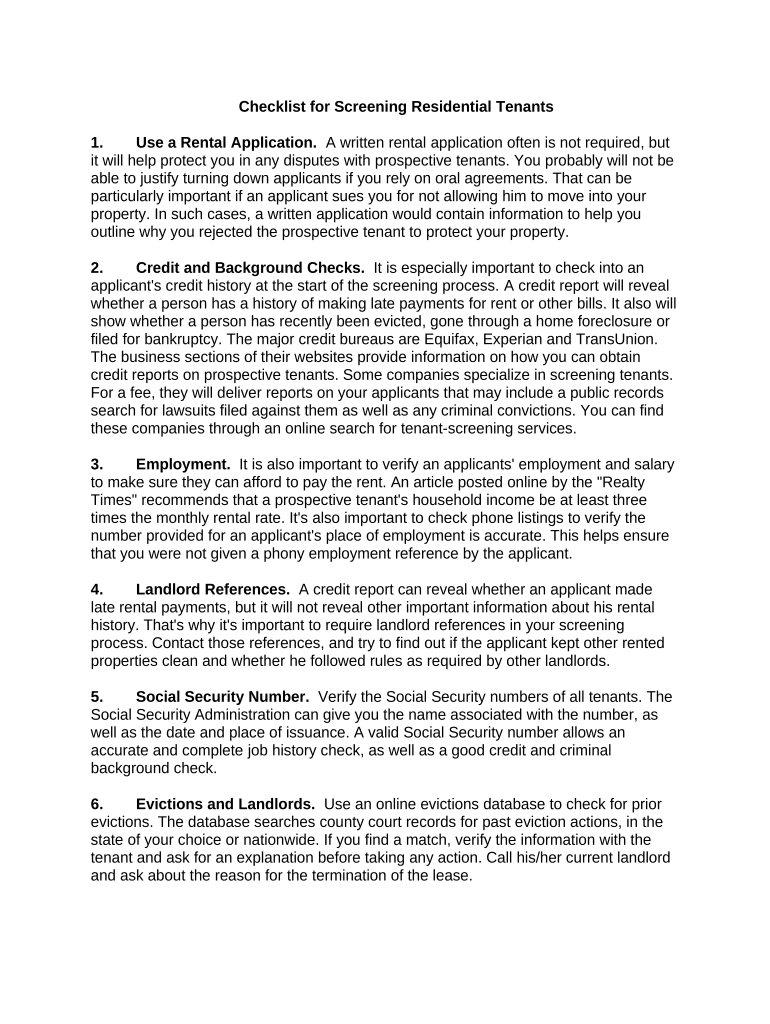
A Checklist for Screening Residential Tenants is a structured document used by landlords and property managers to collect, verify, and document applicant information needed for informed leasing decisions. It centralizes identity verification, consent for consumer reports, income and employment verification, rental history, and any disclosures required by federal or state law. The checklist helps standardize screening steps to reduce inconsistency, document compliance with consumer-reporting rules, and provide an audit trail of decisions and communications in case of disputes.

Why a Standardized Screening Checklist Matters

A professional checklist reduces legal risk, ensures consistent applicant treatment, and documents consent for background and credit checks required under federal law. It supports fair-housing compliance and creates a reproducible record that can be retained for regulatory or evidentiary purposes.

Why a Standardized Screening Checklist Matters

Who Typically Uses This Checklist

The checklist is used by individual landlords, property managers, and screening vendors involved in tenant selection and lease onboarding.

  • Independent landlords who manage one or multiple rental units and handle screening directly.
  • Property management firms that run high-volume, repeatable screening workflows across portfolios.
  • Tenant screening companies and background-check services that gather and report consumer data.

Using a shared checklist across these roles improves consistency, reduces legal exposure, and documents the steps taken when offers are made or declined.

Core Elements to Include in the Screening Checklist

A complete checklist couples required disclosures with verifiable data points and an evidence trail. Below are six core elements to include to make screenings defensible and actionable.

Applicant Consent

A signed consumer-report and tenant-screening consent form that explicitly authorizes credit and background checks and notes how results will be used.
Identity Verification

Collection of government ID type and number, date of birth, and supporting document notes to confirm the applicant is who they claim to be.

Income & Employment

Recent pay stubs, employer contact, or third-party verification notes to substantiate ability to pay rent.

Rental History

Previous landlord contact info, lease end dates, and documented reasons for past tenancy terminations or evictions.

Consumer Reports

Credit score, criminal background checks, and eviction searches with vendor name, order date, and results summary.

Decision Record

Final decision rationale, rent and deposit terms offered, and any adverse-action notices sent to the applicant.

Step-by-Step: Completing the Tenant Screening Checklist

Follow these steps in order to collect consent, verify identity, and document results before making a leasing decision.

  • 01
    1. Prepare: Customize checklist fields to match property rules and state disclosure requirements.
  • 02
    2. Obtain Consent: Have the applicant sign consumer-report authorization before ordering reports.
  • 03
    3. Verify Identity: Match ID, date of birth, and address against report results and attachments.
  • 04
    4. Review & Record: Summarize findings, record decision rationale, and send any required adverse-action notices.

Digital Workflow Overview for Online Completion

A digital workflow reduces manual steps: upload your checklist template, add signature and consent fields, send to applicants, and capture a secure audit trail.

  • Upload Template: Import your checklist as PDF or DOCX and confirm field placement.
  • Add Fields: Place signature, date, and conditional fields for consent and attachments.
  • Send to Applicant: Deliver via email or secure signing link; require consent before screening.
  • Capture Record: Store signed checklist, attachments, and audit trail with timestamped events.

Typical Settings When Configuring an Online Screening Workflow

Configure authentication, attachments, and notifications to align with your compliance and operational needs.

Field Configuration
Authentication Email link or SMS code for signer verification
Conditional Fields Show criminal-history details only after consent is given
Attachments Require ID image and proof of income uploads
Notifications Email alerts to manager on completion

Technical and Integration Considerations

Choose a platform that supports common document formats, necessary authentications, and your existing integrations.

  • Document Formats: PDF and DOCX are standard and widely supported
  • Authentication: Email, SMS, or KBA options improve signer identity assurance
  • Integrations: Connectors for CRM and storage (Salesforce, Google Workspace, Box)

Ensure the chosen platform can produce an audit trail, store signed copies securely, and integrate with your tenant-screening vendor or property-management system.

Time-Sensitive Actions and Common Timing Expectations

Some screening steps are time-sensitive. Observing prompt timelines improves accuracy and reduces legal exposure.

Consent Before Report:

Obtain written consent prior to ordering any consumer-report or background check.

Adverse-Action Notices:

Provide required pre-adverse and adverse-action notices promptly after decision under FCRA obligations.

Record Retention Start:

Retention periods typically begin on the application or decision date.

Applicant Disputes:

Respond to any consumer-report disputes within the vendor-prescribed timeframe.

Application Expiry:

Set and communicate an application validity window, often 30–90 days depending on policy.

eSignature Vendor Comparison for Tenant Screening Checklists

Comparison of basic plan-level features and pricing to consider when enabling e-signing for tenant screening documents.

signNow DocuSign Adobe Sign PandaDoc HelloSign
Starting Price $8/user/mo $15/user/mo $14/user/mo $19/user/mo $15/user/mo
Free Trial 7-day free trial Varies Varies Varies Varies
Bulk Send Yes Yes Yes Yes No
Audit Trail Yes Yes Yes Yes Yes
HIPAA Compliant Yes Yes Yes No No
Envelope Cap No cap 100 envelopes/user/year Varies Varies Varies

Security and Compliance Considerations

Encryption: TLS 1.2/1.3 in transit; AES-256 at rest
Authentication: Email, SMS, and advanced signer methods
Audit Trail: Timestamped events and IP logging
HIPAA Support: BAA available when handling PHI
Legal Compliance: ESIGN and UETA recognition
Access Controls: Role-based permissions and SSO options

Common Mistakes to Avoid When Preparing the Checklist

  • Requesting credit or background checks before obtaining written consent, which can violate federal consumer-report rules.
  • Applying inconsistent screening criteria across applicants, increasing the risk of fair-housing disparate-impact claims.
  • Storing full Social Security Numbers in unsecured locations or email, increasing exposure to identity-theft liability.
  • Failing to document the decision rationale and timing, making it hard to defend adverse actions or tenant disputes.

Potential Penalties and Legal Risks from Incorrect Screening

FCRA Violations: Civil liability and statutory damages
Fair Housing: Discrimination claims and fines
Data Breach: Regulatory and notification costs
State Penalties: Additional statutory fines or remedies
Contract Risk: Lease unenforceability if consent defective
Administrative Sanctions: Licensing or enforcement action

Frequently Asked Questions About the Screening Checklist

Answers to frequent operational and legal questions encountered when using a tenant-screening checklist.


Need help? Contact support

be ready to get more
Join over 28 million airSlate SignNow users