Establishing secure connection…Loading editor…Preparing document…

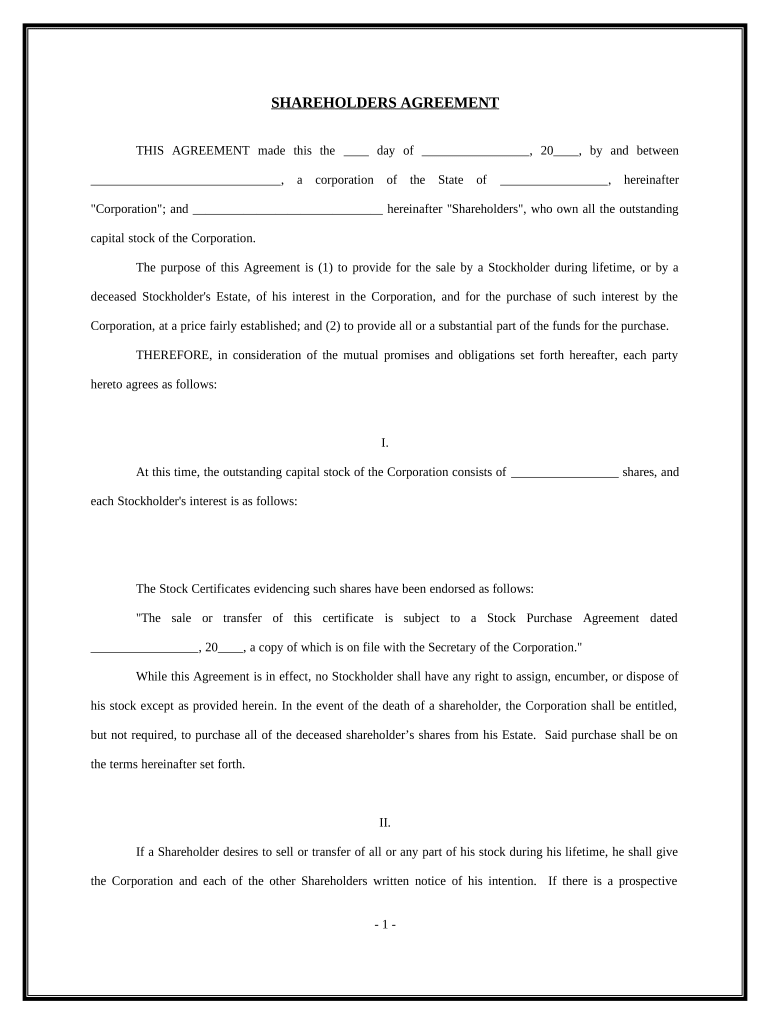
Shareholders Agreement

This template is fully customizable. Edit the text, fill out the fields, and send it for signature. Give it a try!
Shareholders Agreement

What a Shareholders Agreement Is and Why It Matters

A Shareholders Agreement is a private contract among a corporation's shareholders that supplements corporate bylaws by defining ownership rights, transfer restrictions, voting arrangements, management roles, dispute resolution, and exit mechanics. It clarifies how shares may be issued, sold, or pledged; sets procedures for board appointments and major corporate actions; and creates protections for minority and majority holders. Well-drafted agreements reduce uncertainty, limit litigation risk, and provide a predictable framework for ownership transitions, but they typically do not require state filing unless linked to securities or transfer registration requirements.

Core Purposes and Practical Benefits

A Shareholders Agreement aligns expectations between owners, allocates decision rights, protects minority interests, and establishes buy-sell mechanisms that ease ownership changes and reduce disputes.

Core Purposes and Practical Benefits

Who Commonly Prepares and Signs This Agreement

Founders, investors, and corporate legal teams typically use shareholders agreements to document governance and exit rules before or after capitalization events.

  • Founders and co‑founders managing ownership split and voting rights during growth and financing
  • Investors and venture funds requiring transfer restrictions and protective provisions for equity investments
  • Corporate counsel and outside attorneys drafting enforceable clauses and advising on state law implications

Step-by-Step: Executing a Shareholders Agreement

Follow these steps to complete and execute the agreement reliably, whether you use paper or an eSignature workflow.

  • 01
    Draft: Prepare terms with legal counsel, include share schedules and exhibits.
  • 02
    Review: Share a draft with all parties and advisors for comments.
  • 03
    Finalize: Resolve comments and produce a final, executed copy-ready version.
  • 04
    Execute: Obtain signatures, notarization if required, and distribute signed copies.

Essential Clauses to Include

A comprehensive Shareholders Agreement typically contains governance, transfer, financial, and dispute-resolution provisions designed to govern the parties’ relationship and protect corporate continuity.

Ownership Schedule

Detailed list of shareholders, share classes, and current ownership percentages, plus procedures for updating the schedule on transfers.
Transfer Restrictions

Rights of first refusal, buy‑sell triggers, drag‑along and tag‑along rights, registration obligations, and permitted transfers.

Voting and Board Composition

Voting thresholds, board appointment/removal rules, reserved matters requiring supermajority, and quorum definitions.

Dividend and Finance Policy

Dividend policy, capital call procedures, preemptive rights, and mechanisms for additional capital contributions.

Exit and Liquidity

IPO, sale, or liquidation procedures, valuation methods, put/call rights, and drag/tag terms for coordinated exits.

Dispute Resolution

Negotiation, mediation, arbitration clauses, choice of law, and venue for resolving shareholder disputes.

Security and Compliance Elements to Document

Encryption: TLS 1.2/1.3 in transit; AES-256 at rest
Audit Trail: Timestamps, IP, and action logs
Access Controls: Role-based permissions for document access
Data Privacy: GDPR and CCPA compliance measures
Regulatory Certs: SOC 2 Type II and ISO 27001 available
HIPAA Support: BAA option for protected health data

Common Legal and Commercial Risks

Unenforceable Provisions: Overbroad terms may be struck down
Invalid Signatures: Improper e-sign or missing consent risks challenge
Tax Consequences: Incorrect classification may trigger liabilities
Breach Damages: Litigation and indemnity exposure
Triggering Securities Rules: Unintended registration obligations possible
Deadlock Costs: Business paralysis without dispute process

Frequent Preparation Pitfalls to Avoid

  • Using ambiguous buyout formulas that create valuation disputes and prolonged litigation instead of clear, objective methods
  • Failing to update the ownership schedule after share issuances, causing conflict over rights and distributions
  • Neglecting to specify the governing law and venue, which can multiply costs during cross-jurisdictional disputes
  • Omitting deadlock and tie‑break provisions for equal shareholders, leaving the company unable to act on critical decisions

Typical Execution Flow for an Electronic Agreement

This workflow outlines how a Shareholders Agreement moves from draft to signed execution using an eSignature-enabled process.

  • Upload Document: Import final PDF or DOCX into the signing platform
  • Place Fields: Add signature, date, and initial fields as needed
  • Add Signers: Enter signer names, emails, and signing order
  • Send for Signature: Distribute via email link or secure signing portal

Recommended Digital Workflow Settings

Configure the eSignature workflow to match legal needs and reduce signer friction; adjust authentication and retention settings accordingly.

Field Configuration
Signer Order Sequential or parallel based on governance needs
Authentication Email link, SMS code, or stronger MFA if required
Notifications Reminders and completion confirmations enabled
Retention Preserve signed PDF and audit trail for set period

Technical Considerations for eSigning

Ensure the chosen signing platform supports required authentication, audit trails, and exportable signed records.

  • Authentication: Email, SMS, KBA, or SSO
  • Audit Trail: Immutable logs and timestamping
  • Integrations: Connectors for Google Workspace, NetSuite, Salesforce

How a Shareholders Agreement Differs from Corporate Bylaws

Shareholders agreements and bylaws overlap but serve distinct purposes; the table contrasts their typical scope and enforceability.

Document Shareholders Agreement Corporate Bylaws
Primary Purpose owner rights and transfers internal governance rules
Typical Signatories shareholders only corporation (board) only
Flexibility private, contract-based publicly adopted by board
Enforceability Focus contract remedies corporate formalities

eSignature Vendor Pricing and Feature Snapshot

Compare starting price, trial availability, bulk send, audit trail, HIPAA support, and envelope limits across common eSignature providers; signNow is listed first per platform comparison guidelines.

signNow DocuSign Adobe Sign PandaDoc HelloSign
Starting Price $8/user/mo $15/user/mo $14/user/mo $19/user/mo $15/user/mo
Free Trial 7-day free trial, no card Varies by vendor Varies by vendor Varies by vendor Varies by vendor
Bulk Send Yes (Premium) Yes Yes Yes No
Audit Trail Yes Yes Yes Yes Yes
HIPAA Compliant Yes Yes Yes No No

Time-Sensitive Items and Typical Deadlines

Track key dates tied to execution, transfer notice periods, and tax reporting triggered by changes in ownership.

Effective Date Entry:

Enter the execution date as MM/DD/YYYY; governs timing of obligations

Transfer Notice Period:

Commonly 15–30 days for ROFR or buyout elections

Tax Reporting:

Report ownership changes per IRS timelines; consult tax advisor

Record Updates:

Update corporate records and cap table promptly after transfer

Retention Events:

Preserve records through statute of limitations and dispute windows

Key Milestones from Negotiation to Enforceability

Sequential milestones help stakeholders follow progress from drafting to enforceable execution and post‑signing obligations.

01

Drafting Completed

Legal counsel finalizes terms and exhibits

02

Review and Negotiation

Parties exchange comments and settle open items

03

Execution

All required signatories sign and date the agreement

04

Distribution and Filing

Distribute signed copies and record relevant corporate minutes

Frequently Asked Questions About Execution and Enforceability

Answers to common execution and compliance questions for Shareholders Agreements, including e-signature and retention concerns.


Need help? Contact support

be ready to get more
Join over 28 million airSlate SignNow users