Establishing secure connection…Loading editor…Preparing document…

Underwriting Agreement

This template is fully customizable. Edit the text, fill out the fields, and send it for signature. Give it a try!
Underwriting Agreement

What an Underwriting Agreement Is and when it applies

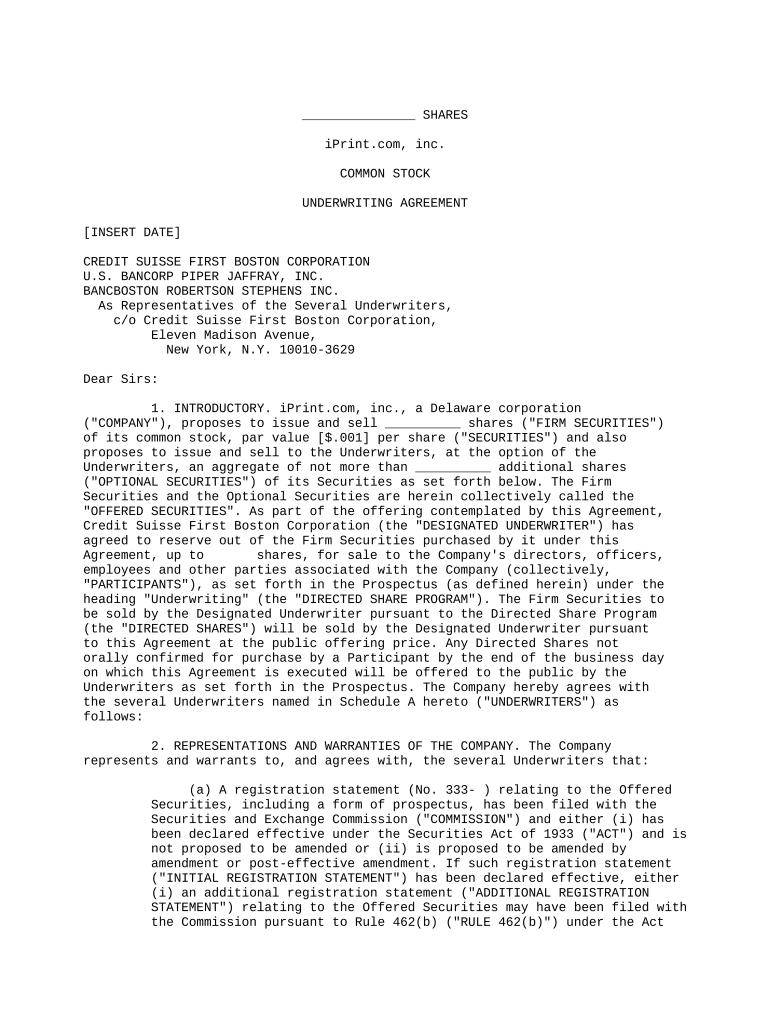
An Underwriting Agreement is a contract between an issuer and one or more underwriters that sets the terms for a securities offering or insurance risk placement. It allocates responsibilities — pricing, distribution scope, underwriting discounts, indemnities and closing conditions — and records representations and warranties from the issuer. The agreement governs settlement mechanics, regulatory filings, and the parties' obligations if the offering is delayed, withdrawn, or fails to close.

Why an Underwriting Agreement matters to transactions

The agreement creates predictable allocation of financial risk, formalizes issuer and underwriter duties, and documents closing conditions that protect both sides. Clear terms reduce negotiation friction, support regulatory compliance, and define remedies if representations are breached.

Why an Underwriting Agreement matters to transactions

Who typically prepares and signs an Underwriting Agreement

Typical parties and teams involved in preparing and executing an Underwriting Agreement.

  • Issuers and corporate legal teams preparing offering disclosures and corporate approvals.
  • Investment banks and underwriting syndicates managing pricing, allocation, and distribution.
  • Outside counsel and securities counsel advising on representations, indemnities, and regulatory filings.

Roles vary by transaction size; parties should confirm signing authority and approval chains before execution.

Key clauses that appear in a professional Underwriting Agreement

A typical Underwriting Agreement contains clauses that allocate risk, set economics, and provide procedural steps for closing and settlement.

Purchase Terms

Specifies number of shares/units, purchase price, underwriting discount or commission, and payment/settlement mechanics.
Representations

Issuer representations about organization, capitalization, financial statements, disclosure accuracy, and absence of undisclosed liabilities.

Conditions Precedent

List of actions, approvals, and filings required before underwriters must purchase securities or accept risk.

Indemnities

Allocation of loss for misstatements or omissions in offering documents and procedures for indemnity claims.

Termination Rights

Events permitting termination or price adjustment, including material adverse changes and regulatory stops.

Post-Closing Obligations

Lock-up periods, stabilizing actions, and continuing disclosure obligations after closing.

Filling and executing an Underwriting Agreement — step by step

Follow this sequence to prepare, review, and finalize the agreement with minimal rework.

  • 01
    Draft: Prepare initial draft with core economic terms.
  • 02
    Legal Review: Securities counsel reviews for compliance and disclosure accuracy.
  • 03
    Underwriter Comments: Syndicate provides markups and pricing mechanics.
  • 04
    Execution: Authorized signatories sign; exchange fully executed counterparts.

How to set up a digital signing workflow for this agreement

Configure authentication, fields, and routing to match the agreement's approval flow and regulatory needs.

Field Configuration
Authentication Method Email link or SMS code; use stronger MFA for high-value deals
Signature Type Click-to-sign or drawn signature image as allowed by counsel
Conditional Fields Enable conditional display for pricing or allocation schedules
Audit Trail Record IP, timestamp, and signer actions for compliance

Typical routing and submission flow for signed copies

Understand where copies must go and which records must be preserved after signatures are applied.

  • Upload: Sender uploads final agreement to the signing platform.
  • Place Fields: Add signature, date, and initial fields per signatory.
  • Route: Set signer order and notifications for the syndicate.
  • Archive: Store executed PDF and audit trail in secure repository.

Technical and compliance requirements for eSigning an Underwriting Agreement

Use a platform that supports secure storage, audit trails, and the integrations you need for regulatory workflows.

  • Formats: PDF, DOCX supported
  • Integrations: Salesforce, NetSuite, Google Workspace
  • Security: AES-256 at rest, TLS 1.2/1.3

Ensure the chosen platform supports your required signer authentication, retention policies, and any industry-specific compliance (for example, HIPAA or 21 CFR Part 11 if applicable).

eSignature vendor comparison for underwriting workflows

Compare common plan features and starting prices for vendors frequently used in financial transactions. signNow is shown first per platform comparison conventions.

signNow DocuSign Adobe Sign PandaDoc HelloSign
Starting Price $8/user/mo $15/user/mo $14/user/mo $19/user/mo $15/user/mo
Free Trial 7-day free trial Varies by vendor Varies by vendor Varies by vendor Varies by vendor
Bulk Send Yes (Business Premium) Yes Yes Yes Varies
Audit Trail Yes Yes Yes Yes Yes
HIPAA Compliant Yes Yes Yes No No
Envelope Cap No cap 100 envelopes/user/year Varies Varies Varies

Essential transaction data to include on the first page

Effective Date: MM/DD/YYYY
Parties: Issuer and underwriter full names
Offering Size: Total dollars and units
Price: Price per unit/share
Closing Location: Physical or electronic closing place
Governing Law: State chosen to interpret agreement

Primary penalties and risks of errors in an Underwriting Agreement

Misstatements: Liability exposure
Late Filings: Regulatory fines
Unclear Pricing: Settlement disputes
Missing Signatures: Enforceability issues
Improper Authority: Contract voidability
Tax Errors: Backup withholding risk

Common preparation mistakes to avoid

  • Using informal or abbreviated party names that do not match charter or formation documents, creating ambiguity during closing.
  • Failing to tie offering price or allocation formula to defined schedules, leading to settlement disputes after final pricing.
  • Neglecting to document conditions precedent and timelines, which can cause last-minute disagreements and missed closing conditions.
  • Overlooking regulatory filings or required disclosures under federal securities laws, increasing the risk of corrective action.

How underwriting agreements are used in real transactions

Two representative examples show how firms handle execution and workflow in practice.

Optica Ventures (Private Placement)

Optica used a clear underwriting agreement to define allocation and closing mechanics.

  • Lead manager assigned distribution and indemnity responsibilities to the syndicate.
  • The structured contract reduced negotiation cycles and clarified remedies, enabling faster settlement without in-person signings.

Tech Data (Public Offering Support)

Tech Data standardized its underwriting templates for recurring offerings.

  • Standard clauses covered price adjustments and termination events.
  • Reusable templates and consistent signature workflows reduced outside counsel review time and improved time-to-close for multiple transactions.

Practical tips for accurate and efficient completion

Adopt these practices to minimize rework and legal risk during the life of the transaction.

Use definitive names
Always match issuer and underwriter names to formation documents and ensure authorized signatories are documented.
Lock core economics
Fix offering size, per-unit price, and discount terms before circulating drafts to avoid repeated edits.
Preserve the audit trail
Retain signed PDFs and full audit logs including timestamps and signer attribution for compliance.
Coordinate filings
Plan regulatory filings, investor notices, and trustee instructions concurrent with signing to prevent closing delays.

Frequently asked questions about signing and enforcing an Underwriting Agreement

Answers to common concerns about eSigning, enforceability, and post-execution obligations.


Need help? Contact support

be ready to get more
Join over 28 million airSlate SignNow users