Establishing secure connection…Loading editor…Preparing document…

Subordination Agreement

This template is fully customizable. Edit the text, fill out the fields, and send it for signature. Give it a try!
Subordination Agreement

What a Subordination Agreement Is and when it matters

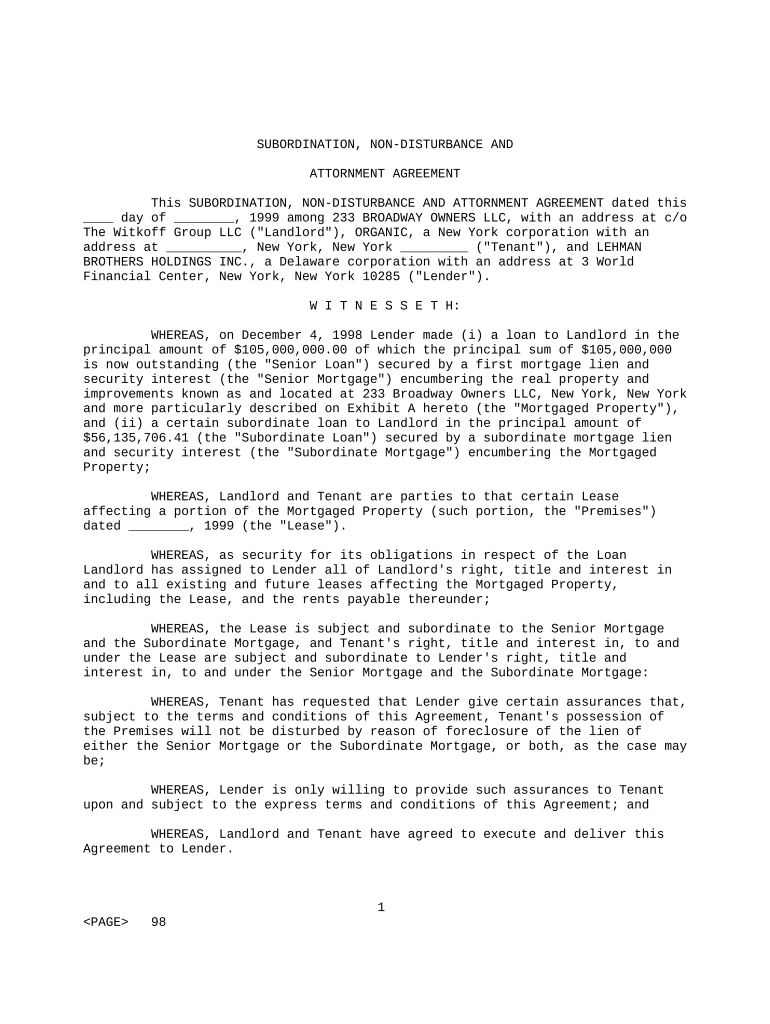
A Subordination Agreement is a contract in which one creditor agrees that its lien or security interest will rank behind another creditor’s lien. Commonly used in real estate and commercial finance when refinancing, adding a senior mortgage, or restructuring priorities among lenders, the agreement adjusts priority without extinguishing the underlying obligation. It must identify the affected instruments, the parties involved, and any conditions for effectiveness. Many lenders and title insurers require clear references to recorded documents; some jurisdictions also require notary acknowledgement or recording to preserve the intended priority.

Why a Subordination Agreement matters for lenders, borrowers, and title

A Subordination Agreement creates predictable lien priority, enables refinances or new senior financing, and reduces litigation risk by documenting consent. It protects a senior lender’s position and clarifies obligations for junior creditors and borrowers, while supporting title insurance underwriting and recording accuracy.

Why a Subordination Agreement matters for lenders, borrowers, and title

Who typically prepares and signs a Subordination Agreement

Common participants include lenders, borrowers, title professionals, and closing agents who must coordinate to preserve priority and insurance coverage.

  • Senior lenders: review terms, require conditions, and protect lien priority.
  • Junior lenders or lienholders: consent to reduced priority, often negotiate conditions.
  • Title companies and closing agents: verify references, endorse recording, and adjust policies.

Step-by-step: completing a Subordination Agreement

Follow a standard sequence to prepare, approve, sign, and record the agreement to preserve lien priority and title insurance coverage.

  • 01
    Draft the Document: Reference exact instruments and describe the priority change clearly.
  • 02
    Obtain Consent: Collect written approval from the senior and junior lenders as required.
  • 03
    Execute & Authenticate: Sign, date, and notarize where necessary; use reliable signer authentication.
  • 04
    Record and Distribute: File with the recorder and share certified copies with all parties and title insurer.

Common questions and troubleshooting for Subordination Agreements

Answers to frequent user questions about enforceability, notarization, signing authority, and correcting errors when preparing or filing subordinations.


Need help? Contact support

Security and compliance considerations for executing subordinations

Encryption: TLS 1.2/1.3 in transit
Data at rest: AES-256 encryption
Audit trail: Timestamped signature history
Regulatory compliance: ESIGN and UETA support
Certification: SOC 2 Type II available
Healthcare BAA: HIPAA available with BAA

Risks and consequences of incorrect Subordination Agreements

Invalid priority: Improper form can leave junior lien ahead.
Recording delay: Late recording may impair senior lien rights.
Name mismatch: Inconsistent names can trigger rejections.
Unauthorized signature: Lack of authority can void consent.
Title insurer denial: Insurance coverage may be withheld.
Foreclosure exposure: Priority disputes increase litigation risk.

Common preparation errors to avoid

  • Referencing an incorrect instrument number, book/page, or recording date often causes recorders to reject the filing and delays priority protection.
  • Using inconsistent party names across documents—abbreviations, initials, or corporate variations—creates ambiguity that can invalidate consent.
  • Failing to include a clear legal description of the property or relying solely on street addresses risks misidentification and recording issues.
  • Skipping lender or title insurer review before execution can lead to unapproved conditions and a rejected or contested subordination later.

How a Subordination Agreement moves from draft to recorded instrument

A Subordination Agreement follows a short workflow: prepare, get lender approvals, sign (and notarize if required), then record and distribute copies.

  • Prepare: Draft with exact instrument and property references.
  • Approve: Senior lender reviews and sets any conditions.
  • Execute: All parties sign; notarize as required.
  • Record: File with county recorder and send certified copies.

Key elements to include in a robust Subordination Agreement

A professional Subordination Agreement is concise but precise: identify parties, reference instruments, define priority changes, state conditions, and provide execution and recording instructions.

Parties

Full legal names and capacities (e.g., trustee, corporation) of the subordinating lienholder, the senior lienholder, and the borrower or property owner.
Recitals

Background statements that identify the original instruments, recording details, and the transaction context that justifies the subordination.

Subordination Clause

Clear operative language stating which liens are subordinated and the senior lien(s) that will take precedence as a result.

Referenced Instruments

Specific citation of mortgages, deeds of trust, or UCC filings by recording book/page or instrument number and county.

Conditions

Any conditions precedent such as payoff, escrow instructions, or lender approval steps required before the subordination becomes effective.

Execution & Recording

Signature blocks, notary acknowledgement if needed, and explicit instructions about where and when to record the instrument.

Configuring an online workflow to prepare and sign the agreement

Set up authentication, signer order, and template fields to ensure accurate data capture and enforceable signatures.

Field Configuration
Authentication method Email verification with optional SMS code
Signature order Sequential signing to ensure lender approvals
Template fields Names, dates, legal descriptions, instrument refs
Record export PDF with audit trail and embedded metadata

Technical considerations for eSigning and eFiling

Ensure the platform supports required file formats, strong authentication, and integrations with your closing systems.

  • Integrations: Salesforce, NetSuite, Microsoft 365
  • File formats: PDF, DOCX, PDF/A
  • Authentication: Email, SMS code, KBA available

Timing and processing expectations when executing subordinations

Timely execution and recording reduce priority risk. Allow time for lender review, title updates, and county recorder processing.

Signing Window:

Complete execution within lender-specified timeframe, often 10–30 days.

Lender Review:

Allow 5–15 business days for senior lender approval.

Title Update:

Request updated title endorsement within 30 days of recording.

Recording Window:

Record promptly after execution to protect priority.

Document Retention:

Keep signed originals or certified copies per retention policy.

Key milestones from negotiation to recorded priority

A sequential milestone view helps teams coordinate approvals, signing, and recording to protect rights and meet lender conditions.

01

Drafting & Review

Prepare the agreement and circulate for legal and title review.

02

Lender Approval

Senior and junior lenders review and provide written consent.

03

Execution & Notarization

All parties sign; obtain notary or follow RON procedures if allowed.

04

Recording & Distribution

File at county recorder and send certified copies to all parties.

Real-world examples of Subordination Agreements in use

Practical examples show how subordinations support refinancing and project financing while protecting lender priorities and streamlining closings.

Martin Properties (Real Estate)

A regional developer needed to place a new senior mortgage while preserving an existing construction lender’s interest.

  • Lender consent negotiated with conditions.
  • The executed Subordination Agreement was recorded and the title insurer issued an updated endorsement, enabling the refinance without litigation and preserving clear priority for the new senior lender.

BIS (Corporate Finance)

A company reorganizing debt required priority changes among multiple creditors to secure new capital.

  • Subordinations coordinated across lenders.
  • The agreements documented priority shifts, were executed digitally with audit trails, and prevented competing claims during subsequent enforcement events, improving creditor certainty.

eSignature solution comparison for Subordination Agreement workflows

Basic pricing and feature differences among common eSignature providers. signNow appears first for neutral comparison of core capabilities and compliance.

signNow DocuSign Adobe Sign PandaDoc HelloSign
Starting Price $8/user/mo $15/user/mo $14/user/mo $19/user/mo $15/user/mo
Free Trial 7-day free trial No No Yes, limited Yes, limited
Bulk Send Yes Yes Yes Yes No
Audit Trail Yes Yes Yes Yes Yes
HIPAA Compliant Yes Yes Yes No No
Envelope Cap No envelope cap 100 envelopes/user/year Varies by plan Varies by plan Varies by plan
be ready to get more
Join over 28 million airSlate SignNow users