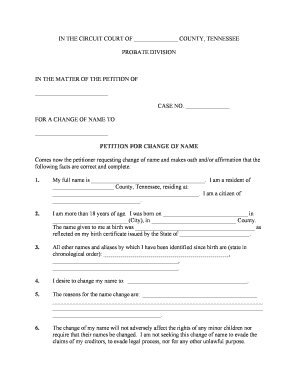
Tennessee Petition for Change of Name
What the Tennessee Petition for Change of Name Is
Why a Proper Petition Matters
A correctly completed petition creates a clear record for courts and third parties, reduces delays, and ensures the name change is accepted by government agencies, banks, and employers. Accurate petitions also help avoid privacy or legal issues later when updating identity documents.
Who Typically Files and Uses This Petition
Typical filers include adults seeking a name change after marriage, divorce, gender transition, or personal choice; parents or guardians filing for a minor; and attorneys acting on behalf of clients.
- Individual petitioners who want their legal name updated for identity consistency and records.
- Parents or guardians requesting a child’s name change due to custody, adoption, or parenting reasons.
- Attorneys preparing and filing petitions for clients to ensure procedural compliance and court advocacy.
The petition supports downstream updates to IDs, Social Security records, driver licenses, bank accounts, and professional licenses once the court signs the decree.
Step-by-step: Completing the Petition
-
01Prepare Form: Obtain the county-specific petition form and local instructions.
-
02Complete Fields: Fill all required sections with accurate, verifiable information.
-
03Attach Documents: Include ID copy, birth certificate, and any court-required exhibits.
-
04File and Serve: File with the clerk, pay fees, and provide required notice or publication.
Overview of the Filing and Review Process
-
Filing: Petition is filed with county court clerk and fees paid.
-
Notice: Court directs notice or publication if required by local rules.
-
Hearing: Judge reviews petition and hears objections if any are filed.
-
Order: If granted, court issues an order and certified copies are available.
Digital Workflow Settings for Online Completion
| Field | Configuration |
|---|---|
| Signature Type | Allow wet or e-signatures per county rules |
| Authentication | Email plus SMS code recommended for identity proofing |
| Document Format | Save final order as certified PDF with metadata |
| Retention | Archive for required statutory period |
Technical Requirements for eSubmission and eSignatures
Courts and agencies may accept electronic documents and signatures only when platform features meet legal and procedural requirements.
- File Formats: PDF and DOCX are commonly accepted
- Security: TLS encryption and audit trail required
- Authentication: Multi-factor options improve acceptance
Verify local court rules before e-filing; include certified copies or wet stamps where courts require originals.
Key Risks and Consequences of Errors
Common Mistakes to Avoid
- Using a different format for the name than on your ID, which slows secondary updates and can require additional affidavits.
- Failing to check local publication or notice requirements, leading to a court continuance or order to republish at your expense.
- Omitting required supporting documents such as a certified birth certificate or proof of residency, causing rejection at filing.
- Relying on a generic online form without confirming county-specific procedural steps, which can result in missing fees or incorrect filing venue.
Real-world Examples of Digital Name Change Workflows
Optica Ventures
The interface is simple and easy-to-use for our team.
- Staff used secure templates to collect identifications and signatures quickly.
- By standardizing forms and capturing audit trails, the finance and HR teams reduced follow-up questions and sped downstream account updates with verified court orders.
Martin Properties
I can process and execute all of these documents online with 100% compliance.
- Property managers gathered tenant name-change requests and identity documents remotely.
- Centralized, auditable records eliminated paper handling, reduced in-person visits, and provided consistent evidence for lease and utility updates.
Practical Tips for Accurate and Efficient Completion
Who Signs and Certifies the Petition
Petitioner
The individual seeking the change signs the petition under penalty of perjury; the petitioner must provide verifiable identity information and may need to appear at a hearing or provide notarized signature where required.
Court Clerk
The county court clerk accepts and stamps the filed petition, collects filing fees, schedules hearings, and issues certified copies of the final order that the petitioner uses to update other records.
Typical Timeframes and Scheduling Expectations
Initial Filing:
File the petition when ready; clerk receipts issued immediately
Publication Period:
Publication or notice often requires 14–30 days depending on local rules
Hearing Scheduling:
Hearing may be set 4–12 weeks after filing in many counties
Objection Window:
Third parties may have a statutory period to object after notice
Final Order Issuance:
Court issues signed order after hearing or default
eSignature Pricing Comparison for Name-Change Workflows
| signNow | DocuSign | Adobe Sign | PandaDoc | HelloSign | |
|---|---|---|---|---|---|
| Starting Price | $8/user/mo | $15/user/mo | $14/user/mo | $19/user/mo | $15/user/mo |
| Free Trial | 7-day free trial | Varies | Varies | Varies | Varies |
| Bulk Send | Yes | Yes | Yes | Yes | Limited |
| Audit Trail | Yes | Yes | Yes | Yes | Yes |
| HIPAA Compliant | Yes | Yes | Yes | No | No |
Frequently Asked Questions and Troubleshooting
-
Can I e-sign the petition?
Some courts accept electronic signatures; many court filings still require wet signatures or notarization. Confirm the county clerk’s local rules before relying on e-signatures.
-
Is notarization required?
Many jurisdictions require notarized signatures on the petition or affidavits. Remote Online Notarization (RON) may be accepted where state and county rules permit.
-
Do I need to publish notice?
Publication requirements depend on local rules and the reason for the change; some counties waive publication for safety or confidentiality concerns.
-
How long until the court rules?
Scheduling varies by county and caseload; expect several weeks to a few months between filing and final order in routine matters.
-
What documents should I attach?
Attach a government-issued ID, certified birth certificate if required, and any court forms specified by the clerk to verify identity and statutory compliance.
-
How do I update IDs after the order?
Obtain certified copies of the signed order and follow agency-specific procedures for Social Security, DMV, passport, banks, and employers.