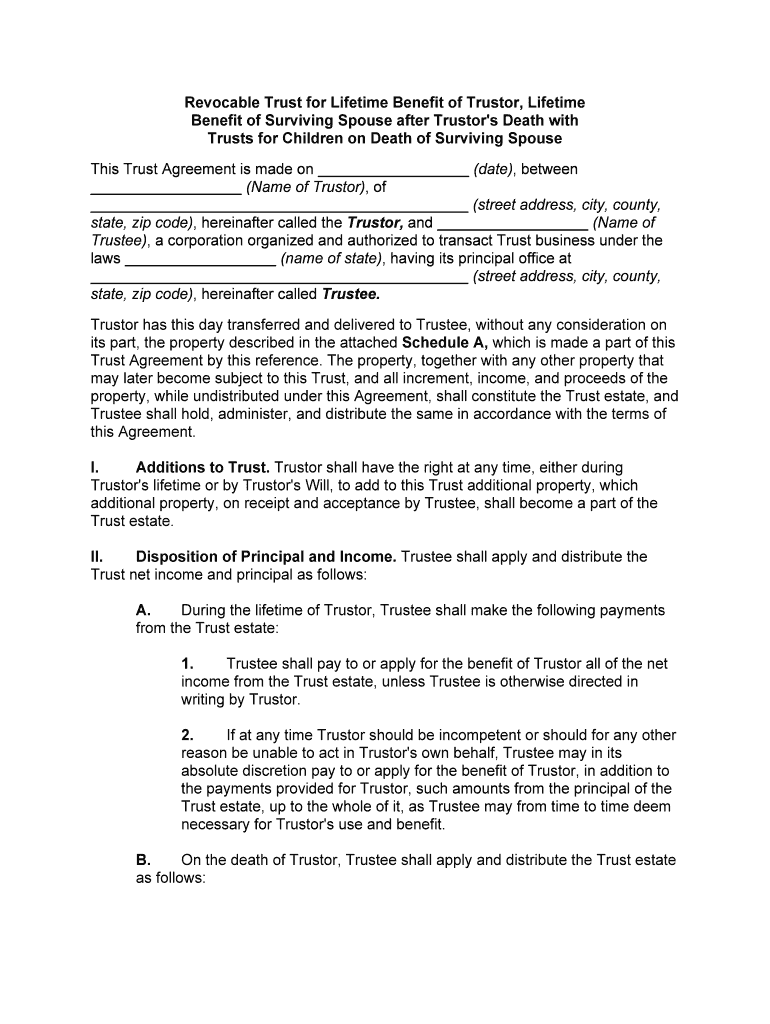
Revocable Trust for Lifetime Benefit of Trustor, Lifetime
Benefit of Surviving Spouse after Trustor's Death with
Trusts for Children on Death of Surviving Spouse
This Trust Agreement is made on __________________ (date), between
__________________ (Name of Trustor), of
_____________________________________________ (street address, city, county,
state, zip code), hereinafter called the Trustor, and __________________ (Name of
Trustee), a corporation organized and authorized to transact Trust business under the
laws __________________ (name of state), having its principal office at
_____________________________________________ (street address, city, county,
state, zip code), hereinafter called Trustee.
Trustor has this day transferred and delivered to Trustee, without any consideration on
its part, the property described in the attached Schedule A, which is made a part of this
Trust Agreement by this reference. The property, together with any other property that
may later become subject to this Trust, and all increment, income, and proceeds of the
property, while undistributed under this Agreement, shall constitute the Trust estate, and
Trustee shall hold, administer, and distribute the same in accordance with the terms of
this Agreement.
I. Additions to Trust. Trustor shall have the right at any time, either during
Trustor's lifetime or by Trustor's Will, to add to this Trust additional property, which
additional property, on receipt and acceptance by Trustee, shall become a part of the
Trust estate.
II. Disposition of Principal and Income. Trustee shall apply and distribute the
Trust net income and principal as follows:
A. During the lifetime of Trustor, Trustee shall make the following payments
from the Trust estate:
1. Trustee shall pay to or apply for the benefit of Trustor all of the net
income from the Trust estate, unless Trustee is otherwise directed in
writing by Trustor.
2. If at any time Trustor should be incompetent or should for any other
reason be unable to act in Trustor's own behalf, Trustee may in its
absolute discretion pay to or apply for the benefit of Trustor, in addition to
the payments provided for Trustor, such amounts from the principal of the
Trust estate, up to the whole of it, as Trustee may from time to time deem
necessary for Trustor's use and benefit.
B. On the death of Trustor, Trustee shall apply and distribute the Trust estate
as follows:
1. Trustee shall pay from the principal of the Trust estate the
expenses of the last illness, funeral, and burial of Trustor and any
inheritance, estate, or other taxes that may be due on the Trust estate or
any distributable portion of the Trust estate, unless Trustee shall
determine in its absolute discretion that other provisions have been made
or other means are available for the payment of such expenses and taxes;
provided, however, that in no event shall any part of the expenses or taxes
paid by Trustee be charged against or deducted from the money
distributable by Trustee as provided below, or collected by Trustee from
the distributee of the same.
2. Trustee shall pay $_______________ from the principal of the
Trust estate to __________________ (name of spouse), Trustor's
__________________ (husband/wife), hereinafter called
__________________ (husband/wife). If __________________
(husband/wife) should predecease Trustor, then that sum shall remain a
part of the Trust estate.
3. Trustee shall pay to or apply for the benefit of ______________
(husband/wife) during _______ (his/her) lifetime all of the net income from
the Trust estate in as nearly equal monthly installments as is practicable,
having in mind the anticipated annual net income, together with any
amounts from the principal of the Trust estate that may from time to time
be necessary to make each such monthly payment equal
$______________. If during any year the net income should exceed
$______________ in any month, then Trustee shall use such excess net
income to restore to principal any amounts previously paid from principal,
before paying any of the excess net income to or for the benefit
of ______________ (husband/wife) in any subsequent month or months
at the end of the year.
4. __________________ (Husband/Wife) shall have the right, from
time to time, to direct Trustee in writing to pay to _______ (him/her) or
apply for _______ (his/her) benefit such amounts from the principal of the
Trust estate as _______ (he/she) may designate, up to but not exceeding
$__________________ in any one calendar year, and not exceeding in
the aggregate __________________ no responsibility to inquire into or
determine for what purpose any such withdrawals are made by _______
(him/her). This limited right of __________________ (husband/wife) to
make withdrawals from the principal of the Trust estate shall be
cumulative; that is to say, any amount which _______ (he/she) might have
withdrawn but did not withdraw from the principal of the Trust estate
during any calendar year, may be so withdrawn by _______ (him/her)
during any subsequent calendar year or years.
5. If at any time, in the absolute discretion of Trustee,
__________________ (husband/wife) should for any reason be in need
of funds for _______ (his/her) proper care, maintenance, and support,
Trustee may in its absolute discretion pay to _______ (him/her) or apply
for _______ (his/her) benefit, in addition to the payments above, such
amounts from the principal of the Trust estate, up to the whole, as Trustee
may from time to time deem necessary or advisable for _______
(his/her) use and benefit.
6. On the death of __________________ (husband/wife), Trustee
shall pay from the principal of the Trust estate the expenses
of __________________ (husband/wife)'s last illness, funeral, and burial,
unless Trustee shall determine in its absolute discretion that other
provisions have been made or other means are available for the payment
of such expenses. All the expenses that may be paid by Trustee shall be
charged equally against and paid from the principal of the respective
shares of the Trust estate as provided below.
C. On the death of the survivor of Trustor and __________________
(husband/wife), Trustee shall divide the Trust estate into equal shares as follows,
each of which shares shall be held, administered, and distributed by Trustee as a
separate Trust:
1. One-third of the Trust estate shall be set aside for the benefit of
__________________ (name of child 1), the __________________
(son/daughter) of Trustor and born on __________________ (date), and
shall constitute the Trust estate of _______ (his/her) Trust.
2. One-third of the Trust estate shall be set aside for the benefit of
__________________ (name of child 2), the __________________
(son/daughter) of Trustor and born on __________________ (date of birth
of child 2), and shall constitute the Trust estate of _______ (his/her) Trust.
3. One-third of the Trust estate shall be set aside for the benefit
of __________________ (name of child 3), the __________________
(son/daughter) of Trustor and born on __________________ (date), and
shall constitute the Trust estate of _______ (his/her) Trust.
4. All references in this Trust Agreement to Trust or Trust estate,
unless otherwise specifically provided in this Agreement, are intended to
refer to each of the separate Trusts provided for above, and the Trust
estate of each such Trust.
D. Trustee shall apply and distribute the net income and principal of each of
the shares of the Trust estate set aside for the benefit of __________________
(name of child 1), __________________ (name of child 2), and
__________________ (name of child 3), children of Trustor, as follows:
1. Until each of the children of Trustor attains the age of _______
(18/21) years, respectively, Trustee shall pay to or apply for the benefit of
the child so much of the net income from his or her share of the Trust
estate, up to the whole of it, as the Trustee in its absolute discretion may
from time to time deem necessary or advisable for the proper
maintenance, support, and education of the child. The balance of the net
income, if any, shall be accumulated by Trustee and from time to time
added to the principal of the child's share of the Trust estate. On each
child of Trustor attaining the age of _______ (18/21) years, respectively,
Trustee subsequently shall pay to or apply for the benefit of the child all of
the net income from his or her share of the Trust estate, until the child
attains the age of _______ (age) years.
2. If at any time, in the absolute discretion of Trustee, any of the
children of Trustor should for any reason be in need of funds for his or her
proper care, maintenance, support, and education, Trustee may in its
absolute discretion pay to or apply for the benefit of any such child, in
addition to the payments above provided for him or her, such amounts
from the principal of his or her share of the Trust estate, up to the whole of
such share, as Trustee may from time to time deem necessary or
advisable for his or her use and benefit.
3. On each child of Trustor attaining the age of _______ (age) years,
respectively, Trustee shall distribute and deliver to the child _______%
(fraction of balance of principal) of the then-balance of the principal of his
or her share of the Trust estate; on each child of Trustor attaining the age
of _______ (age) years, respectively, Trustee shall distribute and deliver
to the child _______% (fraction of balance of principal) of the then-balance
of the principal of his or her share of the Trust estate; and on each child or
Trustor attaining the age of _______ (age) years, respectively, Trustee
shall distribute and deliver to the child all of the then-balance of his or her
share of the Trust estate.
4. If any child of Trustor should survive Trustor and ____________
(husband/wife) but should die prior to attaining the age of _______
(age) years, then on the death of the child, or if any child of Trustor should
predecease the survivor of Trustor and __________________
(husband/wife), then on the death of the survivor, Trustee shall distribute
and deliver all of the then-balance of the deceased child's share of the
Trust estate to his or her surviving issue, including descendants, __________________ (per stirpes or by right of representation) . If there
should be no such surviving issue including descendants, then all of the
balance of the deceased child's share of the Trust estate shall be added
equally to the shares of the Trust estate set aside for the benefit of the
others of children of Trustor, to be held, administered, and distributed as a
part of the other children's shares, respectively, including proportionately
both the distributed and undistributed portions of each such share.
5. If all of the children of Trustor should die prior to the final
distribution of the Trust estate, and if all or any portion of the Trust estate
should not be disposed of under the provisions set forth above, then on
the death of the last survivor of Trustor, _______ ( his/her)
__________________ (husband/wife) and _______ (his/her) children, all
of the Trust estate not so disposed of shall be distributed and delivered by
Trustee to the executor or administrator of the estate of Trustor, to be
held, administered, and distributed as a part of the estate.
E. Each of the separate Trusts provided for in this Agreement, unless sooner
terminated in accordance with the provisions set forth above, shall in any event
terminate on the death of the last survivor of Trustor, __________________
(husband/wife), and Trustor's children, __________________ (name of child
1), __________________ (name of child 2) and __________________ (name of
child 3).
F. In exercising its discretionary authority with respect to the payment of net
income or principal of the Trust estate or of any share of the same to any
beneficiary under any of the provisions of this Agreement, Trustee shall take into
consideration any income of or other means of care, maintenance, support, and
education available to the beneficiary from sources outside of this Trust that may
be known to Trustee; and the determination of Trustee with respect to the
necessity for and the amounts of any such payments from net income or principal
to be made to or for the benefit of any beneficiary, as above provided, shall be
conclusive on all persons interested in this Trust.
G. Whenever the right of any beneficiary to payments from net income or
principal shall terminate, either by reason of death or otherwise, all such
payments accrued or undistributed by Trustee at the date of the termination shall
be distributed to the beneficiary entitled to the next successive interest.
H. On any division or partial or final distribution of the property of the Trust
estate, Trustee may divide or distribute the property in kind, including undivided
interests in the property, or in its absolute discretion Trustee may sell all or any
part of the property and make such division or distribution in cash or partly in
cash and partly in kind. The decision of Trustee as to what constitutes a proper
division of the Trust estate either prior to or on any distribution shall be binding
on all beneficiaries.
I. The term issue as used in this Agreement shall mean lawful issue, and
shall mean descendants as well as immediate issue, and shall include legally
adopted children and issue and descendants of legally adopted children.
III. Powers of Trustee. Subject only to the provisions and limitations set forth in this
Section III and elsewhere in this instrument, Trustee, in extension and not in limitation
of the powers given Trustee by law or other provisions of this instrument, shall have the
following powers with respect to the Trust created by this Agreement and its property, in
each case to be exercised from time to time in Trustee's discretion and without the order
or license of any court:
A. To change the situs of the Trust and of any property which is part of the
Trust to any place in the United States of America or any other country.
B. Not to file an inventory of the property which is part of the Trust or annual
accounts of administration with and not to have any of the property examined by
any court where the filing or examination is not required by applicable law.
C. To retain for any period of time any property which may be received or
acquired, even though its retention by reason of its character or otherwise would
not be appropriate apart from this provision.
D. To collect, receive, and receipt for rents, profits, or other income from any
property which may be held.
E. To expend money or other property in order to collect, sell, manage,
conserve, or administer any property which may be held, or in order to improve,
repair, equip, develop, furnish, maintain, alter, extend, or add to any such
property.
F. To sell at public or private sale (including, specifically, the power to initiate
or participate in any public offering or underwriting), partition, exchange for like or
unlike property, lease for any period of time even though it may be longer than
the duration of the estate or of the Trust, modify, renew, or extend any lease,
grant, options on, release, demolish, abandon, dedicate and otherwise dispose of
any property which may be held, on such terms and conditions, including credit,
and for such consideration, even though it may be less than the value at which
the property was appraised in the estate or was received or acquired, or for such
other benefit, even though it may be intangible, as may be deemed appropriate.
G. To transfer title to, grant rights in, and convey in fee simple or otherwise
any property which may be held, free of all Trust.
H. To invest and reinvest in any and all kinds of securities, domestic or
foreign, including common and preferred stocks, bonds, debentures, notes,
commodity contracts, mortgages, and options on property; in money market
funds, commercial paper, repurchase agreements, United States Treasury
obligations, certificates of deposit, savings accounts, checking accounts, and any
other cash investment medium; in investment trusts and in common trust funds;
in any real property; in any personal or mixed property; in any business, mining,
or farming operation, or other venture; or in any other interest or investment
medium, even though such investment would not be of a character authorized by
applicable law but for this provision.
I. Not to diversify the property which may be held, whether the property was
originally received or subsequently acquired by exchange, investment, or
otherwise.
J. To retain cash for reasonable periods of time in amounts sufficient to meet
anticipated needs, including payments of expenses and to beneficiaries.
K. With respect to property subject to depreciation or depletion, to withhold
an amount from Trust income in the discretion of Trustee to provide for a
reasonable allowance for depreciation or depletion on the property under
generally accepted accounting principles.
L. To do all things necessary, customary, or desirable to conduct the affairs
of an unincorporated business, mining, or farming operation or other venture.
M. To do all things necessary, customary, or desirable to conduct the affairs
of any corporation; to act as officer, director, attorney, or employee of any
corporation; and to place stock in the name of an individual personal
representative or Trustee or any beneficiary of the estate or of the Trust in order
to qualify the person as a director of the corporation.
N. Alone or with others, to organize, reorganize, merge, consolidate,
recapitalize, dissolve, liquidate, or otherwise create or change the form of any
corporation, partnership, joint venture, or other entity.
O. To exercise all voting, sale, purchase, exchange, or other rights or options
with respect to any security or other property which may be held.
P. To refuse, reject, or not to exercise any offer to purchase, option to
purchase, voting, or other right or option with respect to any security or other
property which may be held.
Q. To participate in any plan or proceeding for protecting or enforcing any
right, obligation, or interest arising from any property which may be held; to serve
as a member of a securities-holder protective committee; and to deposit
securities in accordance with any plan agreed on.
R. To expend money or other property, whether by bidding in at foreclosure,
by making a contribution to capital, by paying an assessment, or otherwise, in
order to protect any property which may be held.
S. To pay, contest, compromise, abandon, release, adjust, submit to
arbitration, sue on, defend, and otherwise deal with and settle any claim in favor
of or against the estate or the Trust or the personal representative or Trustee.
T. To receive, acquire and retain policies of fire, motor vehicle, business-
interruption, title, liability, fidelity, indemnity, or other casualty insurance, either in
stock or in mutual companies, in any amount, against any risk in which the estate
or the Trust has an insurable interest.
U. To borrow money or other property for such periods of time, on such terms
and conditions, and for such purposes as may be deemed appropriate; to
mortgage, pledge, or otherwise encumber any property which may be held as
security for any such loan; and to renew, extend, or refund any existing loan
either as maker or endorser.
V. With respect to any obligation held, whether secured or unsecured, to
reduce the interest rate on it, to continue it on and after maturity with or without
renewal or extension and without regard to the then-value of any security, to
foreclose on the security or to acquire the security without foreclosure.
W. To keep books of account and to make reports on such reasonable basis
and with such detail as may be deemed appropriate.
X. To execute any instrument, under seal or otherwise.
Y. To bind absolutely, by any action taken or not taken, all beneficiaries, born
or unborn, ascertained or unascertained, of the Trust estate or of the Trust as
against any other party; and no party dealing with the personal representative or
Trustee shall have any duty to follow any property transferred by the party to the
personal representative or Trustee.
Z. To sell any property to, to exchange any property with, to purchase any
property from, or otherwise to deal with any beneficiary of the estate or of the
Trust or with any Trust or estate of which either Trustor, Trustor's spouse, or any
ancestor or issue of Trustor is or was a donor or beneficiary, whether created by
this Agreement or not, even though some or all of the personal representatives or
Trustees are also fiduciaries of such other Trust or estate. When dealing with any
fiduciaries, Trustee shall have no duty to follow any property transferred by them.
AA. To act notwithstanding the self-interest of any of the personal
representatives or Trustee, including the powers to lease, mortgage, or sell any
property to or lease or purchase any property from any personal representative,
to determine the amount of and to receive compensation for services as Trustee
or in any other capacity, in the case of a corporate personal representative or
Trustee, to borrow from, deposit money, or otherwise deal with its own banking
department, to invest in its own stock or the stock of any of its affiliates, or to
invest in its own common trust fund, and to be interested in any investment,
corporation, unincorporated business, farming, or mining operation, real-estate
operation, or other venture in which the estate or the Trust is interested.
BB. To obtain the advice of accountants, attorneys at law, brokers, investment
counsel, realtors, appraisers, and other experts, and to compensate the experts
by salary, commission, fee, or otherwise, and to act pursuant to the advice of
such experts without independent investigation.
CC. To delegate to one or more personal representatives or Trustees or to
agents or nominees: the authority to execute contracts, checks, documents of
title, and other instruments, to keep books of account, to prepare reports and tax
returns, to hold possession and record ownership of securities, bank accounts,
and other property, or to perform any other ministerial function; the authority to
perform the following discretionary functions; the management of any investment,
unincorporated business, farming, or mining operation, real estate operation, or
other venture (whether by employing agents, giving proxies, entering into voting
trusts, or otherwise, and whether or not such agency Agreements, proxies, voting
trust agreements, or other arrangements may extend beyond the term of the
Trusts), and the selection of the time to acquire or to dispose of any property
which may be held; any power, including this power, possessed by Trustee,
which is necessary, customary, or desirable so that the delegate may perform
any function delegated pursuant to this paragraph; and to compensate the
agents by salary, commission, fee, or otherwise; provided, however, that any
power specifically reserved by the terms of this Agreement to Trustee may be
delegated or redelegated only to another Trustee.
DD. To enter into binding agreements not to exercise any power which may be
possessed on such terms and conditions and for such reasons as may be
deemed appropriate.
EE. To enter into any pooling or unitization agreement.
FF. To advance money on behalf of the Trust or of the estate, for which
advances, with any interest, Trustee shall have a lien on the assets of the Trust
or estate as against any beneficiary.
GG. To permit any beneficiary to have the use, possession, and enjoyment of
any property then distributable pending actual distribution of the property.
HH. To retain for any period of time cash or other unproductive property.
II. To receive, acquire, and retain policies, and proceeds of policies, of life
insurance and of immediate and deferred annuities, either in stock or in mutual
companies, in any amount, on the life of any beneficiary of the Trust estate or of
any Trust created by this instrument, or on the life of any person in whom the
beneficiary, the Trust estate, or any Trust created by this instrument has an
insurable interest; to pay the premiums on the policies out of the Trust estate or
out of either the income or principal or both of any Trust created by this
Agreement which is the beneficiary of the policy or out of which the beneficiary of
the policy is eligible to receive income; and to exercise all rights, privileges, and
options available under the policy.
JJ. To loan money or other property, with or without formal evidence of
indebtedness, with or without collateral security, for such periods of time and on
such terms and conditions as may be deemed appropriate to any beneficiary of
the Trust estate or of any Trust created by this instrument, to any business
controlled by any such beneficiary, or to any estate or Trust of which any such
beneficiary is a beneficiary, out of the Trust estate or out of any Trust created by
this instrument from which the beneficiary is eligible to receive income, as the
case may be; to make any such loan a lien on any property payable or
distributable to the beneficiary; and to guarantee any loans of any such
beneficiary, business, estate, or Trust.
KK. To receive, acquire, and retain any of the property of the several Trusts
created by this instrument undivided until division shall become necessary in
order to make any payment or distribution; to hold, manage, invest, reinvest, and
account for the several shares or parts of shares by appropriate entries in books
of account, and to allocate to each such share or partial share its proportionate
part of all receipts and expenses.
IV. Spendthrift Provision. No beneficiary of this Trust shall have any right to
alienate, encumber, or hypothecate his or her interest in the principal or income of the
Trust in any manner, nor shall any interest be subject to claims of his or her creditors or
liable to attachment, execution, or other process of law.
V. Amendments. Trustor shall have the right at any time to amend any of the
provisions of this Trust Agreement or of any amendment to it, by an Agreement in
writing executed by Trustor and Trustee, and to revoke this Trust in whole or in part by
an instrument in writing executed by Trustor and delivered to Trustee. In the event of
the incompetency of Trustor or on Trustor's death, this Trust shall be irrevocable and
shall not be subject to amendment during such incompetency or after such death.
The foregoing provisions of this Section V shall not limit or otherwise affect the right
of (husband/wife) or of any of the children of Trustor to make withdrawals from principal
as provided elsewhere in this Trust instrument.
VI. Competency. All rights granted to any person by any provisions of this Trust
Agreement may be exercised by that person at any time during his or her lifetime and
competency, unless otherwise specifically provided in this Agreement. For all purposes
of this Trust Agreement, it shall be conclusively presumed that each such person is
competent unless he or she shall have been declared incompetent or had a guardian of
his or her person or estate appointed by a court having jurisdiction; no guardian of his or
her person or guardian of his or her estate shall have power to exercise any of his or
her rights under this Agreement.
VII. Resignation. Trustee shall have the right to resign at any time, and on such
resignation Trustor shall appoint a successor Trustee; in the event of the failure, refusal,
or inability of Trustor to do so, then Trustee or any beneficiary of the Trust may secure
the appointment of a successor Trustee by a court of competent jurisdiction, at the
expense of the Trust.
VIII. Successor Trustee. Any successor of Trustee, whether through the sale or
transfer of its business or its trust department, or the conversion, consolidation, merger,
or resignation as Trustee under this Agreement, or otherwise, shall immediately become
the successor Trustee, and shall succeed to all title of Trustee to the Trust estate, and
all powers, rights, discretions, obligations, and immunities of Trustee, with the same
effect as though the successor were originally named as Trustee.
IX. Compensation. Trustee shall receive as compensation for its services under this
Agreement the following fees: _____________________________________________
(description of fees). The term value, as used above with reference to the Property held
in the Trust, shall mean the unpaid principal of all promissory notes, either secured or
unsecured, and the market value of all other property, or should there be no market
then the reasonable value of the property.
X. Acceptance; Governing Law; Severability. This Trust has been accepted by
Trustee and will be administered in __________________ (name of state). Its validity,
construction, and all rights under it shall be governed by the laws of that state. If any
provision of this Trust Agreement should be invalid or unenforceable, the remaining
provisions shall continue to be fully effective.
Trustor and Trustee have executed this Trust Agreement on __________________
(date of execution).
______________________________
(Signature of Trustor)
________________________
(Printed Name of Trustor)
________________________
(Name of Trustee)
By:____________________________
________________________
(Name of Trustee officer)
________________________
(Printed Name and Title)
(Acknowledgments)
(Attachment of schedule)