Establishing secure connection… Loading editor… Preparing document…
Navigation

Fill and Sign the Two Individuals Husband and Wife to an Form
Fill and Sign the Two Individuals Husband and Wife to an Form

How it works

Open the document and fill out all its fields.
Apply your legally-binding eSignature.
Save and invite other recipients to sign it.

Rate template

4.6
60 votes
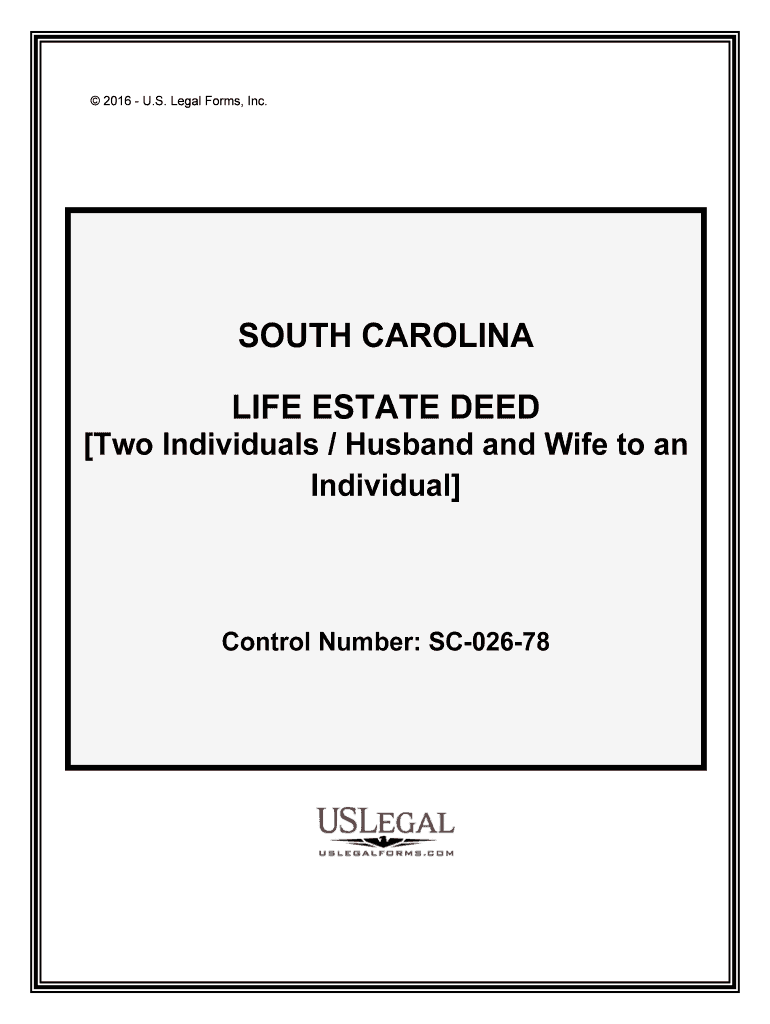
© 2016 - U.S. Legal Forms, Inc. SOUTH CAROLINA LIFE ESTATE DEED [Two Individuals / Husband and Wife to an Individual] Control Number: SC-026-78 I. TIPS ON COMPLETING THE FORMSThe form(s) in this packet may contain “form fields” created using Microsoft Word or Adobe Acrobat (“.pdf” format). “Form fields” facilitate completion of the forms using your computer. They do not limit your ability to print the form “in blank” and complete with a typewriter or by hand. It is also helpful to be able to see the location of the form fields. Go to the View menu, click on Toolbars, and then select Forms. This will open the Forms toolbar. Look for the button on the Forms toolbar that resembles a shaded letter “a”. Click this button and the form fields will be visible. By clicking on the appropriate form field, you will be able to enter the needed information. In some instances, the form field and the line will disappear after information is entered. In other cases, it will not. The form was created to function in this manner. II. Notes on Filing this Form Original Signatures of Executing Party(ies) & Date of Execution - Although documents may be a copy or a FAX, all required signatures must be originals. The Register of Deeds in South Carolina “encourage” use of BLUE INK for Signatures. Indexing of Executing Parties are taken from the signature, rather than from the typed name on the face of the document. If these names are totally different, the document may be returned “Unfiled”. The exact name spelling should be typed or printed beneath each signature. The Date of Execution must also be clearly noted on the document. Subscribing Witnesses - Most documents require 2 witnesses’ original signatures. One of these witnesses may sign the “Affidavit of Probate” and the other may be the Notary Public. The individuals who execute the document may not be any of these. Affidavits of Probate and Acknowledgements - Documents must have either this “Affidavit” or an Acknowledgement following the Execution and Witness Signatures. The Probate provides for one of the two Witnesses to confirm to either the other witness or Notary, that he/she saw the Grantor(s) execute the document. The Acknowledgement provides for the Executing party to make oath to the Notary that he/she executed the document. Notary Public - Documents presented for filing, except as otherwise provided by law, must be “Notarized”, by a licensed Notary Public, with the appropriate “Notary” statement, signature, expiration date and Seal. Description & Derivation Clause - Most documents must contain some legal description of the property involved and/or reference to an attached Plat which provides such description (see Plat Recording Guidelines). Deeds, except Quit Claim Deeds, must include a derivation clause, preferably at the end of the legal description, that gives recording information for the Deed which established the Grantor’s (seller’s) ownership, and provides an important link in the "Chain of Title". This Clause shall include the Name of the original Grantor, and the Recording Date AND/OR Book and Page number of the Deed which originally conveyed the property to the Grantor. Grantee’s/Mortgagee’s Address - The address of the Buyer (Grantee) on Deeds, and the Secured Party (Mortgagee) on Mortgages, must be clearly noted, usually on the face of those documents. Preparation Clause - Deeds must have a clause, preferably at the end of the legal description, that tells the name, and the address, of who prepared the document. District, Map & Parcel No. - This information must be clearly noted somewhere on all Deeds and all Plats ( preferably on the first page ). This DMP information is an important link between a number of shared data-bases for County staff and public access to information related to Real Property. The information may be obtained off of the old Deed or a Tax Notice. Affidavit of True Consideration - Any conveyance of property that meets State and Local laws requiring payment of Recording Fees, Transfer Fees, etc., must indicate the “True Consideration” or value in money’s worth for that conveyance (see S.C. Code Sect 12-24 as amended). Thus, for example, if a Deed does not indicate on its face the amount paid, or the words “and other consideration”, or if a trade of property is involved, there must be attached an “Affidavit of True Consideration” that reflects the actual value of the transaction. That value is used to calculate Fees (including State & County Recording Fees, and Town of Hilton Head Island Transfer Fees) due for the recording. NOTE: If the Filer claims an “Exemption” from any Fees established by State or Local laws, an Affidavit must also be attached which cites the specific section of the law under which such Exemption is claimed. EXEMPTIONS FROM RECORDING FEESPER 12-24-40, SC CODE OF LAWS EXEMPTED FROM THE RECORDING FEES ARE DEEDS WHICH: 1) transfer realty in which the value of the realty, as defined in Code Section 12-24-30, is equal to or less than $100; 2) transfer realty to the federal government or to a state, its agencies and departments, and to its political subdivisions, including school districts; 3) are otherwise exempted under the laws and constitution of the State of South Carolina or the United States (give cite); 4) transfer realty in which no gain or loss is recognized by reason of Section 1041 of the US Internal Revenue Code, as defined in section 12-6-40(A) of the SC Code of Laws; 5) transfer realty in order to partition the realty, as long as no consideration is paid for the transfer other than the interests in the realty(s) that are being partitioned; 6) transfer an individual grave space at a cemetery owned by a cemetery company licensed under Chapter 55 of Title 39; 7) constitutes a contract for sale of timber to be cut (but not the land upon which the timber stands); 8) transfers realty to a corporation, partnership, or trust in order to become, or as, a stockholder, partner, or trust beneficiary of the entity, provided no consideration is paid for the transfer other than stock in the entity, interest in the partnership, beneficiary interest in the trust, or the increase in value in such stock or interest held by the grantor. However, the transfer of realty from a corporation, partnership, or trust to a stockholder, partner, or trust beneficiary of the entity is subject to the fee even if the realty is transferred to another corporation, partnership, or trust; 9) transfers realty from a family partnership to a partner or from a family trust to a beneficiary, provided no consideration is paid for the transfer other than a reduction in the grantee’s interest in the partnership or trust. A “family partnership” is a partnership whose partners are all members of the same family. A family trust is a trust, in which the beneficiaries are all members of the same family. The beneficiaries of a family trust may also include charitable entities. A “family” means the grantor and the grantor’s, parents, grandparents, sisters, brothers, children, stepchildren, grandchildren, and the spouses and lineal descendants of any of the above. A charitable entity means an entity which may receive deductible contributions under Section 170 of the US Internal Revenue Code, as defined in SC Code Section 12-6-40(A); 10) transfers realty in a statutory merger or consolidation from a constituent corporation to the continuing or new corporation; 11) transfers realty to a merger or consolidation from a constituent partnership to the continuing or new partnership; 12) constitutes a corrective deed or a quitclaim deed used to confirm title already vested in the grantee, provided that no consideration of any kind is paid or is to be paid under the corrective deed or quitclaim deed; 13) transfers realty subject to a mortgage to the mortgagee, whether by a deed in lieu of foreclosure executed by the mortgagee, or by deed pursuant to foreclosure; 14) transfers realty from an agent to the agent’s principal, in which the realty was purchased with funds of the principal, provided that a notarized document is also filed with the deed that establishes the fact that the agent and principal relationship existed at the time of the original purchase as well as for the purpose of purchasing the realty; and, 15) transfers title to facilities for transmitting electricity that is transferred, sold, or exchanged by electrical utilities, municipalities, electric cooperatives, or political subdivisions to a limited liability company which is subject to regulation under the Federal Power Act (16 U.S.C. Section 791(a)), and which is formed to operate or to take functional control of electric transmission assets as defined in the Federal Power Act. III. DISCLAIMERThese materials were developed by U.S. Legal Forms, Inc. based upon statutes and forms for the subject state. All information and Forms are subject to this Disclaimer: All forms in this package are provided without any warranty, express or implied, as to their legal effect and completeness. Please use at your own risk. If you have a serious legal problem, we suggest that you consult an attorney in your state. U.S. Legal Forms, Inc. does not provide legal advice. The products offered by U.S. Legal Forms (USLF) are not a substitute for the advice of an attorney. THESE MATERIALS ARE PROVIDED “AS IS” WITHOUT ANY EXPRESS OR IMPLIED WARRANTY OF ANY KIND INCLUDING WARRANTIES OF MERCHANTABILITY, NONINFRINGEMENT OF INTELLECTUAL PROPERTY, OR FITNESS FOR ANY PARTICULAR PURPOSE. IN NO EVENT SHALL U.S. LEGAL FORMS, INC. OR ITS AGENTS OR OFFICERS BE LIABLE FOR ANY DAMAGES WHATSOEVER (INCLUDING WITHOUT LIMITATION DAMAGES FOR LOSS OR PROFITS, BUSINESS INTERRUPTION, LOSS OF INFORMATION) ARISING OUT OF THE USE OF OR INABILITY TO USE THE MATERIALS, EVEN IF U.S. LEGAL FORMS, INC. HAS BEEN ADVISED OF THE POSSIBILITY OF SUCH DAMAGES. Life Estate Deed Page 1 of 3 Recording Requested By and When Recorded Mail to: Recording Time, Book & Page LIFE ESTATE DEED COUNTY: TAX MAP NUMBER: CITY: DATE: This Indenture , made the day of , 20 by GRANTORS: , a married person, whose postal address is , and , a married person, whose postal address is , and GRANTEE: , a married person, whose postal address is . WITNESS: That the GRANTORS, for and in consideration of Ten Dollars and other valuable consideration, do hereby grant, bargain, sell, release and convey unto the GRANTEE a LIFE ESTATE in the following described land, situate, lying and being in County, South Carolina, to wit: See Exhibit A attached hereto and incorporated by reference as though set forth in full Legal Description: Prior Instrument Reference : Book , Page , Document No. of the Public Records of the Recorder of County, South Carolina. RESERVATIONS AND LIMITATIONS TO CONVEYANCE: 1. It is the intention of the Grantors to create a Life Estate in Grantee with right of possession and use of the property, as well as the rents, revenues and profits generated by the property during the term of the Grantee's natural life. Life Estate Deed Page 2 of 3 2. EXECUTED this day of , 20 Signed, sealed and delivered in the presence of: Witness Signature Signature of Grantor Printed Name Printed Name Witness SignaturePost Office Address Printed NameCity, State and Zip Code Witness Signature Signature of Grantor Printed NamePrinted Name Witness SignaturePost Office Address Printed NameCity, State and Zip Code STATE OF SOUTH CAROLINA COUNTY OF I, a Notary Public for South Carolina, do hereby certify that , Grantor, personally appeared before me this day and acknowledged the due execution of the foregoing instrument. Witness my hand and official seal this the day of , 20 . Notary Public for South Carolina My Commission Expires: Life Estate Deed Page 3 of 3 STATE OF SOUTH CAROLINA COUNTY OF I, a Notary Public for South Carolina, do hereby certify that , Grantor, personally appeared before me this day and acknowledged the due execution of the foregoing instrument. Witness my hand and official seal this the day of , 20 . Notary Public for South Carolina My Commission Expires: Affidavit Page 1 of 3 STATE OF SOUTH CAROLINA : : COUNTY OF : AFFIDAVIT PERSONALLY appeared before me the undersigned, who being duly sworn, deposes and says: 1. I have read the information on this Affidavit and I understand such information. 2. The property being transferred is located at ________________________________________, bearing County Tax Map Number _____________________________________, was transferred by ____________________________________ to ____________________________________ on ________________________. 3. Check one of the following: THE DEED IS a. Subject to the deed recording fee as a transfer for consideration paid or to be paid in money or money’s worth. b. Subject to the deed recording fee as a transfer between a corporation, a partnership, or other entity and stockholder, partner, or owner of the entity or is a transfer to a trust or as distribution to a trust beneficiary. c. Exempt from the deed recording fee because (See information section of Affidavit): ________________________________________________ (If exempt, please skip items 4 -7, and go to item 8 of this affidavit.) If exempt under exemption #14 as described in the Information section of this affidavit, did the agent and principal relationship exist at the time of the original sale and was the purpose of this relationship to purchase the realty? Check Yes or No ? 4. Check one of the following if either item 3(a) or item 3(b) above has been checked (See Information section of this affidavit.): a. The fee is computed on the consideration paid or to be paid in money or money’s worth in the amount of $______________________________ b. The fee is computed on the fair market value of the realty which is ______________________________ c. The fee is computed on the fair market value of the realty as established for property tax purposes which is ______________________________ 5. Check YES or NO to the following: A lien or encumbrance existed on the land, tenement, or realty before the transfer and remained on the land, tenement, or realty after the transfer. If “YES”, the amount of the outstanding balance of this lien or encumbrance is $______________. 6. The DEED Recording Fee is computed as follows: (a) Place the amount listed in item 4 above here: __________________ (b) Place the amount listed in item 5 above here: __________________* (c) Subtract Line 6(b) from Line 6(a) and place the result here: __________________ *If no amount is listed, place zero here. 7. The deed recording fee due is based on the amount listed in Line 6(c) above and the deed recording fee due is: ______________________________ Affidavit Page 2 of 3 8. As required by Code Section 12-24-70, I state that I am a responsible person who was connected with the transaction as: _______________________________________ 4. I understand that a person required to furnish this Affidavit who willfully furnishes a false or fraudulent affidavit is guilty of a misdemeanor and, upon conviction, must be fined not more than one thousand dollars or imprisoned not more than one year, or both. _______________________________________ Responsible Person Connected with the Transaction Sworn to before me this ______ __________________________________________ day of ______________, 20 ______ Print or Type Name Here _____________________________ Notary Public for __________________ My commission expires __________________ INFORMATION Except as provided in this paragraph, the term ''value'' means the consideration paid or to be paid in money or money’s worth for the realty. Consideration paid or to be paid in money’s worth includes, but is not limited to, other realty, personal property, stocks, bonds, partnership interest and other intangible property, the forgiveness or cancellation of a debt, the assumption of a debt, and the surrendering of any right. The fair market value of the consideration must be used in calculating the consideration paid in money’s worth. Taxpayers may elect to use the fair market value of the realty being transferred in determining fair market value of the consideration. In the case of realty transferred between a corporation, a partnership, or other entity and a stockholder, partner, or owner of the entity, and in the case of realty transferred to a trust or as a distribution to a trust beneficiary, “value” means the realty’s fair market value. A deduction from value is allowed for the amount of any lien or encumbrance existing on the land, tenement, or realty before the transfer and remaining on the land, tenement, or realty after the transfer. Taxpayers may elect to use the fair market value for property tax purposes in determining fair market value under the provisions of the law. Exempted from the fee are deeds: . (1) Transferring realty in which the value of the realty, as defined in Code Section 12-24-30, is equal to or less than one hundred dollars; (2) Transferring realty to the federal government or to a state, its agencies and de partments, and its political subdivisions, including school districts; (3) That are otherwise exempted under the laws and Constitution of this State or of the United States; (4) Transferring realty in which no gain or loss is recognized by reason of Section 1041 of the Internal Revenue Code as defined in Section 12-6-40(A); (5) Transferring realty in order to partition realty as long as no consideration is paid for t he transfer other than the interests in the realty that are being exchanged in order to partition the realty; (6) Transferring an individual grave space at a cemetery owned by a cemetery company li censed under Chapter 55 of Title 39; (7) That constitute a contract for the sale of timber to be cut; (8) Transferring realty to a corporation, a partnership, or a trust in order to become, or as, a stockholder, partner, or trust beneficiary of the entity provided no consideration is paid for t he Affidavit Page 3 of 3 transfer other than stock in the corporation, interest in the partnership, beneficiary interest in the trust, or the increase in value in such stock or interest held by the grantor. However, the transfer of realty from a corporation, a partnership, or a trust to a stockholder, partner, or trust beneficiary of the entity is subject to the fee even if the realty is transferred to another corporation, a partnership, or trust; (9) Transferring realty from a family partnership to a partner or from a family trust to a beneficiary, provided no consideration is paid for the transfer other than a reduction in the grantee’s inte rest in the partnership or trust. A “family partnership” is a partnership whose partners are all me mbers of the same family. A “family trust” is a trust, in which the beneficiaries a re all members of the same family. The beneficiaries of a family trust may also include charitable entities. “Family” means the grantor and the grantor’s spouse, parents, grandparents, sisters, brothers, children, stepchildren, grandchildren, and the spouses and lineal descendants of any the above. A “charitable entity” means an entity which may receive deductible contribut ions under Section 170 of the Internal Revenue Code as defined in Section 12-6-40(A); (10) Transferring realty in a statutory merger or consolidation from a constituent corporation t o the continuing or new corporation; (11) Transferring realty in a merger or consolidation from a constituent partnership to the cont inuing or new partnership; and, (12) That constitute a corrective deed or a quit claim deed used to confirm tit le already vested in the grantee, provided that no consideration of any kind is paid or is to be paid under the corre ctive or quit claim deed. (13) Transferring realty subject to a mortgage to the mortgagee whether by a deed in li eu of foreclosure executed by the mortgagee or deed pursuant to foreclosure proceedings. (14) Transferring realty from an agent to. the. agent=s principal in which the realty wa s purchased with funds of the principal, provided that a notarized document is also filed with the deed that establishes the fact that the agent and principal relationship existed at the time of the original purchase as well as for the purpose of purchasing the realty. (15) Transferring title to facilities for transmitting electricity that is tra nsferred, sold, or exchanged by electrical utilities, municipalities, electric cooperatives, or politic al subdivisions to a limited liability company which is subject to regulation under the Federal Power Act (16 U.S. C . Section 791(a)) and which is formed to operate or to take functional control of electric transmi ssion assets as defined in the Federal Power Act. ProbatePage 1 of 1 State of South Carolina ) ) Probate County of ) Personally appeared before me the undersigned witness, who on oath deposes and says that s/he saw the within named Grantor by their act and deed sign and seal the within deed and deliver the same, and s/he, with the other subscribing witness, witnessed the execution thereof. ____________________________________Witness Sworn to before me this day of , 20 . Notary Public for My Commission expires:

Essential advice on setting up your ‘Two Individuals Husband And Wife To An’ online

Are you fed up with the complications of managing paperwork? Look no further than airSlate SignNow, the premier eSignature solution for individuals and small to medium-sized businesses. Bid farewell to the monotonous routine of printing and scanning documents. With airSlate SignNow, you can effortlessly fill out and sign documents online. Take advantage of the robust features embedded in this user-friendly and cost-effective platform and transform your method of document management. Whether you need to approve forms or gather signatures, airSlate SignNow manages everything efficiently, needing just a few clicks.

Follow this comprehensive guide:

  1. Log into your account or register for a complimentary trial with our service.
  2. Click +Create to upload a file from your device, cloud storage, or our form library.
  3. Edit your ‘Two Individuals Husband And Wife To An’ in the editor.
  4. Select Me (Fill Out Now) to finalize the document on your part.
  5. Add and designate fillable fields for other participants (if necessary).
  6. Proceed with the Send Invite settings to solicit eSignatures from others.
  7. Save, print your version, or convert it into a reusable template.

No need to worry if you want to work with your teammates on your Two Individuals Husband And Wife To An or send it for notarization—our solution offers everything required to accomplish such tasks. Sign up with airSlate SignNow today and elevate your document management to a new standard!

Here is a list of the most common customer questions. If you can’t find an answer to your question, please don’t hesitate to reach out to us.

Need help? Contact Support

The best way to complete and sign your two individuals husband and wife to an form
Save time on document management with airSlate SignNow and get your two individuals husband and wife to an form eSigned quickly from anywhere with our fully compliant eSignature tool.
How to Sign a PDF Online How to Sign a PDF Online

How to complete and sign documents online

In the past, coping with paperwork took lots of time and effort. But with airSlate SignNow, document management is quick and easy. Our robust and easy-to-use eSignature solution allows you to easily fill out and electronically sign your two individuals husband and wife to an form online from any internet-connected device.

Follow the step-by-step guidelines to eSign your two individuals husband and wife to an form template online:

  • 1.Register for a free trial with airSlate SignNow or log in to your account with password credentials or SSO authentication.
  • 2.Click Upload or Create and add a file for eSigning from your device, the cloud, or our form catalogue.
  • 3.Click on the file name to open it in the editor and use the left-side menu to fill out all the empty fields properly.
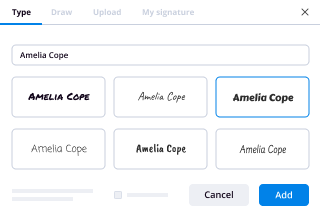
  • 4.Drop the My Signature field where you need to approve your sample. Type your name, draw, or upload a photo of your regular signature.
  • 5.Click Save and Close to accomplish modifying your completed form.

As soon as your two individuals husband and wife to an form template is ready, download it to your device, save it to the cloud, or invite other individuals to electronically sign it. With airSlate SignNow, the eSigning process only requires a couple of clicks. Use our robust eSignature solution wherever you are to deal with your paperwork effectively!
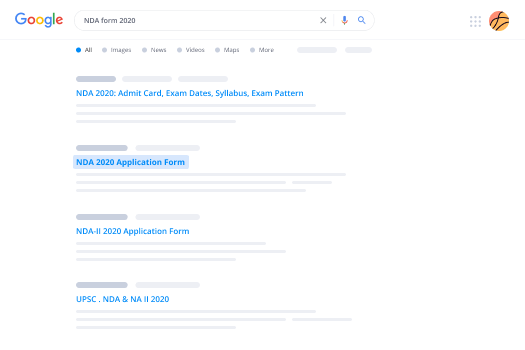

How to Sign a PDF Using Google Chrome How to Sign a PDF Using Google Chrome

How to complete and sign documents in Google Chrome

Completing and signing paperwork is simple with the airSlate SignNow extension for Google Chrome. Adding it to your browser is a fast and beneficial way to manage your paperwork online. Sign your two individuals husband and wife to an form template with a legally-binding electronic signature in just a few clicks without switching between programs and tabs.

Follow the step-by-step guide to eSign your two individuals husband and wife to an form template in Google Chrome:

  • 1.Navigate to the Chrome Web Store, search for the airSlate SignNow extension for Chrome, and install it to your browser.
  • 2.Right-click on the link to a form you need to eSign and select Open in airSlate SignNow.
  • 3.Log in to your account with your credentials or Google/Facebook sign-in option. If you don’t have one, you can start a free trial.
  • 4.Use the Edit & Sign toolbar on the left to fill out your sample, then drag and drop the My Signature option.
  • 5.Upload an image of your handwritten signature, draw it, or simply type in your full name to eSign.
  • 6.Make sure all the details are correct and click Save and Close to finish modifying your paperwork.

Now, you can save your two individuals husband and wife to an form sample to your device or cloud storage, send the copy to other individuals, or invite them to electronically sign your document with an email request or a secure Signing Link. The airSlate SignNow extension for Google Chrome improves your document processes with minimum time and effort. Start using airSlate SignNow today!


How to Sign a PDF in Gmail How to Sign a PDF in Gmail How to Sign a PDF in Gmail

How to complete and sign paperwork in Gmail

When you receive an email with the two individuals husband and wife to an form for approval, there’s no need to print and scan a document or save and re-upload it to a different program. There’s a better solution if you use Gmail. Try the airSlate SignNow add-on to quickly eSign any documents right from your inbox.

Follow the step-by-step guidelines to eSign your two individuals husband and wife to an form in Gmail:

  • 1.Visit the Google Workplace Marketplace and locate a airSlate SignNow add-on for Gmail.
  • 2.Set up the program with a corresponding button and grant the tool access to your Google account.
  • 3.Open an email with an attached file that needs approval and use the S sign on the right sidebar to launch the add-on.
  • 4.Log in to your airSlate SignNow account. Choose Send to Sign to forward the document to other parties for approval or click Upload to open it in the editor.
  • 5.Place the My Signature option where you need to eSign: type, draw, or upload your signature.

This eSigning process saves time and only requires a couple of clicks. Utilize the airSlate SignNow add-on for Gmail to adjust your two individuals husband and wife to an form with fillable fields, sign forms legally, and invite other parties to eSign them al without leaving your mailbox. Enhance your signature workflows now!
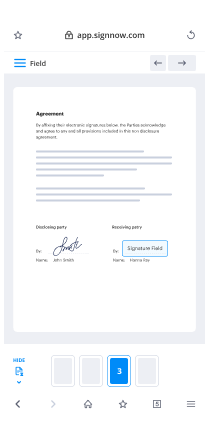
How to Sign a PDF on a Mobile Device How to Sign a PDF on a Mobile Device How to Sign a PDF on a Mobile Device

How to complete and sign forms in a mobile browser

Need to rapidly fill out and sign your two individuals husband and wife to an form on a smartphone while doing your work on the go? airSlate SignNow can help without the need to set up extra software applications. Open our airSlate SignNow solution from any browser on your mobile device and create legally-binding eSignatures on the go, 24/7.

Follow the step-by-step guidelines to eSign your two individuals husband and wife to an form in a browser:

  • 1.Open any browser on your device and follow the link www.signnow.com
  • 2.Sign up for an account with a free trial or log in with your password credentials or SSO authentication.
  • 3.Click Upload or Create and add a file that needs to be completed from a cloud, your device, or our form collection with ready-to go templates.
  • 4.Open the form and complete the empty fields with tools from Edit & Sign menu on the left.
  • 5.Place the My Signature area to the form, then type in your name, draw, or upload your signature.

In a few simple clicks, your two individuals husband and wife to an form is completed from wherever you are. As soon as you're finished editing, you can save the file on your device, create a reusable template for it, email it to other people, or invite them electronically sign it. Make your paperwork on the go prompt and effective with airSlate SignNow!
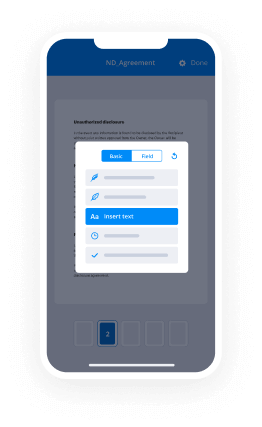

How to Sign a PDF on iPhone How to Sign a PDF on iPhone

How to fill out and sign forms on iOS

In today’s business community, tasks must be accomplished quickly even when you’re away from your computer. Using the airSlate SignNow app, you can organize your paperwork and approve your two individuals husband and wife to an form with a legally-binding eSignature right on your iPhone or iPad. Set it up on your device to close deals and manage documents from just about anywhere 24/7.

Follow the step-by-step guide to eSign your two individuals husband and wife to an form on iOS devices:

  • 1.Open the App Store, find the airSlate SignNow app by airSlate, and install it on your device.
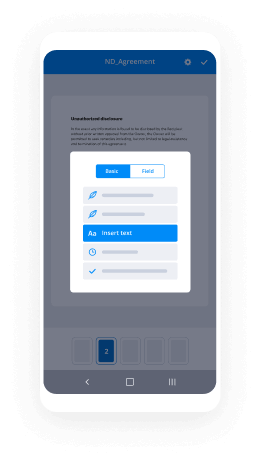
  • 2.Open the application, tap Create to upload a template, and choose Myself.
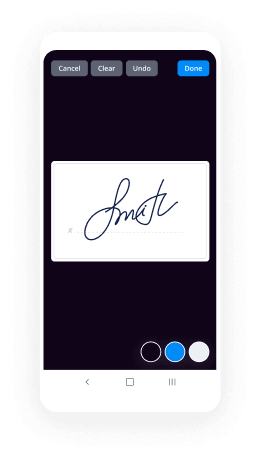
  • 3.Opt for Signature at the bottom toolbar and simply draw your autograph with a finger or stylus to eSign the form.
  • 4.Tap Done -> Save after signing the sample.
  • 5.Tap Save or utilize the Make Template option to re-use this document later on.

This process is so easy your two individuals husband and wife to an form is completed and signed in just a few taps. The airSlate SignNow app works in the cloud so all the forms on your mobile device remain in your account and are available any time you need them. Use airSlate SignNow for iOS to improve your document management and eSignature workflows!
How to Sign a PDF on Android How to Sign a PDF on Android

How to fill out and sign documents on Android

With airSlate SignNow, it’s easy to sign your two individuals husband and wife to an form on the go. Install its mobile application for Android OS on your device and start enhancing eSignature workflows right on your smartphone or tablet.

Follow the step-by-step guidelines to eSign your two individuals husband and wife to an form on Android:

  • 1.Open Google Play, find the airSlate SignNow app from airSlate, and install it on your device.
  • 2.Log in to your account or create it with a free trial, then add a file with a ➕ button on the bottom of you screen.
  • 3.Tap on the imported file and choose Open in Editor from the dropdown menu.
  • 4.Tap on Tools tab -> Signature, then draw or type your name to eSign the sample. Fill out empty fields with other tools on the bottom if necessary.
  • 5.Use the ✔ key, then tap on the Save option to end up with editing.

With an easy-to-use interface and full compliance with major eSignature laws and regulations, the airSlate SignNow application is the perfect tool for signing your two individuals husband and wife to an form. It even operates offline and updates all document adjustments once your internet connection is restored and the tool is synced. Fill out and eSign documents, send them for approval, and create re-usable templates anytime and from anyplace with airSlate SignNow.

Sign up and try Two individuals husband and wife to an form
  • Close deals faster
  • Improve productivity
  • Delight customers
  • Increase revenue
  • Save time & money
  • Reduce payment cycles