Establishing secure connection…Loading editor…Preparing document…

Virginia Deed of Easement

This template is fully customizable. Edit the text, fill out the fields, and send it for signature. Give it a try!
Virginia Deed of Easement

What a Virginia Deed of Easement Is and when it applies

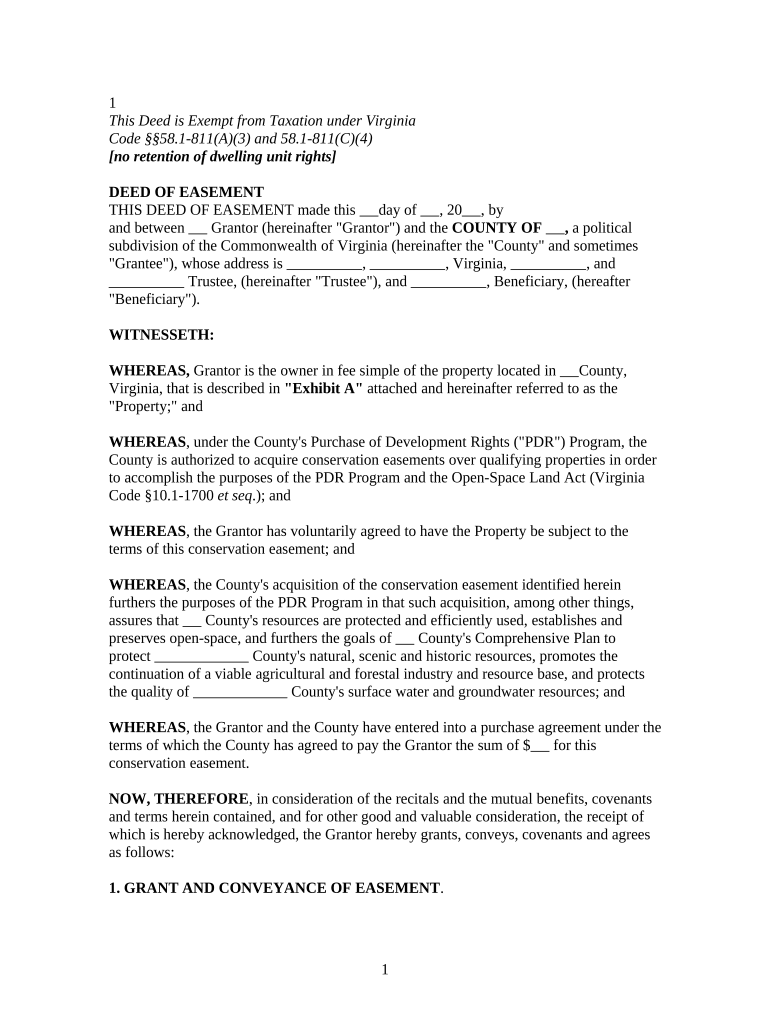
A Virginia Deed of Easement is a recorded legal instrument that grants a specific property right—such as access, utility placement, or drainage—across real property in Virginia. The deed identifies the grantor (owner conveying the easement), the grantee (party receiving the easement), a precise legal description of the servient and dominant tenements, the scope of rights granted or reserved, any consideration, and the intended duration or termination conditions. Once acknowledged and recorded in the county land records, the easement runs with the land and binds successors in title, subject to recording and state property law.

Why a properly drafted deed of easement matters

A clear Virginia Deed of Easement defines permitted uses, prevents disputes, and creates a public record that binds future owners. Precise drafting reduces litigation risk, clarifies maintenance responsibilities, and protects property values under Virginia property law.

Why a properly drafted deed of easement matters

Who typically prepares, signs, or records this document

Each participant has specific responsibilities—detailed roles and signing authority are addressed below to reduce execution errors.

  • Property owners and sellers who need to grant or confirm a right of way or other land use
  • Utility companies, municipalities, and homeowners associations that require permanent or temporary access
  • Real estate attorneys and title companies handling closing, recording, and title clearance

Core elements included in a professional Virginia Deed of Easement

A complete deed of easement for Virginia should contain six core elements so the grant is clear, enforceable, and record-ready.

Grantor Details

Full legal name and capacity of the owner granting the easement; include entity type and signing authority where applicable to avoid title challenges.
Grantee Details

Name and address of the easement holder (individual, company, municipality); specify successors or assigns if the easement is transferable.

Legal Description

Precise metes-and-bounds or plat reference for servient and dominant parcels, including tax parcel ID and recorded plat book/page when available.

Scope of Rights

Detailed description of permitted activities (access, construction, utility lines), any limitations, and standards for restoring property after use.

Duration and Termination

State whether perpetual, for a fixed term, or conditional; include termination events, abandonment rules, or reversionary clauses.

Acknowledgment and Recording

Notary acknowledgement, witness language if required, and instructions for recording in the appropriate Virginia county land records.

Required information fields at a glance

Grantor Name: Full legal name
Grantee Name: Full legal name
Property Description: Metes-and-bounds
Consideration: Dollar or nominal
Effective Date: MM/DD/YYYY
Notary Block: State acknowledgement

Step-by-step: preparing and executing the deed

Follow these sequential steps to draft, execute, and record a Virginia Deed of Easement with minimal risk.

  • 01
    Draft: Prepare deed with legal description and detailed rights.
  • 02
    Review: Title and legal review to confirm ownership and lien status.
  • 03
    Execute: Sign before a Virginia notary or follow RON rules if allowed.
  • 04
    Record: Submit to county land records for indexing and constructive notice.

How to set up a digital execution workflow

Configure a signing workflow to collect signatures, notarization (if e-notary supported), and immediate recording-ready output.

Field Configuration
Signer Order Grantor first, grantee second, notary last
Authentication Email plus SMS code or stronger KBA for identity
Notary Support Enable remote online notarization where permitted
Document Format Produce PDF/A for recording compatibility

Where the deed goes after signing

After execution, the deed should be acknowledged and delivered to the recorder; the following destinations are typical for a Virginia deed.

  • Recorder: County clerk or land records office for recording and indexing
  • Title Company: Provide final recorded copy for title files and insurance
  • Grantee: Deliver executed recorded instrument to the easement holder
  • Grantor: Retain original recorded copy with closing documents

Digital signing and technical requirements

Ensure the chosen digital workflow supports notarization, audit-trail export, and produces a recording-ready PDF to match county recorder requirements.

  • File formats: Accept PDF, Word DOCX; recorders typically require PDF for submission
  • Integrations: Common integrations include Salesforce, NetSuite, Google Workspace, Box for storage
  • Security: Use TLS/AES encryption and audit trails for chain-of-custody

Timing considerations and recording expectations

Key dates and deadlines influence effective rights and title insurance; recording promptly preserves priority and avoids subsequent claim conflicts.

Effective Date:

Date listed inside deed; use MM/DD/YYYY format

Recording Deadline:

Record promptly; delays can affect priority against subsequent liens

Title Insurance:

Submit recorded deed to insurer immediately for policy coverage

Tax Assessments:

Inform taxing authority when easement alters assessed use

Easement Maintenance:

Document recurring maintenance schedules in the deed or annex

Key milestones from draft to record

A concise milestone timeline helps coordinate parties and the recorder during closing and after execution.

01

Draft Complete

Final draft and legal review completed prior to signing

02

Execution

Grantor and grantee sign before notary or RON official

03

Acknowledgment

Notary acknowledgement or RON certification added

04

Recording

Deed recorded and indexed by county land records office

Common drafting and execution pitfalls to avoid

  • Using an informal property address instead of a legal description leads to ambiguous scope and recording rejection.
  • Failing to specify maintenance obligations or limits on equipment can produce costly disputes about acceptable uses.
  • Signing with a name variant (nickname or missing corporate suffix) can create title exceptions and delay recording.
  • Omitting a clear termination event or abandonment standard may leave successors uncertain about duration or rights.

Consequences of improper or unrecorded easements

Recording Risk: Loss of priority
Title Insurance: Potential exceptions
Enforceability: Challengeable rights
Liability: Unclear maintenance liability
Tax Issues: Assessment disputes
Litigation Cost: Higher legal fees

How a deed of easement differs from related instruments

Compare common document types to choose the right instrument for granting rights in land.

Document Type Deed of Easement Easement Agreement License
Transferability runs with land often contractual non-transferable
Recorded in land records yes or optional
Duration typical perpetual or term term or conditions short-term
Requires Notary usually yes not typically

eSignature vendor comparison for executing and notarizing deeds

Basic vendor pricing and feature indicators to evaluate eSignature options for deed execution and remote notarization workflows.

signNow DocuSign Adobe Sign PandaDoc HelloSign
Starting Price $8/user/mo $15/user/mo $14/user/mo $19/user/mo $15/user/mo
Free Trial 7-day free trial Verify Verify Verify Verify
Bulk Send Yes Yes Yes Yes No
Audit Trail Yes Yes Yes Yes Yes
HIPAA Compliant Yes Yes Yes No No
Envelope Cap No cap 100 envelopes/user/year Verify Verify Verify

Frequently asked questions about Virginia deeds of easement

Answers to common execution, recording, and enforceability questions for deeds of easement in Virginia.


Need help? Contact support

be ready to get more
Join over 28 million airSlate SignNow users