Establishing secure connection…Loading editor…Preparing document…

Wyoming Estate

This template is fully customizable. Edit the text, fill out the fields, and send it for signature. Give it a try!
Wyoming Estate

What the Wyoming Estate package includes

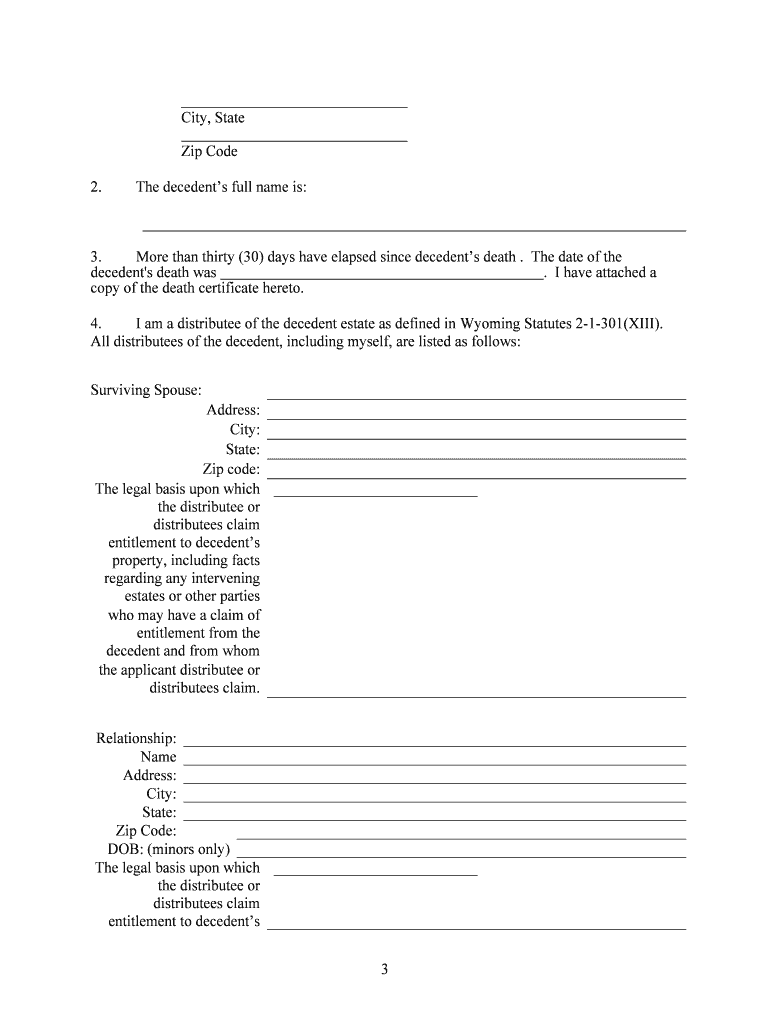
Wyoming Estate refers to documents and procedures used to manage, transfer, and settle a deceased person's property under Wyoming law. Typical materials include a last will and testament, trusts, inventories of assets, beneficiary designations, and court filings for probate or small estate administration. Estate documents establish the executor or personal representative, identify heirs and creditors, describe distribution plans, and set instructions for guardianship or fiduciary responsibilities. While many components can be prepared in advance, some options — notably wills — often require witnesses and follow state-specific formalities that affect validity and probate processing.
Why a clear Wyoming Estate matters

Using a formal Wyoming Estate structure clarifies ownership, reduces probate complexity, and records beneficiaries and fiduciary duties. Clear documentation helps executors and courts resolve claims faster, protects family intent, and supports tax and asset-transfer planning under applicable state law.

Why a clear Wyoming Estate matters

Who commonly prepares and uses a Wyoming Estate

Individuals, family members, and professionals use Wyoming Estate documents to formalize asset transfer and post-death administration.

  • Executors and personal representatives handling probate and estate administration matters.
  • Estate attorneys drafting wills, trusts, and guidance for Wyoming probate.
  • Financial advisors coordinating beneficiary designations and asset transfer timelines.

Primary roles involved in an estate

Executor / PR

The executor or personal representative is appointed to collect assets, pay valid debts and taxes, file required probate petitions, and distribute property per the will or state law. They must follow Wyoming probate rules and keep accurate records for court review.

Estate Attorney

An estate attorney prepares and reviews wills, trusts, and related filings, advises on fiduciary duties and tax obligations, and represents executors or beneficiaries in contested matters. Legal counsel ensures documents comply with Wyoming statute and minimizes probate disputes.

Core components of a professional Wyoming Estate

A professional Wyoming Estate package combines legally executed wills, trusts, inventories, fiduciary appointments, beneficiary designations, and clear distribution plans tailored to state formalities.

Last Will

A Last Will names the testator, appoints an executor, identifies beneficiaries, and specifies asset distribution. Witness requirements in Wyoming must be met to avoid probate challenges; a self-proving affidavit can streamline court proceedings.

Revocable Trust

A revocable trust holds assets during the grantor's life and avoids probate for funded property. It names a trustee and successor trustee, provides distribution instructions, and can include disability provisions without court intervention.

Inventory

An asset inventory lists real property, bank accounts, investment holdings, retirement accounts, and personal property with estimated values. Accurate inventories support tax filings, creditor notices, and equitable distribution among heirs.

Beneficiaries

Designation sections record primary and contingent beneficiaries for accounts and personal property. Clear beneficiary data reduces conflicts, prevents default intestacy rules, and speeds transfer of nonprobate assets.

Executor Duties

Executor duties include filing the will with probate court, providing creditor notice, settling debts and taxes, maintaining estate records, and distributing assets per the will or court order, following Wyoming probate procedures.

Distribution Plan

Spendthrift, contingent, and fractional distribution clauses clarify how and when heirs receive funds or property, and may include age-based releases, trust layers, or conditions to protect beneficiaries.

Step-by-step: preparing and submitting a Wyoming Estate

Follow these sequential steps to prepare, sign, notarize, and submit a Wyoming Estate document correctly for probate or transfer.

  • 01
    Assemble Documents: Gather wills, trusts, deeds, and beneficiary records.
  • 02
    Confirm Signatures: Verify witness signatures and dates.
  • 03
    Notarize / Self-Prove: Notarize affidavits to speed probate.
  • 04
    File With Court: Submit probate petition with required exhibits.

Typical routing for signing and filing

This process explains routing: drafting, internal review, signer execution, notarization, filing with the Wyoming district court, and record retention.

  • Draft: Create or import estate documents.
  • Review: Attorney or advisor checks legal sufficiency.
  • Sign: Signers execute with required witnesses.
  • File: Submit probate packet to the local court.

File formats and platform considerations

Electronic workflows can accept PDF, DOCX, and scanned images; ensure documents are legible and complete before signing.

  • File Types: PDF and DOCX supported.
  • Integrations: Works with Google Workspace and NetSuite.
  • Authentication: Email, SMS, or advanced methods.

Security and compliance for electronic estate records

Encryption: AES-256 encryption at rest
In Transit: TLS 1.2 and 1.3 enforced
Audit Trail: Timestamps, IP address, action log
Access Controls: Role-based permissions required and enforced
Compliance: ESIGN, UETA, HIPAA where applicable
Certifications: SOC 2 Type II and ISO 27001

Consequences of incorrect estate documents

Invalid Will: Probate delay or denial
Creditor Claims: Unexpected liabilities arise
Tax Penalties: Estate tax filings affected
Contested Estate: Lengthy litigation risk
Notary Errors: Document rejected or delayed
Privacy Breach: Sensitive data exposure

Common preparation pitfalls to avoid

  • Mismatched names across accounts and documents lead to delays and may trigger a request for additional identity proof or court clarification during probate.
  • Failing to include a complete asset inventory or omitting account identifiers can cause assets to remain unreleased and complicate tax reporting for the estate.
  • Using informal beneficiary language or leaving percentages ambiguous increases the risk of disputes and may require court interpretation of testator intent.
  • Neglecting to update estate documents after major life events such as marriage, divorce, or property sale can result in unintended transfers.

Key timelines and filing windows

Key filing and notification timelines affect estate administration, probate initiation, tax reporting, and creditor notices—observe federal and Wyoming-specific deadlines.

File probate petition with court:

Initiate probate after death to appoint an executor and manage estate assets.

Publish notice to creditors and claimants:

Provide creditor notice per Wyoming rules to allow claims within allowed period.

Estate tax return (Form 706) deadline:

Generally due nine months after death; IRS extension may apply.

Obtain multiple certified death certificates promptly:

Courts and financial institutions require certified copies to release assets and settle accounts.

Prepare final accounting and distribution report:

File when estate debts paid and assets distributed to complete probate.

eSignature vendor pricing and compliance snapshot

Marketplace pricing and core feature differences among leading eSignature vendors influence cost and compliance for estate workflows in Wyoming.

signNow DocuSign Adobe Sign PandaDoc HelloSign
Starting Price $8/user/mo $15/user/mo $14/user/mo $19/user/mo $15/user/mo
Free Trial 7-day free trial Varies Varies Varies Varies
Bulk Send Availability Yes Varies Varies Varies Varies
Audit Trail Yes Yes Yes Yes Yes
HIPAA Compliant Yes Varies Varies Varies Varies
Envelope Cap No cap 100 envelopes/user/year Varies Varies Varies

Frequently asked questions about Wyoming Estate documents

Answers to common questions about preparing, signing, notarizing, and filing a Wyoming Estate document in a legally compliant way.


Need help? Contact support

be ready to get more
Join over 28 million airSlate SignNow users