Empower your Pharmaceutical Business with Business Development Funnel Stages for Pharmaceutical
airSlate SignNow regularly wins awards for ease of use and setup




See airSlate SignNow eSignatures in action
Our user reviews speak for themselves










Why choose airSlate SignNow
-
Free 7-day trial. Choose the plan you need and try it risk-free.
-
Honest pricing for full-featured plans. airSlate SignNow offers subscription plans with no overages or hidden fees at renewal.
-
Enterprise-grade security. airSlate SignNow helps you comply with global security standards.
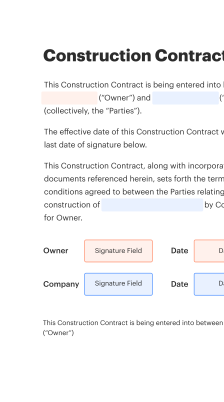
Business development funnel stages for Pharmaceutical
business development funnel stages for Pharmaceutical
Experience the benefits of airSlate SignNow for yourself and streamline your document signing process today. airSlate SignNow offers a user-friendly interface, secure storage for your documents, and the ability to track the status of your signatures in real-time.
airSlate SignNow by airSlate - your all-in-one solution for efficient document signing.
airSlate SignNow features that users love




Get legally-binding signatures now!
FAQs online signature
-
What are the 4 stages in order in the inbound marketing funnel?
The Four Stages of Inbound Marketing Sales Inbound vs. outbound marketing. How Inbound Marketing Works. Stage 1: Attract. How do inbound marketers make content that will attract prospects? Stage 2: Convert. Inbound Offers. ... Stage 3: Close. CRM and Marketing Database Systems. ... Stage 4: Delight. ... Inbound Marketing FAQ.
-
What are the 4 phases of a winning content marketing funnel?
The funnel contains four stages: awareness, evaluation, conversion, and delight. It is a tried and true tactic, so you don't need to reinvent the wheel to gain your customers' attention. You just need to adapt or repurpose your content to meet the needs of your customers and overall business strategy.
-
What are the 7 layers of the sales funnel?
What are the Stages of the Sales Funnel? Stage 1: Awareness. ... Stage 2: Interest. ... Stage 3: Evaluation. ... Stage 4: Decision and Negotiation. ... Stage 5: Sale. ... Stage 6: Renewal. ... Stage 7: Repurchase. ... The Stage You're Missing: Revive Dead Leads.
-
What are the KPI stages of the funnel?
There are 5 main stages in the marketing funnel: awareness, consideration, conversion, retention, and loyalty. Key awareness stage KPIs are ad clicks, blog post views, and SEO rankings. Key consideration stage KPIs are pricing page clicks, case study views, and the number of demos requested.
-
What are the 4 stages of the marketing funnel?
There are four stages of the marketing funnel: 1) awareness, 2) consideration, 3) conversion, and 4) loyalty. A brand's goal in each stage is to 1) attract, 2) inform, 3) convert, and 4) engage customers.
-
What are the 4 steps of the marketing funnel?
Marketing funnel phases Awareness - Content focused on educating your audience. Evaluation - Customers determine whether they need your product. Conversion - Reasons to buy your product. Delight - Keeping your audience engaged.
-
What is business development funnel?
The three stages of the business development funnel. The first two stages of the model, Attract Prospects and Build Engagement, are traditional marketing functions. The final stage, Turn Opportunities into Clients, is a traditional sales function.
-
What are the 5 stages of the marketing funnel?
5 stages of the marketing funnel Awareness. Regardless of the marketing funnel stage in use, it begins with awareness. ... Consideration. As the lead leaves the awareness stage, they move into the consideration phase. ... Conversion. ... Loyalty. ... Advocacy.
Trusted e-signature solution — what our customers are saying


How to create outlook signature
in this video we will discuss the lifecycle manager strategies of pharmaceutical products the product life cycle is defined as the pathway of a product from the beginning of its birth to the last phase of its dead from sales revenue insight the stages of the product life cycle are similar to these of humans as time passes the product move from infancy grow and reach maturity eventually it will decline and die there are four stages in the product lifecycle introduction growth maturity and decline by plotting the revenue on the y-axis and the time on the x-axis the product life cycle curve is as shown on the screen this curve is further divided into four phases introduction growth maturity and finally decline when it comes to pharmaceutical products the curve is a bit different there are three distinctive stages in the lifecycle of a new drug the research and development stage from the drug discovery up to its launch to the market the period of time between its launch and the loss of market exclusivity the period after the loss of market exclusivity when generics can enter the market we will explore the three stages early middle and late in more detail during the early stage the new drug is submitted to certain intensive clinical and preclinical tests at this stage the company invests money without generating sales as the drug is not launched yet in the market the company starts the pre-launch activities market exclusivity period is the time period between the market launch of an innovator drug and the launch of its first generic the company files for a patent soon after the discovery of the drug from that point the company has a 20 year patent for the product the R&D phase takes several years so by the time the product is approved and available on the market the patent can be close to running out a research was done by Duke University economist Henry grabovsky in 2016 calculated the average market exclusivity period of new drugs ing to this report the average market exclusivity period is 13.5 years during the middle stage the drug is launched to the market and the company starts making profit as soon as the product is introduced to the market the company starts activities like creating awareness and informing current and potential customers on the product once it enters the growth stage the goal is to achieve the largest possible share of the market and maximize turnover when growth is no longer possible the product matures and the company focuses on maintaining its market share when market share and profits start to decline the company consolidate on the market segments gained and try to minimize the expenses when the patent expires companies seek offensive strategies to combat generic competitors and retain market share the ultimate objective of any company is to extend the life cycle over a longer period of time the question is what are the majors strategy assualt by pharmaceutical companies to extend the life cycle of an innovator drug an interesting paper published in the Journal of generic medicine explored the branded drug companies strategies to overcome generic competition these strategies are evergreening flanking and rx2 OTC switching we will speak about each strategy in detail evergreening is a strategy involving either line extensions or launching a next-generation version of the current drug within the evergreening strategy brand teams attempt to switch patients to the newly patented drug before the patent on the original drug expires switching patients to the new drug minimizes market share loss and makes it less attractive for generics competitors to enter the market evergreening is the most successful strategy employed by branded companies to maintain market share AstraZeneca switch from prilosec to next-generation nexium is a successful implementation of the evergreening strategy the first patent of omeprazole was filed in 1979 nine years later prilosec was launched for the market by 1996 prilosec became the world's best-selling drug in 2006 point three billion u.s. dollars its patent see should have expired in late 2002 nexium the next generation drug developed from prilosec proved more effective in treating patients Astra Zeneca submitted the drug to the FDA early enough to assure its approval before the patent expiration of prilosec in 2000 Astra Zeneca launched nexium before the patent expiration of prilosec the company transferred 40% of prilosec patients to next-generation nexium as well as managing a 9% growth in its gastrointestinal franchise in 2001 alone the patent protection for nexium which was an improvement over prilosec expired in 2014 this means 35 years after the original patent for prilosec was taken out in order to implement the evergreening strategy successfully the company should shift patients to use the new drug before the launch of the generic version of the first generation product the next generation drug must offer a new and better benefit than the current drug a certain degree of commonality with the popular and trusted original brand is also important AstraZeneca made nexium purple and very similar looking to the original prilosec shearling plow failed to implement the evergreening strategy properly claritin achieved very good sales figures to maintain these figures the company planned to replace it with the next generation clare in x delays in u.s. FDA approval for Claire and X enabled generics to enter the market before switching claritin patients to clarinets as a result Claire and X failed to reach blockbuster status and sales of claritin dropped dramatically from three billion dollars to only three hundred million dollars within a short time the second strategy is flanking generics flanking strategy involves entry into the generics market in this strategy the Brandon's drug company develops its own generic and marketed through its own subsidiary or through another company with permission as soon as the patency of an innovator drug expires generics enter the market generics attract some new patients and the branded company loses a considerable number of patients to the generic market by launching a generic version of the brand at a competitive price the company can maintain those patients who will not be switched and take as much share as possible from those patients who chose generic products the company can execute the flanking strategy in one of three ways the first option is to sell the generic drug by the company itself or through its generic arm the second option is to sell the drug on to a third party usually a generic player to market it under that company's brand the third option is to authorize a generic company to manufacture and market its own version of the drug Fiser led this strategy launching authorized generic versions of its products through its authorized generic subsidiary greenstone the third strategy is switching from rx to OTC this strategy is appropriate when a branded drug whose patent is about to expire gains approval by the FDA for OTC sale the switch will make the market unattractive for generics AstraZeneca succeeded in keeping 40% of prilosec patients by introducing them to nexium shortly afterward prilosec gained OTC status keeping generics competition from flooding the market to take AstraZeneca 's revenue and market share to successfully switch a product from prescription to a TC it should have a competitive advantage over existing available drugs and inherit a high level of brand awareness among current users and pharmacists by this you have reached the end of the video thank you for watching for more resources on farmer marketing please visit our website the farmer market accom
Show more