Send Freeform Invites with SignNow

Save time adding fields to documents. With airSlate SignNow you can send freeform invites that allow recipients to add their own fields anywhere on your document.

Award-winning eSignature solution

Overview of send freeform invites

send freeform invites is a flexible eSignature workflow that lets a sender distribute a signing request to a variable set of recipients without predefining a strict signing order or fixed recipient fields. The sender composes an invite, assigns roles or editable fields as needed, and allows recipients to complete, sign, and return the document. In regulated U.S. environments this method supports common authentication options and audit logging to maintain evidentiary records while reducing preparatory steps compared with rigid routing templates.

When send freeform invites are appropriate

Use send freeform invites to simplify ad hoc signing, accommodate varying recipient lists, and speed approvals for documents that do not require a locked signer sequence or pre-assigned signature slots.

When send freeform invites are appropriate

Common challenges to anticipate

  • Untracked recipient lists can complicate audit trails if roles and permissions are not set before sending.
  • Varying signer identity controls increase risk unless authentication and access restrictions are applied consistently.
  • Document version control issues may arise when multiple invite cycles occur without clear retention policies.
  • Nonstandardized field placement can lead to incomplete submissions or inconsistent data capture across signers.

Representative user profiles

HR Manager

An HR Manager issues onboarding documents and policy acknowledgements to new hires and contractors. They rely on freeform invites to send documents to different combinations of recipients quickly, apply access tokens when required, and maintain an auditable record of acceptance for personnel files and compliance reviews.

Field Sales Rep

A Field Sales Rep sends proposals and amendments to prospects encountered during meetings. They value the ability to create a one-off invite, attach a contract, and collect signatures without creating a formal reusable template, while preserving verification data and timestamps for sales records.

Typical organizations and teams using freeform invites

Small to mid-size teams and departments that require flexible, on-the-fly signature requests often choose freeform invites for operational simplicity.

  • Human resources teams handling variable onboarding packets and acknowledgements.
  • Sales representatives sending ad hoc agreements or amendments to prospects.
  • Legal operations and contract managers circulating drafts for rapid review.

Larger enterprises may use freeform invites for low-risk, internal approvals while applying stricter workflows for high-value contracts.

Advanced capabilities that enhance freeform invites

Beyond basics, these capabilities help organizations scale ad hoc signing with governance, integration, and reporting functionality.

Bulk notifications

Senders can issue repeated reminder schedules or batch notifications to outstanding recipients, reducing manual follow-up and improving completion rates while maintaining auditability.


Role-based permissions

Assign roles that control which users can place fields, send invites, or finalize documents, ensuring separation of duties and conforming to internal control frameworks.

API access

Programmatic endpoints let applications generate freeform invites, attach documents, and track status to integrate signing into business systems and automate routine tasks.

Conditional fields

Fields that appear based on earlier responses allow more dynamic forms and help reduce signer confusion by only showing relevant inputs during a freeform signing session.

Reporting dashboard

Centralized dashboards provide status summaries, completion metrics, and exportable logs for compliance reviews and operational monitoring across freeform invite activity.

Integrations

Native connectors to cloud storage and common business applications make it straightforward to attach documents and archive signed records without manual downloads or uploads.

be ready to get more

Choose a better solution

Core features that support freeform invites

Several platform-level features make freeform invites practical for everyday use, balancing flexibility with necessary controls for secure signing.

Field editor

A drag-and-drop field editor lets senders place signature, initial, date, and custom data fields directly on a document prior to distributing a freeform invite, allowing accurate data capture without building a template.

Authentication options

Multiple authentication choices—email confirmation, SMS code, and optional knowledge-based methods—allow senders to tailor signer verification to the transaction’s risk and compliance requirements.

Expiration controls

Senders may apply expiry dates or set time-limited access to invites to reduce the window for unauthorized signing and to help enforce document lifecycle policies.

Audit trail

Each freeform invite transaction includes a tamper-evident audit trail that records signer verification method, timestamps, IP addresses, and document events for compliance and recordkeeping.
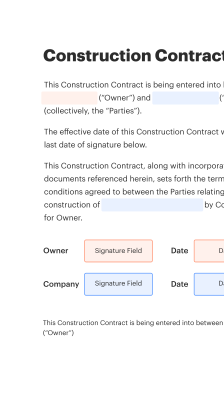
How freeform invites progress from sender to signer

This sequence explains the typical flow from creating an invite to completing the signing event and recording the transaction.

  • Compose invite: Upload doc and configure fields
  • Configure access: Set authentication and expiry
  • Distribute link: Send to recipients or broadcast
  • Complete signing: Signers authenticate and apply signatures
Collect signatures
24x
faster
Reduce costs by
$30
per document
Save up to
40h
per employee / month

Quick step-by-step: sending a freeform invite

Follow these concise steps to prepare and send a freeform invite while maintaining necessary controls and documentation.

  • 01
    Select document: Choose the file for signing
  • 02
    Define roles: Assign signer roles or leave flexible
  • 03
    Set authentication: Choose email, SMS or password
  • 04
    Send invite: Distribute and monitor responses
be ready to get more

Why choose airSlate SignNow

  • Free 7-day trial. Choose the plan you need and try it risk-free.
  • Honest pricing for full-featured plans. airSlate SignNow offers subscription plans with no overages or hidden fees at renewal.
  • Enterprise-grade security. airSlate SignNow helps you comply with global security standards.
illustrations signature

Typical workflow settings for freeform invite deployments

Recommended baseline configuration items for team use of freeform invites; adjust values to fit organizational policy and compliance needs.

Setting Name Configuration
Reminder Frequency 48 hours
Default Authentication Method Email verification
Invite Expiration 14 days
Template Approval Required No
Audit Log Retention 7 years

Platform and device requirements for freeform invites

send freeform invites work across modern browsers and mobile environments, but specific features and authentication methods may vary by platform and device capabilities.

  • Desktop browsers: Chrome, Edge, Safari
  • Mobile devices: iOS and Android
  • Network needs: TLS-enabled connections

For best results, use up-to-date browser versions, ensure JavaScript and cookies are enabled for the signing session, and confirm mobile users have a recent OS release to support SMS authentication and secure document handling.

Security and authentication controls

Access tokens: Time-limited links
Email verification: Standard confirmation
SMS codes: Optional two-factor
Password protection: Sender-defined passwords
Document encryption: AES-256 at rest
Audit logging: Detailed event records

Practical examples of send freeform invites

Two representative scenarios show how freeform invites streamline ad hoc signing while preserving compliance controls and operational records.

Onboarding Acknowledgement

A human resources coordinator prepares an employee handbook acknowledgement and sends a freeform invite to a new hire with email verification set and password protection applied

  • Role assignment is flexible to include manager countersignature if needed
  • The document retains a full audit record and time-stamped events for HR files

Resulting in a defensible acceptance trail and reduced manual filing work.

Sales Amendment

A sales representative updates agreement terms after negotiation and sends the revised page to a prospect using a freeform invite with SMS code authentication

  • No template creation is required and fields are added directly to the document
  • The transaction logs signer IP, authentication method, and timestamp for internal records

Leading to faster deal closure and clear proof of signature integrity.

Best practices for secure and reliable freeform invites

Apply consistent policies and operational habits to reduce risk and improve accuracy when using freeform invites across teams.

Standardize authentication level per document type
Define a minimum authentication requirement tied to document sensitivity so senders know when to use email verification, SMS code, or stricter identity checks. Document this policy for audits and train staff on its application.
Use templates for recurring documents
When documents are reused frequently, convert them to templates with predefined fields and roles. This reduces layout errors, ensures consistent data capture, and still allows freeform invites for truly ad hoc situations.
Implement retention and version control
Establish retention schedules and versioning rules so signed records are stored in a controlled repository. Maintain a single source of truth and avoid distributing multiple uncontrolled copies.
Limit invite lifespan and monitor access
Set sensible expiration periods for invites and review access logs regularly. Short lifespans reduce exposure to leaked links and make auditing easier if a signature’s authenticity is later questioned.

FAQs and troubleshooting for send freeform invites

Answers to common operational and technical questions to help users resolve typical issues when sending or managing freeform invites.

Comparison: digital freeform invites vs. paper processes

A concise comparison of key criteria across leading eSignature platforms and conventional paper-based workflows to highlight availability and practical differences.

Feature or Criteria Name for Comparison signNow (Recommended) Adobe Sign DocuSign
Ad hoc invite support
Flexible recipient lists
Audit trail detail Extensive Extensive Extensive
Paper-based equivalent Not applicable Not applicable Not applicable
be ready to get more

Get legally-binding signatures now!

Compliance risks and penalties to consider

Insufficient authentication: Evidence weakens
Missing audit details: Enforceability reduced
Improper PHI handling: HIPAA violations
FERPA exposure: Student data risk
Retention failures: Regulatory penalties
Unauthorized access: Data breach liability

How to send freeform invites with airSlate SignNow

When sending documents for filling out and signing, save time on adding necessary fields by allowing recipients to insert data themselves.

With a freeform invite, a recipient can annotate the document and control signature placement.

Easy to start

Upload a document or template to your airSlate SignNow account by clicking Upload Documents/Upload Templates.
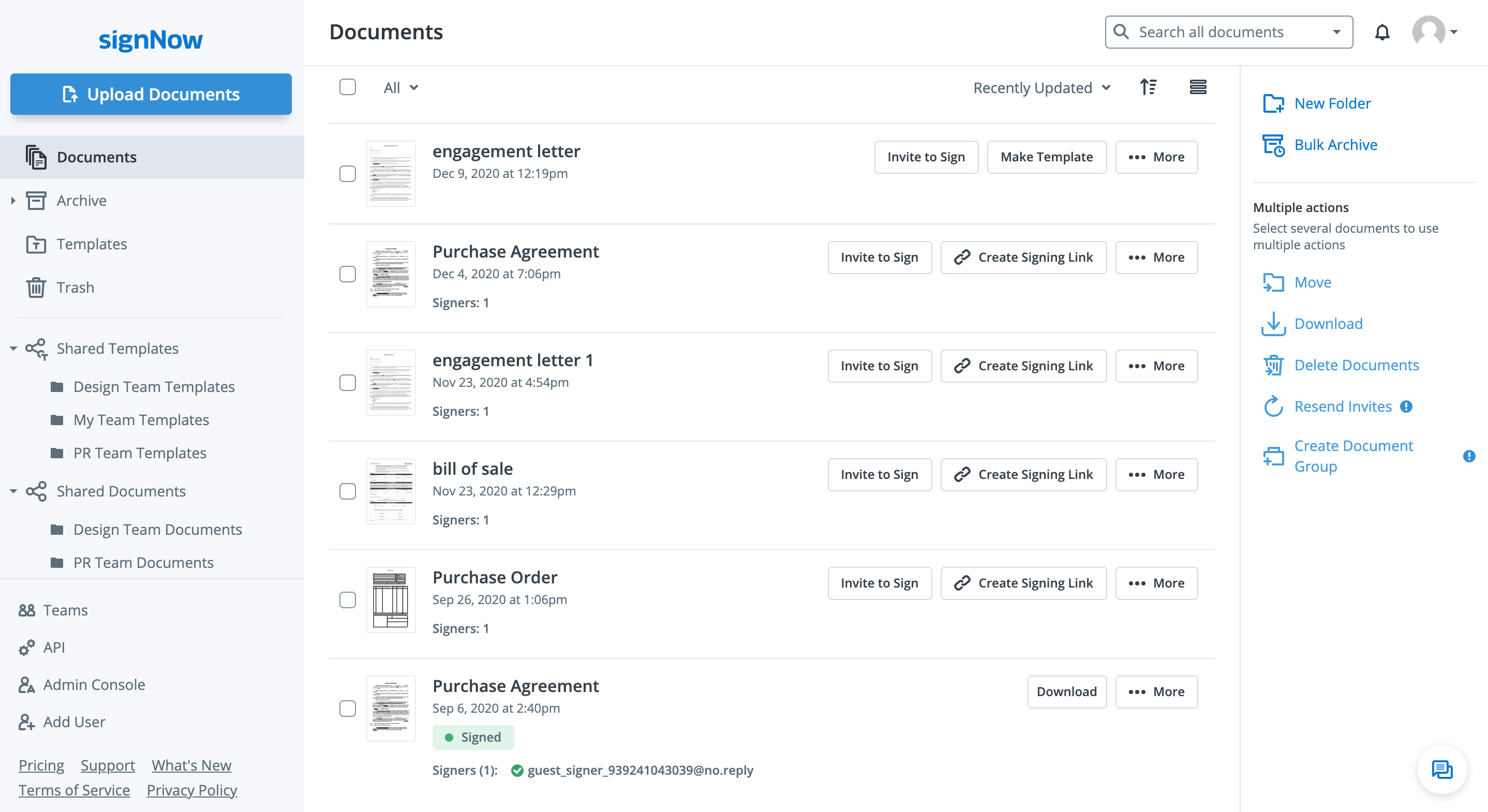
fill-guide-illustration

Easy to navigate

Once the document is uploaded, click on it to view more options. In the right-hand sidebar, select Freeform Invite. This option is also available if you click the More button next to the document name.
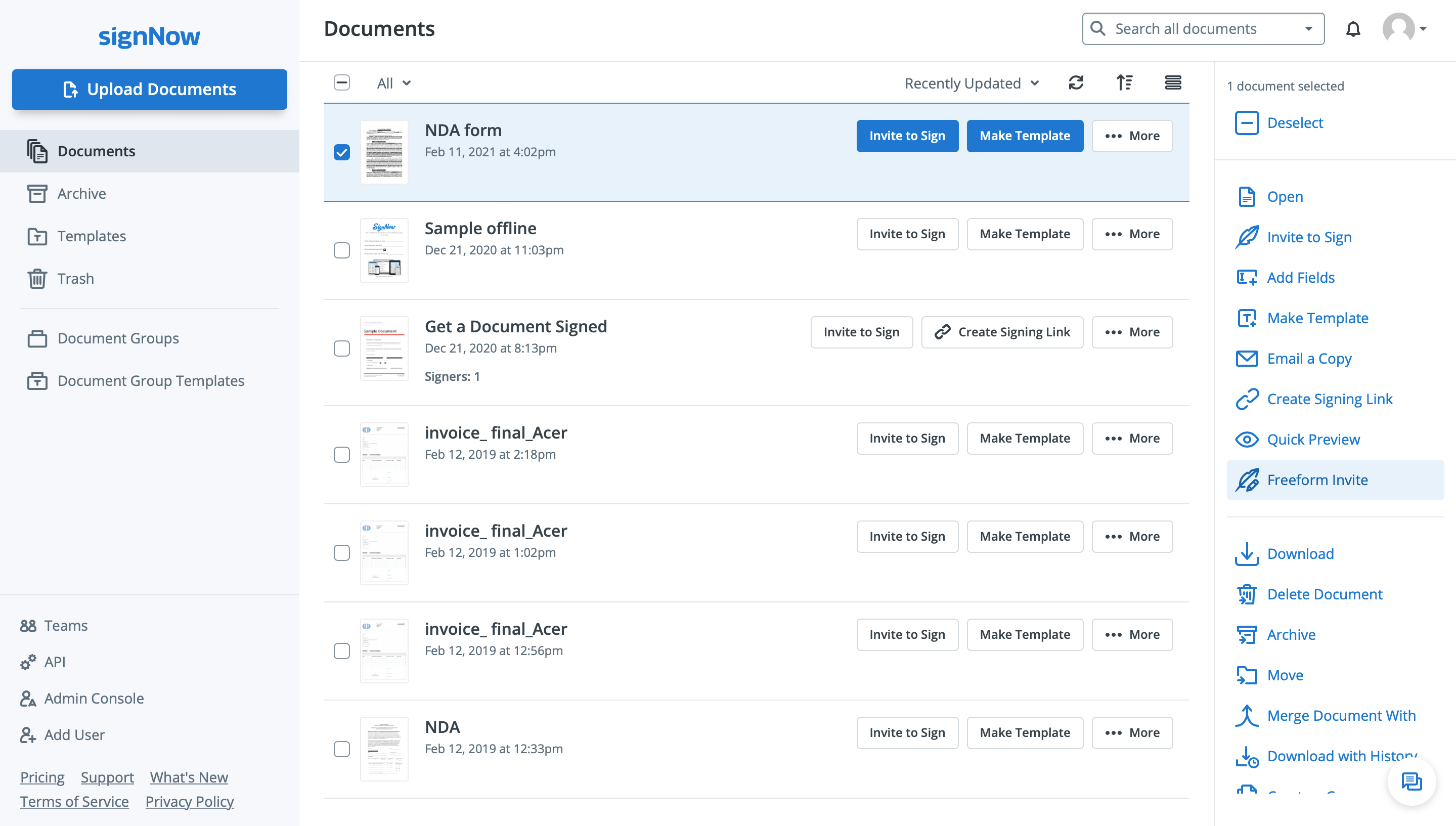
fill-guide-illustration

Easy to send

Before sending a freeform invite, you may want to customize the subject line and message shown to a recipient once they open your email. Then, enter a recipient’s email address (or the addresses of multiple recipients) and click Send Invite.
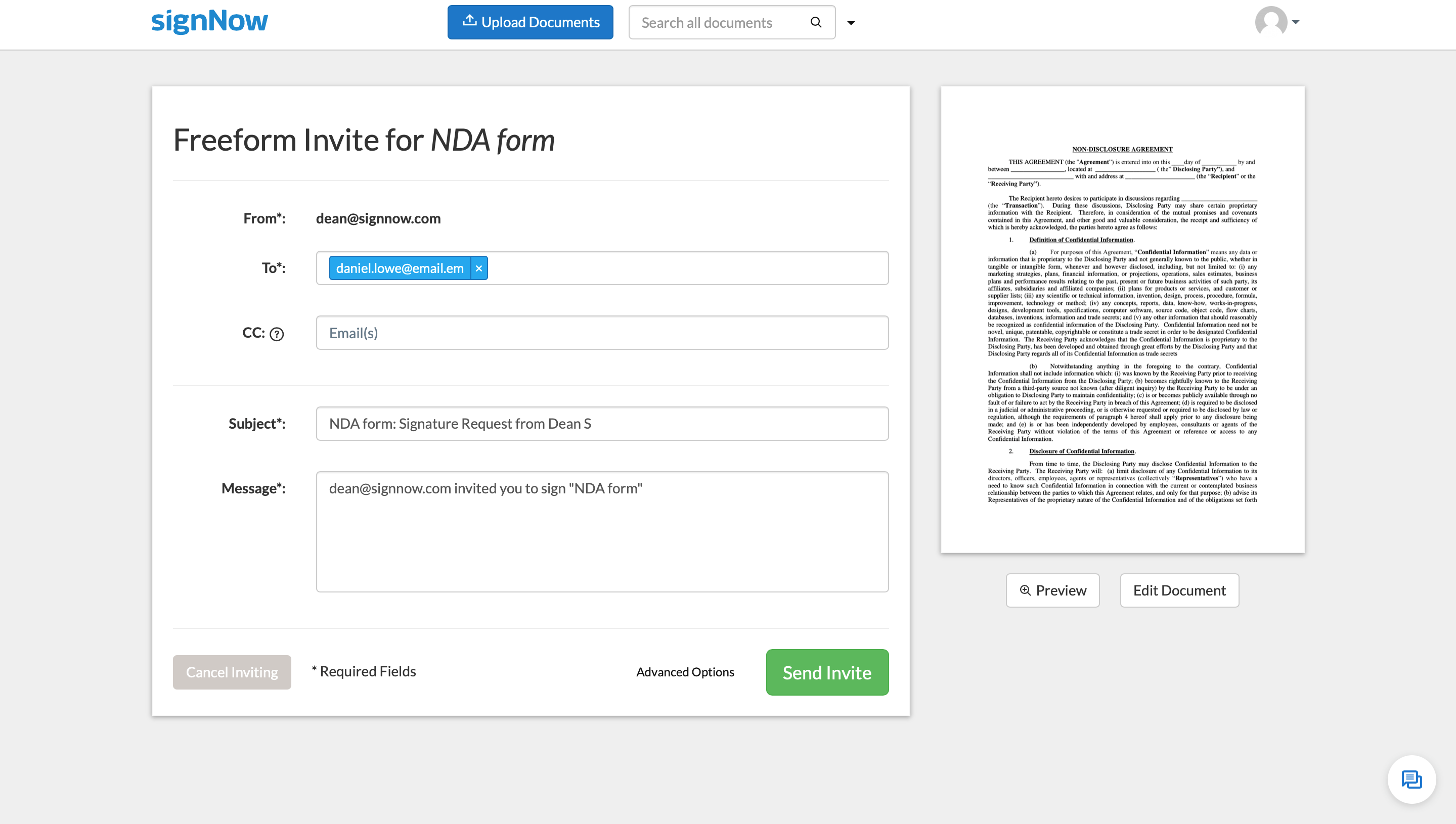

fill-guide-illustration
walmart logo
exonMobil logo
apple logo
comcast logo
facebook logo
FedEx logo
be ready to get more

Get legally-binding signatures now!