Streamline lead management and opportunity management in NDAs with airSlate SignNow
airSlate SignNow regularly wins awards for ease of use and setup




See airSlate SignNow eSignatures in action
Our user reviews speak for themselves











Why choose airSlate SignNow
-
Free 7-day trial. Choose the plan you need and try it risk-free.
-
Honest pricing for full-featured plans. airSlate SignNow offers subscription plans with no overages or hidden fees at renewal.
-
Enterprise-grade security. airSlate SignNow helps you comply with global security standards.
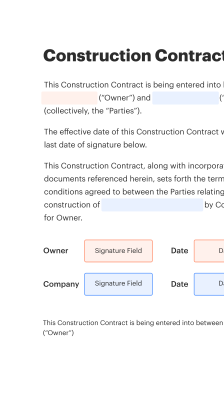
Lead management and opportunity management in NDAs
lead management and opportunity management in NDAs
Start streamlining your lead management and opportunity management processes today with airSlate SignNow from airSlate. Sign up for a free trial and experience the benefits firsthand.
Get started with airSlate SignNow now!
airSlate SignNow features that users love





Get legally-binding signatures now!
FAQs online signature
-
What is the difference between lead management and opportunity management?
The main difference between lead management and opportunity management is that lead management focuses on identifying and nurturing potential customers. On the other hand, opportunity management deals with a qualified lead that is converted into a potential sale.
-
What are the five major stages of lead management?
When it comes down to it, there are five major stages in the lead management process: Lead Capturing. Lead Tracking. Lead Qualification. Lead Distribution. Lead Nurturing.
-
What are the red flags for NDA?
Before signing an NDA, look out for seven crucial red flags that could limit your freedom or expose you to risks, including broad definitions of confidential information, indefinite duration, lack of mutuality, restrictive non-compete clauses, absence of provisions for legal disclosures, unclear remedies for breach, ...
-
What comes under lead management?
Lead management refers to all the ongoing processes involved in attracting leads (potential customers), qualifying them, and using targeted strategies to convert them into customers.
-
What are the rules of an NDA?
An NDA requires the recipient to take reasonable measures to keep the information confidential and prohibits each recipient from disclosing it to any unauthorized party. This way, your information is only used by those who you want to use it, and then only for the purposes you want it used for.
-
What does a good NDA look like?
The nondisclosure agreement should identify the parties to the agreement and which one is the disclosing party, or side sharing the information, and the recipient. Names and addresses of the parties should be included. The agreement should also identify other individuals who may be parties to the agreement.
-
What are the main points of NDA?
The Purpose of a Non-Disclosure Agreement An NDA creates the legal framework to protect ideas and information from being stolen or shared with competitors or third parties. Breaking an NDA agreement triggers a host of legal ramifications, including lawsuits, financial penalties, and even criminal charges.
-
What are the 5 key elements of a non-disclosure agreement?
7 Key elements to a non-disclosure agreement Identification of involved parties. ... Definition of the confidential information. ... Information ownership. ... Exclusions not considered confidential. ... Obligations and requirements of the involved parties. ... Effective agreement period. ... Consequences of a breach.
Trusted e-signature solution — what our customers are saying


How to create outlook signature
So today we're going to talk about Federal capture management Made Easy right it's it's a 30-minute session where we're going to try to drop a lot into the training but I just want you to keep something in mind capture management is not a process a secret right it's a process capture management is not complicated I hear people all the time saying uh capture management or Federal Government Contracting is complicated capture management is not complicated it's just a process capture management is not even hard it's just a process when we don't know the process it can seem like capture management might be hard when we don't know the process the step-by-step path to to follow to take to reach success when we don't know that capture management can seem um complicated and when we don't know the process sometimes it just seems mythical magical a secret well it's not it's just a process and that's what I'm going to talk to you about um in this Federal training today I want to talk to you about Federal capture management Made Easy and there's three things I want to cover I want to specifically talk about focusing your effort on the right tax write tasks and not the wrong tasks I don't want you working on the activity that's not really going to be helpful to you the second thing I want to talk about is how having the right relationships can help you increase the P win the likelihood that you win you will win a contract and then the third thing that we'll wrap up with is moving how you can move an opportunity forward in the sales cycle to increase your P win right when you do capture when you're moving it forward it's all about trying to increase the likelihood that you'll win the probability of winning right and so I want to talk to you about some things you can think about on how to do your activities better or more effectively and so that's what we're going to talk about today if you don't know who I am my name is Neil McDonald I'm the president of the govcon Chamber of Commerce and I want to welcome you to my federal sales training where I teach tips for success in the federal Market I spent 20 years as a small business owner in the federal market and since 2018 I've been teaching people like you that Government Contracting is not a secret it's just a process if you follow a process A to Z it's going to lead to repeatable predictable results and that's what we want for you before we get started do me a favor help buyers remember who you are put your I can see in the chat put your company name uh put your core competency two or three words in there that describe what your company sells products Services Etc um if you're not on LinkedIn please come into LinkedIn this is the place where we engage as a community uh one of the best things about the training that we do is that there's all sorts of people in the chat and on other platforms it's a little harder plus when you come in you can connect with me personally so we know each other on LinkedIn and so many other people including Federal buyers are on LinkedIn where it's a great way to start the relationship so other people know like and trust you so come on over into this if you're open to um connecting with anybody in the gov con space put that in the chat I'm open to connecting with anybody so I'm going to reach out to connect with you but if you're open let others know in the chat finally I wanted to say thank you to the govcon Chamber of Commerce sustaining members we don't take any federal dollars we don't have any large primes sponsoring us sustaining members like you are the ones who make this training possible we just put out three incredibly valuable directories on our website um sustaining members are the ones who help make this possible and so we just wanted to say thank you we really appreciate your support all right let's go ahead and dive into Federal capture management made easy um first I want to talk about just the capture process and how I simplify it right there's if you've been in this industry for a while in the FED Federal Market there's a lot of ways you might have heard about it but I'm a big fan of simplifying things this is part of the process for me of making it just easy to understand and so the way I describe the federal capture management process is you identify an opportunity right and and so um really the first step is finding an opportunity sometimes we call it identifying the second step is to qualify that opportunity and when I say qualify I mean you're trying to qualify whether that opportunity is a slam dunk opportunity for your company slam dunk opportunity are just opportunities that fall squarely in your core competency I have a whole nother training on talking about how do you identify your slam dunk opportunities and then how do you find those opportunities so the first step is finding an opportunity second step is qualifying an opportunity third step is pursuing an opportunity there might be all sorts of various stages in your your sales pipeline that people describe it as but basically you're just pursuing an opportunity I I describe it as you're shaping your competitive Advantage so uh one one of my customers has a stage that's pursue and then bid and then proposal and so pursue and bid are the same thing to me in this four-step process they're just pursuing that opportunity I want to shape the technical requirements I want to shape the acquisition approach things like that right and so you're shaping that opportunity to your advantage find an opportunity qualify an opportunity pursue an opportunity and then write a winning proposal those are the four steps so it's pretty simple that direction the reason I point them out is because as we talk about the activity that you can be doing I want to make sure you're working on activity that is contributing to those four steps and not some other activity so I I describe it really straightforward as as right activity and wrong activity um and so let's talk about uh wrong activity for a second and some examples here the biggest thing and just tell you why I actually latched onto this and I communicated is I'm a sales guy I've been a sales guy my entire career I um I'm also a business owner I'm also an I.T person but at my core since I was 10 or something I was a sales person if you don't know this I was selling vacuum cleaners door to door when I was 18. so I've been selling for a long time I obviously evolved into selling a billion dollar opportunities you're going after billion dollar opportunities but along the way the the idea of selling um the the people involved in the process of selling has pretty much been the same right you try to understand a customer's needs and fill those needs that's fundamentally sales the reason I don't like the wrong activities is because they're generally driven by leadership management Etc and they're busy work but they killed the Mojo of us salespeople and if you're a business developer or a capture manager then your job primarily is to go out to the customer to get out there talk to them engage them understand what's going on we are people people if that makes sense right we like talking to people we don't like sitting over here and doing something accountants as an example they're comfortable doing um work on a computer in an office that's where they feel good about their you know what they like to do and what they do do the value they bring to the company if you send them out and say I need you to start talking to people you know generally that would be frightened and scared they will be staying in their car they'll be on the wall they won't do it it's because that's not their strength their strength is here and sales people our strength is going out and saying hi to people we don't know that's what we want from sales people and so when organizations make us do the wrong activity this busy work um it just uh sucks it's like no fun for us and that's why I said kills by Mojo and I don't want anybody who's doing sales to have their Mojo dropped by bad activities um these tend to be activities wrong activities tend to be activities that are similar that whole line of activity for activities sake people think if they put these activities in place that um somehow it's contributing to the sale but if those activities aren't aligned to the four steps of the capture process that I laid out then they're really not contributing to the success of the sale let me give you my biggest uh the task I hate more than anything else in in Federal Business Development capture federal sales it's when organizations require capture managers to put together a capture management plan I hate those the passion they're from like 20 and 30 years ago even though I've been around for that whole time they're really old uh way of looking at things and it's this documentation for the sake of documenting something I am a big fan of capture planning I am not a big fan of what I uh what typically is known as a capture plan almost always is in a PowerPoint deck or something because what happens is we're forcing sales people business developers capture managers Etc to be having to fill out this PowerPoint and the the information in there begins to become less reliable than Upstream um the activity that we want a salesperson to be doing can easily fit into the pipeline as fields or as stages that can be measured and so then leadership can see the quality of their pipeline um if you're using a capture management plan or capture plan in in some formal way that tends to be a lot more normal at the billion dollar companies when you have many people going after a particular opportunity but when you're Downstream even I work with customers who have one in two people who are four or eighty percent of the time driving the sales activity on 100 and 200 million dollar opportunities to take them off and say I need you to fill this deck out that's that's an activity that's not there but what I do think is important is that when they have a meeting with a customer that that capture person should document the the notes of that meeting I went and asked the customer about um uh I went and asked him about challenges for example pain points well they should write a paragraph or two or a set of bullets that is communicating to the rest of the team in the pipeline some tool that you have here's what I learned right it's not enough for the capture managers so that is a right activity and and when I talk to capture managers it's like look you're not going to get any uh love from me on avoiding writing notes on your meetings that's an important exercise that's something that is vital to the whole process moving forward all the way to proposal writing right so um I'm not going to go too much further into the wrong activities but wrong activities the easiest way you can tell that they're not helpful is if they're not driving forward the opportunity if all they are is communicating Upstream then the leadership should figure out how to get that information they want from their Pipeline and the tools that they use the right activities do move the opportunity forward and so um one of the things I want you to consider is Right activities have a positive Roi a return on investment if I do this task there's going to be a positive return on investment in in the sale in the opportunity moving forward if I have a meeting if I have a meeting with a customer or internally about an opportunity it should have a positive Roi it should at least have an expected Roi positive Roi right if I miss it because something happens it doesn't happen well that's fine that happens all the time or that happens sometimes right but um but we should look at any tasks we do and say what's the positive Roi on this how will it move the opportunity forward I'll give you an example when I have a meeting with a customer related to an opportunity I always go in with a call plan it's a one-pager and at the top of the call plan not for the customer but for me I write down my objective what is my objective when I'm meeting with this agency customer or with a teammate and that objective is determining the positive Roi of the meeting when I have this meeting and it goes successfully the way I'm planning I will get this out of this meeting I will move the sale forward this much I will have gotten a strategic document I will have gotten an introduction to the director of cloud I will have gotten something from the um the government there I will have gotten an NDA with a teammate I will have worked out the basics of a teaming agreement not the formal side but just hey how much what percentage what type of work are you doing I will have worked that out so any task I'm doing I want to make sure it has a positive Roi that's the way you can tell if it's got a um uh if it's a right activities if you can Define the outcome is going to be positive from that so I want you to ask yourself about tasks do the um do they support one of the four capture processes that I laid out right finding an opportunity qualifying an opportunity pursuing an opportunity or writing a winning proposal if the tasks you're working on today tomorrow are not um supporting one of those four then ask yourself why am I even doing this task do me a favor in the chat just let me know you're tracking along with what I'm teaching here by putting positive Roi into the chat positive Roi all right uh I had to explain to somebody once what Mojo was so I'm like I don't know that's like a phrase in there but it's it's what makes me me um we need we sales people and business developer captures in particular who have to call the customer and do cold calls and things like that we want our energy to be high okay so let's talk about um what why and what relationships um are important to have and how they can increase your P win so today um the topic of what I'm talking about the last couple of topics here they're both around how do you increase your P1 so first I want to talk about how can relationships increase your P win and P win is just again uh probability of winning uh how How likely are you to win a contract or a proposal if you send it Forward How likely are you to win that proposal so one of the biggest things to just remember about why you need to have relationships or you want to have relationships not not even need so much just why you want to have relationships in almost every opportunity you do well actually the way I'm going to describe it it has the customer so every opportunity but even with teammates um this is important you can't do it alone right as you start going after opportunities uh there's gonna be things you can't do there's going to be information you don't have you can't do this alone and when you team up when you team up with a customer to learn more when you team up with teammates to to work together to go after an opportunity both these people in their own way are going to help you increase your ability to win and so that's why you want to have relationships and that's how these people are going to help you increase your win and let me kind of tell you five of the folks that I think you should be having as uh establishing its relationships for every opportunity you have and by the way just a quick level set I tend to work on opportunities that are in that 20 to 200 million plus level and so there's all sorts of opportunities below and I would do this same process down below but as you get below a million dollars let's say on an opportunity often the transaction will happen so fast that you're not going to do as much capture so you can figure out when you're just getting started if your transactions are more in the simplified acquisition or below a million dollars um you know maybe some of this you can or can't do but these five people that I'm going to talk about these are important for every single time the first one is when I have an opportunity just laying it out as I am qualifying and pursuing an opportunity first relationship I'm establishing is with the Contracting officer if I can't reach the Contracting officer then I can't really find out has there been a funding or budget established for this opportunity I like to call it is there a real opportunity is it real or is it just forecasted that's out there blah blah the Contracting officer specialist who's responsible for this if they are they're named for the opportunity then to me there's a lot more likelihood that it's real and that it's going to come out and it's not just somebody put it as a wishlist item or whatever so first person I want to find out the first relationship I want to develop and it doesn't have to be deep it could be a five minute phone call right just a quick response it could even be them blowing me off saying hey you have to you have to go to the industry today to get the information perfect well at least I know it's you who I'm gonna follow even though you told me to go to the industry day I'm still going to follow up and that's a whole nother training but um so Contracting officer small or Contracting Specialists those are the ones that are going to tell you about the reality of that opportunity they'll be able to give you some information and the other thing As you move forward they're the ones who are going to shape the um that you will be able to work with to shape the acquisition approach the determination on the next code to keep it as small as possible perhaps so the competition is limited um the the contract vehicle to make sure you're able to even compete on it any of this other information set-asides right those those people are the ones who make that decision and so when you're thinking about acquisition shaping the acquisition approach you want to have a relationship with those folks the next one uh agency small business Specialists so anytime I have an opportunity in my pipeline I want to know who the Contracting officer is and I want to know who the small business specialist is I want to be able to talk to that small business specialist one I can get information we call them the focus of receptivity generally they're open to helping us navigate reach the people we want to reach but also they can be influential on making sure this stays small that perhaps it goes to women on small business for example if that's where you want to go these people are Liaisons between your business and the buyer make sure you're establishing a relationship not just in general but at every opportunity every single time I contact a Contracting officer I am ccing I'm making sure the Contracting officer knows I'm copying that small business specialist I don't want to come behind the fact and try to engage a small business specialist if I do it early on they both know that I'm serious and I'm tracking on this the third one is the sba's PCR or procurement Center representative SBA PCR this was this one's an unusual one um you can go watch my training on the seven mentors I think this is one of the mentors we lay out and the procurement Center Representatives fundamentally their job is to make sure things that could go small do go small the reason you want to have a relationship with these folks is because if there's things that you need help with they can they can get involved they're not going to get involved all the time if you're just brand new to Government Contracting don't really latch on but these people can definitely help the bigger the opportunities go in particular if you're interested in going after an opportunity that is larger or might go large and you want to push it small saying hey this absolutely can be done small they can give you advice on how to work and move forward and they can also talk to the Contracting officer in the small business specialist responsible for the opportunities you're interested in so every opportunity every single one I go into my Pipeline and I fill out that PCR I may or may not contact them depending on whether I need their help but I'm gonna know who they are every single time uh fourth one is the program office right so you want to have relationships with program office personnel depending on the size of the opportunity there'll be many people so easily there'll be at least three let's say that you should be trying to find can we find them not all the time right that that's what makes it a competitive competitive Advantage if you can do capture and find these people then you're going to sit there and increase your likelihood of having a high P win because you can talk to the people who will share more information than it's in the written packages that everybody else gets and um as the opportunity gets larger let's say it's 10 million of Beyond you know 20 million and Beyond you're going to start having a whole bunch of people who are engaged people who might not be on the selection board you know the ones who actually go through the awarding the contract they might not be on the selection board but they're definitely influential they're talking about things that they want to pay attention to should an agency or excuse me should a seller like you be Microsoft gold certified or Amazon certified or should they be cmmi is that important to be level two or level three what are the challenges goals objectives that they have all that kind of information comes from the program office and so you want to have a relationship if I'm looking at an opportunity and I'm moving forward in the pursue stage of this and I don't have names let alone relationships with them then that's a massive flag for me because basically all I'm doing is bidding I'm just bidding with a long lead what I mean is I'm not waiting for the RFP to drop I'm I'm looking at the opportunity for six months ahead of that but if I don't have relationships I could have just waited for the RFP to drop because I didn't get any new information relationships are what allow you to learn more stuff to be able to be more prepared to write a winning proposal and have a higher proposal uh score or P win all right the fifth one is industry partners and this is where you can learn about incumbents uh people companies that might be good teammates you want to establish relationships right from the beginning first and foremost I'm reaching out to the incumbent hey just checking in right I'm trying to find out who's there who's the program manager right the further I go along in my capture the more people I will try to know from that place but initially I'm just trying to find out are they going after it was it small before and now they're large do I want to team with them can I get any information from them that might make me feel like you know what this is a shoe in for them I'm out of here so having a relationship with industry Partners will allow you to understand more about the incumbent but also build your team when you build your team you will have a strong likelihood of winning because you're covering down on areas that you're weak at but your teammates are strong at it's standard teaming right you want them to come in and show up what you're strong at so if you're tracking on that that how important relationships are and how relationships can help increase the Pu input relationships win in the chat let me know you're tracking on that foreign talking about how you can move an opportunity forward to increase the P win the activities you can do and I wanted to give it a different spin today and talk about how I do capture out there uh myself and with customers that I have and the first thing I just want to put in your head is think about capture management management from an agile or an iterative way right I'm a software developer at software development company before and so um you know software agile software development was normal to us but one of the things about agile software development let me just tell you this really quick as an example is there's this big application we want and it has many different features in it so an example is think about your phone it's got the ability to text it's got the ability to email it's got the ability to make phone calls let's just say those three or something and um so in the old days we used to look at the whole thing and try to build the old whole thing now what we do is we we shrink that down um and let's just say we only want to be able to work on it making phone calls and so that's kind of an iterative way I'm releasing these features iteratively agile and iterative for the phone now can be broken down even further I want to be able to take phone calls I want to be able to make phone calls I want to be able to record voicemails um I want to be able to dial with my voice instead of typing with my fingers things like that and so these agile just breaks the the work involved down there there is an old adage about um how do you eat an elephant one byte at a time that's what I want you to remember when I talk about agile and iterative to capture management if we look at the whole thing it can be a little bit overwhelming right just see today don't see the award um and so the way I break that down is I take my tasks and I I actually use jira if you're familiar with that it's a tool where I can actually have cards and move it from to do in progress to done and it's just me working on it and I moved one card at a time and those cards represent tasks that I'm going to do on the um opportunity how I'm going to really move it forward I'm always working on moving the opportunity forward to increase my P win the likelihood that I can win this opportunity so the first thing I want you to pay attention to is two to four hour tasks so the one two four hour rule um I want you to work on one task that is two to four hours the reason I say work on a two to four hour task is because if I take that task off the to-do list and I put it in my hands in the morning I will get it done and if the task goes longer than that then what we do is we break it down into two to four hour tasks I'll give you an example I want you to write a three-page response to an RFI some people will just leave the task at that whole thing and what we say is break it down so the first thing I'm going to do the one of the first tasks I'm going to do might be write an outline an outline should take me two to four hours tasks right from my outline I then can have two to four hour tasks and um the idea might be well say I have three bullets I can say tomorrow write one bullet or bullet number one bullet number two bullet number three so I'm not seeing the whole RFI right the outline is making sure it's on track but I'm not working on the whole RFI somebody asked me what are you working on I'm working on bullet number one of this RFI you know I'm working on one page if that's a two to four hour task for me that's what I'm working on if I have a page and has a graphic it's really important that I separate the graph account and I have it as a separate task because the graphic could uh you know people get distracted and they think it's still one page but that graphic it's its own page its own project and that graphic might break down to two to four hour tasks the reason I'm telling you this is because then you'll be able to truly measure your steps forward on a capture opportunity so when I do it on capture I write things called definitions of done on my two to four hour task I Define what done means and so an example is reach out and contact a Contracting officer what that means is I have to identify who that person is and I have to reach out to them via voicemail via email and I continue to do it until I reach them it's not done until I talk to them or somehow they blow me off the email response whatever but it's not done because this opportunity needs me to talk to the contract officer and that task though the time it takes to get it done is two to four hours I separate out have a meeting with them so one is scheduling and so things like that like breaking it down and I just want to encourage you as you move forward focus on one thing that you can work on on your opportunities each day and you'll move it forward instead of trying to see the whole thing just go what's one thing I can move this forward um one other quick task because I'm running out of time here is engage your proposal managers you know how can you increase the P win engage your proposal managers or writers early on 15 minutes minute 15 minute meetings once a week is perfect or every couple of weeks when you're ready but engage them say this is what I've done this is what I'm working on how do you any feedback they're smart people who want to help you um succeed right so the sooner you get them involved the sooner they can provide any guidance and then the last thing is always follow a proven process I can't talk to you about my process today running out of time here but I follow a really strict uh process on how I move an opportunity how I pursue an opportunity and I break down those two to four hour tasks and every single opportunity I do the same thing so that way I know where each opportunity is so go ahead and track on that in this lesson today what I try to communicate to you and encourage you to do is focus only on activities that are going to give you positive Roi going to move the sale forward the second thing is establish relationships because they're going to help you increase your P win and then the third thing is follow a proven process right a well-defined set of tasks that you repeat every single opportunity As you move it forward for example find the Contracting officer meet with the Contracting officer as you plan next week's activity determine one task that can move the sale forward for each of your opportunities right a two to four hour task that you can do and move it forward if you found today's training uh valuable do me a favor consider becoming a sustaining member in the govcon Chamber of Commerce and remember Government Contracting it is not a secret it's just a process I'll see you in the next training
Show more